Identifying Novel Endophenotypes of Adolescent Insomnia and their Association with Emotional Dysregulation
DOI:
https://doi.org/10.61838/kman.jayps.1051Keywords:
Adolescent Insomnia, Endophenotypes, Latent Profile Analysis, Emotional DysregulationAbstract
Objective: This study aimed to identify unobservable endophenotypes of adolescent insomnia utilizing latent variable modeling and to evaluate their differential associations with specific facets of emotional dysregulation.
Methods and Materials: A cross-sectional design was employed, encompassing a community sample of adolescents in Egypt. Sleep parameters were rigorously assessed using continuous objective actigraphy worn in the home environment, paired with the subjective self-report Insomnia Severity Index. Emotional dysregulation was quantified using the multidimensional Difficulties in Emotion Regulation Scale. To uncover hidden sub-populations, Latent Profile Analysis was conducted in R using the combined objective and subjective sleep metrics. Subsequently, a Multivariate Analysis of Covariance was utilized to determine how the derived sleep profiles differentially predicted impairments across the various emotional dysregulation subscales, controlling for demographic covariates.
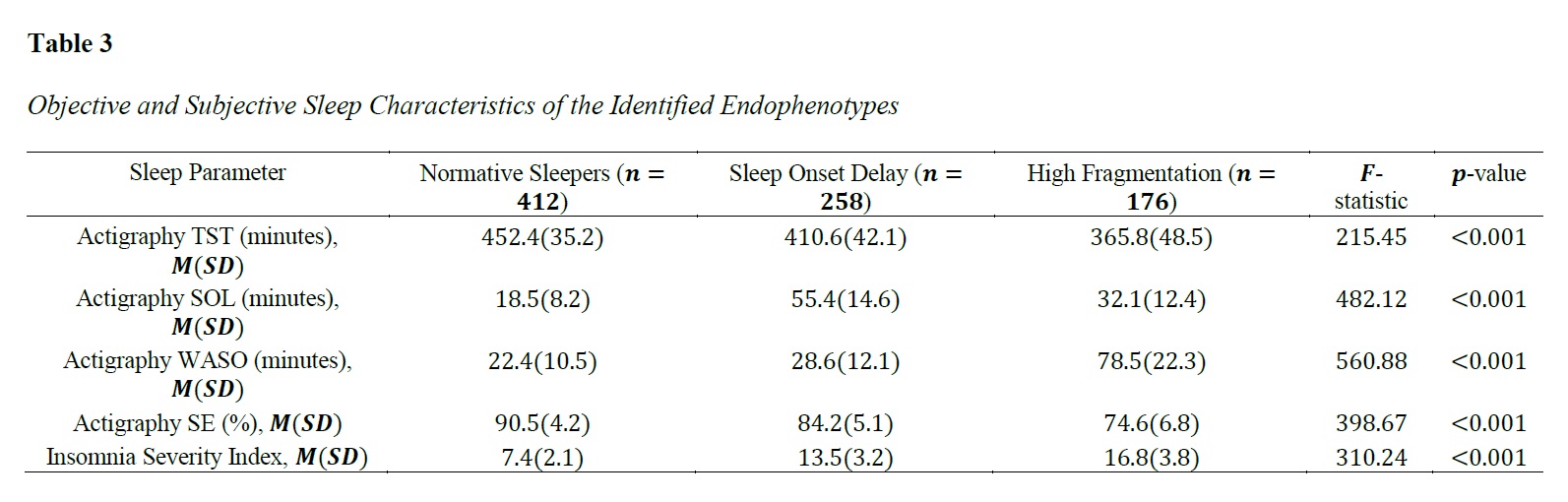
Findings: The Latent Profile Analysis successfully identified distinct insomnia endophenotypes within the adolescent sample: Normative Sleepers, Sleep Onset Delay, and High Fragmentation. The multivariate analyses revealed highly specific associations between these profiles and emotional functioning. Adolescents classified within the Sleep Onset Delay profile demonstrated specialized emotional deficits, specifically characterized by a lack of emotional clarity and severe difficulties engaging in goal-directed behaviors ( ). Conversely, the High Fragmentation profile—marked by extensive wake after sleep onset and reduced total sleep time—was associated with the most severe global impairments in emotion regulation, manifesting primarily as profound deficits in impulse control and a high nonacceptance of emotional responses ( ).
Conclusion: Adolescent insomnia is not a monolithic disorder but a heterogeneous construct comprising distinct endophenotypes linked to specific emotional vulnerabilities. Precision behavioral medicine that tailors interventions to exact sleep architectural disruptions may significantly optimize clinical outcomes and mitigate psychopathological risks.
Downloads
References
Akram, U., Gardani, M., Akram, A., & Allen, S. (2019). Anxiety and Depression Mediate the Relationship Between Insomnia Symptoms and the Personality Traits of Conscientiousness and Emotional Stability. Heliyon, 5(6), e01939. https://doi.org/10.1016/j.heliyon.2019.e01939
Bao, C., & Bihn, D. (2021). Excess Anxiety's Effect on the Occurrence of Insomnia in Adolescents in Late Adolescence. Journal of Asian Multicultural Research for Medical and Health Science Study, 2(3), 52-59. https://doi.org/10.47616/jamrmhss.v2i3.162
Boroumandrad , S. M. (2020). The effectiveness of emotion-focused therapy on promoting mental health and resilience of women affected by infidelity. Journal of Social Psychology, 8(56), 111-122. https://www.magiran.com/paper/2364484
Choi, O. J. E., Kim, J., Lee, Y., Lee, Y.-M., & Song, K. H. (2021). Association Between Stress and Dietary Habits, Emotional Eating Behavior and Insomnia of Middle-Aged Men and Women in Seoul and Gyeonggi. Nutrition Research and Practice, 15(2), 225. https://doi.org/10.4162/nrp.2021.15.2.225
Church, D., Sparks, T., & Clond, M. (2016). EFT (Emotional Freedom Techniques) and Resiliency in Veterans at Risk for PTSD: A Randomized Controlled Trial. EXPLORE, 12(5), 355-365. https://doi.org/10.1016/j.explore.2016.06.012
Farella Guzzo, M., & Gobbi, G. (2021). Parental Death During Adolescence: A Review of the Literature. OMEGA - Journal of Death and Dying, 87(4), 1207-1237. https://doi.org/10.1177/00302228211033661
Fitzpatrick, S., Maich, K. H. G., Carney, C. E., & Kuo, J. R. (2020). Identifying Specific Insomnia Components in Borderline Personality Disorder and Their Influence on Emotion Dysregulation. Personality Disorders Theory Research and Treatment, 11(6), 440-450. https://doi.org/10.1037/per0000395
Hatamian, P., Tabatabaei, K., Azadfallah, P., & Hasani, J. (2023). The effectiveness of transdiagnostic native treatment based on emotion regulation on reducing insomnia disorder (single-case study). Iranian Journal of Nursing Research, 18(3). https://doi.org/10.22034/IJNR.18.3.41
Hou, S., Twayigira, M., Luo, X., Song, L., Cui, X., Xie, Q., Shen, Y., Yang, F., & Yuan, X. (2023). The Relationship Between Emotional Neglect and Non-Suicidal Self-Injury Among Middle School Students in China: The Mediating Role of Social Anxiety Symptoms and Insomnia. BMC psychiatry, 23(1). https://doi.org/10.1186/s12888-023-04735-7
Jansson‐Fröjmark, M., Norell‐Clarke, A., & Linton, S. J. (2015). The Role of Emotion Dysregulation in Insomnia: Longitudinal Findings From a Large Community Sample. British Journal of Health Psychology, 21(1), 93-113. https://doi.org/10.1111/bjhp.12147
Li, S., Graham, B. M., & Werner-Seidler, A. (2020). Gender Differences in Adolescent Sleep Disturbance and Treatment Response to Smartphone App–Delivered Cognitive Behavioral Therapy for Insomnia: Exploratory Study (Preprint). https://doi.org/10.2196/preprints.22498
Li, S., Graham, B. M., & Werner‐Seidler, A. (2021). Gender Differences in Adolescent Sleep Disturbance and Treatment Response to Smartphone App–Delivered Cognitive Behavioral Therapy for Insomnia: Exploratory Study. Jmir Formative Research, 5(3), e22498. https://doi.org/10.2196/22498
Lin, C.-Y., Potenza, M. N., Ulander, M., Broström, A., Ohayon, M. M., Chattu, V. K., & Pakpour, A. H. (2021). Longitudinal Relationships Between Nomophobia, Addictive Use of Social Media, and Insomnia in Adolescents. Healthcare. https://doi.org/10.3390/healthcare9091201
Lovibond, P. F., & Lovibond, S. H. (1995). The structure of negative emotional states: Comparison of the Depression Anxiety Stress Scales (DASS) with the Beck Depression and Anxiety Inventories. Behaviour Research and Therapy, 33(3), 335-343. https://doi.org/10.1016/0005-7967(94)00075-U
Lu, J., Tang, X., Jin, X., Luo, X., Fan, T., & Shen, Y. (2025). A network analysis-based study of the correlations between internet addiction, insomnia, physical activity, and suicide ideation in adolescents. Computers in human Behavior, 163, 108483. https://doi.org/10.1016/j.chb.2024.108483
Park, K. H. (2025). Borderline Personality Traits and Insomnia Severity: A Sequential Mediation Model of Maladaptive Cognitive Emotion Regulation Strategies and Pre-Sleep Arousal. Korean Journal of Stress Research, 33(4), 209-215. https://doi.org/10.17547/kjsr.2025.33.4.209
Ren, X., Shi, M., & Si, S. (2024). Insomnia and Creativity in Chinese Adolescents: Mediation Through Need for Cognition. BMC psychology, 12(1). https://doi.org/10.1186/s40359-024-01663-3
Rice, F., Riglin, L., Lomax, T., Souter, E., Potter, R., Smith, D. J., Thapar, A. K., & Thapar, A. (2019). Adolescent and adult differences in major depression symptom profiles. Journal of affective disorders, 243, 175-181. https://www.sciencedirect.com/science/article/pii/S0165032718306426
Richardson, C., & Gradisar, M. (2020). Perfectionism and insomnia in adolescents: The role of vulnerability to stress and gender. Journal of adolescence, 85(1), 70-79. https://doi.org/10.1016/j.adolescence.2020.10.003
Sohrabian, T., Gholamrezaei, S., & Sepahvandi, M. A. (2020). The relationship between neuroticism and insecure attachment with insomnia: The mediating role of perfectionism and cognitive emotion regulation. Psychological studies, 16(4), 41-57. https://psychstudies.alzahra.ac.ir/article_5261.html
Soltani, S., Noël, M., Bernier, E., & Kopala‐Sibley, D. C. (2023). Pain and Insomnia as Risk Factors for First Lifetime Onsets of Anxiety, Depression, and Suicidality in Adolescence. Pain, 164(8), 1810-1819. https://doi.org/10.1097/j.pain.0000000000002879
Uccella, S., Cordani, R., Salfi, F., Gorgoni, M., Scarpelli, S., Gemignani, A., Geoffroy, P. A., De Gennaro, L., Palagini, L., Ferrara, M., & Nobili, L. (2023). Sleep Deprivation and Insomnia in Adolescence: Implications for Mental Health. Brain Sciences, 13(4), 569. https://doi.org/10.3390/brainsci13040569
Yang, Y. Y. (2021). Association Between Insomnia and Irritable Bowel Syndrome Among Adolescents in South Korea: A Quantitative Cross-Sectional Study. Adolescents, 1(4), 500-507. https://doi.org/10.3390/adolescents1040038
Zakiei, A., Khazaie, H., Reshadat, S., Rezaei, M., & Komasi, S. (2020). The Comparison of Emotional Dysregulation and Experiential Avoidance in Patients With Insomnia and Non-Clinical Population. Journal of caring sciences, 9(2), 87-92. https://doi.org/10.34172/jcs.2020.013
Downloads
Additional Files
Publication Timeline
- Submitted
- Revised
- Accepted