Development of the Interpretation Bias Questionnaire for Obsessive-Compulsive Personality Disorder and Its Psychometric Properties
DOI:
https://doi.org/10.61838/kman.jayps.3703Keywords:
Obsessive-Compulsive Personality Disorder, Interpretation Bias, ScaleAbstract
Objective: The present study aimed to develop the Interpretation Bias Questionnaire for Obsessive-Compulsive Personality Disorder and to determine its psychometric properties among university students.
Methods and Materials: This research was conducted within the positivist paradigm using a quantitative approach through exploratory and confirmatory factor analyses. The target population comprised students from Gonbad Kavous University, from whom 310 individuals (184 women and 126 men) were selected using stratified random sampling from October to December 2024. To assess the variables, three questionnaires were used: the Obsessive-Compulsive Personality Disorder Questionnaire (OCPDQ), the Interpretation Bias Questionnaire for Obsessive-Compulsive Personality Disorder (OCPDIB), and the Flourishing Scale (FS) for psychological well-being.
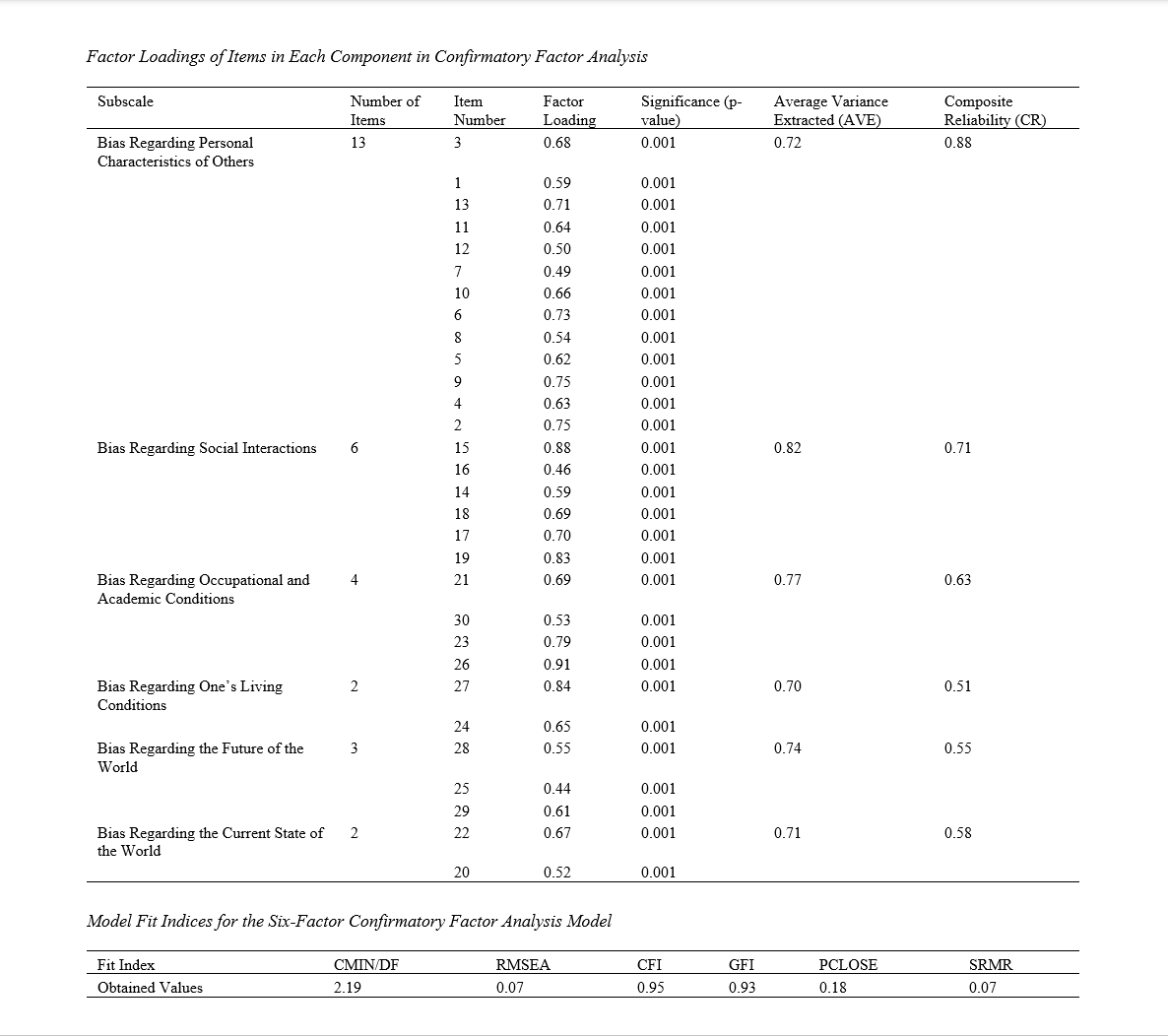
Findings: Based on exploratory factor analysis conducted using SPSS-26, the 30 questionnaire items were categorized into six components, with Cronbach's alpha coefficients ranging from 0.70 to 0.86. Additionally, the results of confirmatory factor analysis using AMOS-24 indicated adequate and appropriate reliability of the questionnaire's constructs.
Conclusion: Therefore, given that this questionnaire is a reliable and valid instrument, it can be utilized by specialists to assess interpretation biases in individuals with obsessive-compulsive personality disorder.
Downloads
References
American Psychiatric Association. (2013). Diagnostic and statistical manual of mental disorders (DSM-5). American Psychiatric Pub. https://doi.org/https://doi.org/10.1176/appi.books.9780890425596
Anglim, J., & O'Connor, P. (2019). Measurement and research using the big five, hexaco, and narrow traits: a primer for researchers and practitioners. Australian Journal of Psychology, 71(1), 16-25. https://doi.org/https://doi.org/10.1111/ajpy.12202
Ansell, E., Pinto, A., Edelen, M. O., & Grilo, C. M. (2008). Structure of Diagnostic and Statistical Manual of Mental Disorders, Fourth Edition criteria for Obsessive-Compulsive Personality Disorder in patients with Binge Eating Disorder. The Canadian Journal of Psychiatry, 53, 863-867. https://doi.org/https://doi.org/10.1177/070674370805301212
Ansell, E. B., Pinto, A., Crosby, R. D., Becker, D. F., Añez, L. M., Paris, M., & Grilo, C. M. (2010). The prevalence and structure of obsessive-compulsive personality disorder in Hispanic psychiatric outpatients. Journal of Behavior Therapy and Experimental Psychiatry, 41(3), 275-281. https://doi.org/https://doi.org/10.1016/j.jbtep.2010.02.005
Atroszko, P. A., Demetrovics, Z., & Griffiths, M. D. (2020). Work Addiction, Obsessive-Compulsive Personality Disorder, Burn-Out, and Global Burden of Disease: Implications from the ICD-11. International journal of environmental research and public health, 17(2), 660. https://doi.org/https://doi.org/10.3390/ijerph17020660
Azimpour, A., Derakhshan, Z., & Ghanbari, S. (2019). Morality and psychopathology: Tendencies to personality disorders and some other mental disorders among individuals with high and low moral identity. Iranian journal of psychiatry and behavioral sciences, 13(1DO - https://doi.org/10.5812/ijpbs.14966). https://brieflands.com/articles/ijpbs-14966.html
Beck, A. T., & Haigh, E. A. (2014). Advances in cognitive theory and therapy: The generic cognitive model. Annual Review of Clinical Psychology, 10, 1-24. https://doi.org/https://doi.org/10.1146/annurev-clinpsy-032813-153734
Bender, J. H. (2021). Do OCPD Symptoms and Intolerance of Uncertainty Predict Emotions? https://researchrepository.wvu.edu/cap_theses/18/
Besharat, M. A., Hosseini, S. A., & Jahed, H. (2019). Obsessive-compulsive personality disorder and perfectionism: A brief review. Thoughts and Behavior in Clinical Psychology, 14(51), 77-88. https://jtbcp.roudehen.iau.ir/m/article_1486.html?lang=en
Bleidorn, W., Schwaba, T., Zheng, A., Hopwood, C. J., Sosa, S. S., Roberts, B. W., & Briley, D. A. (2022). Personality stability and change: A meta-analysis of longitudinal studies. Psychological bulletin, 148(7-8), 588-619. https://doi.org/https://doi.org/10.1037/bul0000365 https://doi.org/10.31234/osf.io/eq5d6
Bogie, B. J. M., Kapczinski, F. P., McCabe, R. E., McKinnon, M. C., & Frey, B. N. (2020). Emotional reactivity and explicit emotional memory biases in major depressive disorder during euthymia. Psychiatry research, 285, 1-8. https://doi.org/https://doi.org/10.1016/j.psychres.2020.112847
Carleton, R. N., Mulvogue, M. K., Thibodeau, M. A., McCabe, R. E., Antony, M. M., & Asmundson, G. J. (2012). Increasingly certain about uncertainty: Intolerance of uncertainty across anxiety and depression. Journal of anxiety disorders, 26, 468-479. https://doi.org/https://doi.org/10.1016/j.janxdis.2012.01.011
Carleton, R. N., Norton, M. A., & Asmundson, G. J. (2007). Fearing the unknown: A short version of the Intolerance of Uncertainty Scale. Journal of anxiety disorders, 21, 105-117. https://doi.org/https://doi.org/10.1016/j.janxdis.2006.03.014
Clemente, M. J., Martins Silva, A. S., Pozzolo Pedro, M. O., Paiva, H. S., de Azevedo Marques Périco, C., Torales, J., Ventriglio, A., & Castaldelli-Maia, J. M. (2022). A meta-analysis and meta-regression analysis of the global prevalence of obsessive-compulsive personality disorder. Heliyon, 8(7), e09912. https://doi.org/https://doi.org/10.1016/j.heliyon.2022.e09912
Clerkin, E. M., & Teachman, B. A. (2011). Training interpretation biases among individuals with symptoms of obsessive compulsive disorder. Journal of Behavior Therapy and Experimental Psychiatry, 42(3), 337-343. https://doi.org/https://doi.org/10.1016/j.jbtep.2011.01.003
Diedrich, A., & Voderholzer, U. (2015). Obsessive-compulsive personality disorder: a current review. Current psychiatry reports, 17, 1-10. https://doi.org/https://doi.org/10.1007/s11920-014-0547-8
Edwards, E., Leahy, R., & Snyder, S. (2023). Patterns of emotional schema endorsement and personality disorder symptoms among outpatient psychotherapy clients. Motivation and Emotion, 47(3), 412-422. https://doi.org/https://doi.org/10.1007/s11031-022-10000-3
Grant, J. E., Pinto, A., & Chamberlain, S. (2020). Obsessive-compulsive personality disorder. American Psychiatric Association Publishing. https://doi.org/https://doi.org/10.1176/appi.books.9781615379293
Gray, E. C. (2024). Factors contributing to obsessive-compulsive personality disorder traits: a scoping review and empirical study https://figshare.mq.edu.au/ndownloader/files/47682112
Grilo, C. M., Sanislow, C. A., Gunderson, J. G., Pagano, M. E., Yen, S., Zanarini, M. C., & McGlashan, T. H. (2004). Two-year stability and change of schizotypal, borderline, avoidant, and obsessive-compulsive personality disorders. Journal of consulting and clinical psychology, 72(5), 767. https://doi.org/https://doi.org/10.1037/0022-006X.72.5.767
Grol, M., Schwenzfeier, A. K., Stricker, J., Booth, C., Temple-McCune, A., Derakshan, N., Hirsch, C., Becker, E., & Fox, E. (2018). The worrying mind in control: an investigation of adaptive working memory training and cognitive bias modification in worry-prone individuals. Behaviour Research and Therapy, 103, 1-11. https://doi.org/https://doi.org/10.1016/j.brat.2018.01.005
Heintz, H. L. (2024). Identifying mechanistic pathways to rigidity associated with Obsessive-Compulsive Personality Disorder traits using a novel decision-making paradigm. https://doi.org/https://doi.org/10.31234/osf.io/5prej
Hemade, A., Fekih-Romdhane, F., Obeid, S., & Hallit, S. (2024). Psychometric Properties of an Arabic Translation of the shortest version of the Obsessive Beliefs Questionnaire (OBQ-9) in adults. https://doi.org/https://doi.org/10.21203/rs.3.rs-4807584/v1
Kanehisa, M., Kawashima, C., Nakanishi, M., Okamoto, K., Oshita, H., Masuda, K., Takita, F., Izumi, T., Inoue, A., Ishitobi, Y., Higuma, H., Ninomiya, T., & Akiyoshi, J. (2017). Gender differences in automatic thoughts and cortisol and alpha-amylase responses to acute psychosocial stress in patients with Obsessive-Compulsive Personality Disorder. Journal of affective disorders, 217, 1-7. https://doi.org/https://doi.org/10.1016/j.jad.2017.03.057
Karimpour, M., Farahani, M. N., & Khanipour, H. (2021). The Relationship between Self-Regulation Processes and Severity of Obsessive Compulsive Personality Disorder Symptoms: the Role of Conscientiousness. Journal of Psychology, 3(25), 389-411. http://www.iranapsy.ir/en/Article/21674
Lee, S. R., & Wu, K. D. (2019). Feelings of incompleteness explain symptoms of OCD and OCPD beyond harm avoidance. Journal of Obsessive-Compulsive and Related Disorders, 21, 151-157. https://doi.org/https://doi.org/10.1016/j.jocrd.2019.04.002
Martukovich, R. (2010). A reexamination of the Obsessive-Compulsive Personality Disorder Questionnaire reliability and validity in a college student sample https://rave.ohiolink.edu/etdc/view?acc_num=csu1273867143
Mayer, J. D., & Bryan, V. M. (2024). On personality measures and their data: A classification of measurement approaches and their recommended uses. Personality and Social Psychology Review, 28(3), 325-345. https://doi.org/https://doi.org/10.1177/10888683231222519
Montazeri, M., Neshatdoost, H., Abedi, M., & Abedi, A. (2013). Effectiveness of Schema Therapy on Symptoms Intensify Reduction and Depression in a Patient with Obsessive Compulsive Personality Disorder: A Single Case Study. Journal of Clinical Psychology, 5(1), 35-45. https://journals.kmanpub.com/index.php/jarac/article/view/2730
Moradi Siah Afshadi, M., Ghasemi, N., & Ghamarani, A. (2015). Evaluating the validity and reliability of flourishing scale and determining the relation between flourishing and academic achievement in students of medicine school. Iranian Journal of Medical Education, 15, 330-337. https://ijme.mui.ac.ir/browse.php?a_code=A-10-2844-1&sid=1&slc_lang=en
Redden, S. A., Mueller, N. E., & Cougle, J. R. (2023). The impact of obsessive-compulsive personality disorder in perfectionism. International Journal of Psychiatry in Clinical Practice, 27(1), 18-24. https://doi.org/https://doi.org/10.1080/13651501.2022.2069581
Shariatzadeh, M., Vaziri, S., & Mirhashemi, M. (2015). Comparison of early maladaptive schemas in patients with Obsessive-Compulsive Disorder, patients with ObsessiveCompulsive Personality Disorder with healthy individuals. Mediterranean Journal of Social Sciences, 6(4S2), 171-181. https://doi.org/https://doi.org/10.5901/mjss.2015.v6n4s2p171
Steenkamp, M. M., Suvak, M. K., Dickstein, B. D., Shea, M. T., & Litz, B. T. (2015). Emotional functioning in obsessive-compulsive personality disorder: Comparison to borderline personality disorder and healthy controls. Journal of personality disorders, 29(6), 794-808. https://doi.org/https://doi.org/10.1521/pedi_2014_28_174
Stieger, M., Liu, Y., Graham, E. K., & DeFrancisco, J. A. U. L. M. E. (2021). Personality change profiles and changes in cognition among middle-aged and older adults. Journal of research in personality, 95, 104157. https://doi.org/https://doi.org/10.1016/j.jrp.2021.104157
Tajii, K. (2018). Type D Personality and Attachment as Predictors of Heart Rate Variability During a Cognitive and Social Stressor https://search.proquest.com/openview/84692ab4d4bd315444d6ffa63739e4cc/1?pq-origsite=gscholar&cbl=18750
Wheaton, M. G., & Pinto, A. (2017). The role of experiential avoidance in ObsessiveCompulsive Personality Disorder traits. Personality disorders, 8(4), 383-388. https://doi.org/https://doi.org/10.1037/per0000200
Wheaton, M. G., & Ward, H. E. (2020). Intolerance of uncertainty and obsessive-compulsive personality disorder. Personality Disorders: Theory, Research, and Treatment, 11(5), 357-364. https://doi.org/https://doi.org/10.1037/per0000396
Woud, M. L. (2022). Interpretational biases in emotional psychopathology. Cognitive and Behavioral Practice, 29(3), 520-523. https://doi.org/https://doi.org/10.1016/j.cbpra.2022.02.010
Downloads
Additional Files
Publication Timeline
- Submitted
- Revised
- Accepted
Issue
Section
License
Copyright (c) 2025 Sepideh Mahmoodzadeh (Author); Ali Pakizeh (Corresponding Author); Seyed Mousa Golestane, Mahnaz Jokar (Author)

This work is licensed under a Creative Commons Attribution-NonCommercial 4.0 International License.