Negative Affectivity and Maladaptive Coping Strategies in Depressed Adolescents’ Family Conflict Management: The Mediating Role of Emotional Flexibility
DOI:
https://doi.org/10.61838/kman.jayps.4919Keywords:
Negative affectivity, Maladaptive coping strategies, Family conflict management, Emotional flexibilityAbstract
Objective: This study aimed to examine the direct and indirect effects of negative emotionality and maladaptive coping strategies on family conflict management among depressed adolescents, with emotional flexibility as a mediating variable.
Methods and Materials: The present research employed a descriptive–correlational design using structural equation modeling. The statistical population consisted of all female students enrolled in upper secondary education in two high schools in District 2 of Tehran during the 2024–2025 academic year, from which 234 adolescents diagnosed with mild to moderate depression were selected based on the Morgan table. Participants completed the Negative Emotionality Questionnaire, the short form of the Coping Inventory for Stressful Situations, the Emotional Flexibility Questionnaire, and the Conflict Tactics Scale. Data were analyzed using Pearson correlation coefficients and structural equation modeling in SPSS 24 and AMOS 24 after confirming normal distribution of variables through the Kolmogorov–Smirnov test.
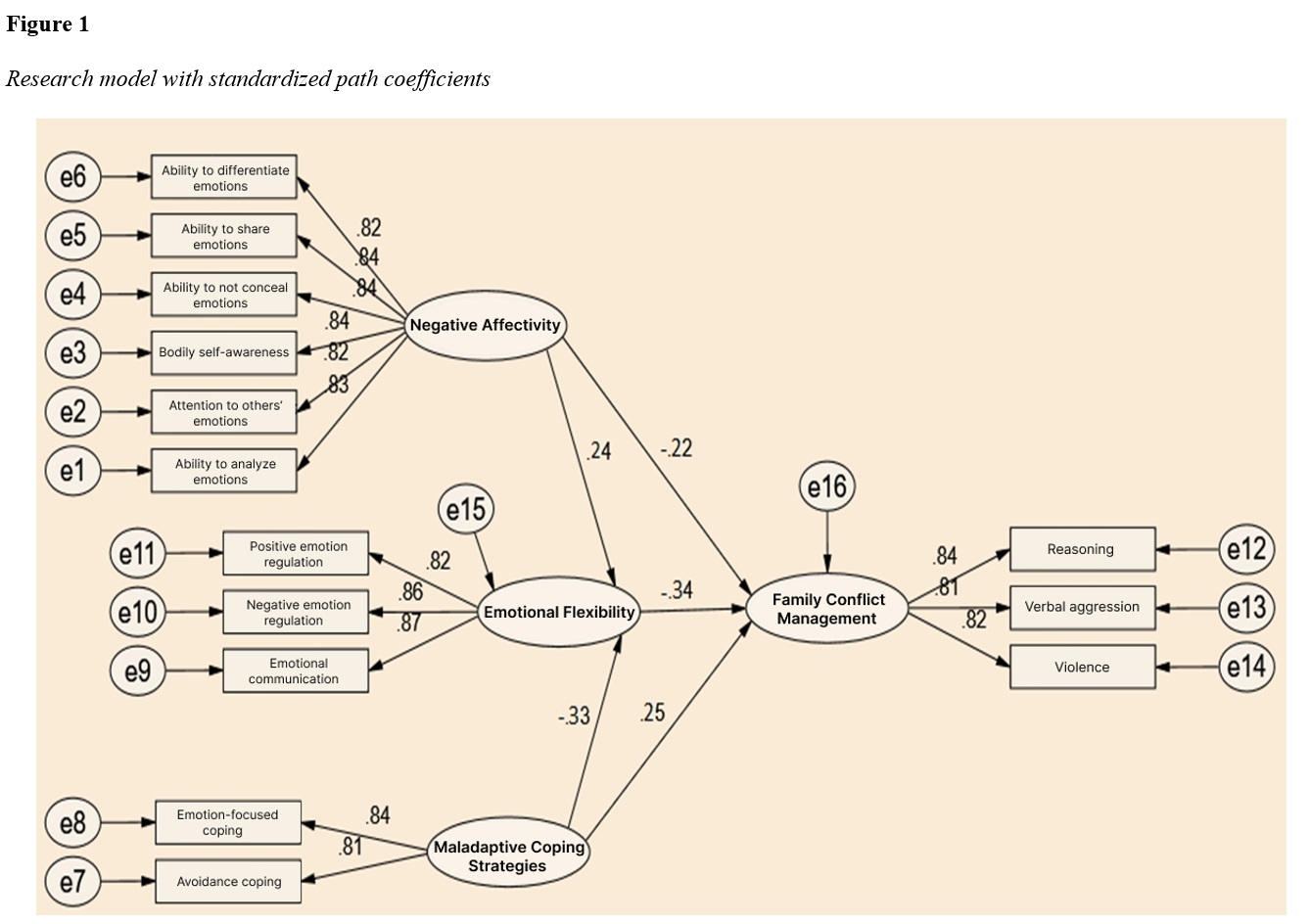
Findings: Structural equation modeling indicated that negative emotionality exerted a significant direct negative effect on family conflict management (β = −0.218, T = 2.845, p < .05), whereas maladaptive coping strategies demonstrated a significant direct positive effect (β = 0.247, T = 3.617, p < .05). Emotional flexibility showed a significant direct negative effect on family conflict management (β = −0.343, T = 6.604, p < .001). Furthermore, negative emotionality significantly predicted emotional flexibility (β = 0.244, T = 3.261, p < .01), while maladaptive coping strategies significantly predicted emotional flexibility in a negative direction (β = −0.328, T = 6.120, p < .001). Sobel test results confirmed the mediating role of emotional flexibility in the relationships between negative emotionality and family conflict management (Z = 2.201, p < .05) and between maladaptive coping strategies and family conflict management (Z = 2.782, p < .01).
Conclusion: The findings demonstrate that emotional flexibility is a central psychological mechanism through which negative emotionality and maladaptive coping strategies influence family conflict management in depressed adolescents, suggesting that enhancing emotional flexibility may substantially improve relational functioning and emotional well-being.
Downloads
References
Afzali Kalateh, G. (2020). The Relationship between Cognitive-Behavioral Coping Strategies and Religious/Spiritual Coping with Pain Adjustment and Improvement of Chronic Pain. 6th International Conference on Psychology, Counseling, and Educational Sciences, Islamic Azad University, Sanandaj Branch, Iran.
Buttelmann, F., & Karbach, J. (2017). Development and plasticity of cognitive flexibility in early and middle childhood. Frontiers in psychology, 8, 1040. https://doi.org/10.3389/fpsyg.2017.01040
Feizi, J., Moradi, A., Khajeh Dalouee, M., & Khadem, N. (2017). The Efficacy of Acceptance and Commitment Therapy on Anxiety and Depression in Pregnant Women. Quarterly Journal of Clinical Psychology Studies, 8(27), 1-21. https://jcps.atu.ac.ir/article_7905.html?lang=en
Kann, S. J., O'Rawe, J. F., Huang, A. S., Klein, D. N., & Leung, H. C. (2017). Preschool negative emotionality predicts activity and connectivity of the fusiform face area and amygdala in later childhood. Social Cognitive and Affective Neuroscience, 12(9), 1511-1519. https://doi.org/10.1093/scan/nsx079
Khosh Lahje Sedgh, A. (2017). The Effect of Metacognitive Therapy on Reducing Symptoms of Depression and Anxiety in Female Patients with Constipation. Health Psychology, 6(21), 116-128. https://hpj.journals.pnu.ac.ir/article_3703.html?lang=en
Kim, T. Y., Lee, J.-H., & Cho, H. (2025). The Role of Self-Emotion Appraisal and Coping Strategies in Enhancing Well-Being and Exercise Commitment Among Elite Athletes: A Cognitive-Motivational-Relational Approach. International Journal of Sports Science & Coaching. https://doi.org/10.1177/17479541251333930
Mahmoodi, T., Bassak Nejad, S., & Mehrabizadeh, M. (2020). Investigating the Role of Anger Rumination and Cognitive Emotion Regulation Strategies in Predicting Sleep Quality of Female Students. Knowledge & Research in Applied Psychology, 21(79), 1-7. https://www.magiran.com/paper/2138006/role-of-anger-rumination-and-cognitive-emotion-regulation-strategies-in-prediction-of-sleep-quality-in-female-students?lang=en
Mera, S., Zimmer‐Gembeck, M. J., Conlon, E. G., Ryan, K. M., & Dower, A. (2025). A Scoping Review of the Role of Mindful Parenting in Youth’s Emotional, Behavioral, and Social Adjustment, Coping, and Emotion Regulation. International Journal of Behavioral Development. https://doi.org/10.1177/01650254251381983
Mousavi, S. A., Alvani, J., & Ghasemi Panah, M. (2021). Determining the Relationship between Emotional Adjustment and Cognitive Emotion Regulation with Resilience in Military Nurses. Maritime Medicine Journal, 3(1), 39-45. https://jmarmed.ir/browse.php?a_id=136&sid=1&slc_lang=en&ftxt=0
Nadimi, S., & Bana, M. (2021). Investigating the Relationship between Spirituality and Emotion Regulation or Resilience in Students. 7th National Conference on New Developments in Positive Psychology, Lar Higher Education Complex.
Nemati Sogoli Tapeh, F. (2017). Predicting University Students' Suicidal Thoughts Based on Depression, Borderline Personality Disorder, Religiosity, Social Support, and Coping Strategies. Modern psychological research, 12(45), 255-280. https://psychologyj.tabrizu.ac.ir/article_6562.html?lang=en
Pv, A. (2025). Impact of Family’s Emotional Involvement and Coping Strategies on Resilience Among Young Adults. World Journal of Advanced Research and Reviews, 25(3), 1994-2002. https://doi.org/10.30574/wjarr.2025.25.3.0848
Quarshie, E. N., Waterman, M. G., & House, A. O. (2020). Adolescent self-harm in Ghana: A qualitative interview-based study of first-hand accounts. BMC psychiatry, 20(1), 1-14. https://doi.org/10.1186/s12888-020-02599-9
Raposo, B., & Francisco, R. (2022). Emotional (dys)regulation and family environment in (non)clinical adolescents' internalizing problems: The mediating role of well-being. Frontiers in psychology, 13, 703762. https://doi.org/10.3389/fpsyg.2022.703762
Ruzbehani, M., & Sharifi, P. (2018). Comparison of Depression Symptom Severity and Information Processing Speed among Individuals with Post-Traumatic Stress Disorder and Normal Adolescents. Quarterly Journal of Clinical Psychology Studies, 9(32), 143-127. https://jcps.atu.ac.ir/article_9545.html?lang=en
Sadock, B. J., Sadock, V. A., & Ruiz, P. (2015). Kaplan & Sadock's Synopsis of Psychiatry: Behavioral Sciences/Clinical Psychiatry (10th ed., Vol. 3). Arjmand Publications. https://psycnet.apa.org/record/2014-37072-000
Simonič, B., Poljak Lukek, S., Valenta, T., Jerebic, D., Jerebic, S., Rijavec Klobučar, N., & Pate, T. (2024). The Role of Emotion Dysregulation in Problematic Alcohol Use and Coping with Problems. European Journal of Mental Health, 19, 1-15. https://doi.org/10.5708/EJMH.19.2024.0018
Thomas, A., Okamoto, S., Rebecca, K., & Pagano, I. (2019). Parental support, parent-adolescent conflict, and substance use of Native Hawaiian and Pacific Islander youth: Ethnic differences in stress-buffering and vulnerability effects. Asian American Journal of Psychology, 10(3), 218-226. https://doi.org/10.1037/aap0000139
Tsuritani, M., & Jikihara, Y. (2024). Moderating Effects of Coping With Interparental Conflict, Emotional Insecurity in the Interparental Relationship, and Adolescents’ Adjustment. The Japanese Journal of Psychology, 95(3), 153-163. https://doi.org/10.4992/jjpsy.95.22049
Vaghee, S., Salarhaji, A., Rezaei Ardani, A., Mazloom, S. R., & Alizadeh, F. (2017). The Relationship of Self-Differentiation with Stress Coping Strategies and Suicide in Patients with Mood Disorders. Journal of Torbat Heydariyeh University of Medical Sciences, 5(1), 17-25. https://jms.thums.ac.ir/browse.php?a_id=392&slc_lang=en&sid=1&printcase=1&hbnr=1&hmb=1
Villacura-Herrera, C., Ávalos-Tejeda, M., Gaete, J., Robinson, J., & Núñez, D. (2025). The underlying dynamics of a suicidal ideation latent network model: The role of hopelessness, psychopathology, emotion regulation, and behavioral coping skills in adolescents from the general population. Journal of affective disorders, 379, 540-548. https://doi.org/10.1016/j.jad.2025.02.101
Vladislav, E. O., Marc, G., Paica, C. I., & Pop, O. (2024). Family resilience in a social-ecological context - emotional difficulties and coping strategies. Frontiers in psychology, 15, 1421745. https://doi.org/10.3389/fpsyg.2024.1421745
Weber, S., & Lynch, S. M. (2024). Interpersonal Violence, Emotion Regulation, and Trauma-Coping Self-Efficacy as Predictors of Posttraumatic Stress Disorder, Substance Use, and Risk Engagement Among Women in Jail. Journal of interpersonal violence. https://doi.org/10.1177/08862605241307227
Yaghoubi Siahgourabi, F., Rezaei, S., & Zabardast, A. (2024). Prevalence of Anxiety and Depression among Adolescent Girls in Lahijan and Associated Demographic Factors. Tolooe Behdasht, 23(3), 1-15. https://doi.org/10.18502/tbj.v23i3.16479
Yen, J. Y., Yeh, Y. C., Wang, P. W., Liu, T. L., Chen, Y. Y., & Ko, C. H. (2018). Emotional regulation in young adults with Internet gaming disorder. International journal of environmental research and public health, 15(1), 30. https://doi.org/10.3390/ijerph15010030
Zamani Zargar, M., Azadi, F., Tasht Zarin, S., Alinejad, P., Zarrine, P., & Mehrzadeh, M. (2023). The Role of Negative Emotionality in Predicting Problematic Smartphone Use. 4th National Conference on Psychopathology, Allameh Tabataba'i University, Azadegan-Nir Unit, Ardabil, Iran.
Downloads
Additional Files
Publication Timeline
- Submitted
- Revised
- Accepted