Interpretable Deep Learning Analysis of Online Social Anxiety in Adolescents Using Feature Saliency Mapping
DOI:
https://doi.org/10.61838/kman.jayps.4996Keywords:
Online social anxiety, Adolescents, Interpretable deep learning, Feature saliency mapping, Social media, Emotional regulationAbstract
Objective: The objective of this study was to develop and validate an interpretable deep learning model for predicting adolescents’ online social anxiety and to identify the most influential psychological and digital behavioral features contributing to its development.
Methods and Materials: A cross-sectional predictive modeling design was employed with a sample of 523 adolescents aged 13–18 years recruited from secondary schools in Austria. Participants completed standardized measures assessing online social anxiety, general social anxiety, self-esteem, perceived social support, emotion regulation, and digital behavior patterns. Data were analyzed using a deep neural network with multiple hidden layers and regularization techniques. Model performance was evaluated using RMSE, MAE, R², and Pearson correlation. Interpretability was achieved through advanced feature saliency mapping, including SHAP values and gradient-based attribution methods, enabling identification of both global and individual-level predictors of online social anxiety.
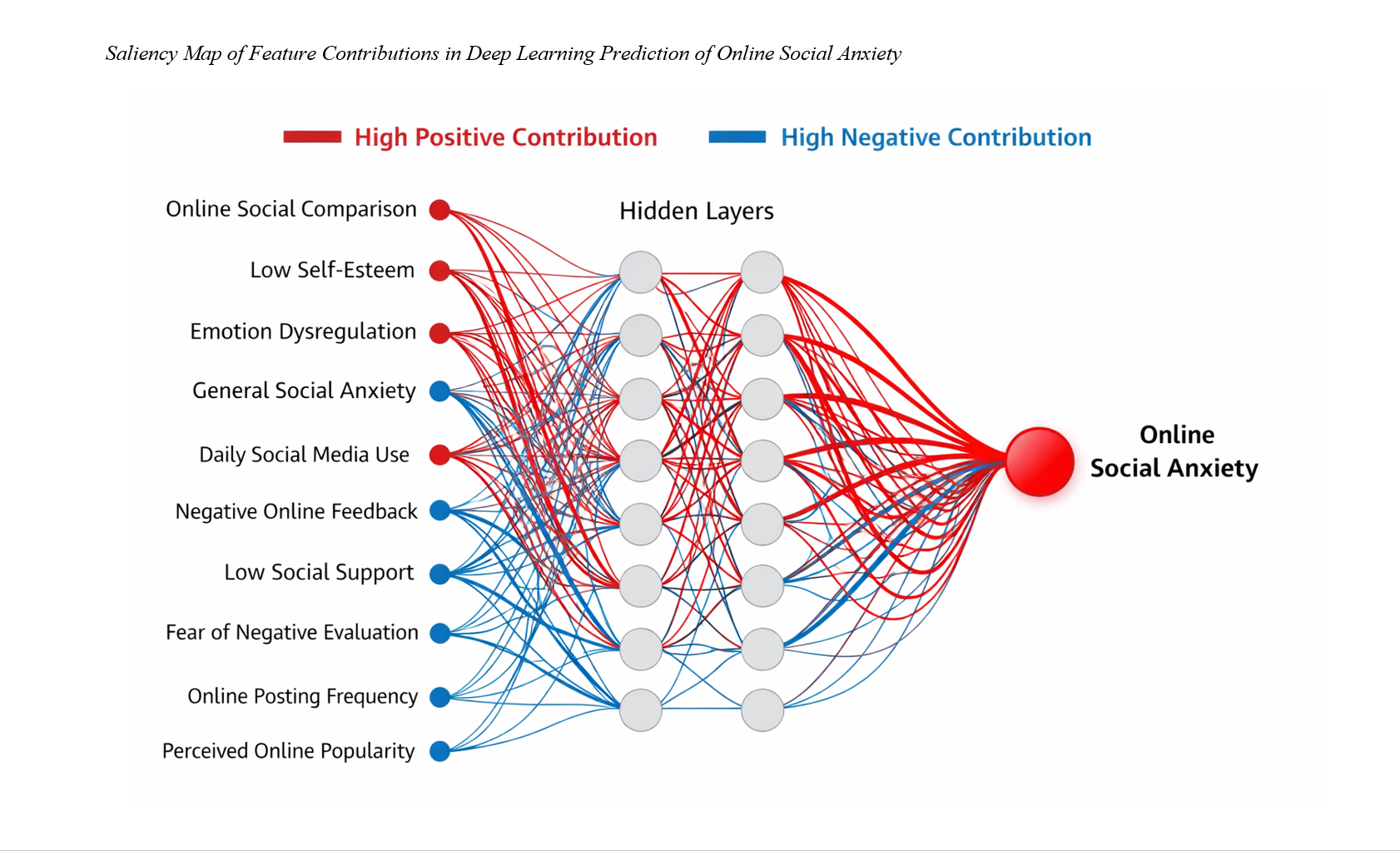
Findings: The deep learning model demonstrated strong predictive performance, explaining 81% of the variance in online social anxiety (R² = .81) with high correspondence between predicted and observed scores (r = .90). Feature saliency analysis revealed that online social comparison exerted the strongest positive influence on anxiety predictions, followed by low self-esteem, emotion dysregulation, general social anxiety, and daily social media use. Perceived social support displayed a robust negative contribution, functioning as a protective factor. Subgroup analysis indicated that adolescents with the highest anxiety levels exhibited intensified contributions from social comparison, emotional instability, excessive media engagement, and negative feedback sensitivity.
Conclusion: Interpretable deep learning provides a powerful and transparent framework for understanding the complex psychological mechanisms underlying adolescents’ online social anxiety, offering critical insights for early identification and targeted intervention.
Downloads
References
Agustiningsih, N., & Fahrany, F. (2022). Personal Resources, Emotion Regulation, Parenting Style, Social Support on Cyberbullying Victims: A Literature Review. International Journal of Research and Studies Publishing, 12(8), 486-491. https://doi.org/10.29322/ijsrp.12.08.2022.p12857
Agustiningsih, N., Yusuf, A., Ahsan, A., & Fanani, Q. (2024). The Impact of Bullying and Cyberbullying on Mental Health: A Systematic Review. International Journal of Public Health Science (Ijphs), 13(2), 513. https://doi.org/10.11591/ijphs.v13i2.23683
Alghamdi, W., Almadani, S., Banjer, H. M., Alsulami, D., & Alghamdi, Y. (2024). Relationship Between Cyberbullying, Anxiety, and Depression Among University Students in Jeddah, Saudi Arabia: A Cross-Sectional Study. The International Journal of Psychiatry in Medicine, 60(2), 170-186. https://doi.org/10.1177/00912174241265560
Annoni, A. M., Petrocchi, S., Camerini, A.-L., & Marciano, L. (2021). The Relationship Between Social Anxiety, Smartphone Use, Dispositional Trust, and Problematic Smartphone Use: A Moderated Mediation Model. International journal of environmental research and public health, 18(5), 2452. https://doi.org/10.3390/ijerph18052452
Audrin, C., & Blaya, C. (2023). Personal and Social Protective Factors of Cyberhate: A General Strain Theory Approach. International journal of psychology, 59(2), 331-339. https://doi.org/10.1002/ijop.13090
Cao, G., Wei, X., Liu, J., & Li, X. Y. (2023). The Association Between Childhood Trauma and Adolescent Cyberbullying: Chain Mediating Roles of Emotional Intelligence and Online Social Anxiety. Frontiers in Psychiatry, 14. https://doi.org/10.3389/fpsyt.2023.1184382
Catone, G., Almerico, L., Pezzella, A., Riccio, M. P., Bravaccio, C., Bernardo, P., Muratori, P., Pascotto, A., Pisano, S., & Senese, V. P. (2021). The Relation of Callous–Unemotional Traits and Bullying in Early Adolescence Is Independent From Sex and Age and Moderated by Conduct Problems. Brain Sciences, 11(8), 1059. https://doi.org/10.3390/brainsci11081059
Ding, H., Zhao, C., Huang, F., Hua, W., & Lei, L. (2024). Do Cyberbullying Victims Feel More Entitled to Bully Others Online? The Moderating Role of Gender. Journal of interpersonal violence, 40(11-12), 2538-2555. https://doi.org/10.1177/08862605241275991
Espino, E., Guarini, A., & Rey, R. D. (2023). Effective Coping With Cyberbullying in Boys and Girls: The Mediating Role of Self-Awareness, Responsible Decision-Making, and Social Support. Current Psychology, 42(36), 32134-32146. https://doi.org/10.1007/s12144-022-04213-5
Garaigordobil, M., & Larrain, E. (2020). Bullying and Cyberbullying in LGBT Adolescents: Prevalence and Effects on Mental Health. Comunicar, 28(62), 79-90. https://doi.org/10.3916/c62-2020-07
Garaigordobil, M., & Navarro, R. (2022). Parenting Styles and Self-Esteem in Adolescent Cybervictims and Cyberaggressors: Self-Esteem as a Mediator Variable. Children, 9(12), 1795. https://doi.org/10.3390/children9121795
Grigore, A.-N., & Maftei, A. (2020). Exploring the Mediating Roles of State and Trait Anxiety on the Relationship Between Middle Adolescents’ Cyberbullying and Depression. Children, 7(11), 240. https://doi.org/10.3390/children7110240
Hu, X., & Xiao, B. (2023). The Effect of Emotional Neglect on Cyberbullying Among Rural Chinese Left-Behind Adolescents—Mediating Role of Social Anxiety. Children, 10(6), 1055. https://doi.org/10.3390/children10061055
Hu, Y., & Wang, Q. (2022). Self-Control, Parental Monitoring, and Adolescent Problematic Mobile Phone Use: Testing the Interactive Effect and Its Gender Differences. Frontiers in psychology, 13. https://doi.org/10.3389/fpsyg.2022.846618
Iannello, N. M., Caravita, S. C. S., Papotti, N., Gelati, C., & Camodeca, M. (2023). Social Anxiety and Bullying Victimization in Children and Early Adolescents: The Role of Developmental Period and Immigrant Status. Journal of youth and adolescence, 53(1), 130-141. https://doi.org/10.1007/s10964-023-01865-9
Jin, X., Zhang, K., Twayigira, M., Gao, X., Xu, H., Huang, C., Luo, X., & Shen, Y. (2023). Cyberbullying Among College Students in a Chinese Population: Prevalence and Associated Clinical Correlates. Frontiers in Public Health, 11. https://doi.org/10.3389/fpubh.2023.1100069
Jun, W. (2020). A Study on the Cause Analysis of Cyberbullying in Korean Adolescents. International journal of environmental research and public health, 17(13), 4648. https://doi.org/10.3390/ijerph17134648
Kaiser, S., Kyrrestad, H., & Fossum, S. (2020). Cyberbullying Status and Mental Health in Norwegian Adolescents. Scandinavian journal of psychology, 61(5), 707-713. https://doi.org/10.1111/sjop.12656
Kim, J., Lee, Y., & Jennings, W. G. (2022). A Path From Traditional Bullying to Cyberbullying in South Korea: Examining the Roles of Self-Control and Deviant Peer Association in the Different Forms of Bullying. Journal of interpersonal violence, 37(9-10), 5937-5957. https://doi.org/10.1177/08862605211067022
Liu, T. L., Hsiao, R. C., Chou, W. J., & Yen, C. F. (2021). Social Anxiety in Victimization and Perpetration of Cyberbullying and Traditional Bullying in Adolescents With Autism Spectrum Disorder and Attention-Deficit/Hyperactivity Disorder. International journal of environmental research and public health, 18(11), 5728. https://doi.org/10.3390/ijerph18115728
Martínez-Monteagudo, M. C., Delgado, B., Inglés, C. J., & Escortell, R. (2020). Cyberbullying and Social Anxiety: A Latent Class Analysis Among Spanish Adolescents. International journal of environmental research and public health, 17(2), 406. https://doi.org/10.3390/ijerph17020406
Molero, M. M., Mártos, Á., Martín, A. B. B., Pérez-Fuentes, M. C., & Linares, J. J. G. (2022). Anxiety and Depression From Cybervictimization in Adolescents: A Metaanalysis and Meta-Regression Study. The European Journal of Psychology Applied to Legal Context, 14(1), 42-50. https://doi.org/10.5093/ejpalc2022a5
Peprah, P., Oduro, M. S., Atta-Osei, G., Addo, I. Y., Morgan, A. K., & Gyasi, R. M. (2024). Problematic Social Media Use Mediates the Effect of Cyberbullying Victimisation on Psychosomatic Complaints in Adolescents. Scientific reports, 14(1). https://doi.org/10.1038/s41598-024-59509-2
Prince, T., Mulgrew, K. E., Driver, C., McLoughlin, L. T., Mills, L., Boyes, A., & Hermens, D. F. (2025). The Body Image Related Cyberbullying Picture Series (BRC-PicS): Developed for Use in Research Relating to Cyberbullying, Body Image and Eating Disorders Among Female Adolescents. Current Psychology, 44(4), 2747-2760. https://doi.org/10.1007/s12144-025-07316-x
Sousa, M., Cruz, S., Inman, R. A., Marchante, M., & Coelho, V. A. (2024). Bullying Victimization and Bullying Perpetration, Social Anxiety, and Social Withdrawal in Portuguese Adolescents: A Reciprocal Association Model. Aggressive Behavior, 50(4). https://doi.org/10.1002/ab.22170
Sousa, V., Silva, P. R., Romão, A. M., & Coelho, V. A. (2023). Can an Universal School-Based Social Emotional Learning Program Reduce Adolescents’ Social Withdrawal and Social Anxiety? Journal of youth and adolescence, 52(11), 2404-2416. https://doi.org/10.1007/s10964-023-01840-4
Ullah, S., Kukreti, M., Sami, A., Shaukat, M. R., & Dangwal, A. (2025). The Role of Bystander Behavior and Employee Resilience in Mitigating Workplace Cyberbullying Impacts on Employee Innovative Performance. Human Systems Management. https://doi.org/10.1177/01672533251317066
Ünal‐Aydın, P., Özkan, Y., Öztürk, M., Aydın, O., & Spada, M. M. (2023). The Role of Metacognitions in Cyberbullying and Cybervictimization Among Adolescents Diagnosed With Major Depressive Disorder and Anxiety Disorders: A Case–control Study. Clinical Psychology & Psychotherapy, 30(3), 659-670. https://doi.org/10.1002/cpp.2826
Wang, A., Wang, Z., Ya, Z., & Shi, X. (2022). The Prevalence and Psychosocial Factors of Problematic Smartphone Use Among Chinese College Students: A Three-Wave Longitudinal Study. Frontiers in psychology, 13. https://doi.org/10.3389/fpsyg.2022.877277
Wang, C., & Zhang, Y. (2021). Social Face Consciousness and Help-Seeking Behavior in New Employees: Perceived Social Support and Social Anxiety as Mediators. Social Behavior and Personality an International Journal, 49(10), 1-11. https://doi.org/10.2224/sbp.10769
Wang, L. (2021). The Effects of Cyberbullying Victimization and Personality Characteristics on Adolescent Mental Health: An Application of the Stress Process Model. Youth & Society, 54(6), 935-956. https://doi.org/10.1177/0044118x211008927
Wang, Y., Chen, A., & Ni, H. (2021). The Relationship Between Cybervictimization and Non-Suicidal Self-Injury in Chinese Adolescents: A Moderated-Mediation Model. Frontiers in psychology, 11. https://doi.org/10.3389/fpsyg.2020.572100
Wang, Y., Liu, Y., & Zhou, J. (2023). Cyberbullying Victimization and Nonsuicidal Self-Injury in Early Adolescents: A Moderated Mediation Model of Social Anxiety and Emotion Reactivity. Cyberpsychology Behavior and Social Networking, 26(6), 393-400. https://doi.org/10.1089/cyber.2022.0346
Wang, Z., Cheng, L., Xie, Z., & Jiang, C. (2024). Cyberbullying Victimization and Perpetration: The Influence on Cyberostracism and Youth Anxiety. Behavioral Sciences & the Law, 42(4), 461-473. https://doi.org/10.1002/bsl.2675
Wang, Z., & Jiang, S. (2022). Influence of Parental Neglect on Cyberbullying Perpetration: Moderated Mediation Model of Smartphone Addiction and Self‐regulation. Health & Social Care in the Community, 30(6), 2372-2382. https://doi.org/10.1111/hsc.13787
Wong, T. K. Y., & Konishi, C. (2020). The Interplay of Perceived Parenting Practices and Bullying Victimization Among Hong Kong Adolescents. Journal of Social and Personal Relationships, 38(2), 668-689. https://doi.org/10.1177/0265407520969907
Wright, M. F., & Wachs, S. (2021). The Buffering Effect of Perceived Parental Social Support in the Longitudinal Relationship Between Homophobic Cyberbullying and LGBTQIA Adolescents’ Health Outcomes. The Journal of Early Adolescence, 42(9), 1152-1174. https://doi.org/10.1177/02724316211036759
Yang, H., Zhang, T., Shi, H.-f., & Fan, C. (2023). Empathy and Bystander Helping Behavior in Cyberbullying Among Adolescents: The Mediating Role of Internet Moral Judgment and the Moderating Role of Internet Self-Efficacy. Frontiers in psychology, 14. https://doi.org/10.3389/fpsyg.2023.1196571
Zahra, M., Anwar, P., Arif, M. B., Qureshi, M. S., Zahid, H., & Rahman, R. (2025). Problematic Social Media Use and Cyberbullying Perpetration Among Young Adults in Pakistan: Narcissistic Traits as a Mediator, Social Support and Empathy as Moderators. J. Asian Dev. Studies, 14(1), 1090-1099. https://doi.org/10.62345/jads.2025.14.1.88
Zhu, Z. Z. (2025). The Hidden Shadows of Social Media: Cyberbullying and Its Impact on Adolescent Mental Health. Highlights in Business Economics and Management, 52, 34-40. https://doi.org/10.54097/pn8xam95
Downloads
Additional Files
Publication Timeline
- Submitted
- Revised
- Accepted