Effectiveness of a Creative Problem-Solving Skills Training Package on Self-Efficacy and Personal Growth Initiative in Students
DOI:
https://doi.org/10.61838/kman.jayps.5047Keywords:
Creative problem-solving skills training, personal growth initiative, self-efficacy, adolescents.Abstract
Objective: The present study was conducted with the aim of examining the effectiveness of a creative problem-solving skills training package on self-efficacy and personal growth initiative among first-cycle secondary school students in the city of Shiraz.
Methods and Materials: This study employed a quasi-experimental design with pre-test, post-test, and one-month follow-up phases, including an experimental group and a control group. The statistical population consisted of female students enrolled in public schools in Shiraz during the 2024–2025 academic year. Using multi-stage cluster sampling, 44 students were randomly assigned to two groups: an experimental group and a control group (22 participants in each group). The research instruments included the Self-Efficacy Questionnaire (Morris, 2001) and the Personal Growth Initiative Scale (Robitschek, 1998). The experimental group received the creative problem-solving skills training package over eight 45-minute sessions, whereas the control group received no intervention. Data were analyzed at the descriptive level (mean and standard deviation) and at the inferential level (mixed repeated-measures analysis of variance) using SPSS version 26.
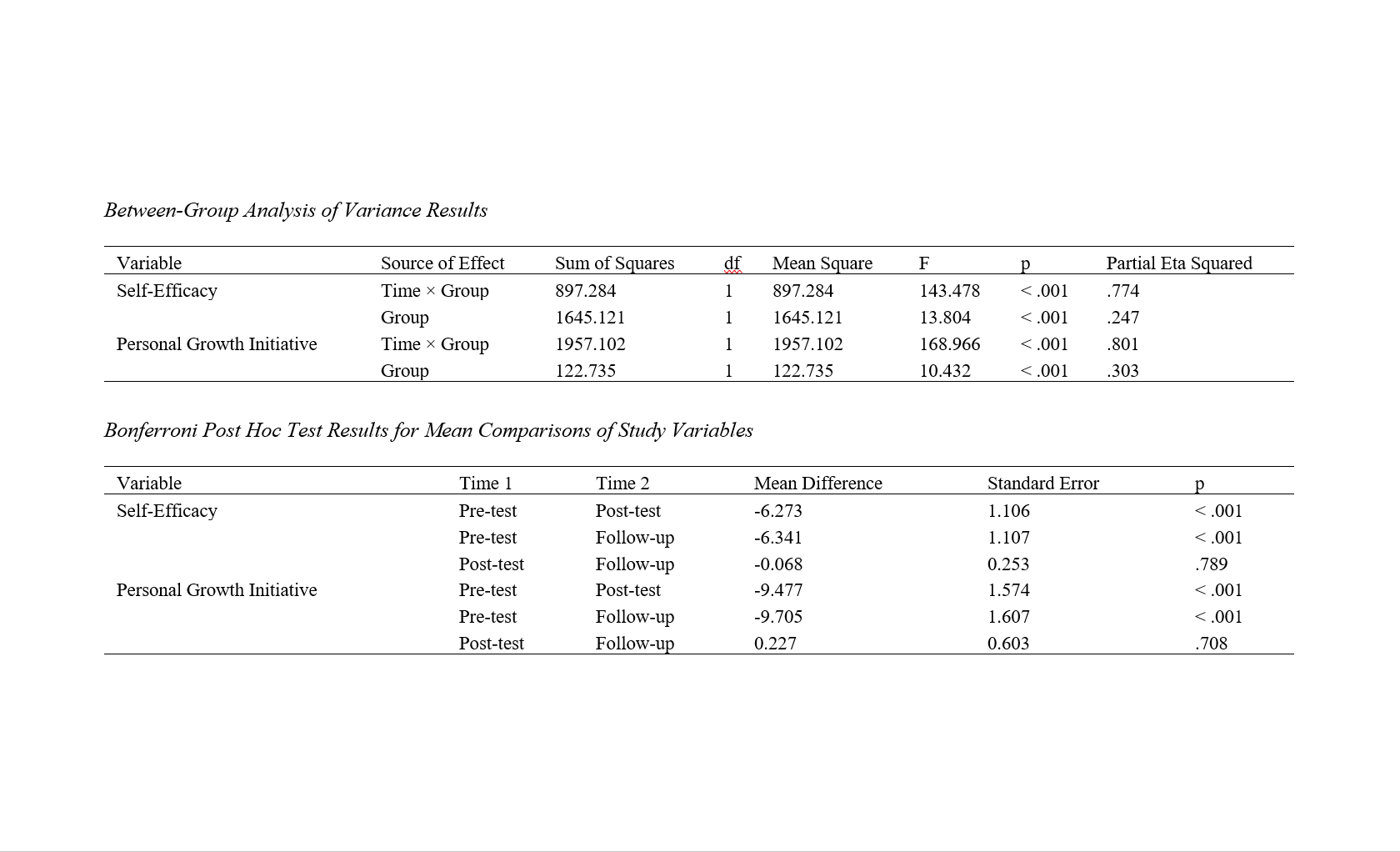
Findings: The results indicated that the creative problem-solving skills training package had a statistically significant effect on increasing self-efficacy and personal growth initiative (p < .05). The one-month follow-up demonstrated that the improvements in self-efficacy and personal growth initiative remained stable in the experimental group, whereas in the control group, no statistically significant differences were observed between the pre-test and follow-up stages for either variable.
Conclusion: The findings of this study suggest that the creative problem-solving skills training package can effectively enhance self-efficacy and personal growth initiative among first-cycle secondary school students. These results have practical implications for educational and counseling programs aimed at promoting students’ cognitive, social, and emotional competencies.
Downloads
References
Adeoye, M. A., & Jimoh, H. A. (2023). Problem-solving skills among 21st-century learners toward creativity and innovation ideas. Thinking Skills and Creativity Journal, 6(1), 52-58. https://doi.org/10.23887/tscj.v6i1.62708
Anderson, R. C., & Haney, M. (2021). Reflection in the creative process of early adolescents: The mediating roles of creative metacognition, self-efficacy, and self-concept. Psychology of Aesthetics, Creativity, and the Arts, 15(4), 612. https://doi.org/10.1037/aca0000324
Bai, N., Sadeghloo, F., & Saemi, H. (2024). The relationship between personal growth initiative and educational quality of elementary school physical education teachers with mediating role of job engagement. Research on Educational Sport, 12(34), 193-212. https://res.ssrc.ac.ir/article_4289_en.html?lang=fa
Bandura, A. (2001). Social cognitive theory: An agentic perspective. Annual review of psychology, 52(1), 1-26. https://doi.org/10.1146/annurev.psych.52.1.1
Bariyyah, K. (2021). Problem solving skills: essential skills challenges for the 21st century graduates. Jurnal EDUCATIO: Jurnal Pendidikan Indonesia, 7(1), 71-80. https://doi.org/10.29210/120212843
Brophy, D. R. (2006). A comparison of individual and group efforts to creatively solve contrasting types of problems. Creativity Research Journal, 18(3), 293-315. https://doi.org/10.1207/s15326934crj1803_6
Chen, P. L., Lin, C. H., Lin, I. H., & Lo, C. O. (2023). The mediating effects of psychological capital and academic self-efficacy on learning outcomes of college freshmen. Psychological Reports, 126(5), 2489-2510. https://doi.org/10.1177/00332941221077026
Chen, S. Y., Tsai, J. C., Liu, S. Y., & Chang, C. Y. (2021). The effect of a scientific board game on improving creative problem solving skills. Thinking Skills and Creativity, 41, 100921. https://doi.org/10.1016/j.tsc.2021.100921
Chen, Y., Wang, S., Liu, S., Hong, X., Zheng, J., Jiao, L., & et al. (2023). Belief in a just world and bullying defending behavior among adolescents: Roles of self-efficacy and responsibility. Current Psychology, 42(25), 21532-21540. https://doi.org/10.1007/s12144-022-03198-5
Eon Duval, P., Frick, A., & Denervaud, S. (2023). Divergent and convergent thinking across the school years: A dynamic perspective on creativity development. The Journal of Creative Behavior, 57(2), 186-198. https://doi.org/10.1002/jocb.569
Ercegovac, I. R., Maglica, T., & Ljubetić, M. (2021). The relationship between self-esteem, self-efficacy, family and life satisfaction, loneliness and academic achievement during adolescence. Croatian Journal of Education, 23(1), 65-83. https://doi.org/10.15516/cje.v23i0.4049
Ghorai, B. C., & Mohakud, L. L. (2025). Systematic Review on Creative Problem-Solving Ability among School Going Adolescents: A Research Trends. [Journal Name]. https://doi.org/10.36349/easjehl.2025.v08i07.005
Golshiri, P., Mostofi, A., & Rouzbahani, S. (2023). The effect of problem-solving and assertiveness training on self-esteem and mental health of female adolescents: a randomized clinical trial. BMC psychology, 11(1), 106. https://doi.org/10.1186/s40359-023-01154-x
Green, Z. A. (2024). Strengths intervention imparted through a blended learning approach to advance personal growth initiative among Pakistan's university students during COVID-19. Studies in Educational Evaluation, 81, 101343. https://doi.org/10.1016/j.stueduc.2024.101343
Hsia, L. H., Lin, Y. N., & Hwang, G. J. (2021). A creative problem solving‐based flipped learning strategy for promoting students' performing creativity, skills and tendencies of creative thinking and collaboration. British Journal of Educational Technology, 52(4), 1771-1787. https://doi.org/10.1111/bjet.13073
Huang, X., Lam, S. M., Wang, C., & Xu, P. (2023). Striving for personal growth matters: The relationship between personal growth initiative, teacher engagement and instructional quality. British Journal of Educational Psychology, 93(3), 658-675. https://doi.org/10.1111/bjep.12583
Ichsan, I., Subroto, D. E., Dewi, R., Ulimaz, A., & Arief, I. (2023). The Effect of Student Worksheet With Creative Problem Solving Based On Students Problem Solving Ability. Journal on Education, 5(4), 11583-11591. https://core.ac.uk/download/pdf/560351101.pdf
Jiao, Z., Chen, Y., & Lyu, C. (2024). Factors correlated with personal growth initiative among college students: A meta-analysis. Heliyon, 10(7). https://doi.org/10.1016/j.heliyon.2024.e28518
Kamyabi, M., Nekooie, M., Hajipoor Abaei, N., & Bahreini Zade, A. (2024). Designing a Model of Academic Procrastination Based on Self-Efficacy and Perfectionism in Kerman Islamic Azad University Psychology Students in the Academic Year 2022-2023 with the Mediating Role of Metacognitive Beliefs: A Descriptive Study. Journal of Rafsanjan University of Medical Sciences, 22(12), 1259-1278. https://doi.org/10.61186/jrums.22.12.1259
Kandemir, M. A., & Gür, H. (2009). The use of creative problem solving scenarios in mathematics education: views of some prospective teachers. Procedia-Social and Behavioral Sciences, 1(1), 1628-1635. https://doi.org/10.1016/j.sbspro.2009.01.286
Karamustafaoğlu, O., & Pektaş, H. M. (2023). Developing students' creative problem solving skills with inquiry-based STEM activity in an out-of-school learning environment. Education and Information Technologies, 28(6), 7651-7669. https://doi.org/10.1007/s10639-022-11496-5
Koenig, J., Farhat, L. C., & Bloch, M. H. (2025). From adolescence into young adulthood-the importance of a longitudinal perspective across development in child and adolescent mental health. Wiley Online Library, 1-3. https://doi.org/10.1111/jcpp.14094
Muris, P. (2001). A brief questionnaire for measuring self-efficacy in youths. Journal of psychopathology and behavioral assessment, 23(3), 145-149. https://doi.org/10.1023/A:1010961119608
Niles, J. K., Spargo, A., Fears, A., & Mullen, P. R. (2024). Meaning in Life As a Predictor of Personal Growth Initiative and Emotional Intelligence for Adolescents. Journal of Child and Adolescent Counseling, 10(3), 181-192. https://doi.org/10.1080/23727810.2024.2372238
Nurihsan, J., & Habibi, M. N. (2024). A Systematic Review of Personal Growth Initiative and Its Impact on Students' Psychological Well-Being. BISMA The Journal of Counseling, 8(3). https://doi.org/10.23887/bisma.v8i3.77661
Parnes, S. J. (1963). Education and creativity. Teachers College Record, 64(4), 1-8. https://doi.org/10.1177/016146816306400408
Phaksunchai, M., Kaemkate, W., & Wongwanich, S. (2014). Research and development of a training package for developing creative problem solving of undergraduate students. Procedia-Social and Behavioral Sciences, 116, 4824-4828. https://doi.org/10.1016/j.sbspro.2014.01.1032
Prates, P. E. G., Correa-Júnior, A. J. S., Russo, T. M. d. S., Paraizo-Horvath, C. M. S., Teles, A. A. d. S., & Sonobe, H. M. (2024). Effectiveness of family coping interventions in improving problem-solving skills in the care of children and adolescent cancer survivors during and after treatment: A scoping review. Nursing Reports, 14(3), 2153-2178. https://doi.org/10.3390/nursrep14030161
Qi, C. (2025). The impact of adolescent innovation on academic resilience, distance learning self-efficacy, and academic performance. Scientific reports, 15(1), 12396. https://doi.org/10.1038/s41598-025-91542-7
Ridwan, M. R., Retnawati, H., & Hadi, S. (2021). The Effectiveness of Innovative Learning on Mathematical Problem-Solving Ability: A Meta-Analysis. International Journal of Research in Education and Science, 7(3), 910-932. https://doi.org/10.46328/ijres.2287
Robitschek, C. (1998). Personal growth initiative: The construct and its measure. Measurement and Evaluation in Counseling and Development, 30(4), 183-198. https://doi.org/10.1080/07481756.1998.12068941
Stith, B. R., & Jiang, X. (2025). Personal growth initiative as a protective factor between the relation of practical stress and life satisfaction. Journal of American College Health, 73(5), 2258-2266. https://doi.org/10.1080/07448481.2023.2277196
Supervía, U. P., Bordás, S. C., & Robres, Q. A. (2022). The mediating role of self-efficacy in the relationship between resilience and academic performance in adolescence. Learning and Motivation, 78, 101814. https://doi.org/10.1016/j.lmot.2022.101814
Torrance, E. P. (1967). The Minnesota studies of creative behavior: National and international extensions. The Journal of Creative Behavior, 1(2), 137-154. https://doi.org/10.1002/j.2162-6057.1967.tb00021.x
Wang, X., Hommel, B., Colzato, L., He, D., Ding, K., Liu, C., & et al. (2023). The contribution of divergent and convergent thinking to visual creativity. Thinking Skills and Creativity, 49, 101372. https://doi.org/10.1016/j.tsc.2023.101372
Weigold, I. K., Weigold, A., Russell, E. J., Wolfe, G. L., Prowell, J. L., & Martin‐Wagar, C. A. (2020). Personal growth initiative and mental health: A meta‐analysis. Journal of Counseling & Development, 98(4), 376-390. https://doi.org/10.1002/jcad.12340
West, M., Rice, S., & Vella-Brodrick, D. (2024). Adolescent social media use through a Self-Determination theory lens: A systematic scoping review. International journal of environmental research and public health, 21(7), 862. https://doi.org/10.3390/ijerph21070862
Xu, E., Wang, W., & Wang, Q. (2023). The effectiveness of collaborative problem solving in promoting students' critical thinking: A meta-analysis based on empirical literature. Humanities and Social Sciences Communications, 10(1), 1-11. https://doi.org/10.1057/s41599-023-01508-1
Yıldırım, M., Batmaz, H., Yıldırım-Kurtuluş, H., & Kurtuluş, E. (2025). Associations between psychological capital, internalizing and externalizing problems, perceived stress, emotional, social, and psychological well-being in adolescents. Youth & Society, 0044118X251317538. https://doi.org/10.1177/0044118X251317538
Yıldız, A. E., & Topaylı, E. (2024). Investigation of Academicians' Positive Psychological Capital Perceptions and Problem Solving Skills. Fostering Organizational Sustainability With Positive Psychology. https://doi.org/10.4018/979-8-3693-1524-8.ch006
Zhang, Y., & Zhu, Y. (2024). Effects of educational robotics on the creativity and problem-solving skills of K-12 students: A meta-analysis. Educational Studies, 50(6), 1539-1557. https://doi.org/10.1080/03055698.2022.2107873
Downloads
Additional Files
Publication Timeline
- Submitted
- Revised
- Accepted