Development of a Social Anxiety Model Based on Dark Personality Traits and Metacognition With the Mediating Role of Alexithymia Among University Students in Kermanshah
DOI:
https://doi.org/10.61838/kman.jayps.5079Keywords:
social anxiety, dark personality traits, metacognition, alexithymiaAbstract
Objective: The objective of this study was to develop and test a structural model of social anxiety based on dark personality traits and meta-worry, with alexithymia as a mediating variable, among university students.
Methods and Materials: This applied study used a descriptive–correlational design based on structural equation modeling. The statistical population consisted of all students enrolled in universities in Kermanshah during the second semester of the 2024–2025 academic year. A total of 238 students were selected using convenience sampling. Data were collected using the Social Phobia Inventory, the Dirty Dozen Dark Personality Traits Questionnaire, the Meta-Worry Questionnaire, and the Toronto Alexithymia Scale (TAS-20). Data analysis was conducted at descriptive and inferential levels using SPSS version 21 and SmartPLS version 3, applying the partial least squares approach due to non-normal data distribution.
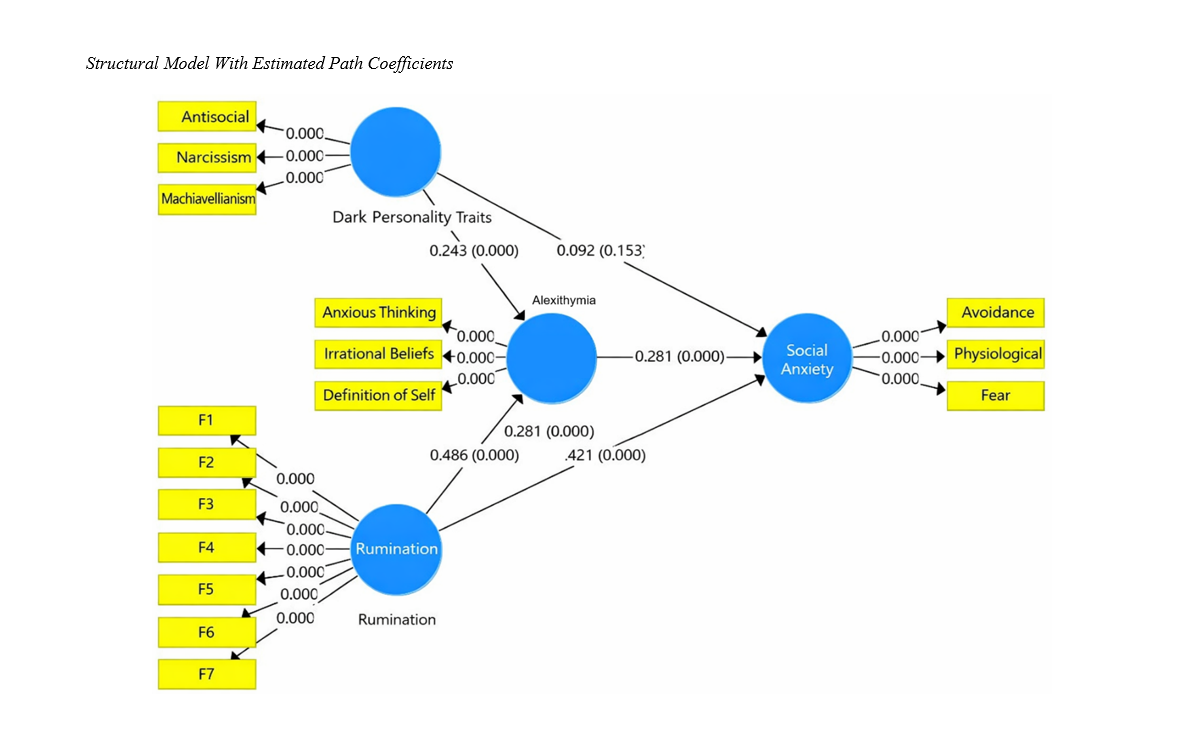
Findings: Structural equation modeling results indicated that dark personality traits did not have a significant direct effect on social anxiety (p > .05). In contrast, meta-worry showed a positive and significant direct effect on social anxiety (β = 0.42, p < .01). Dark personality traits had a significant positive effect on alexithymia (β = 0.24, p < .01), and meta-worry also had a significant positive effect on alexithymia (β = 0.49, p < .01). Indirect path analyses revealed that dark personality traits were significantly related to social anxiety through alexithymia (β = 0.07, p < .01). Similarly, meta-worry was significantly related to social anxiety through alexithymia (β = 0.14, p < .01). Overall model fit indices indicated a strong and acceptable fit for both the measurement and structural models.
Conclusion: The findings suggest that social anxiety in university students is primarily influenced by meta-worry directly and by dark personality traits indirectly through deficits in emotional awareness, highlighting the central mediating role of alexithymia in translating dispositional and metacognitive vulnerabilities into social anxiety symptoms.
Downloads
References
Akan, Ş., & Birtek, D. (2024). The role of basic personality traits, cognitive coping strategies in social anxiety symptoms. Acıbadem Üniversitesi Sağlık Bilimleri Dergisi, 15(1), 31-38. https://doi.org/10.31067/acusaglik.1319964
Asadi, A., & Naseri, A. (2024). The effectiveness of cognitive-behavioral training on meta-worry and social adjustment of students. Sadra Medical Sciences Journal, 13(1), 114-124.
Babaei Quzullu, R., Qoreishi Rad, F., & Vaqef, L. (2018). Structural relationship of the dark dimensions of personality with four-system anxiety Azerbaijan Shahid Madani University].
Bagby, R. M., Taylor, G. J., & Parker, J. D. A. (1994). The twenty-item Toronto Alexithymia Scale: II. Convergent, discriminant, and concurrent validity. Journal of psychosomatic research, 38, 33-40. https://doi.org/10.1016/0022-3999(94)90006-X
Baldaçara, L., Marcon Almeida, T., dos Santos, D. C., Paschoal, A. B., Pinto, A. F., Vesco Gaiotto, L. A., de Lacerda Veiga, A., Loureiro, F. F., Malloy-Diniz, L., Cordeiro, Q., Nardi, A. E., Sanches, M., da Silva, A. G., & Uchida, R. R. (2024). Brazilian Psychiatric Association guidelines for the treatment of Social Anxiety Disorder. Revista Brasileira de Psiquiatria, 1-48. https://doi.org/10.47626/1516-4446-2024-3878
Benson, B., & Kemjika, O. G. (2024). Correlates of social phobia among undergraduate students in universities in Rivers State. British Journal of Education, 12(8), 38-52. https://doi.org/10.37745/bje.2013/vol12n83852
Besharat, M. (2013). Toronto Alexithymia Scale: Questionnaire, method, and scoring (Persian version). Developmental Psychology: Iranian Psychologists, 10(73), 90-92.
Connor, K. M., Davidson, J. R. T., & Churchill, L. E. (2000). Psychometric properties of the Social Phobia Inventory (SPIN): new self-rating scale. Br J Psychiatry, 176, 379-386. https://doi.org/10.1192/bjp.176.4.379
Craib, K., Patterson, S., Laborde, S., & Allen, M. S. (2024). The dark core of personality predicts mate poaching, jealousy, sociosexual orientation, ambivalent sexism, and attitudes toward sexual harassment. Personality and individual differences, 225, 112667. https://doi.org/10.1016/j.paid.2024.112667
Ferber, K. A., Chen, J., Tan, N., Sahib, A., Hannaford, T., & Zhang, B. (2024). Perfectionism and social anxiety: A systematic review and meta-analysis. Clinical Psychology: Science and Practice. https://doi.org/10.1037/cps0000201
Gündüz, A., Gündoğmuş, İ., Engin, B. H., Bağlar, G., & Usta Gündüz, E. B. (2022). The validity and reliability of the Turkish version of the Meta-Worry Questionnaire. Nöropsikiyatri Arşivi, 59(3), 218-225. https://doi.org/10.29399/npa.27926
Harms, P. D., Landay, K., & Fezzey, T. (2024). Examining the Role of Dark Personality in the Workplace. In The Oxford Handbook of Individual Differences in Organizational Contexts.
Hassanvand Amouzadeh, M. (2024). Designing and testing a model of some antecedents of students' social anxiety. Psychological studies, 20(1), 119-134.
Jafari Bazvand, F., & Taherzadeh, S. (2024). Providing a structural model of social anxiety based on dysfunctional attitudes and anxiety sensitivity with the mediating role of difficulty in emotion regulation in adolescents of Romeshkan Bakhtar Institute of Higher Education].
Jahangiri, S. (2024). Structural equation modeling of dark personality traits, identity distress, bullying, and school violence in adolescents Ardakan University].
Jin, W., Zhan, T., Geng, Y., Shi, Y., Hu, W., & Ye, B. (2024). Social appearance anxiety among the dark tetrad and self-concealment. Scientific reports, 14, 4667. https://doi.org/10.1038/s41598-024-55422-w
Jonason, P. K., & Webster, G. D. (2010). The Dirty Dozen: A concise measure of the Dark Triad. Psychol Assess, 22, 420-432. https://doi.org/10.1037/a0019265
Khawaja, N. G., & McMahon, J. (2011). The relationship of meta-worry and intolerance of uncertainty with pathological worry, anxiety, and depression. Behaviour Change, 28(4), 165-180. https://doi.org/10.1375/bech.28.4.165
Kick, L., Schleicher, D., Ecker, A., Kandsperger, S., Brunner, R., & Jarvers, I. (2024). Alexithymia as a mediator between adverse childhood events and the development of psychopathology: a meta-analysis. Frontiers in Psychiatry, 15, 1412229. https://doi.org/10.3389/fpsyt.2024.1412229
Li, J., Liu, C., Albertella, L., Rotaru, K., Li, K., Zhou, Y., Wei, X., Yuan, S., Liu, X., & Ren, L. (2024). Network analysis of the association between Dark Triad traits and depression symptoms in university students. Personality and individual differences, 218, 112495. https://doi.org/10.1016/j.paid.2023.112495
Marhamati, F., Mikaeili, N., & Narimani, M. (2023). The relationship of experiential avoidance and meta-worry with social anxiety symptoms mediated by cognitive emotion regulation University of Mohaghegh Ardabili].
Minaei Namin, M., & Ghaffari, A. (2024). The role of dark and light personality traits in predicting the tendency towards risky sexual behaviors and extramarital relationships in married individuals Islamic Azad University, Ardabil Branch].
Mirkhan, A. (2024). Predicting suicidal ideation based on dark personality traits and affective empathy in students with depressive symptoms. Academic Motivation in Educational Systems, 1(1), 1-10.
Mohammadi, M., & Jafari, R. (2020). The mediating role of alexithymia in the relationship between perceived social support and somatic complaints in depressed women. Woman and Society, 11(44), 199-216.
Montisci, R., Sancassiani, F., Marchetti, M. F., Biddau, M., Carta, M. G., & Meloni, L. (2023). Alexithymia for cardiologists: a clinical approach to the patient. Journal of Cardiovascular Medicine, 24, 392-395. https://doi.org/10.2459/JCM.0000000000001487
Nikpour, M., & Moslehi Jouybari, M. (2023). Investigating the relationship of anxiety sensitivity, intolerance of uncertainty, and mindfulness with social anxiety in male students of Kerman city Farvardin Institute of Higher Education].
Nordahl, H., Strand, E. R., Hjemdal, O., & Nordahl, H. M. (2024). Is meta-worry relevant to interpersonal problems? Testing the metacognitive model of generalized anxiety disorder in an analogue- and a clinical sample of GAD. Cognitive behaviour therapy, 53(5), 455-466. https://doi.org/10.1080/16506073.2024.2331191
Pahlavan, M., Besharat, M. A., Borjali, A., & Farahani, H. (2019). The mediating role of alexithymia between ego defense styles and pain intensity in patients with chronic pain. Anesthesiology and Pain, 10(3), 1-12.
Panayiotou, G., Leonidou, C., Constantinou, E., & Michaelides, M. P. (2020). Self-awareness in alexithymia and associations with social anxiety. Current Psychology, 39, 1600-1609. https://doi.org/10.1007/s12144-018-9850-3
Parker, J. D. A., Taylor, G. J., & Bagby, R. M. (2001). The relationship between emotional intelligence and alexithymia. Personality and individual differences, 30, 107-115. https://doi.org/10.1016/S0191-8869(00)00014-3
Qaderi, B., Mohammadhani, S., & Hasanabadi, H. (2015). Cognitive and metacognitive predictors of anxiety in adolescents. Clinical Psychology, 7(4), 13-26.
Rashidi, S., & Sheibani, H. (2024). The relationship of dark personality traits with aggression and anxiety in single-parent students with the mediating role of irritability in Abhar Payame Noor University].
Ren, L., Yang, Z., Wang, Y., Cui, L. B., Jin, Y., Ma, Z., Zhang, Q., Wu, Z., Wang, H. N., & Yang, Q. (2020). The relations among worry, meta-worry, intolerance of uncertainty and attentional bias for threat in men at high risk for generalized anxiety disorder: a network analysis. BMC psychiatry, 20(1), 452. https://doi.org/10.1186/s12888-020-02849-w
Rieffe, C., & De Rooij, M. (2012). The longitudinal relationship between emotion awareness and internalising symptoms during late childhood. European Child & Adolescent Psychiatry, 21(6), 349-356. https://doi.org/10.1007/s00787-012-0267-8
Sahu, N. K., Gupta, S., & Lone, H. R. (2025). Exploring heart rate variability and heart rate dynamics using wearable before, during and after speech activity: Insights from a controlled study in a low-middle-income country. JMIR Preprints. https://doi.org/10.2196/preprints.71087
Scholz, D. D. (2024). Bridging the gap between clinical and subclinical aversive personality research: The Dark Factor of Personality as a common core for all socially and/or ethically aversive traits Rheinland-Pfälzische Technische Universität Kaiserslautern-Landau].
Shirani, M., Qamrani, A., Arab Bafrani, H., & Fatemi, A. S. (2016). Investigating the relationship between meta-worry and religious doubt in students. Studies in Islam and Psychology, 10(18), 87-104.
Soleimani, M., Yaghobi, H., & Qoreishi Rad, F. (2020). The role of brain-behavioral systems and anxiety sensitivity in predicting social anxiety Azerbaijan Shahid Madani University].
Sun, M., Piao, M., & Jia, Z. (2024). The impact of alexithymia, anxiety, social pressure, and academic burnout on depression in Chinese university students: An analysis based on SEM. BMC psychology, 12, 757. https://doi.org/10.1186/s40359-024-02262-y
Wells, A. (2005). The metacognitive model of GAD: Assessment of meta-worry and relationship with DSM-IV generalized anxiety disorder. Cognitive therapy and research, 29, 107-121. https://doi.org/10.1007/s10608-005-1652-0
Yamen, A. E. (2024). Dark Triad of Personality Traits. In Eurasian Business and Economics Perspectives: Proceedings of the 43rd Eurasia Business and Economics Society Conference (Vol. 30, pp. 289). https://doi.org/10.1007/978-3-031-64140-4_16
Yousefi, R., & Piri, F. (2016). Psychometric properties of the Persian version of the Dirty Dozen Questionnaire. Iranian Journal of Psychiatry and Clinical Psychology, 22(1), 67-76.
Yu, M., Lv, F., Liu, Z., & et al. (2023). How negative automatic thoughts trigger Chinese adolescents' social anxiety: The mediation effect of meta-worry. Current Psychology, 42, 21489-21498. https://doi.org/10.1007/s12144-022-03229-1
Zhang, Z., Xu, D., Li, Z., Liu, J., & Yang, Z. (2021). Neuroticism and test anxiety among Chinese students: The mediating role of intolerance of uncertainty and Meta-worry. Journal of Social Sciences and Humanities, 1(1), 1-9.
Zhao, S., Jia, Y., & Wen, S. (2024). The influence of alexithymia on social anxiety of senior high school students. Applied & Educational Psychology, 5, 104-112. https://doi.org/10.23977/appep.2024.050514
Downloads
Additional Files
Publication Timeline
- Submitted
- Revised
- Accepted