Psychometric Network Analysis of Anhedonia and Reward Responsivity in Adolescents with Subclinical Depression
DOI:
https://doi.org/10.61838/kman.jayps.5085Keywords:
Anhedonia, Reward Responsivity, Adolescents, Subclinical Depression, Anticipatory Pleasure, Behavioral Activation SystemAbstract
Objective: The present study aimed to model the symptom-level network structure of anhedonia and reward responsivity in Moroccan adolescents with subclinical depression.
Methods and Materials: A cross-sectional quantitative design was employed with a community sample of 468 adolescents aged 14–18 years recruited from public high schools in Rabat, Casablanca, and Fez, Morocco. Participants met criteria for subclinical depressive symptoms based on standardized screening thresholds while not fulfilling diagnostic criteria for major depressive disorder. Measures included the Snaith–Hamilton Pleasure Scale (SHAPS) to assess anhedonia, the Temporal Experience of Pleasure Scale (TEPS) to capture anticipatory and consummatory pleasure, and the Behavioral Activation System (BAS) Reward Responsiveness subscale. Data were analyzed using Gaussian Graphical Modeling with graphical LASSO regularization and EBIC model selection. Centrality indices (strength, closeness, betweenness) and bridge centrality metrics were computed. Network accuracy and stability were evaluated using nonparametric bootstrapping procedures and correlation stability coefficients.
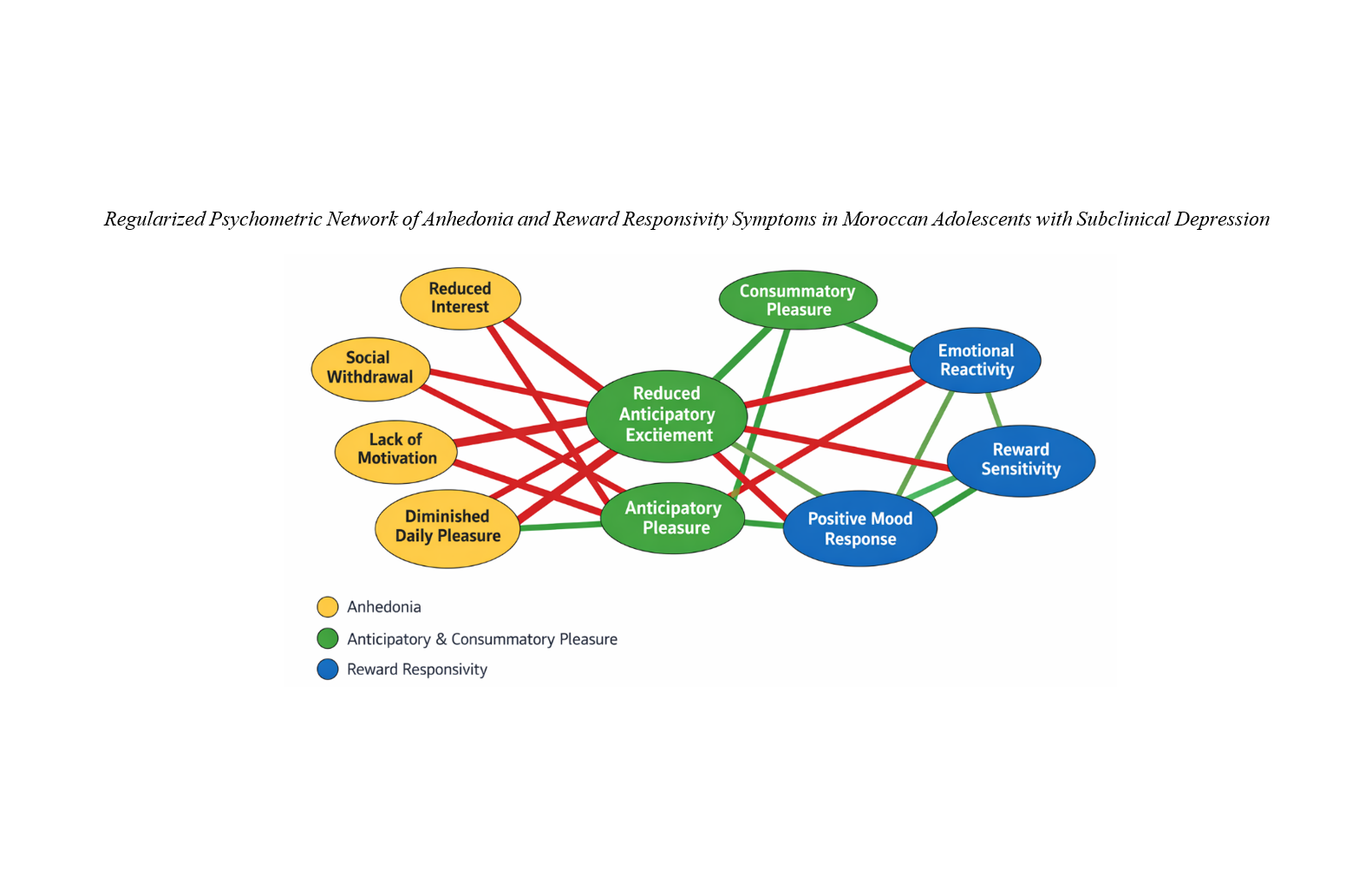
Findings: Network estimation revealed a stable and densely interconnected structure among reward-related symptoms. Anticipatory pleasure deficits demonstrated the highest strength centrality, indicating their structural prominence within the network. Significant negative partial correlations were observed between anhedonia and both anticipatory and consummatory pleasure, as well as reward responsiveness. Bridge centrality analyses identified reduced anticipatory excitement and diminished emotional reactivity to positive stimuli as key connectors linking anhedonia and reward responsivity clusters. Bootstrapped confidence intervals supported the robustness of edge weights, and the correlation stability coefficient for strength centrality exceeded recommended thresholds, confirming network reliability.
Conclusion: The findings suggest that anticipatory motivational deficits occupy a central and bridging position within the symptom architecture of subclinical adolescent depression.
Downloads
References
Baranger, D. A. A., Lindenmuth, M., Yoon, L., Guyer, A. E., Keenan, K., Hipwell, A. E., & Forbes, E. E. (2023). Accelerated Neurodevelopment of Reward Anticipation Processing in Adolescent Girls With Depression. https://doi.org/10.1101/2023.09.15.23295631
Battel, L., Swartz, J. R., Anés, M., Manfro, P. H., Rohde, L. A., Viduani, A., Mondelli, V., & Kieling, C. (2020). Neuroimaging Adolescents With Depression in a Middle-Income Country: Feasibility of an fMRI Protocol and Preliminary Results. Brazilian Journal of Psychiatry, 42(1), 6-13. https://doi.org/10.1590/1516-4446-2019-0508
Cano, M., Lee, E., Worthley, A., Ellard, K. K., Barbour, T., Soriano‐Mas, C., & Camprodon, J. A. (2021). Electroconvulsive Therapy Effects on Anhedonia and Reward Circuitry Anatomy: A Dimensional Structural Neuroimaging Approach. https://doi.org/10.1101/2021.11.16.21266190
Ekhtiari, H., Sangchooli, A., Carmichael, O., Moeller, G., O′Donnell, P., Oquendo, M. A., Paulus, M. P., Pizzagalli, D. A., Ramey, T., Schacht, J. P., Zare-Bidoky, M., Childress, A. R., & Brady, K. T. (2024). Neuroimaging Biomarkers in Addiction. https://doi.org/10.1101/2024.09.02.24312084
Ely, B. A., Liu, Q., DeWitt, S. J., Mehra, L. M., Alonso, C., & Gabbay, V. (2021). Data-Driven Parcellation and Graph Theory Analyses to Study Adolescent Mood and Anxiety Symptoms. Translational psychiatry, 11(1). https://doi.org/10.1038/s41398-021-01321-x
Frank, L. R., Galinsky, V. L., Krigolson, O. E., Tapert, S. F., Bickel, S., & Martı́nez, A. g. (2024). Imaging of Brain Electric Field Networks. https://doi.org/10.21203/rs.3.rs-2432269/v2
Frank, L. R., Galinsky, V. L., Krigolson, O. E., Tapert, S. F., Bickel, S., & Martı́nez, A. g. (2025). Imaging of Brain Electric Field Networks With Spatially Resolved EEG. Elife, 13. https://doi.org/10.7554/elife.100123
Gracia-Tabuenca, Z., Barbeau, É. B., Xia, Y., & Chai, X. J. (2023). Predicting Depression Risk in Early Adolescence via Multimodal Brain Imaging. https://doi.org/10.1101/2023.04.10.536286
Han, K. M., & Ham, B. J. (2021). How Inflammation Affects the Brain in Depression: A Review of Functional and Structural MRI Studies. Journal of Clinical Neurology, 17(4), 503. https://doi.org/10.3988/jcn.2021.17.4.503
Hanuka, S., Olson, E. A., Admon, R., Webb, C. A., Killgore, W. D. S., Rauch, S. L., Rosso, I. M., & Pizzagalli, D. A. (2022). Reduced Anhedonia Following Internet-Based Cognitive-Behavioral Therapy for Depression Is Mediated by Enhanced Reward Circuit Activation. Psychological medicine, 53(10), 4345-4354. https://doi.org/10.1017/s0033291722001106
Hu, Y., Zhao, C., Zhao, H., & Qiao, J. (2022). Abnormal Functional Connectivity of the Nucleus accumbens Subregions Mediates the Association Between Anhedonia and Major Depressive Disorder. https://doi.org/10.21203/rs.3.rs-2259773/v1
Hu, Y., Zhao, C., Zhao, H., & Qiao, J. (2023). Abnormal Functional Connectivity of the Nucleus Accumbens Subregions Mediates the Association Between Anhedonia and Major Depressive Disorder. BMC psychiatry, 23(1). https://doi.org/10.1186/s12888-023-04693-0
Khor, E. Y., McNamara, N., Columb, D., & McNicholas, F. (2023). Neuroimaging Findings in Adolescent Gaming Disorder: A Systematic Review. Irish Journal of Psychological Medicine, 41(3), 375-387. https://doi.org/10.1017/ipm.2023.36
Lin, I. M., Yu, H. E., Yeh, Y. C., Huang, M. F., Wu, K. T., Ke, C. L. K., Lin, P. Y., & Yen, C. F. (2021). Prefrontal Lobe and Posterior Cingulate Cortex Activations in Patients With Major Depressive Disorder by Using Standardized Weighted Low-Resolution Electromagnetic Tomography. Journal of Personalized Medicine, 11(11), 1054. https://doi.org/10.3390/jpm11111054
Mao, J., & Yuan, J. (2021). Anhedonia and Its Intervention in Depressive Adults: New Developments Based on Research Domain Criteria (RDoC) in Mental Illnesses. Stress and Brain, 1(1), 11-32. https://doi.org/10.26599/sab.2020.9060002
Mohammadi, H., & Karwowski, W. (2024). Graph Neural Networks in Brain Connectivity Studies: Methods, Challenges, and Future Directions. Brain Sciences, 15(1), 17. https://doi.org/10.3390/brainsci15010017
Mohammadi, S., Seyedmirzaei, H., Salehi, M. A., Jahanshahi, A., Zakavi, S. S., Firouzabadi, F. D., & Yousem, D. M. (2023). Brain-Based Sex Differences in Depression: A Systematic Review of Neuroimaging Studies. Brain Imaging and Behavior, 17(5), 541-569. https://doi.org/10.1007/s11682-023-00772-8
Murrough, J. W., Fremont, R., Neukam, P. T., Govindarajulu, U., Ables, J. L., Hameed, S., Corwin, M. J., Hargrove, M. S., Chang, H., Boukezzi, S., Kelly, C., Swann, A. C., Salas, R., Amarneh, D., Engelhardt, J., Weyland, A., Bagiella, E., Morris, L., & Mathew, S. J. (2025). A Randomized, Controlled Trial of the Novel, Potent Kv7 Channel Opener Azetukalner in Individuals With Major Depressive Disorder and Anhedonia: Neural Response to Reward, Clinical Outcomes, and Safety. https://doi.org/10.21203/rs.3.rs-7448148/v1
Nilawati, S., Amri, S., Hasanah, N., Saodah, S., Juliati, J., & Sapnita, S. (2024). Unraveling Emotional Regulation Through Multimodal Neuroimaging Techniques. BrainBridge, 1(1), 1-26. https://doi.org/10.35335/a0cfda08
Phillips, R., Walsh, E. C., Zürcher, N. R., Lalush, D. S., Kinard, J. L., Tseng, C.-E. J., Cernasov, P., Kan, D., Cummings, K. K., Kelley, L., Campbell, D. B., Dillon, D. G., Pizzagalli, D. A., Izquierdo‐Garcia, D., Hooker, J. M., Smoski, M. J., & Dichter, G. S. (2022). Striatal Dopamine Binding in Anhedonia: A Simultaneous [11C]Raclopride Positron Emission Tomography and Functional Magnetic Resonance Imaging Investigation. https://doi.org/10.1101/2022.07.21.22277878
Pines, J. R., Hagan, K. E., Lloyd, C., Raffanello, E., Hong, S. N., Posner, J., Walsh, B. T., & Steinglass, J. (2024). Anticipatory and Consummatory Responses Across Reward Domains in Adolescents With Anorexia Nervosa. International Journal of Eating Disorders, 57(11), 2269-2277. https://doi.org/10.1002/eat.24287
Putkinen, V., Hahn, A., Tuisku, J., Harju, H., Seppälä, K., Kirjavainen, A. K., Rajander, J., Hirvonen, J., & Nummenmaa, L. (2025). Cerebral Glucose Utilisation During Musical Emotions: A Multimodal Functional Pet/Mri Study. https://doi.org/10.1101/2025.08.28.672829
Ściślewska, P., Zareba, M. R., Lengier, J., Schirmer, A. E., Bębas, P., & Szatkowska, I. (2025). Circadian Rhythmicity and Reinforcement Processing: A Dataset of MRI, fMRI, and Behavioral Measurements. https://doi.org/10.1101/2025.01.27.635143
Senthilkumar, N., & Thangarajan, R. (2020). Functional Brain Correlates of Risk for Major Depression in Children and Young Adults. International Journal of Engineering Technologies and Management Research, 4(11), 25-35. https://doi.org/10.29121/ijetmr.v4.i11.2017.120
Shamabadi, A., Karimi, H., Cattarinussi, G., Moghaddam, H. S., Akhondzadeh, S., Sambataro, F., Schiena, G., & Delvecchio, G. (2023). Neuroimaging Correlates of Treatment Response to Transcranial Magnetic Stimulation in Bipolar Depression: A Systematic Review. Brain Sciences, 13(5), 801. https://doi.org/10.3390/brainsci13050801
Singh, P., Singh, J., Peer, S., Jindal, M., Khokhar, S. K., Ludhiadch, A., & Munshi, A. (2023). Assessment of Resting-State Functional Magnetic Resonance Imaging Connectivity Among Patients With Major Depressive Disorder: A Comparative Study. Annals of Neurosciences, 32(1), 13-20. https://doi.org/10.1177/09727531231191889
Sun, L., Laurila, S., Lahesmaa, M., Rebelos, E., Virtanen, K. A., Schnabl, K., Klingenspor, M., Nummenmaa, L., & Nuutila, P. (2022). Secretin Modulates Appetite via Brown Adipose Tissue - Brain Axis. https://doi.org/10.1101/2022.05.26.493657
Sun, Y., Zhang, Q., Wang, J., & Zhou, Z. (2025). Neuroimaging and Neuroelectrophysiological Features of Music's Effects on Anhedonia in Major Depressive Disorder: A Minireview. World journal of psychiatry, 15(7). https://doi.org/10.5498/wjp.v15.i7.107721
Vaccarino, S. R., Wang, S., Rizvi, S. J., Lou, W., Hassel, S., MacQueen, G., Ho, K., Frey, B. N., Lam, R. W., Milev, R., Rotzinger, S., Ravindran, A., Strother, S. C., & Kennedy, S. H. (2024). Functional Neuroimaging Biomarkers of Anhedonia Response to Escitalopram Plus Adjunct Aripiprazole Treatment for Major Depressive Disorder. BJPsych Open, 10(1). https://doi.org/10.1192/bjo.2023.588
Valadez, E. A. (2025). Integrating Multimodal Neuroimaging of Error Monitoring to Estimate Future Anxiety in Adolescents. JAMA Network Open, 8(10), e2539133. https://doi.org/10.1001/jamanetworkopen.2025.39133
Wang, X., Zhou, X., Li, J., Gong, Y., & Feng, Z. (2023). A Feasibility Study of Goal-Directed Network-Based Real-Time fMRI Neurofeedback for Anhedonic Depression. Frontiers in Psychiatry, 14. https://doi.org/10.3389/fpsyt.2023.1253727
Wen, Y., Li, H., Huang, Y., Qiao, D., Ren, T., Lei, L., Li, G., Yang, C., Xu, Y., Han, M., & Liu, Z. (2023). Dynamic Network Characteristics of Adolescents With Major Depressive Disorder: Attention Network Mediates the Association Between Anhedonia and Attentional Deficit. Human Brain Mapping, 44(17), 5749-5769. https://doi.org/10.1002/hbm.26474
Willinger, D., Karipidis, I. I., Neuer, S., Emery, S., Rauch, C., Häberling, I., Berger, G., Walitza, S., & Brem, S. (2021). Maladaptive Avoidance Learning in the Orbitofrontal Cortex in Adolescents With Major Depression. https://doi.org/10.1101/2021.05.21.21257570
Wu, Z., Gu, Y., Cao, J., Liu, S., Hu, L., Li, Z., Liang, M., Song, H., Yang, S., Yuan, J. M., Xie, J., Xu, J., Li, X., Zheng, R., Hua, W., Liu, H., Wang, H., Hao, X., Hu, Y., . . . Li, S. (2024). Concurrent Mapping of Electrical, Chemical, and Functional Neuroactivity. https://doi.org/10.1101/2024.12.06.24317948
Yen, C., Lin, C.-L., & Chiang, M. C. (2023). Exploring the Frontiers of Neuroimaging: A Review of Recent Advances in Understanding Brain Functioning and Disorders. Life, 13(7), 1472. https://doi.org/10.3390/life13071472
Yoon, L., Rohrsetzer, F., Battel, L., Anés, M., Manfro, P. H., Rohde, L. A., Viduani, A., Zajkowska, Z., Mondelli, V., Kieling, C., & Swartz, J. R. (2021). Reward‐ and Threat‐related Neural Function Associated With Risk and Presence of Depression in Adolescents: A Study Using a Composite Risk Score in Brazil. Journal of Child Psychology and Psychiatry, 63(5), 579-590. https://doi.org/10.1111/jcpp.13496
Zaboski, B. A., Stern, E., Skosnik, P. D., & Pittenger, C. (2021). Electroencephalographic Correlates and Predictors of Treatment Outcome in OCD: A Brief Narrative Review. Frontiers in Psychiatry, 12. https://doi.org/10.3389/fpsyt.2021.703398
Downloads
Additional Files
Publication Timeline
- Submitted
- Revised
- Accepted