A Gradient‑Boosting Model of Adolescent Social Anxiety Incorporating Rejection Sensitivity, Intolerance of Uncertainty, Emotional Reactivity, and Peer Network Centrality
DOI:
https://doi.org/10.61838/kman.jayps.5216Keywords:
Adolescent Social Anxiety, Emotional Reactivity, Rejection Sensitivity, Peer Network Centrality, Intolerance of UncertaintyAbstract
Objective: This study aimed to develop a highly predictive machine learning model to delineate the complex, non-linear, and synergistic contributions of rejection sensitivity, intolerance of uncertainty, emotional reactivity, and peer network centrality to adolescent social anxiety.
Methods and Materials: A cross-sectional design was employed with a sample of adolescents (ages ) recruited from schools in Armenia via multistage cluster sampling. Participants completed validated Armenian translations of the Social Anxiety Scale for Adolescents (SASA), Rejection Sensitivity Questionnaire (RSQ), Intolerance of Uncertainty Scale (IUS-12), and the Emotion Reactivity Scale (ERS). Peer network centrality was quantified using eigenvector centrality scores derived from a sociometric nomination procedure. An Extreme Gradient Boosting (XGBoost) algorithm was trained and optimized using randomized search cross-validation, with model interpretability established through SHapley Additive exPlanations (SHAP).
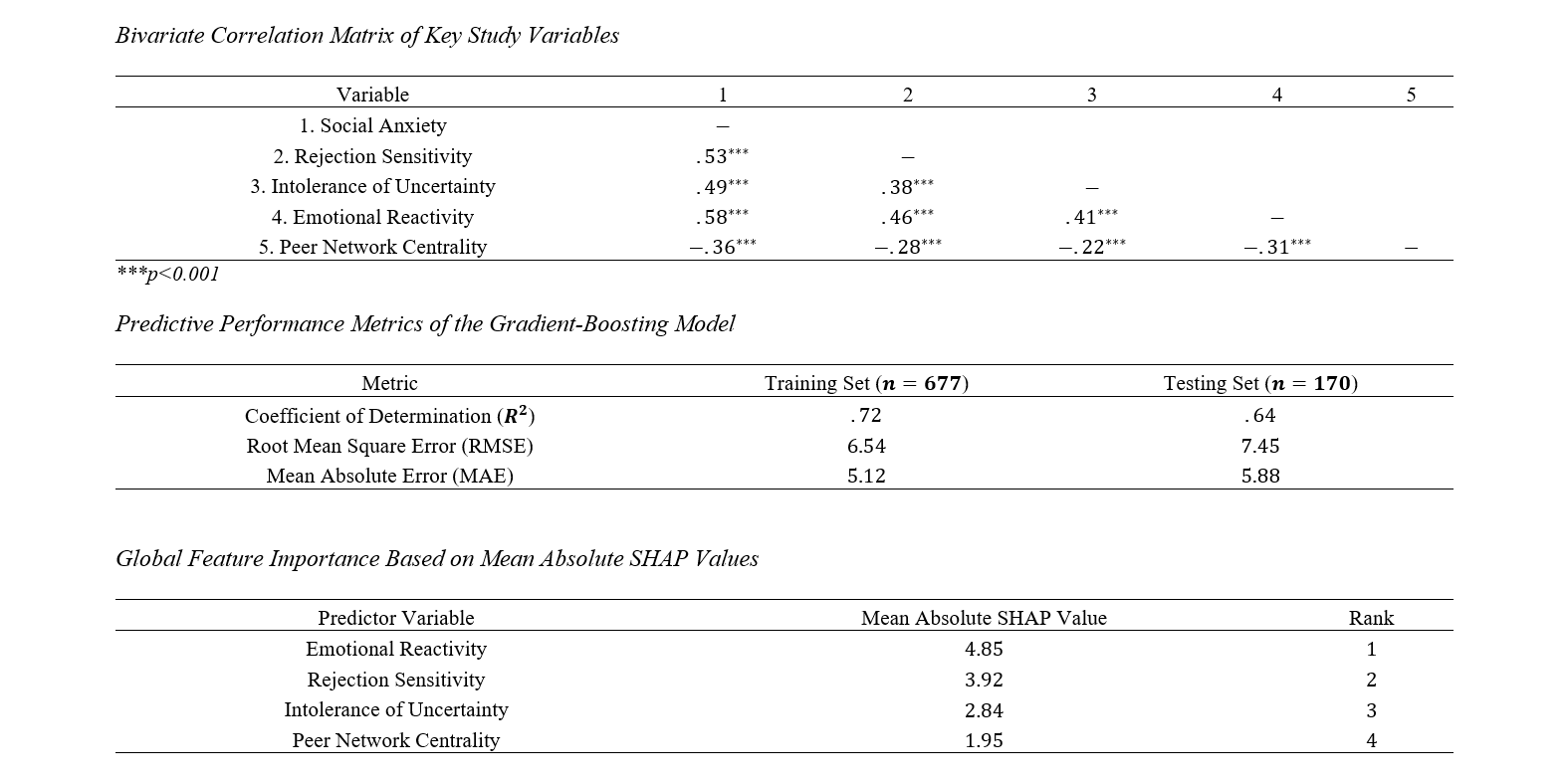
Findings: The final XGBoost model demonstrated robust predictive power on the unseen test set, explaining of the variance in social anxiety scores ( , RMSE , MAE ). Global feature importance analysis, based on mean absolute SHAP values, identified emotional reactivity as the most dominant predictor (Mean SHAP value ), followed by rejection sensitivity (Mean SHAP value ), intolerance of uncertainty (Mean SHAP value ), and peer network centrality (Mean SHAP value ). SHAP analysis further revealed significant synergistic effects, particularly between high emotional reactivity and high rejection sensitivity, which exponentially increased predicted social anxiety.
Conclusion: Emotional reactivity operates as the primary driver of adolescent social anxiety, with its impact significantly amplified by concurrent cognitive and social vulnerabilities, highlighting the necessity of integrated, skills-based clinical interventions.
Downloads
References
Ayaz-Alkaya, S., & Kulakçı-Altıntaş, H. (2025). Social media addiction, nomophobia, and social anxiety among adolescents: A mediation analysis. Journal of Pediatric Nursing, 85, 16-21. https://doi.org/10.1016/j.pedn.2025.07.008
Bintas-Zorer, P., & Dirik, G. (2023). Social Anxiety From an Attachment Theory Perspective: The Mediating Role of Early Maladaptive Schema Domains and Rejection Sensitivity. Journal of Evidence-Based Psychotherapies, 23(2), 25-47. https://doi.org/10.24193/jebp.2023.2.9
Brekalo, M. (2022). Longitudinal study of social anxiety symptoms and appearance rejection in predicting body dysmorphic symptoms: Appearance-based rejection sensitivity as a mediator. Body Image, 42, 440-446. https://doi.org/10.1016/j.bodyim.2022.07.019
Cao, Y., Wang, J., Huang, Z., Qin, Y., Gao, S., Zhang, H., Yuan, M., & Tang, X. (2025). The Relationship Between Social Anxiety and Depression Among Rural High School Adolescents: The Mediating Role of Social Comparison and Social Support. Healthcare, 13(5), 533. https://doi.org/10.3390/healthcare13050533
Chiu, K., Clark, D. M., & Leigh, E. (2021). Prospective associations between peer functioning and social anxiety in adolescents: A systematic review and meta-analysis. Journal of affective disorders, 279, 650-661. https://doi.org/10.1016/j.jad.2020.10.055
Crişan, L. G., Vulturar, R., Miclea, M., & Miu, A. C. (2016). Reactivity to Social Stress in Subclinical Social Anxiety: Emotional Experience, Cognitive Appraisals, Behavior, and Physiology. Frontiers in Psychiatry, 7. https://doi.org/10.3389/fpsyt.2016.00005
Howard, C. J., Oshri, A., Card, N., Muñoz, M., Thomas, C. R., & Brown, G. L. (2025). Perceived mother and father parenting and adolescent social anxiety symptoms: A Meta-Analysis. Adolescent Research Review, 1-20. https://doi.org/10.1007/s40894-025-00268-0
Hussain, M. A., Rafaqat, S., Imran, H., & Hussain, S. (2023). The Relationship Between Rejection Sensitivity and Social Anxiety Among College Students in Rahim Yar Khan District. Voyage Journal of Educational Studies, 3(2), 208-228. https://doi.org/10.58622/vjes.v3i2.58
Hyun, J.-H., & Lim, J. (2022). The Mediating Effect of Social Anxiety on the Relationship Between Parenting Attitudes Perceived by Pre-Service Early Childhood Teachers and Their Rejection Sensitivity. Korean Academy Welfare Counseling, 11(2), 1-25. https://doi.org/10.20497/jwce.2022.11.2.1
Lee, Y. J. (2023). Analysis of Structural Relationships Among Adult Attachment, Rejection Sensitivity, Ambivalence Over Emotional Expressiveness and Social Anxiety of University Students. Korean Association for Learner-Centered Curriculum and Instruction, 23(15), 931-947. https://doi.org/10.22251/jlcci.2023.23.15.931
Lian, W. (2025). Emotional Granularity and Cognitive Reappraisal Affect Social Anxiety and Interpersonal Relationships in Adolescents: A Bayesian Network Analysis. Depression and Anxiety, 2025(1). https://doi.org/10.1155/da/8658973
Muñoz, N. M., Morales, L., & Karstensen, V. (2024). Predicting Social Anxiety Through Peer Rejection and Fear of Negative Evaluation in Youth. Jayps, 5(8), 148-156. https://doi.org/10.61838/kman.jayps.5.8.18
Shi, C., Sun, P., Shi, J., & Hao-sheng, Y. E. (2024). The Effect of Cyber-Ostracism on Social Anxiety Among Undergraduates: The Mediating Effects of Rejection Sensitivity and Rumination. https://doi.org/10.20944/preprints202410.0803.v1
Sireli, O., Ucuz, I., Uzun Çiçek, A., Abanoz, E., & Cömertoğlu Arslan, S. (2024). Are adolescents with social anxiety disorder in danger of peer bullying? Annals of Medical Research, 31, 386-396. https://doi.org/10.5455/annalsmedres.2024.03.053
Sriwenda, D. (2025). Impact of Parent’s Communication on Adolescent Social Anxiety. Ijorer International Journal of Recent Educational Research, 6(2), 398-409. https://doi.org/10.46245/ijorer.v6i2.788
Talha, A., Chrystyna, K., Junghee, L., Daniel, F., & Benjamin, T. (2020). Social anxiety is negatively associated with theory of mind and empathic accuracy. Journal of abnormal psychology, 129(1), 108-113. https://doi.org/10.1037/abn0000493
Tamang, D., & Bhandari, T. R. (2025). Social Anxiety and Its Associated Factors Among Secondary School Adolescents of Kathmandu Metropolitan, Nepal. Journal of Nepal Health Research Council, 22(04), 678-683. https://doi.org/10.33314/jnhrc.v22i04.4755
Tarlow, N., & Greca, A. M. L. (2020). The Role of Empathy and Social Anxiety in Latinx Adolescents' Indirect Peer Aggression During the Transition to High School. Aggressive Behavior. https://doi.org/10.1002/ab.21926
Tsekova, V. (2023). The Role of Perceived Rejection and Cognitive Reappraisal in the Experience of Anger in Individuals High in Social Anxiety. https://doi.org/10.32920/24194715
Wang, M., Li, M., Wu, X., & Zhou, Z. (2022). Cognitive reactivity and emotional dysregulation mediate the relation of paternal and maternal harsh parenting to adolescent social anxiety. Child abuse & neglect, 129, 105621. https://doi.org/10.1016/j.chiabu.2022.105621
Yilmaz, M., Üner, M., Sel, S., & Koldaş, G. (2025). Investigation of the relationships between internet addiction, social anxiety and happiness in adolescents (Arnavutkoy Case). Iranian Evolutionary Educational Psychology Journal, 7(1), 1-20. http://ieepj.hormozgan.ac.ir/article-1-874-fa.html
Zhang, H., & Zhang, B. (2024). The Relationship Between Adolescent Peer Attachment and Social Anxiety: The Mediating Role of Self-Concept and the Moderating Role of Physical Exercise. https://doi.org/10.21203/rs.3.rs-5435212/v1
Zhou, J., Wang, L. A., Zhu, D., & Gong, X. (2024). Social anxiety and peer victimization and aggression: examining reciprocal trait-state effects among early adolescents. Journal of youth and adolescence, 53(3), 701-717. https://doi.org/10.1007/s10964-023-01920-5
Zimmer‐Gembeck, M. J., Gardner, A. A., Hawes, T., Masters, M. R., Waters, A. M., & Farrell, L. J. (2021). Rejection Sensitivity and the Development of Social Anxiety Symptoms During Adolescence: A Five-Year Longitudinal Study. International Journal of Behavioral Development, 45(3), 204-215. https://doi.org/10.1177/0165025421995921
Zolrahim, R., & Azmoudeh, M. (2020). The Effect of Cognitive-Behavioral Play Therapy on Social Anxiety and Aggressive Behaviors in Primary School Children [Research]. Quarterly Journal of Child Mental Health, 6(4), 231-240. https://doi.org/10.29252/jcmh.6.4.21
Downloads
Additional Files
Publication Timeline
- Submitted
- Revised
- Accepted