Modeling Adolescent Aggressive Behavior Using Trait Anger, Executive Function Inhibition Scores, Family Chaos, and Social Rejection via Gradient Boosted Trees
DOI:
https://doi.org/10.61838/kman.jayps.5244Keywords:
Adolescent Aggression, Trait Anger, Executive Function Inhibition, Family Chaos, Social Rejection, Gradient Boosted Trees, Machine LearningAbstract
Objective: The objective of this study was to rigorously predict and model adolescent aggressive behavior through the complex, non-linear interactions of trait anger, executive function inhibition scores, family chaos, and social rejection via a Gradient Boosted Trees approach.
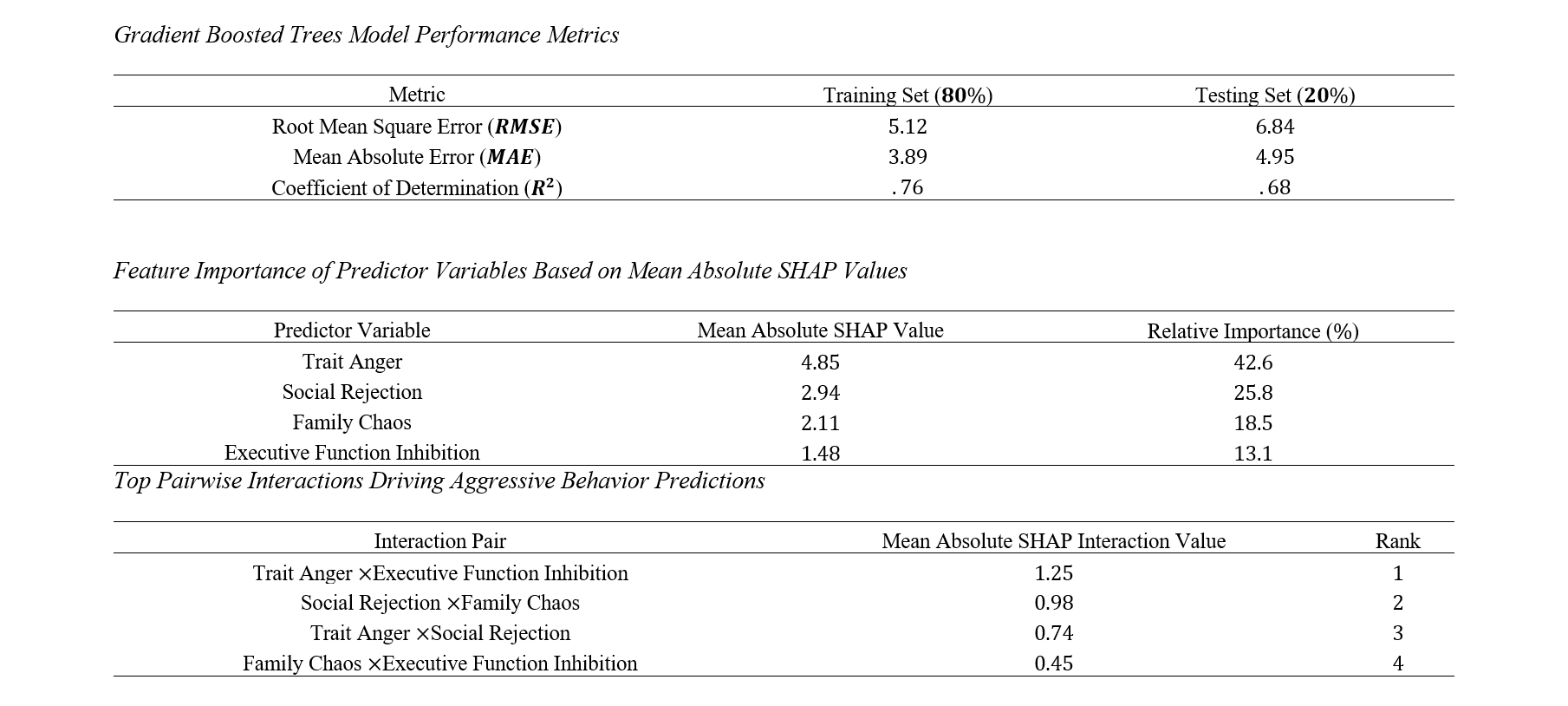
Methods and Materials: A cross-sectional predictive study design was utilized, involving a sample of adolescents (aged – years) recruited from central Mexico. Data were collected using the Buss-Perry Aggression Questionnaire, State-Trait Anger Expression Inventory, a computerized Stroop Color and Word Test, the Confusion, Hubbub, and Order Scale, and the Ostracism Experience Scale. Data analysis was conducted using the XGBoost machine learning algorithm, with the dataset split into an training set ( ) and a testing set ( ). Model evaluation and feature importance were calculated using , , , and SHapley Additive exPlanations (SHAP) values.
Findings: The XGBoost model exhibited robust predictive performance on the unseen testing set ( , , ). Based on Mean Absolute SHAP values, trait anger was identified as the paramount predictor of aggressive behavior ( relative importance), sequentially followed by social rejection ( ), family chaos ( ), and executive function inhibition ( ). Furthermore, interaction analysis revealed profound synergistic effects, with the strongest non-linear interaction occurring between trait anger and executive function inhibition (SHAP Interaction Value ), alongside a highly significant interaction between social rejection and family chaos (SHAP Interaction Value ).
Conclusion: Adolescent aggression is a non-linear, compounded phenomenon that is most accurately predicted by the synergistic interaction of high emotional reactivity, poor cognitive inhibition, and severe environmental stressors.
Downloads
References
Ahemaitijiang, N., Hu, X., Yang, X., & Han, Z. R. (2020). Effects of meditation on the soles of the feet on the aggressive and destructive behaviors of Chinese adolescents with autism spectrum disorders. Mindfulness, 11, 230-240. https://doi.org/10.1007/s12671-019-01246-z
Braithel, D., & Allaouna, R. (2025). Employing Psychodrama as a therapeutic method to reduce aggressive behavior among adolescents (Experimental Study). Lessons in Deviant Psychology, 9(2), 262-2472. https://asjp.cerist.dz/en/article/261252
Cano, M. Á., Schwartz, S. J., Castillo, L. G., Romero, A. J., Huang, S., Lorenzo-Blanco, E. I., Unger, J. B., Zamboanga, B. L., Des Rosiers, S. E., Baezconde-Garbanati, L., Lizzi, K. M., Soto, D. W., Oshri, A., Villamar, J. A., Pattarroyo, M., & Szapocznik, J. (2015). Depressive symptoms and externalizing behaviors among Hispanic immigrant adolescents: Examining longitudinal effects of cultural stress. Journal of adolescence, 42(1), 31-39. https://doi.org/10.1016/j.adolescence.2015.03.017
Chiocchetti, A. G., Yousaf, A., Waltes, R., Bernhard, A., Martinelli, A., Ackermann, K., Haslinger, D., Rotter, B., Krezdorn, N., Konrad, K., Kohls, G., Vetro, A., Hervas, A., Fernández-Rivas, A., & Freitag, C. M. (2022). The methylome in females with adolescent Conduct Disorder: Neural pathomechanisms and environmental risk factors. PLoS One, 17(1), e0261691. https://doi.org/10.1371/journal.pone.0261691
Clifford, M. E., Nguyen, A. J., & Bradshaw, C. P. (2020). Emotion Processing Associated With Aggression in Early Adolescents: A Focus on Affective Theory of Mind. Aggressive Behavior, 47(2), 173-182. https://doi.org/10.1002/ab.21936
Cornejo-Babida, P. L. (2020). Aggressive Behavior and Suicidal Ideation of Adolescents With High and Low Level of Frustration Intolerance. Ajehd, 1(1). https://doi.org/10.69566/ajehd.v1i1.17
Darmadi, I. R., & Badayai, A. R. A. (2021). The Relationship Between Emotional Dysregulation and Aggressive Behavior Among Adolescents. International Journal of Academic Research in Business and Social Sciences, 11(6). https://doi.org/10.6007/ijarbss/v11-i6/10238
Fauziah, F., Netrawati, N., Neviyarni, N., & Nurfarhanah, N. (2023). The Analysis of Passive Aggressive Behavior on Islamic Adolescent From Single Parent Families. Psikis Jurnal Psikologi Islami, 9(2), 285-292. https://doi.org/10.19109/psikis.v9i2.19936
Gong, J., & Popescu, A. C. (2024). Predicting Aggressive Behavior From Exposure to Violence and Emotion Dysregulation in Adolescents. Jayps, 5(7), 163-171. https://doi.org/10.61838/kman.jayps.5.7.18
Hauschild, S., Kasper, L., Volkert, J., Sobanski, E., & Taubner, S. (2023). Mentalization-based treatment for adolescents with conduct disorder (MBT-CD): a feasibility study. European Child & Adolescent Psychiatry, 32(12), 2611-2622. https://doi.org/10.1007/s00787-022-02113-4
Heiman, T., Olenik-Shemesh, D., & Eden, S. (2014). Aggressive behavior and vulnerability on the Internet: Characteristics, patterns, risk and protective factors among children and adolescents. Research Report. http://cms.education.gov.il/NR/rdonlyres/5B2E6358-A9D7-4F8B-83A2-E1F46CB4DF94/185400/Unnamed6.pdf
Kaveh, M. H., Zare, E., Ghahremani, L., Nazari, M., & Karimi, M. (2025). The correlation between resilience, self-control, self-regulation, and decision-making style and aggressive behavior in adolescents: An analysis using structural equation modeling. International Journal of School Health, 12(1), 33-41. https://intjsh.sums.ac.ir/article_50422.html
Laible, D., Murphy, T. P., & Augustine, M. (2014). Adolescents’ Aggressive and Prosocial Behaviors: Links With Social Information Processing, Negative Emotionality, Moral Affect, and Moral Cognition. The Journal of Genetic Psychology, 175(3), 270-286. https://doi.org/10.1080/00221325.2014.885878
Lin, S., Longobardi, C., Gastaldi, F. G. M., & Fabris, M. A. (2023). Social Media Addiction and Aggressive Behaviors in Early Adolescents: The Mediating Role of Nighttime Social Media Use and Sleep Quality. The Journal of Early Adolescence, 44(1), 41-58. https://doi.org/10.1177/02724316231160142
McQuade, J. D., & Breaux, R. P. (2017). Parent emotion socialization and pre-adolescent’s social and emotional adjustment: Moderating effects of autonomic nervous system reactivity. Biological Psychology, 130, 67-76. https://doi.org/10.1016/j.biopsycho.2017.10.007
Mohammed, Q. (2023). Association between Parental Treatment and Aggressive Behaviors among Adolescent Students. Iraqi National Journal of Nursing Specialties, 36(1). https://doi.org/10.58897/injns.v36i1.717
Nugroho, W., & Reza, I. F. (2022). Frustration as a Forming Factor of Aggressive Behavior in Moslem Adolescents in Playing Online Games. Indonesian Journal of Multidisciplinary Sciences (Ijoms), 1(1), 50-66. https://doi.org/10.59066/ijoms.v1i1.50
Radwan, K., & Coccaro, E. F. (2020). Comorbidity of disruptive behavior disorders and intermittent explosive disorder. Child and adolescent psychiatry and mental health, 14(1), 24. https://doi.org/10.1186/s13034-020-00330-w
Sari, F. S., Batubara, I. M. S., Solikhah, M. M., Kusumawati, H. N., Eagle, M., Sulisetyawati, S. D., & Mariyati, M. (2022). Effect of Cognitive Behavior-Anger Management Therapy on Aggressive Behavior in Adolescents. Open Access Macedonian Journal of Medical Sciences, 10(G), 275-278. https://doi.org/10.3889/oamjms.2022.8496
Shalchi, B., Vahidnia, B., Dadkhah, M., Alipouri Niaz, M., & Moghimifam, P. (2017). Comparation of Affective -Behavioral Disorders and Social Skills among Normal Adolescents and institutional children of Social Welfare Bureau. Yektaweb_Journals, 17(67), 173-201. http://refahj.uswr.ac.ir/article-1-3094-en.html
Sousa, M., Cruz, S., Inman, R. A., Marchante, M., & Coelho, V. A. (2024). Bullying Victimization and Bullying Perpetration, Social Anxiety, and Social Withdrawal in Portuguese Adolescents: A Reciprocal Association Model. Aggressive Behavior, 50(4). https://doi.org/10.1002/ab.22170
Sukhodolsky, D. G., Smith, S. D., McCauley, S. A., Ibrahim, K., & Piasecka, J. B. (2016). Behavioral Interventions for Anger, Irritability, and Aggression in Children and Adolescents. Journal of Child and Adolescent Psychopharmacology, 26(1), 58-64. https://doi.org/10.1089/cap.2015.0120
Wachs, S., Bilz, L., Wettstein, A., & Espelage, D. L. (2023). Validation of the Multidimensional Bystander Responses to Racist Hate Speech Scale and Its Association With Empathy and Moral Disengagement Among Adolescents. Aggressive Behavior, 50(1). https://doi.org/10.1002/ab.22105
Yang, P., Schlomer, G. L., Lippold, M. A., & Feinberg, M. E. (2021). Longitudinal Discrepancy in Adolescent Aggressive Behavior Problems: Differences by Reporter and Contextual Factors. Journal of youth and adolescence, 50(8), 1564-1581. https://doi.org/10.1007/s10964-021-01431-1
Zhang, J., Li, Y., Li, J., Lyu, M., Chen, Y., Yang, S., Tan, C., Tao, Y., Ye, B., Zhang, J., Cheng, F., & Mao, T. (2023). The effect of life events, resilience, self-esteem, and coping styles on aggressive behavior among left-behind adolescents: Structural equation modeling [Original Research]. Frontiers in Psychiatry, 14. https://doi.org/10.3389/fpsyt.2023.991608
Zimmermann, P., & Spangler, G. (2016). Effects of Gene × Attachment Interaction on Adolescents’ Emotion Regulation and Aggressive Hostile Behavior Towards Their Mothers During a Computer Game. Frontiers in human neuroscience, 10. https://doi.org/10.3389/fnhum.2016.00254
Downloads
Additional Files
Publication Timeline
- Submitted
- Revised
- Accepted