Machine‑Learning Identification of Subtypes of Adolescent Perfectionism Based on Concern Over Mistakes, Parental Expectations, Cognitive Rigidity, and Negative Affect
DOI:
https://doi.org/10.61838/kman.jayps.5253Keywords:
Adolescent perfectionism, Machine learning, Gaussian Mixture Modeling, Cognitive rigidity, Negative affect, Parental expectationsAbstract
Objective: The objective of this study was to identify distinct latent subtypes of adolescent perfectionism by applying unsupervised machine-learning algorithms to a comprehensive set of variables, specifically concern over mistakes, parental expectations, cognitive rigidity, and negative affect.
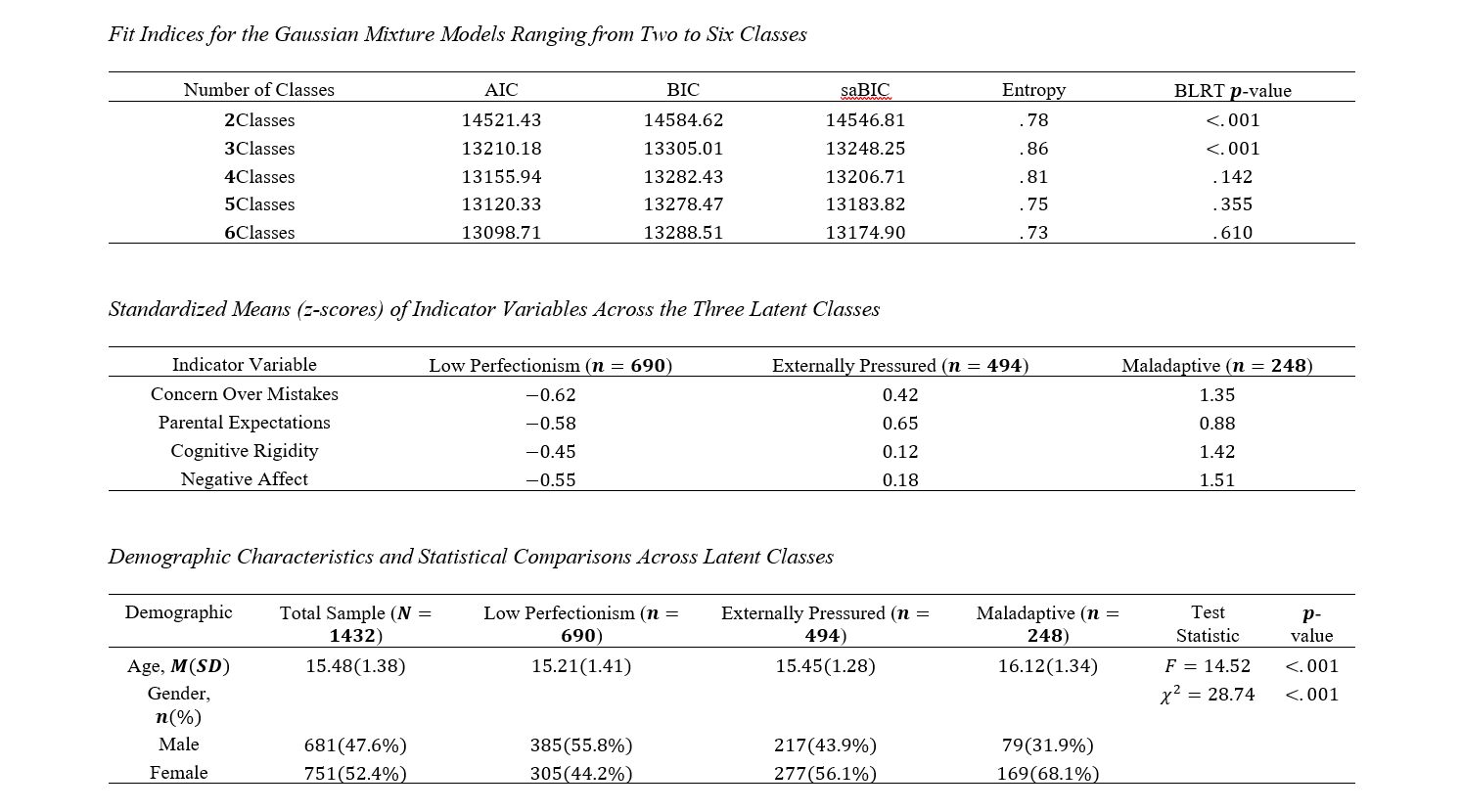
Methods and Materials: The research utilized a cross-sectional, school-based design, sampling adolescents from Germany. Data were gathered using standardized self-report instruments to measure the four target variables, with all raw scores converted to standardized -scores. Following data preprocessing, unsupervised machine learning via Gaussian Mixture Modeling (GMM) was employed to uncover latent subpopulations, evaluating models ranging from two to six classes using fit indices such as the Bayesian Information Criterion and the Bootstrapped Likelihood Ratio Test.
Findings: The GMM algorithm identified an optimal three-class structural model (Entropy = ). The sample was categorized into Class : Low Perfectionism ( , ); Class : Externally Pressured Perfectionism ( , ), defined predominantly by elevated perceived parental expectations ( ); and Class : Maladaptive Perfectionism ( , ), characterized by pervasive elevations across all domains, notably severe negative affect ( ) and extreme cognitive rigidity ( ). Demographic analyses revealed significant differences, indicating that older adolescents ( , ) and females ( , ), who comprised of Class , were significantly overrepresented in the Maladaptive Perfectionism profile.
Conclusion: Adolescent perfectionism manifests in distinct multivariate phenotypes, highlighting the critical necessity of identifying high-risk, maladaptive subtypes to deliver highly targeted clinical interventions focusing on cognitive flexibility and emotion regulation.
Downloads
References
Akbaba, M. F. (2024). Examining School Satisfaction in Adolescents: The Role of Academic Perfectionism and Meaning in Life. The Universal Academic Research Journal, 6(3), 143-150. https://doi.org/10.55236/tuara.1473940
Aygün, M. S., & Akbağ, M. (2025). Perceived Parenting Styles, Perfectionism, and Social Appearance Anxiety Among Emerging Adults: A Mediation Analysis. Opus Toplum Araştırmaları Dergisi, 22(2), 175-194. https://doi.org/10.26466/opusjsr.1639925
Bills, E., Greene, D., Stackpole, R., & Egan, S. J. (2023). Perfectionism and eating disorders in children and adolescents: A systematic review and meta-analysis. Appetite, 187, 106586. https://doi.org/10.1016/j.appet.2023.106586
Chen, C., Brugnera, A., Hewitt, P. L., Caelian, C. F., & Flett, G. L. (2022). Familial Affective Responsiveness Mediates the Relations Between Parental Perfectionistic Self-Presentation and Adolescent Psychological Maladjustment. https://www.researchsquare.com/article/rs-1317918/latest
Ebrahimi, M., Raisi, Z., Taheri, H., & Haqayegh, S. A. (2022). The effectiveness of schema therapy training on perfectionism and fear of intimacy in obese women. Studies and New Psychological Findings in Adolescents and Young Adults, 2(13), 479-491. https://doi.org/10.61838/kman.jayps.3.2.37
Endleman, S., Brittain, H., & Vaillancourt, T. (2022). The longitudinal associations between perfectionism and academic achievement across adolescence. International Journal of Behavioral Development, 46(2), 91-100. https://doi.org/10.1177/01650254211037400
Fatemi, M., Bakhtiarpour, S., Pasha, R., & Hafezi, F. (2022). Model for Predicting Social Anxiety Based on Perfectionism, Social Self-Efficacy, and Cognitive Distortions in Male and Female Adolescents. Journal of Applied Psychological Research, 13(4), 187-202. https://japr.ut.ac.ir/article_91197.html?lang=en
Ford, C. J., Usher, E. L., Scott, V. L., & Chen, X. Y. (2023). The 'perfect'lens: Perfectionism and early adolescents' math self‐efficacy development. British Journal of Educational Psychology, 93(1), 211-228. https://doi.org/10.1111/bjep.12550
Ghorbannezhad, A. (2022). Prediction of perfectionism dimensions based on positive and negative meta-emotions in students. Journal of Psychological Dynamics in Mood Disorders (PDMD), 1(3), 42-49. https://ijpdmd.com/article_180524.html
Haddadi, S., & Temanai Far, M. (2022). Comparison of uncompromising perfectionism, maladaptive strategies of cognitive emotion regulation and rumination in adolescents with high and low social anxiety. Social Psychology Research, 12(45), 1-26. https://ensani.ir/fa/article/511442/
Jannesari, Z. (2025). Predicting Parental Stress in Mothers of Children With Behavioral Problems Based on Perfectionism Mediated by Psychological Flexibility. Ijhespub, 3(1), 11-18. https://doi.org/10.63053/ijhes.108
Lee, Y. A., Park, H. G., Cheon, J. E., Rice, K. G., & Kim, Y. H. (2024). Mediating role of social skills in the longitudinal relationship between intrapersonal perfectionism and psychological well-being of preadolescents. Journal of School Psychology, 102(February), 101257. https://doi.org/10.1016/j.jsp.2023.101257
Liang, Y., Xu, L., Huang, Y., Zhu, W., Yu, J., Ma, L., & Jiang, X. (2025). The relationship between obsessive-compulsive symptoms and parenting styles: The mediating effect of perfectionism. https://doi.org/10.22541/au.173935763.37800795/v1
Livazović, G., & Kuzmanović, K. (2022). Predicting Adolescent Perfectionism: The Role of Socio-Demographic Traits, Personal Relationships, and Media. World Journal of Clinical Cases, 10(1), 189-204. https://doi.org/10.12998/wjcc.v10.i1.189
Livet, A., Navarri, X., Pomerleau, P. P., Champagne, S., Yunus, F. M., Chadi, N. M. G., & Conrod, P. (2023). Perfectionism in children and adolescents with eating-related symptoms: a systematic review and a Meta-analysis of Effect estimates. Adolescents, 3(2), 305-329. https://doi.org/10.3390/adolescents3020022
Mofield, E., Parker Peters, M., & Chakraborti-Ghosh, S. (2016). Perfectionism, Coping, and Underachievement in Gifted Adolescents: Avoidance vs. Approach Orientations. Education Sciences, 6(3).
Mohorić, T., Pokrajac-Bulian, A., Anić, P., Kukić, M., & Mohović, P. (2023). Emotion regulation, perfectionism, and eating disorder symptoms in adolescents: the mediating role of cognitive eating patterns. Current Psychology, 42(32), 28505-28516. https://doi.org/10.1007/s12144-022-03824-2
Nigar, A., & Naqvi, I. (2019). Body Dissatisfaction, Perfectionism, and Media Exposure Among Adolescents. Pakistan Journal of Psychological Research, 34(Spring 2019), 57-77. https://doi.org/10.33824/pjpr.2019.34.1.4
Oh, S. (2024). Unintentional Nonsuicidal Self-Injury in an Adolescent With Perfectionism. Precision and Future Medicine, 8(3), 112-115. https://doi.org/10.23838/pfm.2024.00114
Peleg, O., Boniel-Nissim, M., & Tzischinsky, O. (2023). Adolescents at risk of eating disorders: The mediating role of emotional distress in the relationship between differentiation of self and eating disorders [Original Research]. Frontiers in psychology, 13. https://doi.org/10.3389/fpsyg.2022.1015405
Richardson, C., & Gradisar, M. (2020). Perfectionism and insomnia in adolescents: The role of vulnerability to stress and gender. Journal of adolescence, 85(1), 70-79. https://doi.org/10.1016/j.adolescence.2020.10.003
Seong, H., Lee, S., & Chang, E. (2021). Perfectionism and academic burnout: Longitudinal extension of the bifactor model of perfectionism. Personality and individual differences, 172, 110589. https://doi.org/10.1016/j.paid.2020.110589
Seyidabrahimi, S. A. (2019). Predicting anxiety based on perfectionism and cognitive thinking styles in college entrance exam candidates. Psychological Studies of Adolescents and Young Adults, 1(1), 1-19. https://doi.org/10.61838/kman.jayps.1.1.11
Souri, A., Aghayousefi, A., & Dortaj, F. (2024). Explaining the phenomenon of students' academic burnout based on the role of academic procrastination and parents' perfectionism (case study of high school students of Qom city). Sociology of Education, 10(3), 98-108. https://www.iase-jrn.ir/article_718757.html?lang=en
Ståhlberg, J., Tuominen, H., Pulkka, A.-T., & Niemivirta, M. (2021). Students' perfectionistic profiles: Stability, change, and associations with achievement goal orientations. Psychology in the Schools, 58(1), 162-184. https://doi.org/10.1002/pits.22444
Vois, D., & Damian, L. (2019). Perfectionism and Emotion Regulation in Adolescents: A Two-Wave Longitudinal Study. Personality and individual differences, 156, 6. https://doi.org/10.1016/j.paid.2019.109756
Zhao, M., Li, J., Lin, Y., Zhang, B., & Shi, Y. (2022). The effect of perfectionism on test anxiety and the mediating role of sense of coherence in adolescent students. Journal of affective disorders, 310, 142-149. https://www.sciencedirect.com/science/article/pii/S0165032722005110
Downloads
Additional Files
Publication Timeline
- Submitted
- Revised
- Accepted