Predicting Problematic Internet Use via Impulsivity, Emotion Dysregulation, Reward-System Reactivity, and Loneliness Using SVM Models
DOI:
https://doi.org/10.61838/kman.jayps.5259Keywords:
Problematic Internet Use, Support Vector Machine, Emotion Dysregulation, Impulsivity, Loneliness, Machine LearningAbstract
Objective: The present study aimed to predict the severity of problematic internet use by examining the complex interplay of impulsivity, emotion dysregulation, reward-system reactivity, and loneliness utilizing advanced Support Vector Machine (SVM) models.
Methods and Materials: A cross-sectional predictive design was employed, collecting self-reported data from a sample of Argentine adults using validated psychometric questionnaires to measure problematic internet use, impulsivity, emotion dysregulation, reward-system reactivity, and subjective loneliness. Data analysis involved preliminary bivariate correlations and the application of machine learning classification algorithms, specifically training and evaluating various SVM kernels to distinguish between high and low-to-moderate problematic internet users. Finally, permutation feature importance techniques were utilized to rank the predictive weight of the psychological constructs within the optimal model.
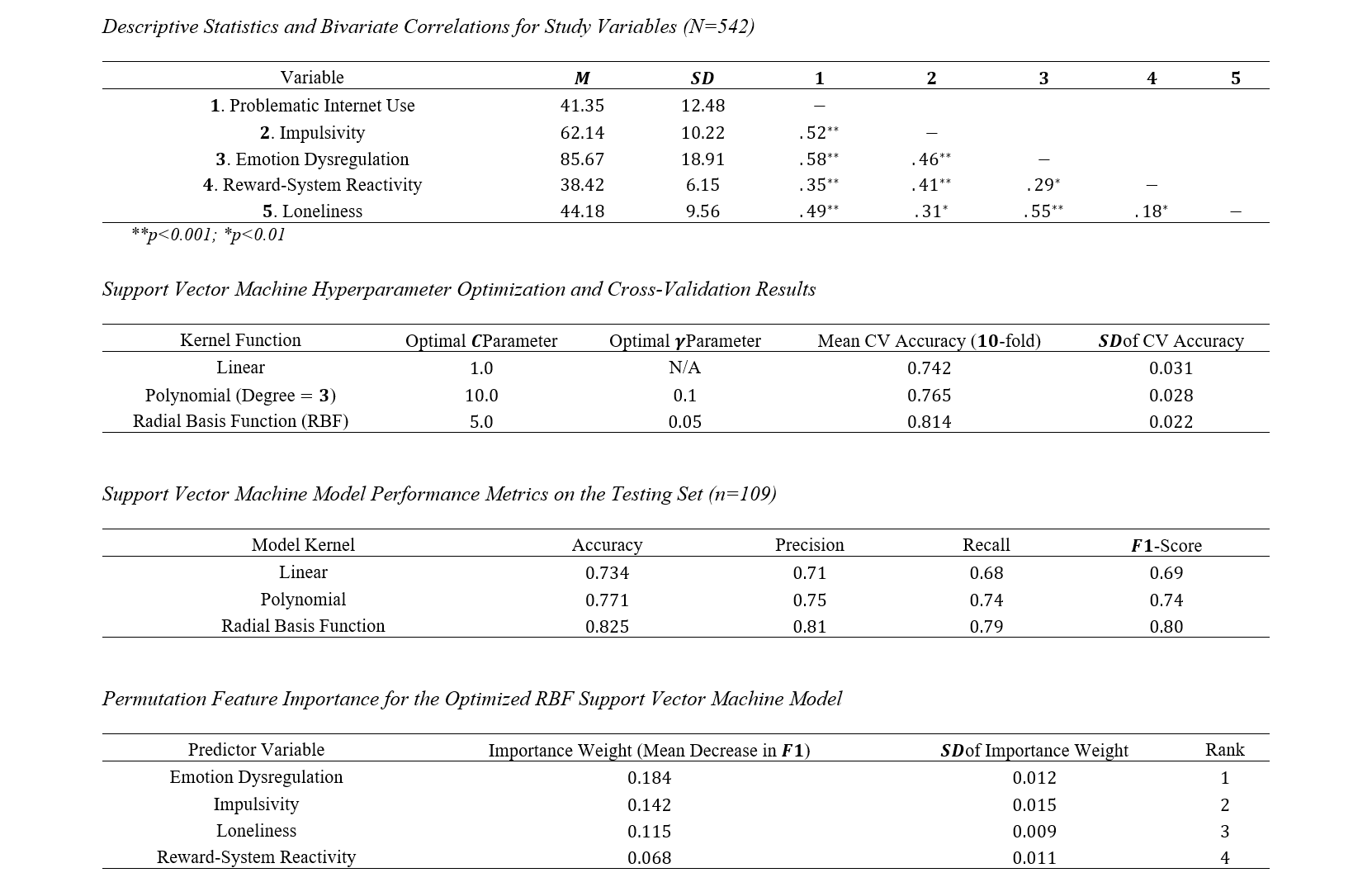
Findings: Preliminary bivariate analyses revealed significant positive correlations between problematic internet use and all predictor variables, most notably emotion dysregulation ( ) and impulsivity ( ). The Radial Basis Function (RBF) kernel emerged as the optimal SVM model, demonstrating robust predictive capability with an overall classification accuracy of and an F1-score of . Furthermore, permutation feature importance analysis identified emotion dysregulation as the most critical predictor of pathological digital behavior, followed sequentially by impulsivity, loneliness, and reward-system reactivity.
Conclusion: Problematic internet use is profoundly driven by underlying deficits in emotional and behavioral self-regulation, underscoring the necessity for targeted psychological interventions that address these core vulnerabilities rather than merely restricting screen time.
Downloads
References
Aquino, A. P. S., & Kimong, P. J. (2022). Boredom and Distress Tolerance on Problematic Internet Use Among Public University Students. Malaysian Journal of Social Sciences and Humanities (MJSSH), 7(5), e001477. https://doi.org/10.47405/mjssh.v7i5.1477
Arató, A., Nagy, S. A., Perlaki, G., Gergely Orsi, G., Anna Tímea Szente, A. T., Kis‑Jakab, G., Áfra, E., Alhour, H. A., Norbert Kovács, N., József Janszky, J., & Gergely Darnai, G. (2023). Emotional face expression recognition in problematic Internet use and excessive smartphone use: task‑based fMRI study. Scientific reports, 13(354), 1-12. https://doi.org/10.1038/s41598-022-27172-0
Chen, J., Li, S., & Nie, Y. (2024). Parent-Adolescent Conflict and Problematic Internet Use Among Chinese Adolescents: The Mediating Role of Depression and the Moderating Role of School Climate. BMC psychology, 12(1). https://doi.org/10.1186/s40359-024-01781-y
Ding, H., Cao, B., & Sun, Q. (2023). The association between problematic internet use and social anxiety within adolescents and young adults: a systematic review and meta-analysis. Frontiers in Public Health, 11, 1275723. https://doi.org/10.3389/fpubh.2023.1275723
El-Ashry, A. M., Hussein Ramadan Atta, M., Alsenany, S. A., Farghaly Abdelaliem, S. M., & Abdelwahab Khedr, M. (2023). The effect of distress tolerance training on problematic internet use and psychological wellbeing among faculty nursing students: A randomized control trial. Psychology research and behavior management, 4015-4032. https://doi.org/10.2147/PRBM.S423194
El Archi, S., Barrault, S., Brunault, P., Ribadier, A., & Varescon, I. (2022). Co-occurrence of adult ADHD symptoms and problematic internet use and its links with impulsivity, emotion regulation, anxiety, and depression. Frontiers in Psychiatry, 13, 792206. https://doi.org/10.3389/fpsyt.2022.792206
Fan, Z., Chen, M., & Lin, Y. (2022). Self-Control and Problematic Internet Use in College Students: The Chain Mediating Effect of Rejection Sensitivity and Loneliness. Psychology research and behavior management, Volume 15, 459-470. https://doi.org/10.2147/prbm.s352060
Fujita, J., Aoyama, K., Saigusa, Y., Miyazaki, H., Aoki, Y., Asanuma, K., Takahashi, Y., & Hishimoto, A. (2022). Problematic Internet Use and Daily Difficulties Among Adolescents With School Refusal Behaviors. Medicine, 101(7), e28916. https://doi.org/10.1097/md.0000000000028916
Goldstein, M. A., & Goldstein, M. C. (2024). Problematic Internet Use. 145-160. https://doi.org/10.1093/med/9780197640739.003.0010
Hayixibayi, A., Strodl, E., Chen, W., & Kelly, A. B. (2022). Associations Between Adolescent Problematic Internet Use and Relationship Problems in Chinese Families: Findings From a Large-Scale Survey. Jmir Pediatrics and Parenting. https://doi.org/10.2196/35240
Huang, L., Zeng, M., Jiao, T., Yang, F., & Zhang, Y. (2026). The Association between Parental Control and Problematic Internet Use among Adolescents: Three-Level Meta-Analysis and Meta-Analytic Structural Equation Modeling. Journal of youth and adolescence, 55(2), 289-315. https://doi.org/10.1007/s10964-025-02268-8
Khanbabaei, S., Abdollahi, M. H., & Shahgholian, M. (2022). The predictive role of working memory and impulsivity in internet addiction, an investigation about the mediating role of time perception. Personality and individual differences, 185, 111280. https://doi.org/10.1016/j.paid.2021.111280
Kim, S., Jin, J.-C., Yoo, S.-K., & Han, D. H. (2025). Changes in Internet Activities and Influencing Factors for Problematic Internet Use During the COVID-19 Pandemic in Korean Adolescents: Repeated Cross-Sectional Study. Jmir Pediatrics and Parenting, 8, e66448. https://doi.org/10.2196/66448
Laconi, S., Kalaitzaki, A., Spritzer, D. T., Hauck, S., Gnisci, A., Sergi, I., Vally, Z., Tudorel, O., Vintila, M., Malik, S., Ramos-Diaz, J., Männikkö, N., Cikrikci, O., Salas, G., Ardila, R., Zambrano, D., Lopez-Calle, C., & Sahlan, R. N. (2022). A Cross-cultural exploration of problematic Internet use, pathological personality traits, defense mechanisms, coping strategies, and self-esteem in 14 countries. Annales Médico-psychologiques, revue psychiatrique. https://doi.org/10.1016/j.amp.2022.09.008
Lee, C., & Park, S. (2025). Mediating Roles of Self-Control and Social Support in the Relationship Between Problematic Internet Use and Depression Among Korean Children and Adolescents. Journal of Korean Academy of Child and Adolescent Psychiatry, 36(4), 245-253. https://doi.org/10.5765/jkacap.250039
Onyekachi, B. N., Egboluche, F. O., & Chukwuorji, J. C. (2022). Parenting Style, Social Interaction Anxiety, and Problematic Internet Use among Students. Journal of Psychology in Africa, 32(1), 79-85. https://doi.org/10.1080/14330237.2021.2002030
Ozaslan, A., Yıldırım, M., Güney, E., Güzel, H. S., & İşeri, E. (2022). Association between problematic internet use, quality of parent-adolescents relationship, conflicts, and mental health problems. International journal of mental health and addiction, 20, 2503-2519. https://doi.org/10.1007/s11469-021-00529-8
Pérez-Sáenz, J., Ortuño-Sierra, J., Pérez-Albéniz, A., Mason, O., & Fonseca-Pedrero, E. (2023). Problematic Internet Use in adolescents: New psychometric evidence for the Spanish short form of the Compulsive Internet Use Scale. Brain and Behavior, 13(9), e3133. https://doi.org/10.1002/brb3.3133
Safari, M., Chen, H., Chang, C., Fan, C., Huang, S., & Cheng, J. (2022). Effects of sleep quality on association between problematic internet use and quality of life in people with substance use disorder. BJPsych Open, 8, e155. https://doi.org/10.1192/bjo.2022.557
Sánchez-Fernández, M., Borda-Más, M., & Mora-Merchan, J. (2023). Problematic internet use by university students and associated predictive factors: A systematic review. Computers in human Behavior, 139, 107532. https://doi.org/10.1016/j.chb.2022.107532
Sedana, G. (2024). Psychological Rigidity, Perceived Parenting, and Problematic Internet Use in Adolescent Mental Health: A Review. Journal of Research in Vocational Education, 6(7), 22-27. https://doi.org/10.53469/jrve.2024.06(07).06
She, R., Kit han Mo, P., Li, J., Liu, X., Jiang, H., Chen, Y., Ma, L., & Tak fai Lau, J. (2023). The double-edged sword effect of social networking use intensity on problematic social networking use among college students: The role of social skills and social anxiety. Computers in human Behavior, 140, 107555. https://doi.org/10.1016/j.chb.2022.107555
Tian, J., He, X., & Guo, Z. (2025). Optimal Non-Pharmacological Interventions for Reducing Problematic Internet Use in Youth: A Systematic Review and Bayesian Network Meta-Analysis. Behavioral Sciences, 15(1), 98. https://doi.org/10.3390/bs15010098
Tsang, E. W., Yuen, C. C., Lau, J. C., Ma, V. W., Wat, M. T., Yu, J. Y., Privitera, A. J., Chung, R. C. K., & Chan, C. C. H. (2024). Influences of Lifestyle Profiles and Problematic Internet Use on Mental Distress in University Students. Psychological studies, 69(1), 81-91. https://doi.org/10.1007/s12646-023-00766-y
Varchetta, M., Tagliaferri, G., Mari, E., Quaglieri, A., Cricenti, C., & Vilar, M. M. (2024). Cross-Cultural Examination of Problematic Internet Use and Associated Psychological Variables: A Comparative Study in Italy, Spain, Ecuador, and Peru. Journal of clinical medicine, 13(12), 3451. https://doi.org/10.3390/jcm13123451
Xu, C., Liao, M., & Hong, Y. (2025). Rejection Sensitivity and Problematic Internet Use Among Medical Students: A Moderated Mediation Model Involving Loneliness and Self-Control. Behavioral Sciences, 15(5), 589. https://doi.org/10.3390/bs15050589
Xu, C., Qiu, M., Jiang, X., Liao, M., Lei, L., Liu, L., Yu, L., & Hong, Y. (2024). The Rejection Sensitivity and Problematic Internet Use Among Medical Students: A Moderated Mediation Model Involving Loneliness and Self-Control. https://doi.org/10.21203/rs.3.rs-3958231/v1
Yang, L., Yuan, J., Yang, B., Sun, H., Tang, W., & Yu, J. (2023). Problematic Internet Use Related to Mental Health Conditions Among Left-Behind Children and Adolescents: A Systematic Review. https://doi.org/10.21203/rs.3.rs-3142378/v1
Yildirim Demirdöğen, E., Akinci, M. A., Bozkurt, A., Bayraktutan, B., Turan, B., Aydoğdu, S., & Ferahkaya, H. (2024). Social Media Addiction, Escapism and Coping Strategies are Associated with the Problematic Internet Use of Adolescents in Türkiye: A Multi-Center Study. Frontiers in Psychiatry, 15, 1355759. https://doi.org/10.3389/fpsyt.2024.1355759
Zhang, D., You, Y., Cai, L., Zhang, W., Zhang, K., & Wu, Y. (2024). The Relationship Between Family Communication and Adolescent Problematic Internet Use: The Chain Mediation Effects of Loneliness and Depression. Psychology research and behavior management, Volume 17, 4263-4280. https://doi.org/10.2147/prbm.s486192
Zhang, L., & Zhao, C. (2021). Problematic internet use, emotion dysregulation and academic performance. Adolescence Research Review, 6(1), 45-58. https://doi.org/10.1007/s40894-020-00115-5
Downloads
Additional Files
Publication Timeline
- Submitted
- Revised
- Accepted