Design and Testing of a Model of the Effect of Social Situation Appraisal on Social Anxiety in Female University Students with the Mediating Role of Safety Behaviors and Social Beliefs and Thoughts
DOI:
https://doi.org/10.61838/Keywords:
Social anxiety, social situation appraisal, social beliefs and thoughtsAbstract
Objective: The present study aimed to design and test a structural model of the effect of social situation appraisal on social anxiety in female university students, with the mediating roles of safety behaviors and social beliefs and thoughts.
Methods and Materials: This study employed a descriptive correlational design using structural equation modeling. The statistical population consisted of female students enrolled at Ahvaz Jundishapur University of Medical Sciences during the 2020–2021 academic year, from which 483 participants were selected through convenience sampling. Data were collected using the Social Phobia Inventory (SPIN), the Overall Assessment of the Speaker’s Experience of Stuttering (OASES), the Social Thoughts and Beliefs Scale (STABS), and the Social Phobia Safety Behaviors Scale (SPSBS). After screening for assumptions such as normality and absence of multicollinearity, data were analyzed using AMOS (version 23) with the maximum likelihood estimation method. Indirect effects were examined using the bootstrap procedure.
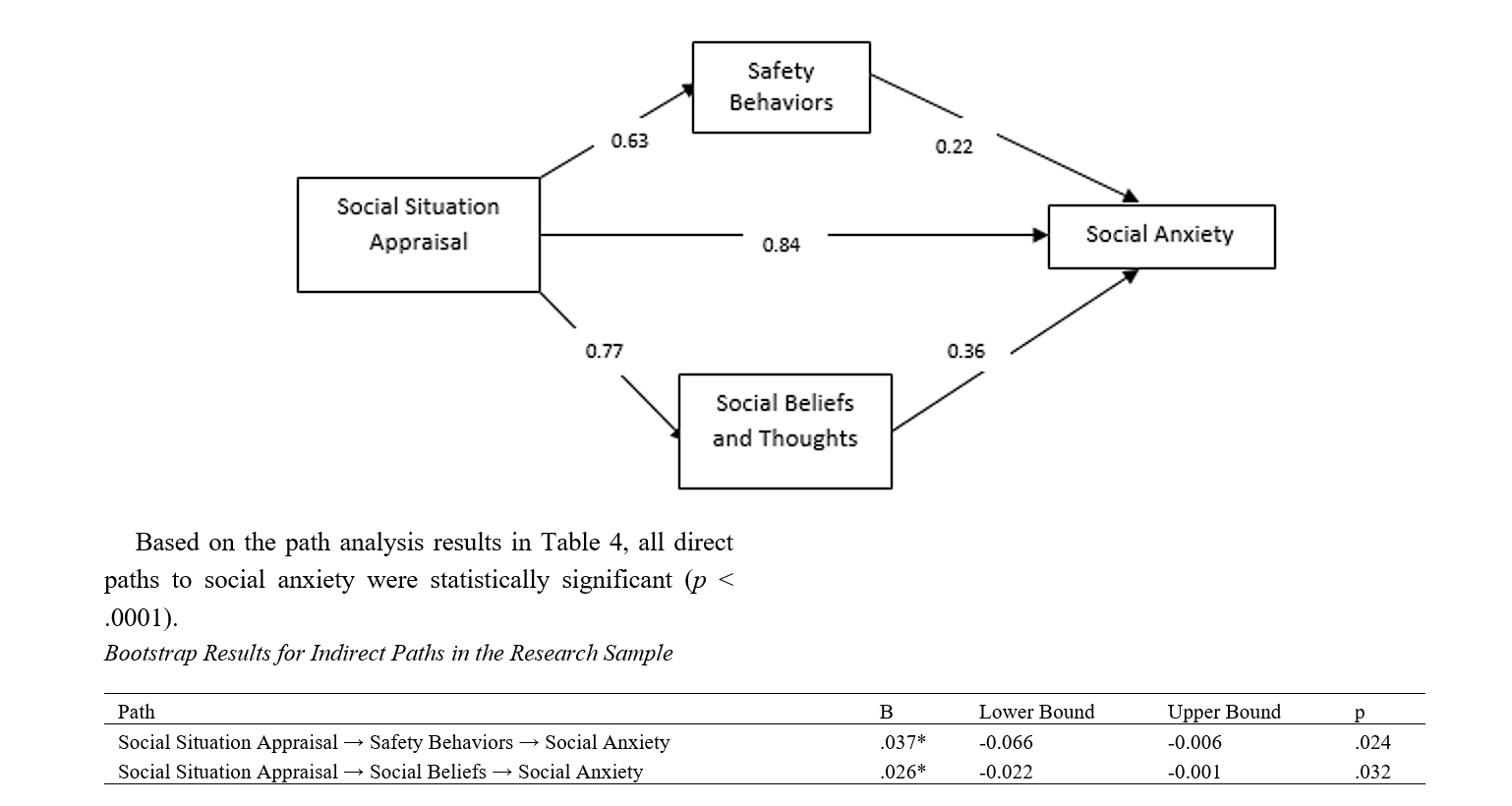
Findings: The results indicated that the final structural model demonstrated acceptable fit indices (RMSEA = 0.07, CFI = 0.98, IFI = 0.98, GFI = 0.97, AGFI = 0.95, χ²/df = 3.75). Social situation appraisal had a significant direct effect on social anxiety (β = 0.84, p < .0001), as well as on safety behaviors (β = 0.63, p < .0001) and social beliefs and thoughts (β = 0.77, p < .0001). In addition, safety behaviors (β = 0.22, p < .0001) and social beliefs and thoughts (β = 0.26, p < .0001) had significant direct effects on social anxiety. Bootstrap analysis confirmed significant indirect effects of social situation appraisal on social anxiety through safety behaviors (β = 0.037, p = .024) and social beliefs and thoughts (β = 0.026, p = .032).
Conclusion: The findings support an integrated cognitive-behavioral model in which social situation appraisal influences social anxiety both directly and indirectly through safety behaviors and social beliefs, highlighting the importance of targeting both cognitive and behavioral mechanisms in interventions for socially anxious students.
Downloads
References
Acarturk, C., Smit, F., De Graaf, R., Van Straten, A., Ten Have, M., & Cuijpers, P. (2009). Economic costs of social phobia: a population-based study. Journal of affective disorders, 115(3), 421-429. https://doi.org/10.1016/j.jad.2008.10.008
Alden, L. E., Buhr, K., Robichaud, M., Trew, J. L., & Plasencia, M. L. (2018). Treatment of social approach processes in adults with social anxiety disorder. Journal of consulting and clinical psychology, 86(6), 505-517. https://doi.org/10.1037/ccp0000306
Bahrami, M., Abolghasemi, A., & Narimani, M. (2012). Comparing self-perception and safety measures in students with social anxiety disorder symptoms and normal students. Journal of School Psychology, 2(1), 62-79.
Beck, A. T., & Haigh, E. A. (2014). Advances in cognitive theory and therapy: the generic cognitive model. Annual Review of Clinical Psychology, 10, 1-24. https://doi.org/10.1146/annurev-clinpsy-032813-153734
Blanco, C., Rubio, J., Wall, M., Wang, S., Jiu, C. J., & Kendler, K. S. (2014). Risk factors for anxiety disorders: common and specific effects in a national sample. Depression and Anxiety, 31(9), 756-764. https://doi.org/10.1002/da.22247
Calvete, E., Orue, I., & Hankin, B. L. (2015). A longitudinal test of the vulnerability-stress model with early maladaptive schemas for depressive and social anxiety symptoms in adolescents. Journal of psychopathology and behavioral assessment, 37(1), 85-99. https://doi.org/10.1007/s10862-014-9438-x
Cougle, J. R., Mueller, N. E., McDermott, K. A., Wilver, N. L., Carlton, C. N., & Okey, S. A. (2020). Text message safety behavior reduction for social anxiety: A randomized controlled trial. Journal of consulting and clinical psychology, 88(5), 445-455. https://doi.org/10.1037/ccp0000494
Evans, R., Chiu, K., Clark, D. M., Waite, P., & Leigh, E. (2021). Safety behaviours in social anxiety: An examination across adolescence. Behaviour Research and Therapy, 144, 103931. https://doi.org/10.1016/j.brat.2021.103931
Gilboa-Schechtman, E., Keshet, H., Peschard, V., & Azoulay, R. (2020). Self and identity in social anxiety disorder. Journal of personality, 88(1), 106-121. https://doi.org/10.1111/jopy.12455
Heimberg, R. G., Brozovich, F. A., & Rapee, R. M. (2014). A cognitive-behavioral model of social anxiety disorder. In Social Anxiety (pp. 705-728). Academic Press. https://doi.org/10.1016/B978-0-12-394427-6.00024-8
Hofmann, S. G., Ellard, K. K., & Siegle, G. J. (2021). Neurobiological correlates of cognitions in fear and anxiety: A cognitive-neurobiological information processing model. Fernanda Rufino, 1(1), 1-10.
Iverach, L., Rapee, R. M., Wong, Q., & Lowe, R. (2017). Maintenance of social anxiety in stuttering: A cognitive-behavioral model. American Journal of Speech-Language Pathology, 26(2), 540-556. https://doi.org/10.1044/2016_AJSLP-16-0033
Jacobucci, R., Grimm, K. J., & McArdle, J. J. (2016). Regularized structural equation modeling. Structural Equation Modeling: A Multidisciplinary Journal, 23(4), 555-566. https://doi.org/10.1080/10705511.2016.1154793
Jefferies, P., & Ungar, M. (2020). Social anxiety in young people: A prevalence study in seven countries. PLoS One, 15(9), e0239133. https://doi.org/10.1371/journal.pone.0239133
Norouzi, M., Michaeli Manee, F., & Issazadegan, A. (2016). The prevalence of self-reported social anxiety disorder on Iranian students. Studies in Medical Sciences, 27(2), 155-166.
Okawa, S., Arai, H., Sasagawa, S., Ishikawa, S. I., Norberg, M. M., Schmidt, N. B., & Shimizu, E. (2021). A cross-cultural comparison of the bivalent fear of evaluation model for social anxiety. Journal of Behavioral and Cognitive Therapy, 31(3), 205-213. https://doi.org/10.1016/j.jbct.2021.01.003
ÖZok, H. İ., Kaya, A., Dinçer, R. E., & Yıldırım, M. (2025). Associations Between Social Appearance Anxiety, Problematic Social Media Use, Selfitis Behavior, and Adaptable Self: A Moderated-Mediation Model. Psihologija(00), 14-14. https://doi.org/10.2298/psi231025014o
Read, D. L., Clark, G. I., Rock, A. J., & Coventry, W. L. (2018). Adult attachment and social anxiety: The mediating role of emotion regulation strategies. PLoS One, 13(12), e0207514. https://doi.org/10.1371/journal.pone.0207514
Sabah, A., Alduais, A., Aljaberi, M. A., & Manouchehri, M. (2025). Online and Offline Social Sensitivity as Mediator Between Online Vigilance and Depression, Anxiety, and Stress Among Algerian Female Students. PsyCh Journal, 14(4), 473-482. https://doi.org/10.1002/pchj.70017
Spence, S. H., & Rapee, R. M. (2016). The etiology of social anxiety disorder: An evidence-based model. Behaviour Research and Therapy, 86, 50-67. https://doi.org/10.1016/j.brat.2016.06.007
Spiroiu, F. I., & Maranzan, K. A. (2025). Cognitive‐Emotional Impact of Negative Interpretations of Ambiguous Social Information and Fear of Negative Evaluation on the Association Between Intolerance of Uncertainty and Social Anxiety Subtypes: A Cross‐Sectional Mediation Analysis. Scandinavian journal of psychology. https://doi.org/10.1111/sjop.13115
Stein, I., Asher, M., Erez, S., Shechner, T., Marom, S., Hermesh, H., & Aderka, I. M. (2019). Developing a brief version of the Social Thoughts and Beliefs Scale (STABS) using item response theory. Cognitive therapy and research, 43(4), 792-801. https://doi.org/10.1007/s10608-019-10000-7
Stork, M., Lemos, M., & Roman-Calderon, J. P. (2023). Differences in anxiety sensitivity and experiential avoidance between subtypes of social anxiety disorder. PLoS One, 18(9), e0290756. https://doi.org/10.1371/journal.pone.0290756
Taylor, C. T., & Alden, L. E. (2010). Safety behaviors and judgmental biases in social anxiety disorder. Behaviour Research and Therapy, 48(3), 226-237. https://doi.org/10.1016/j.brat.2009.11.005
Tosun, H. (2025). Problematic Social Media Use and Its Relationship With Breastfeeding Behaviors and Anxiety in Social Media-Native Mothers: A Mixed-Methods Study. Healthcare, 13(17), 2216. https://doi.org/10.3390/healthcare13172216
Uzun, K., Ünlü, S., & Arslan, G. (2025). Does Intolerance of Uncertainty Influence Social Anxiety Through Rumination? A Mediation Model in Emerging Adults. Behavioral Sciences, 15(5), 687. https://doi.org/10.3390/bs15050687
Vos, L. M. W., Bronstein, M. V., Gendron, M., Joormann, J., & Everaert, J. (2025). Navigating the Social World: The Interplay Between Cognitive and Socio-Affective Processes in Depression and Social Anxiety. Cognitive therapy and research. https://doi.org/10.1007/s10608-024-10557-y
Wolitzky-Taylor, K., & LeBeau, R. (2023). Recent advances in the understanding and psychological treatment of social anxiety disorder. Faculty Reviews, 12, 8. https://doi.org/10.12703/r/12-8
Wong, Q. J., & Rapee, R. M. (2016). The aetiology and maintenance of social anxiety disorder: A synthesis of complementary theoretical models and formulation of a new integrated model. Journal of affective disorders, 203, 84-100. https://doi.org/10.1016/j.jad.2016.05.069
Yan, Y., Ma, Y., Xu, L., & Lv, Y. (2025). Impact of perceived social support on anxiety and depression in women undergoing in vitro fertilization-embryo transfer: the role of psychological resilience. Journal of Assisted Reproduction and Genetics. https://link.springer.com/article/10.1007/s10815-024-03308-1
Zhao, L., Xu, F., Zheng, X., Xu, Z., Osten, B., Ji, K., Ding, S., Liu, G., Yang, S., & Chen, R. (2023). Mediation role of anxiety on social support and depression among diabetic patients in elderly caring social organizations in China during COVID-19 pandemic: a cross-sectional study. BMC Geriatrics, 23(1), 790. https://doi.org/10.1186/s12877-023-04502-z
Zhu, Y., Jin, G., Shi, H., Sun, C., Wei, H., Yang, L., Hao, J., Sun, Y., Su, P., Wu, X., Tang, X., & Zhang, Z. (2025). Mediating Effect of Social Anxiety on the Association Between Self-Esteem and Internet Addiction Among Chinese Vocational School Students. Frontiers in Public Health, 13. https://doi.org/10.3389/fpubh.2025.1412480
Downloads
Additional Files
Publication Timeline
- Submitted
- Revised
- Accepted