The Effectiveness of Resilience-Based Group Training on Uncertainty Intolerance, Future Orientation, and Stress Appraisal in High School Students
DOI:
https://doi.org/10.61838/Keywords:
Resilience-Based Training, Intolerance of Uncertainty, Future Orientation, Stress Appraisal, High School Students, AdolescentsAbstract
Objective: The present study aimed to investigate the effectiveness of resilience-based group training on intolerance of uncertainty, future orientation, and stress appraisal among high school students.
Methods and Materials: The present study employed a quasi-experimental design with a pretest-posttest structure and a control group. The statistical population consisted of high school students in Ahwaz during the 2025–2026 academic year. Using multistage cluster sampling, 40 students were selected and randomly assigned to an experimental group (n = 20) and a control group (n = 20). Data collection instruments included the Intolerance of Uncertainty Scale developed by Freeston et al., the Future Orientation Questionnaire developed by Seginer, and the Stress Appraisal Measure developed by Peacock and Wong. The experimental group participated in eight 90-minute sessions of resilience-based group training, while the control group received no intervention during the study period. Data were analyzed using descriptive statistics and multivariate analysis of covariance (MANCOVA) in IBM SPSS Statistics version 27.
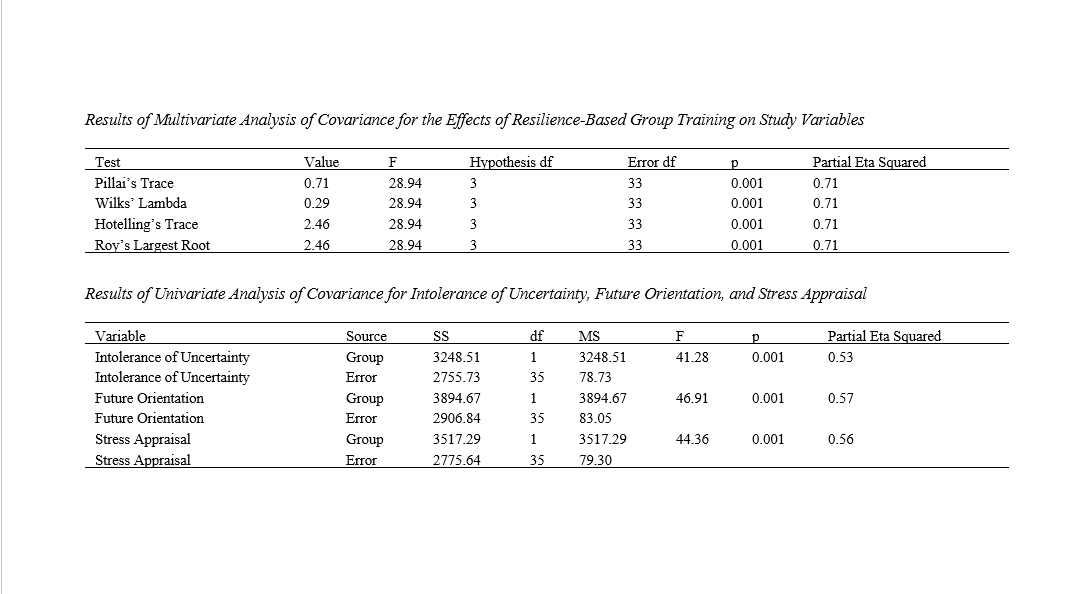
Findings: The results of multivariate analysis of covariance revealed a statistically significant overall effect of resilience-based group training on the combined dependent variables of intolerance of uncertainty, future orientation, and stress appraisal (Wilks’ Lambda = 0.29, F = 28.94, p < .001, η² = 0.71). Univariate analyses further indicated that the intervention significantly reduced intolerance of uncertainty (F = 41.28, p < .001, η² = 0.53) and maladaptive stress appraisal (F = 44.36, p < .001, η² = 0.56), while significantly increasing future orientation among students in the experimental group compared with the control group (F = 46.91, p < .001, η² = 0.57). The obtained effect sizes demonstrated that the resilience-based intervention exerted substantial positive effects on students’ adaptive psychological functioning.
Conclusion: The findings of the present study suggest that resilience-based group training is an effective psychological intervention for reducing intolerance of uncertainty and maladaptive stress appraisal while enhancing future orientation among high school students. Strengthening resilience-related capacities may improve adolescents’ emotional adjustment, coping flexibility, and positive future-directed thinking.
Downloads
References
AtİLa, F. (2023). A Qualitative Study on Undergraduates’ Psychological Capital Class Connectedness and School Alienation. Bingöl Üniversitesi Sosyal Bilimler Enstitüsü Dergisi(25), 399-416. https://doi.org/10.29029/busbed.1114936
Ben‐Asher, S., & Huss, E. (2023). Strengthening Resilience in Refugee Children Through Art and Attention to Their Voices. Journal of Education in Black Sea Region, 8(2), 14-29. https://doi.org/10.31578/jebs.v8i2.289
Bozkurt, H. Ö. (2023). The Effect of Uncertainty Intolerance on Career Anxiety and Career Change Intention: A Case Study of the Hospitality Industry. Journal of Business Research - Turk. https://doi.org/10.20491/isarder.2023.1699
Buenconsejo, J. U., Pianpiano, O. I. P., & Datu, J. A. D. (2022). Psychometric Properties of the School Kindness Scale in Hong Kong, Mainland China, and the Philippines. Psychology in the Schools, 60(3), 780-792. https://doi.org/10.1002/pits.22793
Cao, Q. (2021). The Mediated Effect of Stress on Uncertainty and Students’ Perceived Performance in Online Classes: A Mediation Analysis. https://doi.org/10.2991/assehr.k.211220.302
Capurso, M., Stasio, S. D., & Ragni, B. (2022). Universal Crisis Psychoeducational Interventions in Schools: A Scoping Review. School Psychology International, 43(4), 339-380. https://doi.org/10.1177/01430343221104986
Cogorno, L., Smithbauer, S., Beck, C., & Zaporozhets, O. (2023). The Contributing Factors for Psychology Students Continuing Higher Education Amid War. Continuing Professional Education Theory and Practice, 18-31. https://doi.org/10.28925/1609-8595.2023.4.2
Cole, R., Pearce, E. N., Hildreth, A., Ren, X., & Vojta, L. (2024). The Impact of a Prehospital Simulation on Medical Students’ Resourcefulness, Personal Growth Initiative, and Uncertainty Tolerance. Aem Education and Training, 8(5). https://doi.org/10.1002/aet2.11032
Du, G., & Lyu, H. (2021). Future Expectations and Internet Addiction Among Adolescents: The Roles of Intolerance of Uncertainty and Perceived Social Support. Frontiers in Psychiatry, 12. https://doi.org/10.3389/fpsyt.2021.727106
Dupuis, A., Therriault, D., Lane, J., Smith, J., Gosselin, P., Drapeau, M., Mousset, E. S., Morin, P., Thibault, I., Dufour, M., Viscogliosi, C., & Berrigan, F. (2024). Changes in Anxiety Symptoms and Their Correlates in Adolescents Participating in a School-Based Anxiety Prevention Program During the COVID-19 Pandemic. Canadian Journal of School Psychology, 39(2), 111-131. https://doi.org/10.1177/08295735241240672
Ellis, B. J., Abrams, L. S., Masten, A. S., Sternberg, R. J., Tottenham, N., & Frankenhuis, W. E. (2023). The Hidden Talents Framework. https://doi.org/10.1017/9781009350051
Finch, J., Waters, A. M., & Farrell, L. J. (2023). Developing the HERO Within: Evaluation of a Brief Intervention for Increasing Psychological Capital (PsyCap) in Australian Female Students During the Final Year of School in the First Year of COVID-19. Journal of affective disorders, 324, 616-623. https://doi.org/10.1016/j.jad.2022.12.169
Fu, C., Jin, L., Ye, B., & Yang, Q. (2024). Intolerance of Uncertainty and Negative Emotions Among High School Art Students During COVID-19 Pandemic: A Moderated Mediation Analysis. Frontiers in Public Health, 12. https://doi.org/10.3389/fpubh.2024.1277146
Iovino, E. A., Koslouski, J. B., & Chafouleas, S. M. (2021). Teaching Simple Strategies to Foster Emotional Well-Being. Frontiers in psychology, 12. https://doi.org/10.3389/fpsyg.2021.772260
Kareem, J., Thomas, S., Kumar, A., & Neelakantan, M. (2022). The Role of Classroom Engagement on Academic Grit, Intolerance to Uncertainty and Well‐being Among School Students During the Second Wave of the COVID‐19 Pandemic in India. Psychology in the Schools, 60(5), 1594-1608. https://doi.org/10.1002/pits.22758
Mastrothanasis, K. (2025). Participatory Arts as Emergency Responses for Strengthening Community Resilience and Psychosocial Support: A Retrospective Phenomenological Inquiry. Children, 12(11), 1498. https://doi.org/10.3390/children12111498
McIntosh, C. E., & Stone, G. (2022). Introduction to the Special Issue: How COVID‐19 Has Affected Students' Health, Achievement, and Mental Health. Psychology in the Schools, 60(5), 1325-1328. https://doi.org/10.1002/pits.22820
Morillo‐Sarto, H., Torres‐Vallejos, J., Supervía, P. U., Barrada, J. R., & Juarros‐Basterretxea, J. (2025). The Impact of Social Media Disorder, Family Functioning, and Community Social Disorder on Adolescents’ Psychological Distress: The Mediating Role of Intolerance to Uncertainty. Children, 12(7), 861. https://doi.org/10.3390/children12070861
Nigam, D., Khan, A., & Srivastava, A. (2024). A Comprehensive Analysis on Exploring the Role of Artificial Intelligence: Prioritizing Mental Well-Being for Teachers and Students Amidst and Beyond the Covid-19. International Research Journal of Modernization in Engineering Technology and Science. https://doi.org/10.56726/irjmets51480
Odacı, H., Kaya, F., & Aydın, F. (2022). Does Educational Stress Mediate the Relationship Between Intolerance of Uncertainty and Academic Life Satisfaction in Teenagers During the COVID‐19 Pandemic? Psychology in the Schools, 60(5), 1514-1531. https://doi.org/10.1002/pits.22766
Oral, M., & Karakurt, N. (2022). The Impact of Psychological Hardiness on Intolerance of Uncertainty in University Students During the COVID‐19 Pandemic. Journal of Community Psychology, 50(8), 3574-3589. https://doi.org/10.1002/jcop.22856
Qiang, J., He, X., Zheng, X., Huang, J., & Xu, C. (2024). The Association Between Intolerance of Uncertainty and Academic Burnout Among University Students: The Role of Self-Regulatory Fatigue and Self-Compassion. Frontiers in Public Health, 12. https://doi.org/10.3389/fpubh.2024.1441465
Sagone, E., & Indiana, M. L. (2023). The Roles of Academic Self-Efficacy and Intolerance of Uncertainty on Decisional Procrastination in University Students During the COVID-19 Pandemic. Education Sciences, 13(5), 476. https://doi.org/10.3390/educsci13050476
Santilli, S., Grossen, S., & Nota, L. (2020). Career Adaptability, Resilience, and Life Satisfaction Among Italian and Belgian Middle School Students. The Career Development Quarterly, 68(3), 194-207. https://doi.org/10.1002/cdq.12231
Sulistiobudi, R. A., & Kadiyono, A. L. (2023). Employability of Students in Vocational Secondary School: Role of Psychological Capital and Student-Parent Career Congruences. Heliyon, 9(2), e13214. https://doi.org/10.1016/j.heliyon.2023.e13214
Wang, S., Chu, Y., & Dai, H. (2022). Role of Emotion Regulation Capacities in Affective State Among Chinese High School Students in the Post-Pandemic Era of COVID-19. Frontiers in psychology, 13. https://doi.org/10.3389/fpsyg.2022.1015433
Waters, L. (2023). "When Adversity Strikes: Maintaining Student and Teacher Wellbeing During the Covid-19 Pandemic". Scholarly Journal of Psychology and Behavioral Sciences, 7(2). https://doi.org/10.32474/sjpbs.2023.07.000258
Wu, H., Liu, Q., Liu, J., & Liu, M. (2024). Effects of Neuroticism on Pre-Exam Irritable Bowel Syndrome in Female Middle School Students: Mediating Role of Intolerance of Uncertainty and Moderating Role of Exercise Duration. Frontiers in Psychiatry, 15. https://doi.org/10.3389/fpsyt.2024.1420970
Yang, N. (2022). An Investigation Into the Interplay Between Chinese EFL Teachers' Emotional Intelligence, Ambiguity Tolerance, and Work Engagement. Frontiers in psychology, 13. https://doi.org/10.3389/fpsyg.2022.929933
Yao, Z., Pang, L., Jin, X., Shi, S., & Min, O. (2023). The Relationship Between Social Anxiety and Self-Injury of Junior High School Students: Mediation by Intolerance of Uncertainty and Moderation by Self-Esteem. Frontiers in Public Health, 11. https://doi.org/10.3389/fpubh.2023.1046729
Zhang, C., Wang, W., Pei, Y., Zhang, Y., He, C., Wang, J., Gao, X., & Hou, H. (2021). Benevolent Childhood Experiences and Depressive Symptoms Among Chinese Undergraduates: A Moderated Mediation Model Examining the Roles of Uncertainty Stress and Family Relationship. Frontiers in Public Health, 9. https://doi.org/10.3389/fpubh.2021.757466
Downloads
Additional Files
Publication Timeline
- Submitted
- Revised
- Accepted