Effectiveness of Dialectical Behavior Therapy on Distress Tolerance and Difficulties in Emotion Regulation among Adolescents with Impulsive Behaviors
DOI:
https://doi.org/10.61838/Keywords:
Dialectical behavior therapy, distress tolerance, difficulties in emotion regulation, impulsive behaviorsAbstract
Objective: The present study was conducted to determine the effectiveness of dialectical behavior therapy on distress tolerance and difficulties in emotion regulation among adolescents with impulsive behaviors.
Materials and Methods: This was a quasi-experimental study with a pretest–posttest design and a two-month follow-up period including a control group. The statistical population consisted of adolescents aged 13 to 18 years with impulsive behaviors in Tehran in 2026. A total of 30 eligible adolescents were selected through purposive sampling and were randomly assigned to either the experimental group or the control group, with 15 participants in each group. The experimental group received dialectical behavior therapy skills training based on Linehan’s treatment package during eight 90-minute sessions, whereas the control group received no intervention during this period. Data were collected using the Distress Tolerance Scale developed by Simons and Gaher and the Difficulties in Emotion Regulation Scale developed by Gratz and Roemer. Data were analyzed using the independent samples t-test, Fisher’s exact test, and two-way repeated measures analysis of variance in SPSS version 26.
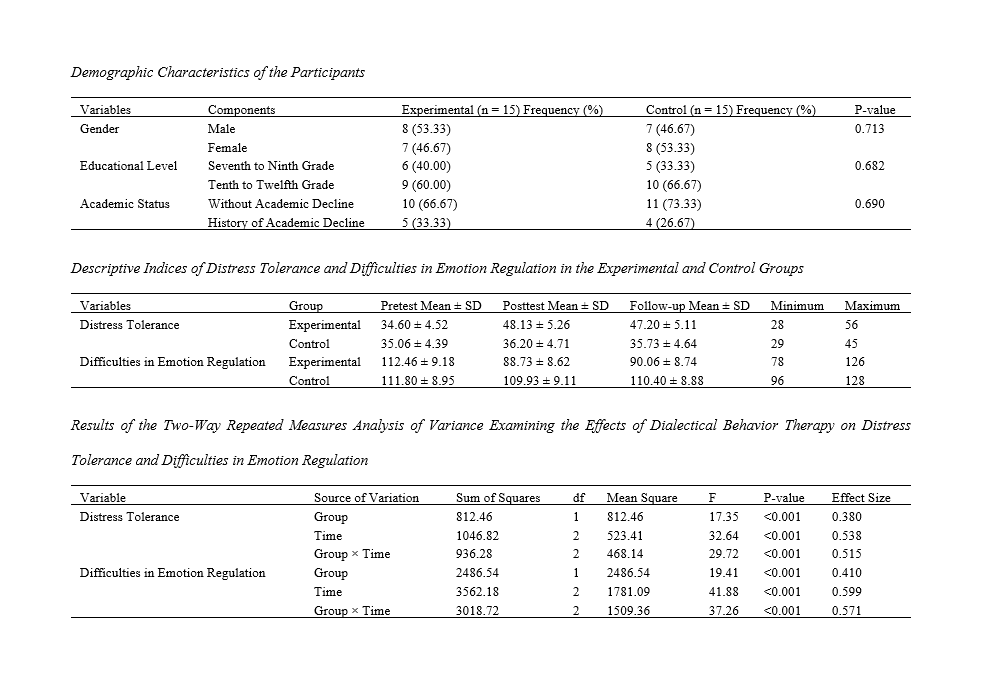
Findings: The results indicated that there were no significant differences between the experimental and control groups in terms of demographic characteristics. Furthermore, the results of the two-way repeated measures analysis of variance demonstrated that the interaction effect of group and time on distress tolerance and difficulties in emotion regulation was significant. Mean comparisons showed that distress tolerance scores in the experimental group increased from the pretest to the posttest stage, whereas difficulties in emotion regulation scores decreased. These changes remained largely stable at the two-month follow-up stage, while no considerable changes were observed in the control group.
Conclusion: Based on the findings of the study, dialectical behavior therapy can increase distress tolerance and reduce difficulties in emotion regulation among adolescents with impulsive behaviors. Therefore, the application of this approach in schools, counseling centers, and adolescent clinics may be beneficial for improving emotional skills, enhancing the ability to tolerate difficult situations, and reducing impulsive reactions.
Downloads
References
Artigues-Barberà, E., Tort-Nasarre, G., Pollina-Pocallet, M., Ferrer Suquet, Y., Ayats Pallés, A., Guasch Niubó, O., Ortega-Bravo, M., & García-Martínez, E. (2025). Key Factors in Supporting Adolescents to Achieve High Self-Esteem and a Positive Body Image: A Qualitative Community-Based Study. PLoS One, 20(2), e0318989. https://doi.org/10.1371/journal.pone.0318989
Carter, A., Steindl, S. R., Parker, S., Gilbert, P., & Kirby, J. N. (2023). Compassion-Focused Therapy to Reduce Body Weight Shame for Individuals With Obesity: A Randomized Controlled Trial. Behavior therapy, 54(5), 747-764. https://doi.org/10.1016/j.beth.2023.02.001
Demetriou, M., Anagnostopoulou, V., Markatis, V., Peyioti, M., & Argitis, P. (2025). The Impact of Social Media on Adolescent Body Image: A Comprehensive Review. European Psychiatry, 68(Suppl 1), S548. https://doi.org/10.1192/j.eurpsy.2025.1124
Fadhillah, U. (2025). The Relationship Between Body Image and Body Shaming on Self-Esteem Among Final Year Students. At-Taujih: Jurnal Bimbingan Konseling Islam, 3(2), 125-137. https://doi.org/10.37216/at-taujih;jurnalbimbingankonselingislam.v3i2.1839
George, C. (2025). Attachment, Shame, and Trauma. Brain Sciences, 15(4), 415. https://doi.org/10.3390/brainsci15040415
Gilbert, P., & Irons, C. (2009). Shame, Self-Criticism, and Self-Compassion in Adolescence. In Adolescent Emotional Development and the Emergence of Depressive Disorders (pp. 195-214). Cambridge University Press.
Khosravi, A., Abyar, F., Merci, Y., Khodakhah Darban, S., Vandshekari, F., & Ebadi, Z. (2022). The Effect of Compassion-Focused Therapy on Self-Compassion and Self-Criticism in Adolescents with Body-Image Disorder. Journal of Research in Psychopathology, 3(9), 8-14. https://doi.org/10.22098/jrp.2022.10363.1067
Leaviss, J., & Uttley, L. (2015). Psychotherapeutic Benefits of Compassion-Focused Therapy: An Early Systematic Review. Psychological medicine, 45(5), 927-945. https://doi.org/10.1017/S0033291714002141
Mastorci, F., Lazzeri, M. F. L., Vassalle, C., & Pingitore, A. (2024). The Transition from Childhood to Adolescence: Between Health and Vulnerability. Children, 11(8), 989. https://doi.org/10.3390/children11080989
Merino, M., Tornero-Aguilera, J. F., Rubio-Zarapuz, A., Villanueva-Tobaldo, C. V., Martín-Rodríguez, A., & Clemente-Suárez, V. J. (2024). Body Perceptions and Psychological Well-Being: A Review of the Impact of Social Media and Physical Measurements on Self-Esteem and Mental Health with a Focus on Body Image Satisfaction and Its Relationship with Cultural and Gender Factors. Healthcare, 12(14), 1396. https://doi.org/10.3390/healthcare12141396
Rajabi, G., & Abbasi, G. (2011). Investigating the Relationship Between Self-Criticism, Social Anxiety, and Fear of Failure with Shyness in Students. Clinical Psychology and Counseling Researches, 1(2).
Ramos, P., Moreno-Maldonado, C., Moreno, C., & Rivera, F. (2019). The Role of Body Image in Internalizing Mental Health Problems in Spanish Adolescents: An Analysis According to Sex, Age, and Socioeconomic Status. Frontiers in psychology, 10, 1952. https://doi.org/10.3389/fpsyg.2019.01952
Rodgers, R. F., Laveway, K., Campos, P., & de Carvalho, P. H. B. (2023). Body Image as a Global Mental Health Concern. Global Mental Health, 10, e9. https://doi.org/10.1017/gmh.2023.2
Takahashi, E., Fukuda, R., Takahashi, T., & Katsuragawa, T. (2025). Self-Compassion, Well-Being, and Body Image Concern in Young Japanese Women: The Role of Positive and Negative Facets of Self-Compassion. PLoS One, 20(11), e0334753. https://doi.org/10.1371/journal.pone.0334753
Vannucci, A., & Ohannessian, C. M. (2018). Body Image Dissatisfaction and Anxiety Trajectories During Adolescence. Journal of Clinical Child and Adolescent Psychology, 47(5), 785-795. https://doi.org/10.1080/15374416.2017.1390755
Vidal, J., & Soldevilla, J. M. (2023). Effect of Compassion-Focused Therapy on Self-Criticism and Self-Soothing: A Meta-Analysis. British Journal of Clinical Psychology, 62(1), 70-81. https://doi.org/10.1111/bjc.12394
Voelker, D. K., Reel, J. J., & Greenleaf, C. (2015). Weight Status and Body Image Perceptions in Adolescents: Current Perspectives. Adolescent Health, Medicine and Therapeutics, 6, 149-158. https://doi.org/10.2147/AHMT.S68344
Zaccari, V., Fazi, M., Scarci, F., Correr, V., Trani, L., Filomena, M. G., Piccione, V., Cattan, S. J., Ginni, M. G., D'Olimpio, F., & Mancini, F. (2024). Understanding Self-Criticism: A Systematic Review of Qualitative Approaches. Clinical Neuropsychiatry, 21(6), 455-476. https://doi.org/10.36131/cnfioritieditore20240602
Downloads
Additional Files
Publication Timeline
- Submitted
- Revised
- Accepted