Support Vector Machine Prediction of Adolescent Anxiety Based on Nomophobia, Fear of Missing Out (FoMO), Perfectionism, Cognitive Fusion, and Parent–Child Communication
DOI:
https://doi.org/10.61838/kman.jayps.5420Keywords:
Adolescent Anxiety, Support Vector Machine, Nomophobia, Fear of Missing Out, Perfectionism, Cognitive Fusion, Parent–Child Communication, Machine Learning, Mental Health, AdolescentsAbstract
Objective: The present study aimed to predict adolescent anxiety using a Support Vector Machine (SVM) model based on nomophobia, Fear of Missing Out (FoMO), perfectionism, cognitive fusion, and parent–child communication among Tunisian adolescents.
Methods and Materials: The study employed a cross-sectional correlational design with a machine learning approach. The statistical population consisted of secondary school adolescents in Tunisia during the 2025–2026 academic year. Using multistage cluster random sampling, 742 students were selected, of whom 718 valid questionnaires were retained for final analysis after data screening. Data were collected using the Beck Anxiety Inventory, Nomophobia Questionnaire, Fear of Missing Out Scale, Multidimensional Perfectionism Scale, Cognitive Fusion Questionnaire, and Parent–Adolescent Communication Scale. Descriptive statistics and Pearson correlation analyses were conducted using SPSS-27, while machine learning analyses were performed using Python and Scikit-learn libraries. The dataset was divided into training and testing subsets using an 80/20 ratio, and a radial basis function kernel Support Vector Machine model with five-fold cross-validation was implemented to predict adolescent anxiety.
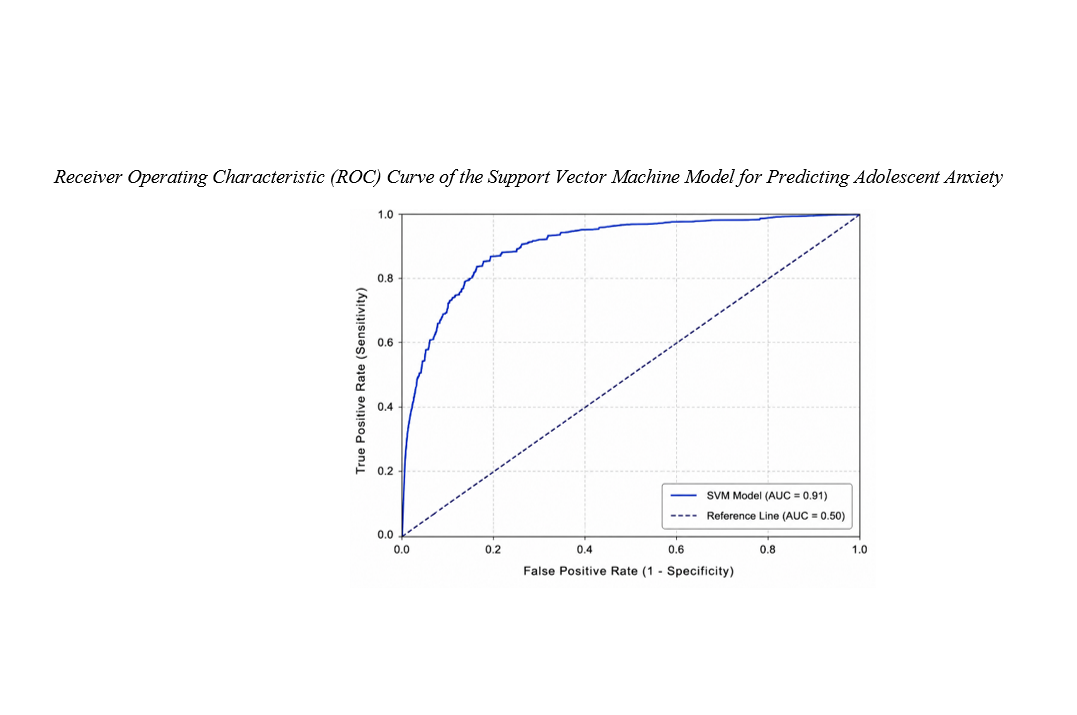
Findings: The findings indicated significant positive correlations between adolescent anxiety and nomophobia, FoMO, perfectionism, and cognitive fusion, while parent–child communication demonstrated a significant negative relationship with anxiety symptoms. Cognitive fusion emerged as the strongest predictor variable, followed by nomophobia, parent–child communication, FoMO, and perfectionism. The Support Vector Machine model demonstrated high predictive performance, achieving 88.76% classification accuracy in the testing dataset, with an F1-score of 87.16% and an area under the curve (AUC) value of 0.91. The confusion matrix additionally revealed high sensitivity and specificity in distinguishing adolescents with elevated anxiety symptoms from those with lower anxiety levels.
Conclusion: The results demonstrated that adolescent anxiety can be effectively predicted through the combined influence of cognitive, technological, emotional, and family-related factors using machine learning techniques. Cognitive fusion and nomophobia represented the strongest psychological risk factors, while healthy parent–child communication functioned as a protective factor against anxiety symptoms. The findings support the usefulness of Support Vector Machine models in adolescent mental health screening and highlight the importance of addressing maladaptive cognitive processes, digital dependency, and family communication patterns in preventive and intervention programs targeting adolescent anxiety.
Downloads
References
Amirian, Z., Asadzadeh, H., & Mousavi, S. R. (2022). Prediction of Symptoms of Psychosomatic Disorders in University Students Based on Perfectionism Mediated by Smartphone Addiction. Caspian Journal of Health Research, 7(3), 151-158. https://doi.org/10.32598/cjhr.7.3.421.1.7
Baytemir, K. (2022). Do Parents Have Exam Anxiety, Too? The Predictive Role of Irrational Beliefs and Perfectionism With Parental Exam Anxiety in Explaining Students’ Exam Anxiety. School Psychology International, 44(3), 257-278. https://doi.org/10.1177/01430343221122387
Bhuvaneswari, G., & E, E. J. (2021). Assess the Level of Stress, Sleep Disturbance, Depression With Nomophobia Among Undergraduate Students. International Journal of Advanced Psychiatric Nursing, 3(2), 24-27. https://doi.org/10.33545/26641348.2021.v3.i2a.59
Cataldo, I., Lepri, B., Neoh, M. J. Y., & Esposito, G. (2021). Social Media Usage and Development of Psychiatric Disorders in Childhood and Adolescence: A Review. Frontiers in Psychiatry, 11. https://doi.org/10.3389/fpsyt.2020.508595
Cervin, M., McNeel, M. M., Wilhelm, S., McGuire, J., Murphy, T. K., Small, B. J., Geller, D., & Storch, E. A. (2022). Cognitive Beliefs Across the Symptom Dimensions of Pediatric Obsessive-Compulsive Disorder: Type of Symptom Matters. Behavior therapy, 53(2), 240-254. https://doi.org/10.1016/j.beth.2021.08.001
Chessell, C., Halldorsson, B., Harvey, K., Holst, C. G., & Creswell, C. (2021). Cognitive, Behavioural and Familial Maintenance Mechanisms in Childhood Obsessive Compulsive Disorders: A Systematic Review. Journal of Experimental Psychopathology, 12(3). https://doi.org/10.1177/20438087211036581
Derbich, J., Kuk, A., & Milde, K. (2024). The Smartphone That Cannot Be Abandoned - The Phenomenon of Nomophobia Among Students. Kwartalnik Naukowy Fides et Ratio, 58(2), 27-37. https://doi.org/10.34766/fetr.v58i2.1272
Egan, S. J., Neal, J., Ure, S., Callaghan, T., Ho, P., Shafran, R., & Wade, T. (2023). The Development of Co-Designed Parent-Supported Cognitive Behaviour Therapy for Perfectionism in Adolescents With Eating Disorders: Initial Feasibility and Acceptability. Journal of eating disorders, 11(1). https://doi.org/10.1186/s40337-023-00860-6
Flett, G. L., & Hewitt, P. L. (2022a). Building Adaptability and Resilience in the Perfectionistic Child. 281-309. https://doi.org/10.1037/0000289-014
Flett, G. L., & Hewitt, P. L. (2022b). The Development of Perfectionism. 131-172. https://doi.org/10.1037/0000289-008
Flett, G. L., & Hewitt, P. L. (2022c). Perfectionism and Problems in Learning, Performance, and Achievement. 173-199. https://doi.org/10.1037/0000289-009
G., M., & R., D. R. (2024). Exploring the Relationship Between Attachment Styles and Loneliness Levels in Young Adults. International Journal for Multidisciplinary Research, 6(3). https://doi.org/10.36948/ijfmr.2024.v06i03.19869
Hameed, N., & Arzeen, S. (2023). Perfectionism, Self-Esteem and DSM-IV-Based Symptoms of Anxiety Disorders in Adolescents. PJMHS, 17(3), 310-314. https://doi.org/10.53350/pjmhs2023173310
Hong, W. (2025). No-Mobile-Phone Phobia and Cognitive and Social−emotional Development: Evidence From a Three-Wave Longitudinal Study. Mobile Media & Communication. https://doi.org/10.1177/20501579251390026
Ilmiah, G. I. W., Yusuf, A., & Tristiana, R. D. (2021). An Overview of Self-Control in Adolescent With Nomophobia (No Mobile Phone Phobia). Psychiatry Nursing Journal (Jurnal Keperawatan Jiwa), 3(2), 30. https://doi.org/10.20473/pnj.v3i2.28760
Jeong, S. S. Y., & Ryan, C. (2021). A Critical Review of Child Perfectionism as It Relates to Music Pedagogy. Psychology of Music, 50(4), 1312-1327. https://doi.org/10.1177/03057356211042080
Journault, A. A., Longpré, C., Mageau, G. A., & Lupien, S. (2025). Parental Threat Perception and Hyper‐Parenting as Potential Risk Factors for Adolescents’ Test Anxiety. Social Development, 34(3). https://doi.org/10.1111/sode.70004
Kadan, G. (2023). Investigation of Nomofobia and Netlessphobia Levels of Child Development Undergraduate Students. International Journal of Social Sciences, 7(31), 305-326. https://doi.org/10.52096/usbd.7.31.16
Khadem, S., Fakhri, M. K., & Emadian, S. O. (2023). The Effectiveness of Mindfulness Based Cognitive Therapy on Rumination, Perfectionism and Thought-Action Fusion of Women Suffering From Obsessive-Compulsive Disorder. Jayps, 4(4), 105-117. https://doi.org/10.61838/kman.jayps.4.4.11
Kurşuncu, M. A. (2023). The Mediating Roles of Smartphone Addiction and Resilience in the Relationship Between Triangling and Differentiation of Self. International Journal of Contemporary Educational Research, 10(4), 834-844. https://doi.org/10.52380/ijcer.2023.10.4.541
Li, S. (2024). A Study of the Relationship Between Parenting Styles and Adolescent. Journal of Education Humanities and Social Sciences, 29, 102-109. https://doi.org/10.54097/m6khrz59
Lin, J., & Guo, W. (2024). The Research on Risk Factors for Adolescents’ Mental Health. Behavioral Sciences, 14(4), 263. https://doi.org/10.3390/bs14040263
Mısır, E., & Özbek, M. M. (2025). Obsessive Beliefs, Metacognitive Beliefs, and Rumination in Parents of Adolescents With and Without Obsessive–Compulsive Disorder: A Linear Mixed-Effects Model. Brain Sciences, 15(10), 1093. https://doi.org/10.3390/brainsci15101093
O’Brien, A., Anderson, R., Mazzucchelli, T. G., Ure, S., & Egan, S. J. (2024). A Pilot Feasibility and Acceptability Trial of an Internet Indicated Prevention Program for Perfectionism to Reduce Eating Disorder Symptoms in Adolescents. Eating and Weight Disorders - Studies on Anorexia Bulimia and Obesity, 29(1). https://doi.org/10.1007/s40519-024-01654-8
Özdemir, A., Kapıkıran, G., Bülbüloğlu, S., & Sarıtaş, S. (2022). The Effect of Nomophobic Behavior of Student Nurses Using Smartphones on Social Phobia. Mersin Üniversitesi Tıp Fakültesi Lokman Hekim Tıp Tarihi Ve Folklorik Tıp Dergisi, 12(1), 77-85. https://doi.org/10.31020/mutftd.960984
Pérez‐Jorge, D., Hernández-Henríquez, A. C., Melwani-Sadhwani, R., & Gallo-Mendoza, A. F. (2024). Tomorrow Never Comes: The Risks of Procrastination for Adolescent Health. European Journal of Investigation in Health Psychology and Education, 14(8), 2140-2156. https://doi.org/10.3390/ejihpe14080143
Rahmah, A. A., Mustikawati, I. F., Septianawati, P., & Immanuel, G. (2024). Analysis of Factor Causing Nomophobia in Adolescents: A Meta- Analysis Study. Jurnal Syntax Admiration, 5(4), 237-244. https://doi.org/10.46799/jhs.v5i4.1258
Ruben, R. E. (2022). "Nomophobia and FOMO Syndrome: Are They 21st Century Occupational Diseases?". Psychology and Psychotherapy Research Study, 5(5). https://doi.org/10.31031/pprs.2022.05.000625
Saladino, V. (2025). The Mediating Role of Alexithymia and Loneliness in the Relationship Between Childhood Emotional Abuse and Nomophobia. Developmental Child Welfare. https://doi.org/10.1177/25161032251388301
Smıth, D. J., Damiano, S. R., McLean, S. A., Wertheim, E. H., & Paxton, S. J. (2024). Biopsychosocial Correlates of Body Satisfaction in 7- To 8-Year Old Children: A Cross-Sectional and Prospective Investigation. Journal of eating disorders, 12(1). https://doi.org/10.1186/s40337-024-01178-7
Soleymani, S., Mohammadkhani, P., & Zahrakar, K. (2023). Developing a Model of Symptoms of Nomophobia in Students Based on Attachment Style, Media Literacy and Locus of Control With the Mediation of Internet Addiction. Jayps, 4(3), 83-96. https://doi.org/10.61838/kman.jayps.4.3.8
Viola, D. M. (2021). Negative Health Review of Cell Phones and Social Media. Journal of Mental Health and Clinical Psychology, 5(1), 7-18. https://doi.org/10.29245/2578-2959/2021/1.1232
Zhang, X. (2025). Which Symptoms of Nomophobia, Social Networking Site Addiction, and Fear of Missing Out ( FoMO ) Directly Affect Mental Health? A Symptom Network and Flow Analysis Study. PsyCh Journal, 15(1). https://doi.org/10.1002/pchj.70068
Downloads
Additional Files
Publication Timeline
- Submitted
- Revised
- Accepted