K-Nearest Neighbors Classification of High-Risk Internet Addiction Profiles among Adolescents Based on Impulsivity, Loneliness, Sleep Quality, and Parental Monitoring
DOI:
https://doi.org/10.61838/kman.jayps.5432Keywords:
Internet addiction, adolescents, K-Nearest Neighbors, impulsivity, loneliness, sleep quality, parental monitoring, machine learningAbstract
Objective: This study aimed to develop and evaluate a K-Nearest Neighbors classification model for identifying high-risk internet addiction profiles among Canadian adolescents based on impulsivity, loneliness, sleep quality, and parental monitoring.
Methods and Materials: This cross-sectional predictive study was conducted among 1,284 adolescents aged 13 to 18 years from secondary schools in Canada. Participants completed standardized self-report measures, including the Internet Addiction Test, Barratt Impulsiveness Scale–11, UCLA Loneliness Scale Version 3, Pittsburgh Sleep Quality Index, and Parental Monitoring Scale. Internet addiction risk status was defined using established Internet Addiction Test cutoff scores, and adolescents were classified into high-risk and low-risk groups. Data preprocessing included missing-value treatment, outlier screening, and standardization of continuous predictors. The dataset was divided into training and testing subsets using stratified sampling. A K-Nearest Neighbors algorithm was trained to classify internet addiction risk, and hyperparameter optimization was performed using grid search with five-fold cross-validation.
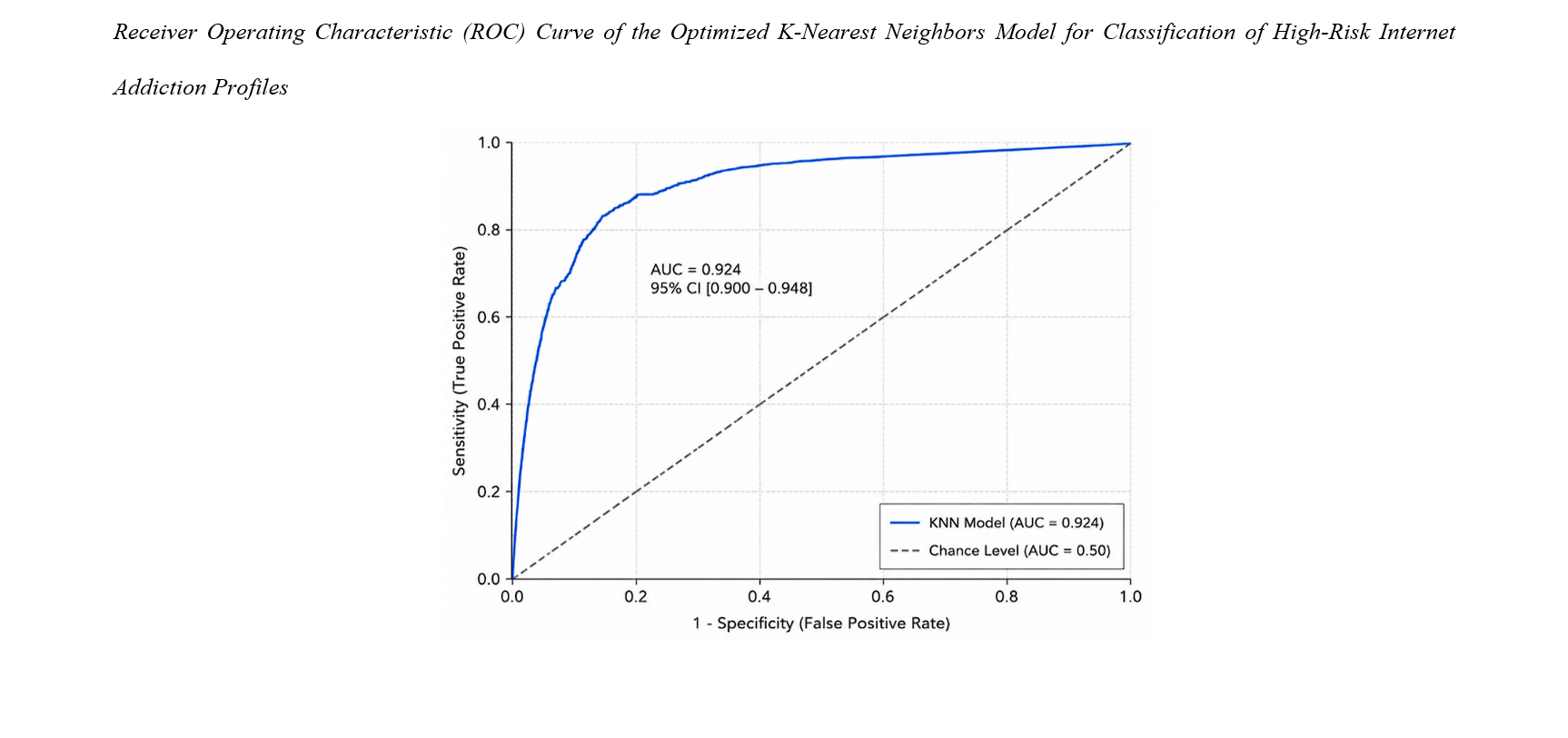
Findings: The optimized KNN model demonstrated strong inferential and predictive performance in classifying adolescent internet addiction risk. The final model achieved an accuracy of 88.72%, precision of 85.91%, recall of 83.47%, specificity of 90.84%, F1-score of 84.67%, AUC-ROC of 0.924, and Cohen’s kappa of 0.742. The confusion matrix showed that the model correctly classified 171 low-risk adolescents and 57 high-risk adolescents, with 17 false positives and 12 false negatives. Hyperparameter optimization indicated that the strongest model performance was obtained with k = 11 using the Euclidean distance metric. Permutation importance analysis identified impulsivity as the strongest predictor, followed by parental monitoring, loneliness, and sleep quality.
Conclusion: The findings indicate that K-Nearest Neighbors classification can accurately identify high-risk internet addiction profiles among adolescents using a concise set of psychological, sleep-related, and family-based predictors.
Downloads
References
Agrawal, M., Rajaram, S., & Kumar, G. R. (2024). Internet Addiction and Psychological Health in Adolescent Indian Medical Students: A Cross-Sectional Study. Basic and Clinical Neuroscience Journal, 15(4), 477-488. https://doi.org/10.32598/bcn.2021.3295.2
Bottaro, R., & Faraci, P. (2022). The Use of Social Networking Sites and Its Impact on Adolescents’ Emotional Well-Being: A Scoping Review. Current Addiction Reports, 9(4), 518-539. https://doi.org/10.1007/s40429-022-00445-4
Çelik, O., YalÇIn, R. Ü., & Eşkısu, M. (2024). A Mixture Modeling of the Behavioral Activation System and Problematic Internet Use in Adolescents: The Role of Metacognition, Online Dissociation, and Insomnia. Scandinavian journal of psychology, 66(3), 355-369. https://doi.org/10.1111/sjop.13091
Chatterjee, D., & Rai, R. (2023). Behind the Screens: Proposing a Mentalization-Based Theoretical Model of Problematic Internet Use. Cyberpsychology Journal of Psychosocial Research on Cyberspace, 17(5). https://doi.org/10.5817/cp2023-5-6
Chen, C., Yang, C., & Nie, Q. (2021). Social-Emotional Learning Competencies and Problematic Internet Use Among Chinese Adolescents: A Structural Equation Modeling Analysis. International journal of environmental research and public health, 18(6), 3091. https://doi.org/10.3390/ijerph18063091
Eşkısu, M., Boysan, M., & Çam, Z. (2023). A Mixture Modeling of the Predictors of Internet Addiction: Cognition and Dissociation. Psychological Reports, 127(5), 2262-2286. https://doi.org/10.1177/00332941221149180
Garcia, B. T., Oliveira, D. L. D., Merlotto, A. C., Domingos, F. C., Cavicchioli, S. d. A., Fernandes, A. C. P., & Siqueira, A. C. (2024). The Impact of the Abuse of Electronic Games in Children and Adolescents: Scoping Review. Brazilian Journal of Health Review, 7(1), 111-133. https://doi.org/10.34119/bjhrv7n1-010
Ge, M. W., Hu, F. H., Jia, Y. J., Tang, W., Zhang, W. Q., Zhao, D. Y., Shen, W. Q., & Chen, H. L. (2023). The Relationship Between Loneliness and Internet or Smartphone Addiction Among Adolescents: A Systematic Review and Meta-Analysis. Psychological Reports, 128(3), 1429-1451. https://doi.org/10.1177/00332941231180119
Ghali, S., Afifi, S., Suryadevara, V., Habab, Y., Hutcheson, A., Panjiyar, B. K., Davydov, G. G., Nashat, H., & Nath, T. S. (2023). A Systematic Review of the Association of Internet Gaming Disorder and Excessive Social Media Use With Psychiatric Comorbidities in Children and Adolescents: Is It a Curse or a Blessing? Cureus. https://doi.org/10.7759/cureus.43835
Haddad, C., Malaeb, D., Sacre, H., Khalil, J. B., Khansa, W., Hajj, R. A., Kheir, N., Saade, S., Obeïd, S., & Hallit, S. (2021). Association of Problematic Internet Use With Depression, Impulsivity, Anger, Aggression, and Social Anxiety: Results of a National Study Among Lebanese Adolescents. Pediatric Investigation, 5(4), 255-264. https://doi.org/10.1002/ped4.12299
He, X., Chen, S., Yu, Q., Yang, P., & Yang, B. (2024). Correlations Between Problematic Internet Use and Suicidal Behavior Among Chinese Adolescents: A Systematic Review and Meta-Analysis. Frontiers in Psychiatry, 15. https://doi.org/10.3389/fpsyt.2024.1484809
Kabadayı, F. (2024). Smartphone Addiction, Depression, Distress, Eustress, Loneliness, and Sleep Deprivation in Adolescents: A Latent Profile and Network Analysis Approach. BMC psychology, 12(1). https://doi.org/10.1186/s40359-024-02117-6
Kim, E. L., Gentile, D. A., Choo, H., Liau, A. K., Li, D., & Khoo, A. (2023). Differential Predictors of Problematic Internet Use and Problematic Video Gaming Among School Children: A 2-Year Longitudinal Study. Technology Mind and Behavior, 4(2), 195-207. https://doi.org/10.1037/tmb0000109
Koca, F., & Saatçı, F. (2022). The Mediator Role of Fear of Missing Out in the Parent-Adolescent Relationship Quality and Problematic Internet Use. International journal of mental health and addiction, 20(3), 1897-1912. https://doi.org/10.1007/s11469-022-00822-0
Kuss, D. J., Kristensen, A. M., & López-Fernández, O. (2021). Internet Addictions Outside of Europe: A Systematic Literature Review. Computers in human Behavior, 115, 106621. https://doi.org/10.1016/j.chb.2020.106621
Kwak, Y., Kim, H., & Ahn, J. W. (2022). Impact of Internet Usage Time on Mental Health in Adolescents: Using the 14th Korea Youth Risk Behavior Web-Based Survey 2018. PLoS One, 17(3), e0264948. https://doi.org/10.1371/journal.pone.0264948
Li, X.-K., Zhan, P.-S., Chen, S.-D., & Ren, J. (2021). The Relationship Between Family Functioning and Pathological Internet Use Among Chinese Adolescents: The Mediating Role of Hope and the Moderating Role of Social Withdrawal. International journal of environmental research and public health, 18(14), 7700. https://doi.org/10.3390/ijerph18147700
Lin, W. H., & Chiao, C. (2022). Relationship Between Adverse Childhood Experiences and Problematic Internet Use Among Young Adults: The Role of the Feeling of Loneliness Trajectory. Journal of Behavioral Addictions, 11(4), 1080-1091. https://doi.org/10.1556/2006.2022.00074
Liu, S., Zhang, D., Tian, Y., Xu, B., & Wu, X. (2023). Gender Differences in Symptom Structure of Adolescent Problematic Internet Use: A Network Analysis. Child and adolescent psychiatry and mental health, 17(1). https://doi.org/10.1186/s13034-023-00590-2
Losaberidze, M., Mallorquí‐Bagué, N., Demetrovics, Z., Jiménez‐Múrcia, S., Potenza, M. N., Soborun, Y., Romero, P., Reinhardt, M., Kökönyei, G., Mestre‐Bach, G., & Czakó, A. (2025). Scars, Screens, and Stakes: Link Between Non-Suicidal Self-Injury and Problem Gambling, Problem Gaming, and Problematic Internet Use – A Systematic Review. Journal of Behavioral Addictions, 14(4), 1481-1502. https://doi.org/10.1556/2006.2025.00079
Marano, G., Lisci, F. M., Rossi, S., Marzo, E. M., Boggio, G., Brisi, C., Traversi, G., Mazza, O., Pola, R., Gaetani, E., & Mazza, M. (2025). Connected but at Risk: Social Media Exposure and Psychiatric and Psychological Outcomes in Youth. Children, 12(10), 1322. https://doi.org/10.3390/children12101322
Moreno, M. A., Binger, K., Zhao, Q., Eickhoff, J. C., Minich, M., & Uhls, Y. T. (2022). Digital Technology and Media Use by Adolescents: Latent Class Analysis. Jmir Pediatrics and Parenting, 5(2), e35540. https://doi.org/10.2196/35540
Nannatt, A., Tariang, N. M., Gowda, M., & Devassy, S. M. (2022). Family Factors Associated With Problematic Use of the Internet in Children: A Scoping Review. Indian Journal of Psychological Medicine, 44(4), 341-348. https://doi.org/10.1177/02537176221090862
Özparlak, A., Karakaya, D., Önder, A., & Günbayı, İ. (2023). Problematic Internet Use in Adolescents: A Phenomenological Study. Journal of Psychiatric and Mental Health Nursing, 30(4), 731-742. https://doi.org/10.1111/jpm.12900
Petrović, Z. K., Peraica, T., Kozarić‐Kovačić, D., & Palavra, I. R. (2022). Internet Use and Internet-Based Addictive Behaviours During Coronavirus Pandemic. Current Opinion in Psychiatry, 35(5), 324-331. https://doi.org/10.1097/yco.0000000000000804
Pontes, H. M., & Macur, M. (2021). Problematic Internet Use Profiles and Psychosocial Risk Among Adolescents. PLoS One, 16(9), e0257329. https://doi.org/10.1371/journal.pone.0257329
Rollo, S., Venuleo, C., Ferrante, L., & Picione, R. D. L. (2023). What Adolescents Have to Say About Problematic Internet Use: A Qualitative Study Based on Focus Groups. International journal of environmental research and public health, 20(21), 7013. https://doi.org/10.3390/ijerph20217013
Tóth‐Király, I., Morin, A. J. S., Hietajärvi, L., & Salmela‐Aro, K. (2021). Longitudinal Trajectories, Social and Individual Antecedents, and Outcomes of Problematic Internet Use Among Late Adolescents. Child development, 92(4), e653-e673. https://doi.org/10.1111/cdev.13525
Wang, Y., Hall, B. J., Chen, Y., & Chen, C. (2025). Latent Profiles of Problematic Internet Use and Their Six-Month Subsequent Psychopathology Outcomes. Addictive Behaviors Reports, 21, 100607. https://doi.org/10.1016/j.abrep.2025.100607
Zeyrek, İ. (2026). Behavioural Addiction and Associated Risk Factors Among High School Students. Acta Neuropsychiatrica, 38. https://doi.org/10.1017/neu.2026.10054
Downloads
Additional Files
Publication Timeline
- Submitted
- Revised
- Accepted