Predicting Romantic Relationship Instability in Emerging Adults Through LightGBM Models of Attachment Anxiety, Jealousy Cognitions, Social Media Surveillance, Emotional Dependency, and Impulsivity
DOI:
https://doi.org/10.61838/kman.jayps.5444Keywords:
Romantic relationship instability, attachment anxiety, jealousy cognitions, social media surveillance, emotional dependency, impulsivity, LightGBM, machine learning, emerging adultsAbstract
Objective: The present study aimed to predict romantic relationship instability in emerging adults through Light Gradient Boosting Machine (LightGBM) models based on attachment anxiety, jealousy cognitions, social media surveillance, emotional dependency, and impulsivity.
Methods and Materials: The study employed a cross-sectional predictive correlational design using machine learning methodology. The statistical population consisted of emerging adults aged 18 to 29 years residing in major urban regions of Canada during 2025–2026. A total of 1,137 participants were selected through online and university-based recruitment procedures. Data were collected using the Relationship Stability Scale, Experiences in Close Relationships-Revised questionnaire, Multidimensional Jealousy Scale, Social Media Surveillance Scale, Emotional Dependency Questionnaire, and Barratt Impulsiveness Scale-Version 11. Data analysis was conducted using Python and machine learning libraries including Scikit-learn and LightGBM. The dataset was divided into training and testing subsets using an 80/20 split procedure. Model performance was evaluated using accuracy, precision, recall, F1-score, area under the curve (AUC), and log-loss indices. SHAP analysis was additionally used to examine predictor importance and model interpretability.
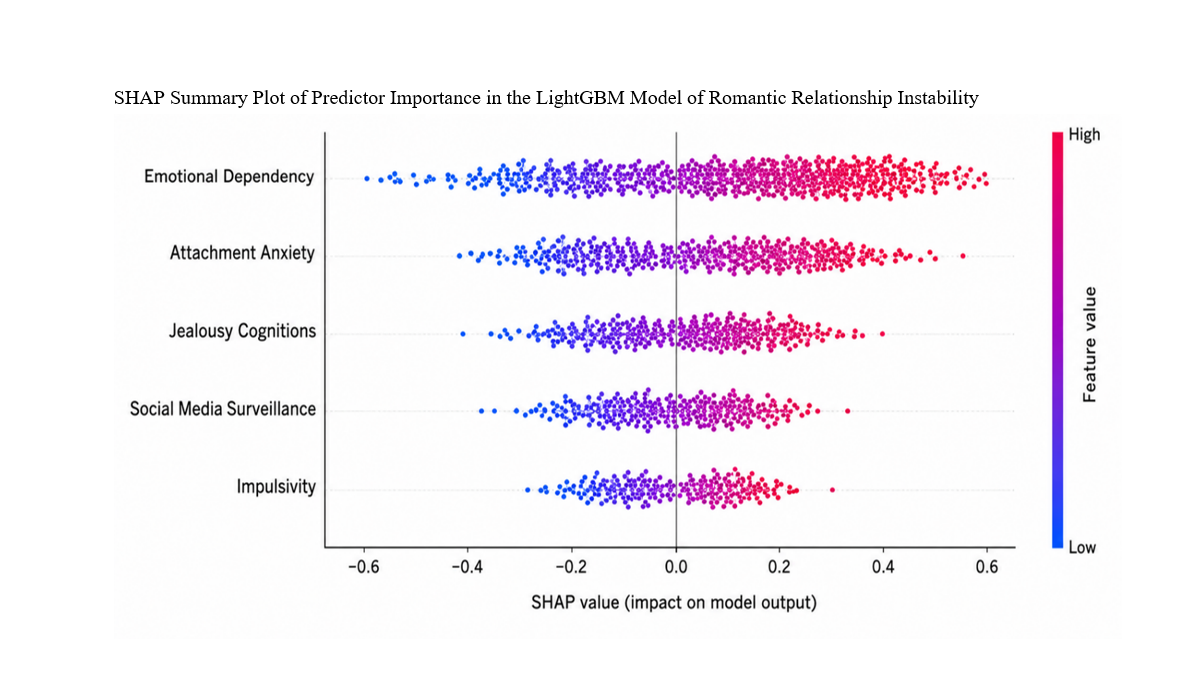
Findings: The findings demonstrated significant positive correlations among all study variables and romantic relationship instability. Emotional dependency showed the strongest correlation with relationship instability, followed by attachment anxiety, jealousy cognitions, social media surveillance, and impulsivity (p < 0.01). The LightGBM model demonstrated high predictive performance with a testing accuracy of 0.88 and an AUC value of 0.91, indicating excellent discriminative ability. SHAP analysis revealed that emotional dependency and attachment anxiety were the most influential predictors of romantic instability. Hierarchical regression analysis further indicated that the predictor variables collectively explained 67% of the variance in relationship instability (R² = 0.67, p < 0.001).
Conclusion: The findings suggest that romantic relationship instability among emerging adults is strongly associated with emotional insecurity, maladaptive jealousy cognitions, impulsive tendencies, and digitally mediated surveillance behaviors. The study further demonstrates that machine learning approaches such as LightGBM provide powerful tools for identifying complex nonlinear interaction patterns underlying romantic dysfunction. These findings highlight the importance of addressing attachment insecurity, emotional dependency, and unhealthy digital relational behaviors in prevention and intervention programs targeting young adults’ romantic well-being.
Downloads
References
Ashdown, B. K., Hackathorn, J., Barclay, L., Browning, H., & Elysee, M. (2021). Surveilling and Spying on Romantic Partners in the United States: The Influence of Perceived Maternal Rejection and Psychological Maladjustment. Journal of Social Psychology Research, 1-17. https://doi.org/10.37256/jspr.112022952
Black, A. E. (2023). Responding to Threatening Online Alternatives: Perceiving the Partner’s Commitment Through Their Social Media Behaviors. Journal of Social and Personal Relationships, 41(5), 1091-1112. https://doi.org/10.1177/02654075231186960
Chugh, R., & Guggisberg, M. (2020). Stalking and Other Forms of Dating Violence: Lessons Learned From You in Relation to Cyber Safety. Journal of interpersonal violence, 37(9-10), NP6760-NP6784. https://doi.org/10.1177/0886260520966674
Civilotti, C., Sciascia, C., Zaccagnino, M., Varetto, A., & Maran, D. A. (2020). States of Mind With Respect to Adult Attachment and Reflective Functioning in a Sample of Men Detained for Stalking: Evaluation and Clinical Implications. Sage Open, 10(4). https://doi.org/10.1177/2158244020962820
Çulfa, E., & Izgı, F. D. (2023). An Examination of Jealousy and Relationship Satisfaction in Romantic Relationships. Plic(8), 179-191. https://doi.org/10.31039/plic.2023.8.181
Degiuli, P., Andreis, L., & Vučenović, D. (2023). The Relationship Between Jealousy and Mate Retention Strategies in Romantic Relationships Among Women During the COVID-19 Pandemic. https://doi.org/10.20944/preprints202310.1249.v1
Deng, M., Tadesse, E., Khalid, S., Zhang, W., Song, J., & Gao, C. (2023). The Influence of Insecure Attachment on Undergraduates’ Jealousy: The Mediating Effect of Self-Differentiation. Frontiers in psychology, 14. https://doi.org/10.3389/fpsyg.2023.1153866
Ergun‐Basak, B. (2025). Digital Violence in Dating Relationships of University Students: A Study Through the Victims' Perspectives. Personal Relationships, 32(3). https://doi.org/10.1111/pere.70030
Farajİ, H., & BaŞÇElİK, E. (2023). Borderline Personality Traits, Love Myhts, and Love Styles. İnsan Ve Toplum Bilimleri Araştırmaları Dergisi, 12(5), 2421-2441. https://doi.org/10.15869/itobiad.1184203
Fernandes, M. I. A., Sousa, C., Conde, A. R., Silva, F. F. d., & Ferreira, M. J. (2023). Exploring the Relationship Between Capacity to Love and Well-Being: A Comparative Study of Emerging Adults and Middle-Aged Adults. Sexuality & Culture, 28(4), 1424-1445. https://doi.org/10.1007/s12119-023-10184-x
Fernández, A. M., Barbato, M. T., Barone, P., Zavalla, B. C., Rivera-Ottenberger, D., & Guzmán‐González, M. (2025). What Is the Link of Closeness and Jealousy in Romantic Relationships? Behavioral Sciences, 15(2), 132. https://doi.org/10.3390/bs15020132
Ferraro, I. K., & Taylor, A. (2021). Adult Attachment Styles and Emotional Regulation: The Role of Interoceptive Awareness and Alexithymia. Personality and individual differences, 173, 110641. https://doi.org/10.1016/j.paid.2021.110641
Ghasemi, F., Namdarpour, F., & Gorji, Y. (2024). Factors of Staying in Abusive Emotional Relationships of Iranian Girls: A Qualitative Study. https://doi.org/10.21203/rs.3.rs-5410409/v1
Gubler, D. A., Schlegel, K., Richter, M., Kapanci, T., & Troche, S. J. (2023). The Green-Eyed Monster in Social Media – Development and Validation of a Digital Jealousy Scale. Psychological Test Adaptation and Development, 4(1), 13-27. https://doi.org/10.1027/2698-1866/a000033
Haack, K. R., Comandulli, B. T., & Falcke, D. (2023). Attachment, Jealousy, and Conjugal Violence. Psicologia Teoria E Pesquisa, 39. https://doi.org/10.1590/0102.3772e39413.en
Hapon, N., Vovk, A., Snyadanko, I., & Fedyna, L. (2021). Ontological Security of an Individual: Attachment Styles and Coping Strategies. Journal of Education Culture and Society, 12(2), 317-329. https://doi.org/10.15503/jecs2021.2.317.329
Huda, F. F., & Lestari, F. D. (2024). Attachment Styles and Coping Mechanisms in Solomon &Amp; Gaenor and Cin(T)A: A Comparative Study. Suar Betang, 19(1), 85-101. https://doi.org/10.26499/surbet.v19i1.14808
Ibrahim, M., Palit, M., & Matthews, R. (2023). Intergenerational Attachment Styles, Emotional Regulation and Relational Outcomes in Couples Therapy. https://doi.org/10.5772/intechopen.108492
Iria de la Osa, S., Astray, A. A., Fernandez, P. V. M., & Dios-Duarte, M. J. d. (2024). IPVAW Male Perpetrators Convicted in Spain: A Typology and Characterization Based on Latent Class Analysis. Frontiers in psychology, 15. https://doi.org/10.3389/fpsyg.2024.1353809
İyiaydın, A. A., Toplu‐Demirtaş, E., Kayabol, N. B. A., & Fincham, F. D. (2020). I Ruminate Therefore I Violate: The Tainted Love of Anxiously Attached and Jealous Partners. Journal of interpersonal violence, 37(9-10), NP7129-NP7155. https://doi.org/10.1177/0886260520967743
Laforte, S., Paradis, A., Todorov, E. H., & Cyr, C. (2023). Romantic Attachment and Cyber Dating Violence in Adolescence: A Dyadic Approach. Journal of adolescence, 95(4), 647-660. https://doi.org/10.1002/jad.12141
Lantagne, A., & Furman, W. (2020). More Than the Sum of Two Partners: A Dyadic Perspective on Young Adult Physical Dating Aggression. Psychology of violence, 10(4), 379-389. https://doi.org/10.1037/vio0000267
Métellus, S., Vaillancourt‐Morel, M. P., Brassard, A., & Daspe, M. È. (2025). Attachment Anxiety and Relationship Satisfaction in the Digital Era: The Contribution of Social Media Jealousy and Electronic Partner Surveillance. Journal of marital and family therapy, 51(4). https://doi.org/10.1111/jmft.70074
Misirli, M., & Kaynak, G. K. (2023). Relationship Obsessive Compulsive Disorder: A Systematic Review. Psikiyatride Guncel Yaklasimlar - Current Approaches in Psychiatry, 15(4), 549-561. https://doi.org/10.18863/pgy.1204303
Ni, N., Ahrari, S., Zaremohzzabieh, Z., Zarean, M., & Roslan, S. (2025). A Meta-Analytic Study of Partner Phubbing and Its Antecedents and Consequences. Frontiers in psychology, 16. https://doi.org/10.3389/fpsyg.2025.1561159
Richter, M., Schlegel, K., Thomas, P., & Troche, S. J. (2022). Adult Attachment and Personality as Predictors of Jealousy in Romantic Relationships. Frontiers in psychology, 13. https://doi.org/10.3389/fpsyg.2022.861481
Rodríguez‐deArriba, M. L., Caridade, S., Rey, R. D., & Sánchez, V. (2024). Longitudinal Predictors of Online Dating Aggression: Similarities and Differences Between Control and Intrusiveness. Cyberpsychology Journal of Psychosocial Research on Cyberspace, 18(1). https://doi.org/10.5817/cp2024-1-1
Shanoora, A., Halimatusaadiah, H., Abdullah, H., & Khir, A. M. (2025). Parent-Child Attachment and Romantic Relationship: Is There a Relationship Between Parent-Child Attachment and Young Adults’ Romantic Relationships? MNJR, 11(Special Issue), 117-135. https://doi.org/10.62338/hdm20528
Stöven, L. M., & Herzberg, P. Y. (2020). Relationship 2.0: A Systematic Review of Associations Between the Use of Social Network Sites and Attachment Style. Journal of Social and Personal Relationships, 38(3), 1103-1128. https://doi.org/10.1177/0265407520982671
Sullivan, K. T. (2021). Attachment Style and Jealousy in the Digital Age: Do Attitudes About Online Communication Matter? Frontiers in psychology, 12. https://doi.org/10.3389/fpsyg.2021.678542
Tandon, A., Dhir, A., & Mäntymäki, M. (2021). Jealousy Due to Social Media? A Systematic Literature Review and Framework of Social Media-Induced Jealousy. Internet Research, 31(5), 1541-1582. https://doi.org/10.1108/intr-02-2020-0103
Toplu‐Demirtaş, E., Kayabol, N. B. A., Aracı‐İyiaydın, A., & Fincham, F. D. (2020). Unraveling the Roles of Distrust, Suspicion of Infidelity, and Jealousy in Cyber Dating Abuse Perpetration: An Attachment Theory Perspective. Journal of interpersonal violence, 37(3-4), NP1432-NP1462. https://doi.org/10.1177/0886260520927505
Vaillancourt, T., Brittain, H., Eriksson, M. J., Krygsman, A., Farrell, A. H., Davis, A. C., Volk, A. A., & Arnocky, S. (2024). Social Media Friendship Jealousy. Evolutionary Psychology, 22(1). https://doi.org/10.1177/14747049231225738
Ventura‐León, J., Reyes, A., Tocto‐Muñoz, S., Gamboa‐Melgar, G., Ruiz‐Castro, J., & Lino‐Cruz, C. (2025). Exploring Infidelity Behavior Patterns in a Sample of Peruvian Young Adults: A Latent Class Analysis. Journal of marital and family therapy, 51(4). https://doi.org/10.1111/jmft.70066
Waffa, F. R., & Pitigala, K. (2024). How Attachment Styles Influence Emotional Regulation of Young Adults in Srilanka. British Journal of Multidisciplinary and Advanced Studies, 5(1), 57-84. https://doi.org/10.37745/bjmas.2022.0436
Wildey, M. N. (2026). Wired for Cognitive Jealousy? Unveiling the Stability Within and Fluctuations Between Relationships. Personal Relationships, 33(1). https://doi.org/10.1111/pere.70051
Downloads
Additional Files
Publication Timeline
- Submitted
- Revised
- Accepted