Random Forest Prediction of Adolescent Risk-Taking Behaviors Based on Sensation Seeking, Online Disinhibition, Emotional Impulsivity, Peer Deviance, and Executive Dysfunction
DOI:
https://doi.org/10.61838/kman.jayps.5479Keywords:
Adolescent Risk-Taking, Random Forest, Emotional Impulsivity, Online Disinhibition, Peer Deviance, Executive Dysfunction, Sensation Seeking, Machine Learning, Adolescents, Behavioral PredictionAbstract
Objective: The present study aimed to predict adolescent risk-taking behaviors using a Random Forest machine learning model based on sensation seeking, online disinhibition, emotional impulsivity, peer deviance, and executive dysfunction among adolescents in Argentina.
Methods and Materials: The study employed a cross-sectional predictive-correlational design with a machine learning framework. The statistical population consisted of Argentine adolescents enrolled in secondary schools in Buenos Aires, Córdoba, and Rosario during the 2025–2026 academic year. Using multistage cluster sampling, 1,284 adolescents aged 14 to 18 years were selected. Data were collected using the Adolescent Risk-Taking Questionnaire, Brief Sensation Seeking Scale, Online Disinhibition Scale, UPPS-P Negative Urgency Subscale, Peer Deviance Scale, and the Behavior Rating Inventory of Executive Function. Preliminary statistical analyses were conducted using SPSS-28, while the Random Forest predictive model was implemented in Python using the Scikit-learn library. Data were divided into training and testing subsets using an 80/20 split procedure. Model performance was evaluated through accuracy, precision, recall, F1-score, area under the curve (AUC), cross-validation scores, and SHAP feature-importance analyses.
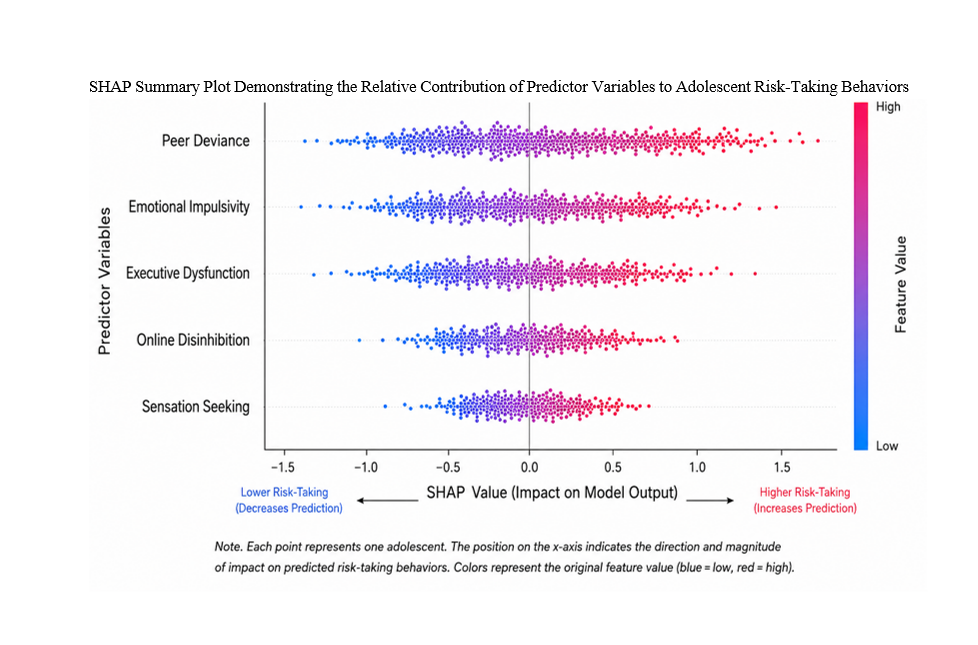
Findings: The findings demonstrated significant positive correlations among all study variables. Peer deviance showed the strongest positive association with adolescent risk-taking behaviors, followed by emotional impulsivity and executive dysfunction. The Random Forest model demonstrated strong predictive performance, with testing accuracy of 0.87 and AUC of 0.90, indicating excellent classification capability. Feature importance analysis revealed that peer deviance was the most influential predictor, followed respectively by emotional impulsivity, executive dysfunction, online disinhibition, and sensation seeking. SHAP analyses further indicated substantial interaction effects among emotional, cognitive, and social variables in predicting adolescent risk-taking behaviors.
Conclusion: The findings suggest that adolescent risk-taking behaviors emerge through complex interactions among emotional dysregulation, cognitive-control deficits, peer-related influences, and digital behavioral tendencies. The strong performance of the Random Forest model highlights the usefulness of machine learning approaches for identifying high-risk adolescents and understanding multidimensional psychosocial predictors of maladaptive behaviors. Early prevention efforts targeting emotional impulsivity, executive dysfunction, peer deviance, and online disinhibition may contribute significantly to reducing behavioral risk among adolescents.
Downloads
References
Antón‐Toro, L. F., Bruña, R., Cerro‐León, A. d., Shpakivska, D., Gordo, P. M., Porras‐Truque, C., Gómez, R. G., Maestú, F., & García‐Moreno, L. M. (2022). Electrophysiological Resting‐state Hyperconnectivity and Poorer Behavioural Regulation as Predisposing Profiles of Adolescent Binge Drinking. Addiction Biology, 27(4). https://doi.org/10.1111/adb.13199
Araújo, E., Oliveira, C., Cruz, O., & Moreira, D. (2025). Psychopathic Traits, Antisocial Behavior, and Maladaptive Beliefs of Young Adults. European Psychologist, 30(1), 49-57. https://doi.org/10.1027/1016-9040/a000545
Bertoldi, B. M., Tuvblad, C., Joyner, K. J., Ganley, C. M., Raine, A., Baker, L. A., Latvala, A., Oskarsson, S., & Patrick, C. J. (2022). Role of Triarchic Traits in Relations of Early Resting Heart Rate With Antisocial Behavior and Broad Psychopathology Dimensions in Later Life. Clinical Psychological Science, 11(1), 90-105. https://doi.org/10.1177/21677026221081880
Billen, E., Garofalo, C., & Bogaerts, S. (2022). Self-Regulation All Bass-Ackwards: Similarities and Differences in Component Structure in Community and Forensic Psychiatric Populations. Psychological assessment, 34(3), 247-260. https://doi.org/10.1037/pas0001089
Cavicchioli, M., Mambreani, J., Conti, G., Mazoli, S., Galli, F., & Begarani, M. (2025). The Therapeutic Community Integrated With a DBT Skills Training Program for Substance Use Disorders: The Initial Efficacy for the Treatment of Impulsivity and Related Dimensions. Journal of Clinical Psychology, 81(7), 628-642. https://doi.org/10.1002/jclp.23799
Cheng, Y. (2023). The Impact of Social Media on Deviance and Crime. Journal of Education Humanities and Social Sciences, 22, 873-877. https://doi.org/10.54097/ehss.v22i.14555
Dargis, M., Patrick, C. J., & Blonigen, D. M. (2022). Relevance of Psychopathic Traits to Therapeutic Processes and Outcomes for Veterans With Substance Use Disorders. Personality Disorders Theory Research and Treatment, 13(1), 64-74. https://doi.org/10.1037/per0000485
DeMarsico, D., Bounoua, N., Miglin, R., & Sadeh, N. (2021). Aggression in the Digital Era: Assessing the Validity of the Cyber Motivations for Aggression and Deviance Scale. Assessment, 29(4), 764-781. https://doi.org/10.1177/1073191121990088
El‐Ashry, A. M., El‐Sayed, M. M., Elhay, E. S. A., Taha, S. M., Atta, M. H. R., Hammad, H. A., & Khedr, M. A. (2024). Hooked on Technology: Examining the Co-Occurrence of Nomophobia and Impulsive Sensation Seeking Among Nursing Students. BMC Nursing, 23(1). https://doi.org/10.1186/s12912-023-01683-1
Gullo, M. J., Loxton, N. J., Lindsay, H. J., & Mendes, R. (2023). Losing Control in Controlled Settings: Preclinical Human Research on Impulsivity Within the Context of Addiction. Current Addiction Reports, 10(3), 519-542. https://doi.org/10.1007/s40429-023-00507-1
Hiraoka, T., & Yagi, M. (2023). The Pathogenesis of Disinhibition in Patients With Traumatic Brain Injury: A Two Patient Case Report. Brain Sciences, 13(8), 1227. https://doi.org/10.3390/brainsci13081227
Hudon, A., Harvey, E., Nicolas, S., Dufour, M., Guérin-Thériault, C., Bérubé-Fortin, J., Combey, I., Yue, Y. C., Perreault, A., Pagé, S. B., & MacDermott, V. (2025). Cyberpsychopathy: A Multidimensional Framework for Understanding Psychopathic Traits in Digital Environments. European Journal of Investigation in Health Psychology and Education, 15(6), 107. https://doi.org/10.3390/ejihpe15060107
Jensen, M., Weinstein, M., Brown, M. T., & Navarro, J. (2022). Digital Media in Adolescent Health Risk and Externalizing Behaviors. 264-299. https://doi.org/10.1017/9781108976237.015
Joyner, K. J., Daurio, A. M., Perkins, E. R., Patrick, C. J., & Latzman, R. D. (2021). The Difference Between Trait Disinhibition and Impulsivity—and Why It Matters for Clinical Psychological Science. Psychological assessment, 33(1), 29-44. https://doi.org/10.1037/pas0000964
Kar, D., Goyal, N., & Tarafder, S. (2023). Understanding Impulsivity Through P300 Among Clinical Population: A Systematic Review. PSMPH. https://doi.org/10.56831/psmph-03-078
Karabatak, O. (2023). Cognitive Behavioral Therapy (CBT) for Criminal Behaviors. https://doi.org/10.5772/intechopen.1002039
Kim, K. H. (2025). The 7 Muses of Neuro-Creative Cycle: How Some Patients With Parkinson's Disease Can Unleash Latent Creativity. AIMS Neuroscience, 12(2), 250-283. https://doi.org/10.3934/neuroscience.2025014
Lenzenweger, M. F., Patrick, C. J., Watts, A. L., Latzman, R. D., & Depue, R. A. (2022). Reflections on the Personality and Psychopathology Interface in Honor of Scott O. Lilienfeld: Toward Illuminating the Nature of the Processes Underlying Personality Disturbances. Clinical Psychological Science, 11(4), 641-665. https://doi.org/10.1177/21677026221125684
Li, Q., Cao, L., Lai, X., Tao, R., Xiao, J., Hou, X., Zhang, Y., Dai, B., & Hu, K. (2023). Sensation Seeking and Internet Addiction in Adolescents: Moderating and Mediating Mechanisms. https://doi.org/10.21203/rs.3.rs-3685968/v1
MacKenzie, H. M., Flores‐Sandoval, C., Bateman, E. A., McIntyre, A., Barua, U., Mehta, S., Bayley, M., & Teasell, R. (2024). Evidence-Based Review of Randomized Controlled Trials of Interventions for the Management of Behavioral Issues in Individuals With Moderate to Severe Traumatic Brain Injury. Journal of Head Trauma Rehabilitation, 39(5), 369-381. https://doi.org/10.1097/htr.0000000000000971
Mansharamani, H., Mansharamani, B., Behere, P. B., Nagdive, A., & Mansharamani, D. (2023). Personality Traits in Children Of Alcoholic Parents. https://doi.org/10.5772/intechopen.106961
María del Mar Simón, M., Gea, S. F., María del Mar Molero, J., Moreno, P. M., & María del Carmen Pérez, F. (2025). Addictions and Risk Behaviors in Adolescence: A Systematic Review and Qualitative Analysis. Frontiers in psychology, 16. https://doi.org/10.3389/fpsyg.2025.1646746
Mazza, M., Lisci, F. M., Marzo, E. M., Masi, V. D., Abate, F., & Marano, G. (2025). Why Do They Do It? The Psychology Behind Antisocial Behavior in Children and Adolescents. Pediatric Reports, 17(2), 26. https://doi.org/10.3390/pediatric17020026
Moreira, D., Barbosa, F., Sousa‐Gomes, V., & Fávero, M. (2022). Childhood Traumatic Experiences and Psychopathy: A Comprehensive Review. Psychological Trauma Theory Research Practice and Policy, 14(8), 1281-1287. https://doi.org/10.1037/tra0001191
Peris, M., Barrera, U. d. l., Schoeps, K., & Montoya‐Castilla, I. (2020). Psychological Risk Factors That Predict Social Networking and Internet Addiction in Adolescents. International journal of environmental research and public health, 17(12), 4598. https://doi.org/10.3390/ijerph17124598
Rezapour, T., Rafei, P., Baldacchino, A., Conrod, P., Dom, G., Fishbein, D., Kazemi, A., Hendriks, V. M., Newton, N. C., Riggs, N. R., Squeglia, L. M., Teesson, M., Vassileva, J., Verdejo‐García, A., & Ekhtiari, H. (2022). Neuroscience-Informed Classification of Prevention Interventions in Substance Use Disorders: An RDoC-based Approach. https://doi.org/10.1101/2022.09.28.22280342
Satchell, L., Corr, P. J., & Latzman, R. D. (2021). Pirates With Psychopathic Personalities? The Role of Sub-Clinical and Normative Traits in Illegal Streaming and Downloading of Media. https://doi.org/10.31234/osf.io/gucr5
Shaji, J., S, A. D., Iype, J. E., Shajahan, F., & Rajan, P. (2023). Relationship Between Sensation Seeking and Irritability Among College Students. International Journal of Engineering Technology and Management Sciences, 7(4), 513-520. https://doi.org/10.46647/ijetms.2023.v07i04.068
Sharma, M. K., Anand, N., Kumar, K., Singh, R. L., Thakur, P. C., Mondal, I., & Kohli, T. (2021). Constructing the Understanding of Teenagers Deviant Use of Cyberspace. International Journal of Social Psychiatry, 67(8), 1068-1071. https://doi.org/10.1177/0020764020975791
Siraj, R., Najam, B., & Ghazal, S. (2021). Sensation Seeking, Peer Influence, and Risk-Taking Behavior in Adolescents. Education Research International, 2021, 1-8. https://doi.org/10.1155/2021/8403024
Skromanis, S., Padgett, C., Matthewson, M., & Honan, C. A. (2022). Social Disinhibition in Acquired Brain Injury and Neurological Disease: A Concept Analysis. Brain Impairment, 24(3), 529-547. https://doi.org/10.1017/brimp.2022.23
Tan, H. X., Adam Harrish bin Md, K., Thurairajasingam, S., & Phipps, M. E. (2023). Addressing Emotional Dysregulation and Potential Pharmacogenetic Implication of 5-HTTLPR Genotype in Attention Deficit Hyperactivity Disorder. Complex Psychiatry, 9(1-4), 70-88. https://doi.org/10.1159/000529732
Tiego, J., Arnatkevičiūtė, A., Palmer, A. A., Sanchez‐Roige, S., Walters, G. B., Bellgrove, M. A., & Fornito, A. (2022). Precision Phenotyping to Uncover the Latent Structure and Genetic Correlates of Impulsivity. https://doi.org/10.31219/osf.io/x86cz
Wallace, L., Heym, N., Sumich, A., & Fido, D. (2020). A Systematic Review on the Current Conceptualisations of Successful Psychopathy. https://doi.org/10.31234/osf.io/wkjrm
Downloads
Additional Files
Publication Timeline
- Submitted
- Revised
- Accepted