Comparison of the Effectiveness of Mentalization-Based Therapy and Emotion Efficacy-Based Therapy on Cognitive Insight and Distress Tolerance in Adolescents with Generalized Anxiety Symptoms
DOI:
https://doi.org/10.61838/Keywords:
Mentalization-Based Therapy, Emotion Efficacy-Based Therapy, Cognitive Insight, Distress Tolerance, Generalized Anxiety Symptoms, Adolescents.Abstract
Objective: The present study aimed to compare the effectiveness of Mentalization-Based Therapy and Emotion Efficacy-Based Therapy on cognitive insight and distress tolerance among adolescents with generalized anxiety symptoms.
Methods and Materials: This study was applied in terms of purpose and quasi-experimental in terms of methodology, utilizing a pretest–posttest design with two experimental groups and one control group. The statistical population consisted of male and female adolescents with generalized anxiety symptoms in Shiraz during 2025. The sample included 45 adolescents selected through convenience sampling and randomly assigned into three groups of 15 participants each. The first experimental group received Mentalization-Based Therapy, the second experimental group received Emotion Efficacy-Based Therapy, and the control group received no intervention. Data collection instruments included the Beck Cognitive Insight Scale, the Distress Tolerance Scale, and the Generalized Anxiety Disorder Questionnaire (GAD-7). The interventions were implemented over eight weekly 90-minute sessions. Data were analyzed using descriptive statistics and multivariate analysis of covariance (MANCOVA) in IBM SPSS Statistics.
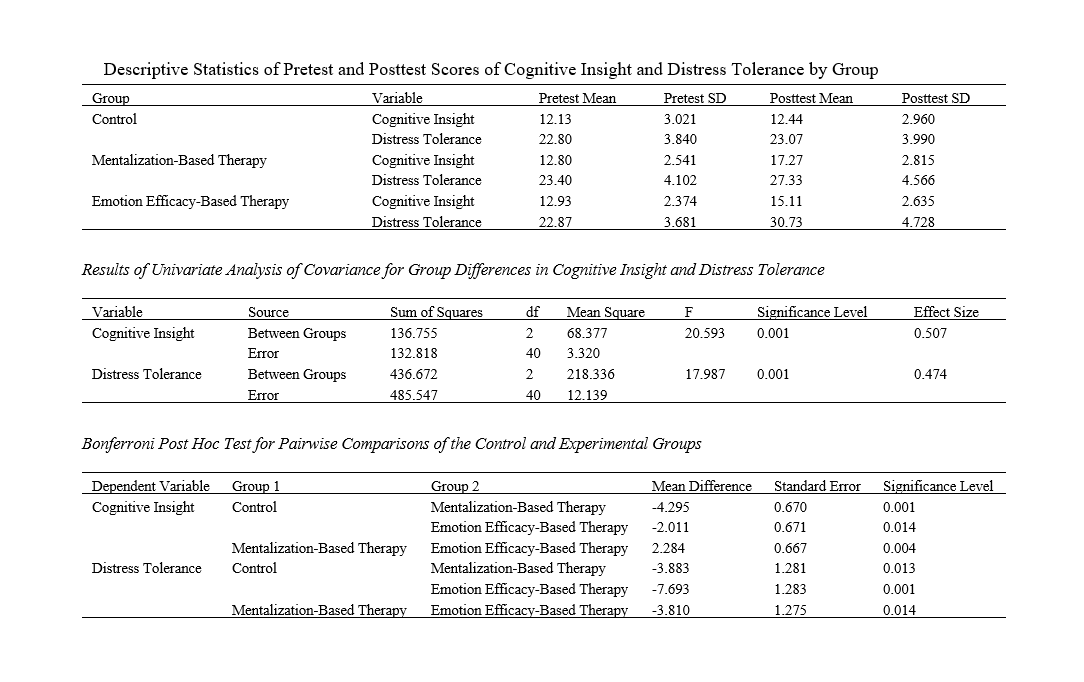
Findings: The results indicated significant differences between the experimental and control groups in cognitive insight and distress tolerance (Wilks’ Lambda = 0.266, F₄,₇₈ = 18.293, p < .01). Univariate covariance analysis demonstrated that both Mentalization-Based Therapy and Emotion Efficacy-Based Therapy significantly improved cognitive insight (F₂,₄₀ = 20.593, p < .001, η² = 0.507) and distress tolerance (F₂,₄₀ = 17.987, p < .001, η² = 0.474) compared to the control group. Bonferroni post hoc comparisons further revealed that Mentalization-Based Therapy was significantly more effective than Emotion Efficacy-Based Therapy in enhancing cognitive insight (p < .01), whereas Emotion Efficacy-Based Therapy demonstrated greater effectiveness in improving distress tolerance (p < .05).
Conclusion: These results emphasize the importance of selecting therapeutic interventions based on the primary psychological needs and treatment goals of adolescents with generalized anxiety symptoms.
Downloads
References
Allen, J. G., & Fonagy, P. (2006). Mentalization-Based Treatment for Borderline Personality Disorder. Guilford Press.
Azadbakht, M., Momeni, K., & Yazdanbakhsh, K. (2024). The Role of Childhood Fears and Behavioral Brain Systems in Adolescent Obsessive-Compulsive Disorder: An Evolutionary Model Based on the Mediation of Intolerance of Uncertainty. Iranian Journal of Evolutionary Educational Psychology, 6(2), 20-38.
Barabadi, E., Flett, G. L., Hewitt, P. L., Razmjoo, S. A., Rahmani Tabar, M., & Chasetareh, F. (2024). Trait Perfectionism, L2 Anxiety, and Willingness to Communicate among Adolescents: Evaluating the Roles of Worrying about Mistakes and Mistake Rumination. Journal of Psychoeducational Assessment, 42(6), 668-684.
Bateman, A., & Fonagy, P. (2018). Handbook of Mentalizing in Mental Health Practice (2nd ed.). American Psychiatric Association Publishing.
Bayrami, R., Moghadam Tabrizi, F., Talebi, E., & Ebrahimi, S. (2019). Investigating the Relationship between Fear of Missing Out and Social Network Use among Students of Urmia University of Medical Sciences. Journal of Nursing and Midwifery, 17(5), 376-383.
Beck, A. T., Baruch, E. H., Balter, J. M., Steer, R. A., & Warman, D. M. (2004). Reliability and Validity of the Beck Cognitive Insight Scale in Psychiatric Patients. Psychological assessment, 16(4), 405-416.
Cripps, L. D., & Hudson, J. L. (2018). Emotional Efficacy Therapy for Adolescents. Academic Press.
Delavar, A. (2011). Statistical Methods in Psychology and Educational Sciences. Virayesh Publications.
Freeston, M. H., Rheaume, J., Letarte, H., Dugas, M. J., & Ladouceur, R. (1994). Why Do People Worry? Personality and individual differences, 17(6), 791-802.
Jeong, S. (2025). The Effect of Intolerance of Uncertainty on Smartphone Overdependence in College Students: The Mediating Effects of Anxiety and Rumination Gwangju University]. South Korea.
Karimi, Y., Mohammadi, N., & Hosseini, S. (2024). The Mediating Role of Rumination in the Relationship between Maladaptive Perfectionism and Social Anxiety Symptoms in Adolescents: A Structural Equation Modeling Study. Quarterly Journal of Research in Psychological Health, 18(1), 45-62.
Kraus, S., Hernandez, C., & Batthyany, K. (2025). Exploring the Components of Psychological Inflexibility in Youth with Perfectionist Traits. Journal of Adolescent and Youth Psychological Studies, 6(4), 1-12.
Leigh, E., Taylor, L., Cole, V., & Smith, P. (2025). Why Is Rumination Unhelpful in Adolescents? Two Studies Examining the Causal Role of Abstract Processing. Journal of affective disorders, 379, 213-222.
Li, X., Zeng, Z., Ma, X., Zhu, J., Guo, J., & Qin, L. (2025). How Intolerance of Uncertainty Affects Negative Emotions in Patients with Primary Glaucoma: A Chain Mediation Model. BMC psychiatry, 25(1), 1-11.
McKay, M., & West, A. (2016). Emotion Efficacy Therapy: A Brief, Exposure-Based Treatment for Emotion Regulation Integrating ACT and DBT. New Harbinger Publications.
Mohammadi, M., Tahmasian, K., & Mazaheri, M. A. (2019). Psychometric Properties of the Distress Tolerance Scale in an Iranian Sample. Quarterly Journal of Psychological Research, 12(4), 23-38.
Molaei Yasavoli, M., Fattahpour Marandi, S., & Ghasemi, S. (2022). Standardization and Psychometric Properties of the Intolerance of Uncertainty Questionnaire in Secondary School Students. Educational Measurement Quarterly, 12(11), 105-124.
Moradi, A., Mirzaei, J., & Doustani, Z. (2018). Standardization and Psychometric Properties of the Persian Version of the Hewitt and Flett Multidimensional Perfectionism Questionnaire in Students. Journal of Psychology, University of Tabriz, 12(45), 31-48.
Naderi, F., Heidari, M., & Rostami, R. (2018). Standardization and Psychometric Properties of the Generalized Anxiety Questionnaire in the Iranian Population. Journal of Psychological Sciences, 17(7), 881-892.
Perrone, M. A. (2016). #FoMO: Establishing Validity of the Fear of Missing Out Scale with an Adolescent Population Alfred University]. Alfred, NY.
Przybylski, A. K., Murayama, K., DeHaan, C. R., & Gladwell, V. (2013). Motivational, Emotional, and Behavioral Correlates of Fear of Missing Out. Computers in human Behavior, 29(4), 1841-1848.
Sarmad, Z., Bazargan, A., & Hejazi, E. (2019). Research Methods in Behavioral Sciences. Agah Publications.
Sharifi, A., Gholamrezaei, S., & Mohammadi, N. (2017). Psychometric Properties of the Persian Version of the Beck Cognitive Insight Scale in Iranian Students. Journal of Clinical Psychology, 8(3), 55-67.
Shipp, L., Leigh, E., Laverton, A., Percy, R., & Waite, P. (2025). Cognitive Aspects of Generalised Anxiety Disorder in Adolescents: Exploring Intolerance of Uncertainty, Cognitive Avoidance, and Positive Beliefs about Worry. Child Psychiatry & Human Development, 1-10.
Simons, J. S., & Gaher, R. M. (2005). The Distress Tolerance Scale: Development and Validation of a Self-Report Measure. Journal of Clinical Psychology, 61(9), 1181-1197.
Toni, C. (2023). Association between Intolerance of Uncertainty, Fear of Missing Out and Social Media Use: A Preliminary Analysis on a Nonclinical Group of Italian Adolescents University of Padua]. Italy.
Ye, H., Chen, S., Cai, Z., Jiang, N., Liu, Y., He, S., & Fan, F. (2024). Negative Life Events and Sleep Disturbance among Adolescents: Intolerance of Uncertainty as Mediator and Moderator. Sleep Medicine, 113, 79-86.
Downloads
Additional Files
Publication Timeline
- Submitted
- Revised
- Accepted