The Effectiveness of Cognitive Behavioral Therapy on Resilience and Perceived Stress in Depressed Adolescents
DOI:
https://doi.org/10.61838/Keywords:
Cognitive Behavioral Therapy, Resilience, Perceived Stress, Depression, AdolescentsAbstract
Objective: The present study aimed to determine the effectiveness of cognitive behavioral therapy on resilience and perceived stress in adolescents with depression.
Methods and Materials: This study employed a quasi-experimental design with a pretest–posttest control group structure. The statistical population consisted of adolescents with depressive disorder who were referred to counseling centers in Tehran during 2026. A total of 28 participants were selected through convenience sampling and randomly assigned into an experimental group (n=14) and a control group (n=14). Data collection was conducted using the Connor–Davidson Resilience Scale (CD-RISC) and the Perceived Stress Scale (PSS). The experimental group received cognitive behavioral therapy in eight 90-minute sessions, whereas the control group received no psychological intervention during the study period. Data were analyzed using descriptive statistics, Levene’s test, and analysis of covariance (ANCOVA).
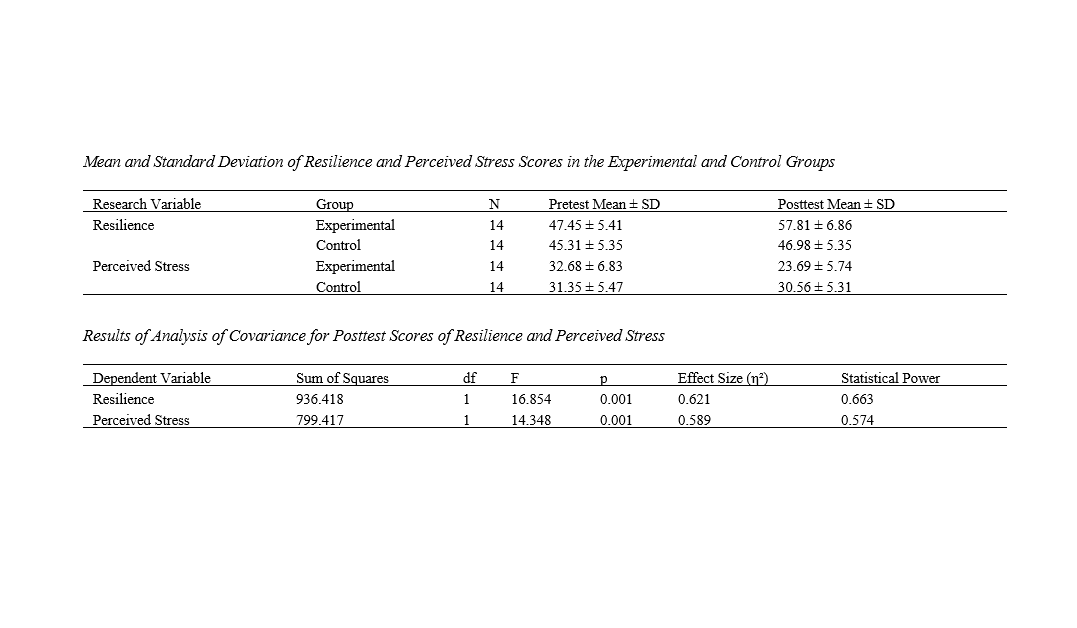
Findings: The findings demonstrated significant differences between the experimental and control groups in posttest scores of resilience and perceived stress after controlling for pretest scores. ANCOVA results indicated that cognitive behavioral therapy significantly increased resilience among depressed adolescents (F=16.854, p<0.001, η²=0.621). In addition, cognitive behavioral therapy significantly reduced perceived stress in the experimental group compared with the control group (F=14.348, p<0.001, η²=0.589). The results confirmed that participation in cognitive behavioral therapy sessions led to improved psychological adjustment and reduced stress perception among adolescents with depressive symptoms.
Conclusion: The results of the present study suggest that cognitive behavioral therapy is an effective intervention for enhancing resilience and decreasing perceived stress in depressed adolescents.
Downloads
References
Ahmadi, S. (2022). The Effect of Binaural Beat Synchronization on Depression, Sleep Quality, and Executive Functions in Individuals with Depressive Symptoms University of Mohaghegh Ardabili]. Ardabil.
Allahmoradi, M., Yaghoubi, M., Ebrahimi, F., Pourmohammadghouchani, K., & Norouziani, Z. (2026). Comparison of the Effectiveness of Cognitive Behavioral Therapy and Acceptance and Commitment Therapy on Referential Thoughts, Cognitive Flexibility, and Distress Tolerance in Patients with Major Depression. Psychological Dynamics in Mood Disorders, 1-18. https://maherpub.com/pdmd/article/view/628
Anand, D., Paquette, C., Bartuska, A., & Daughters, S. B. (2019). Substance Type Moderates the Longitudinal Association between Depression and Substance Use from Pre-Treatment through a 1-Year Follow-Up. Drug and Alcohol Dependence, 164(1), 87-94.
Arvaneh, R., & Badroud, H. (2022). Depressive Disorders in Students and Their Treatment Methods. First National Conference on Psychopathology, Ardabil.
Ashdown-Franks, G., Koyanagi, A., Vancampfort, D., Smith, L., Firth, J., & Schuch, F. (2018). Sedentary Behavior and Perceived Stress among Adults Aged 50 Years and Older in Six Low- and Middle-Income Countries. Maturitas, 116, 100-107.
Bashiri, Z. (2020). The Effectiveness of Group-Based Self-Compassion Training on Self-Efficacy, Perceived Stress, and Job Burnout among Female Teachers Shahid Chamran University of Ahvaz]. Ahvaz.
Beigi, A., Najafi, M., Mohammadifar, M. A., & Abdollahi, A. (2018). The Effectiveness of Positive Cognitive Behavioral Therapy on Resilience and Self-Esteem in Adolescents with Depressive Symptoms. Behavioral Sciences Research, 16(1), 47-53.
Belotto-Silva, C., Diniz, J. B., Malavazzi, D. M., Valerio, C., Fossaluza, V., & Borcato, S. (2012). Group Cognitive-Behavioral Therapy versus Selective Serotonin Reuptake Inhibitors for Obsessive-Compulsive Disorder: A Practical Clinical Trial. Journal of anxiety disorders, 26(1), 25-31.
Carpenter, L. L., Shattuck, T. T., Tyrka, A. R., Geracioti, T. D., & Price, L. H. (2011). Effect of Childhood Physical Abuse on Cortisol Stress Response. Psychopharmacology, 214, 367-375.
Dong, G., Lu, Q., Zhou, H., & Zhao, X. (2010). Impulse Inhibition in People with Internet Addiction Disorder: Electrophysiological Evidence from a Go/NoGo Study. Neuroscience Letters, 485(2), 138-142.
Errisuriz, V. L., Pasch, K. E., & Perry, C. L. (2016). Perceived Stress and Dietary Choices: The Moderating Role of Stress Management. Eating behaviors, 22, 211-216.
Granero, R., Fernandez-Aranda, F., Mestre-Bach, G., Steward, T., & Bano, M. (2017). Cognitive Behavioral Therapy for Compulsive Buying Behavior: Predictors of Treatment Outcome. European Psychiatry, 39(11), 57-65.
Haghayegh, S. A. (2020). The Effectiveness of Acceptance and Commitment Therapy on Resilience, Marital Satisfaction, and Attitudes toward Infertility in Women. Shenakht Journal of Psychology and Psychiatry, 7(2), 13-25.
Halgin, R. P., & Whitbourne, S. K. (2015). Psychopathology: Clinical Perspectives on Psychological Disorders (7th ; 16th printing ed.). Ravan.
Hall, J., Kellett, S., Berrios, R., Bains, M. K., & Scott, S. (2016). Efficacy of Cognitive Behavioral Therapy for Generalized Anxiety Disorder in Older Adults: Systematic Review, Meta-Analysis, and Meta-Regression. American Journal of Geriatric Psychiatry, 24(11), 1063-1073.
Heinze, J. E., Stoddard, S. A., Aiyer, S. M., Eisman, A. B., & Zimmerman, M. A. (2017). Exposure to Violence during Adolescence as a Predictor of Perceived Stress Trajectories in Emerging Adulthood. Journal of Applied Developmental Psychology, 49, 31-38.
Kafinia, F., & Farhadi, H. (2019). The Effectiveness of Group Cognitive Behavioral Therapy on Communication Skills and Internet Addiction among Upper-Secondary School Students. Cognitive Analytical Psychology Quarterly, 10(39), 87-98.
Khabbaz, M., Behjati, Z., & Naseri, M. (2018). The Relationship of Social Support and Coping Styles with Resilience in Adolescent Boys. Applied Psychology Quarterly, 5(22), 123-123.
Klatzkin, R. R., Baldassaro, A., & Rashid, S. (2019). Physiological Responses to Acute Stress and the Drive to Eat: The Impact of Perceived Life Stress. Appetite, 133, 393-399.
Moradzadeh, S., & Najafi, M. (2022). Predicting Depression Based on Childhood Trauma, Impulsivity, and Cognitive Emotion Regulation in Substance-Dependent Individuals. Addiction Research, 1(64), 219-240.
Prasartpornsirichoke, J., Pityaratstian, N., Poolvoralaks, C., Sermruttanawisith, N., Polpakdee, K., Pholphet, K., & Buathong, N. (2025). Effects of Online Cognitive Behavioral Therapy on Depression, Negative Automatic Thoughts, and Quality of Life in Thai University Students During the COVID-19 Lockdown in 2021: A Quasi-Experimental Study. Frontiers in Psychiatry, 16. https://doi.org/10.3389/fpsyt.2025.1502406
Roberge, P., Vasiliadis, H. M., Chapdelaine, A., Battista, M. C., Beaulieu, M. C., Chomienne, M. H., Cumyn, A., Drapeau, M., Durand, C., Girard, A., Gosselin, D., Grenier, J., Hardy, I., Hudon, C., Koszycki, D., Labelle, R., Lesage, A., Lussier, M. T., Mahoney, A., . . . Shiner, C. T. (2025). Transdiagnostic internet cognitive behavioural therapy for anxiety and depressive symptoms in postnatal women: Protocol of a randomized controlled trial. BMC psychiatry, 25(1), 237. https://doi.org/10.1186/s12888-025-05528-7
Salehi, S. N., Eftekharsaadi, Z., & Borna, M. R. (2021). Comparing the Effectiveness of Positive Cognitive Behavioral Therapy and Cognitive Emotion Regulation Strategy Training on Resilience and Self-Efficacy in Female Students with Nonclinical Depression. Journal of Social Psychology, 9(60), 59-73.
Shafiei, H., & Barhemat, A. (2020). The Effectiveness of Cognitive-Behavioral Play Therapy on Resilience and Academic Well-Being in Students with Mathematics Disorder. Journal of Learning Disabilities, 9(4), 52-72.
Vesal, M., & Rahimi, C. (2021). The Effect of Social Media Use on Depression in Adolescents: A Systematic Review and Meta-Analysis. Journal of Arak University of Medical Sciences, 24(1), 2-23.
Wang, Y. B., Chen, X. X., Li, S. T., & Yan, H. P. (2025). Effects of Family Cognitive Therapy on Aggressive Behavior, Family Functioning, and Marital Quality in Patients with Major Depression. World journal of psychiatry, 15(3), 101190. https://doi.org/10.5498/wjp.v15.i3.101190
Yaghoubi, M., Ebrahimi, F., Pour Mohammad Ghochani, K., & Noorouziani, Z. (2026). A Comparison of the Effectiveness of Cognitive Behavioral Therapy and Acceptance and Commitment Therapy on Referential Thoughts, Cognitive Flexibility, and Distress Tolerance in Patients with Major Depression. Psychological Dynamics in Mood Disorders, 1-18. https://doi.org/10.1002/da.22878
Yamamoto, T., Matsumoto, Y., & Bernard, M. (2017). Effects of the Cognitive-Behavioral You Can Do It! Education Program on the Resilience of Japanese Elementary School Students: A Preliminary Investigation. International Journal of Educational Research, 86, 50-58.
Yaqubi, M., Ebrahimi, F., Pourmohammad Ghouchani, K., & Norouziani, Z. (2026). Comparison of cognitive behavioral therapy and acceptance and commitment therapy on referential thoughts, cognitive flexibility, and distress tolerance in patients with major depressive disorder. Psychological Dynamics in Emotional Disorders, 1-18. https://doi.org/https://maherpub.com/pdmd/article/view/628
Downloads
Additional Files
Publication Timeline
- Submitted
- Revised
- Accepted