Parental Reflective Functioning and Object Relations in Adolescents: A Path Model of the Direct and Indirect Effects on Reactive Aggression through Mentalization
DOI:
https://doi.org/10.61838/Keywords:
parental reflective functioning, object relations, mentalization, reactive aggression, adolescents, path analysisAbstract
Objective: The present study aimed to investigate the direct and indirect effects of parental reflective functioning and object relations on reactive aggression among adolescents through the mediating role of mentalization.
Methods and Materials: This study employed a descriptive-correlational design based on path analysis. The statistical population included adolescents enrolled in the second cycle of secondary education (grades 10–12) during the 2025–2026 academic year. Participants were selected using a multistage cluster sampling method, and after screening incomplete responses, the final sample consisted of 463 adolescents aged 15–18 years. Data were collected using the Parental Reflective Functioning Questionnaire–Adolescent Version (PRFQ-A), Bell Object Relations and Reality Testing Inventory (BORRTI), Reflective Functioning Questionnaire for Youth (RFQY), and Reactive–Proactive Aggression Questionnaire (RPQ). Data analysis was performed using SPSS version 27 and AMOS version 26. Descriptive statistics, Pearson correlation analysis, and path analysis with bootstrap estimation were used to examine direct and indirect relationships among variables.
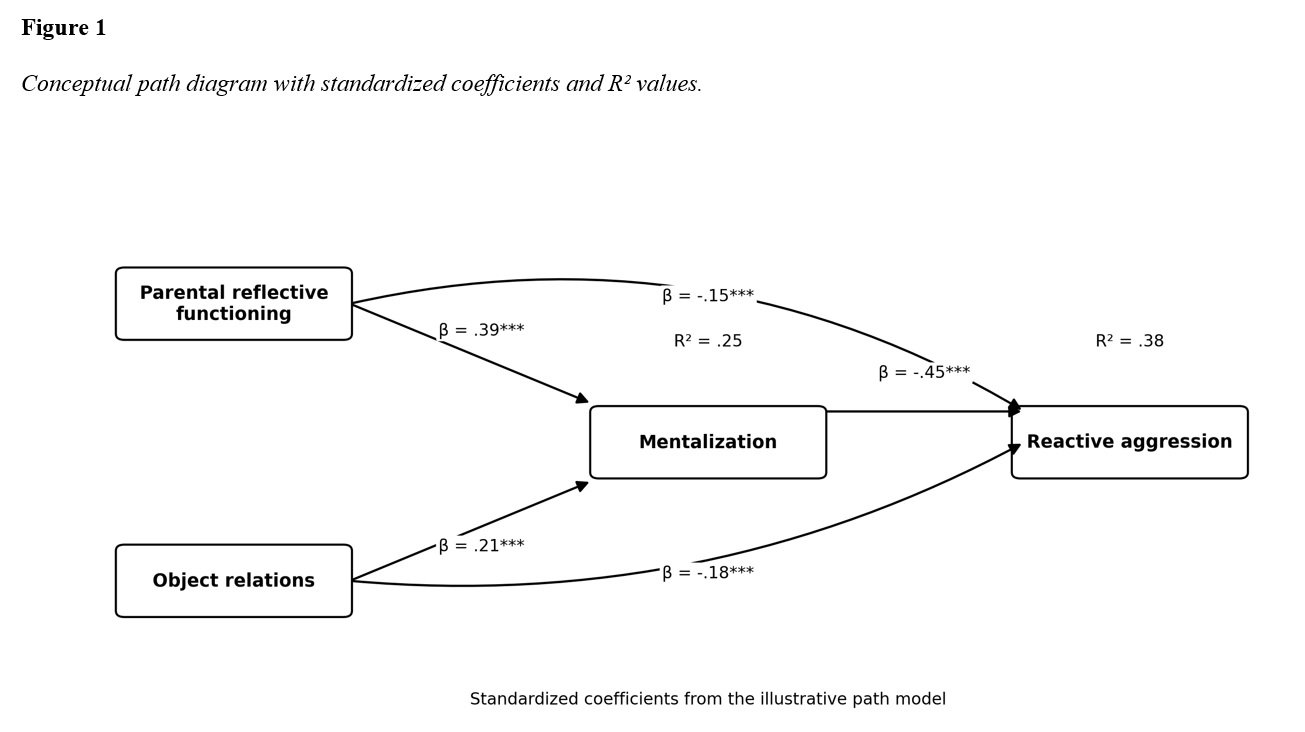
Findings: The results showed that parental reflective functioning significantly and positively predicted mentalization (β = 0.389, p < .001), and object relations also had a significant positive effect on mentalization (β = 0.208, p < .001). Mentalization significantly and negatively predicted reactive aggression (β = -0.447, p < .001). Furthermore, parental reflective functioning (β = -0.145, p < .001) and object relations (β = -0.183, p < .001) had significant direct negative effects on reactive aggression. Bootstrap analysis confirmed the significant mediating role of mentalization in the relationship between parental reflective functioning and reactive aggression (indirect effect = -0.174, 95% CI [-0.224, -0.129]) and between object relations and reactive aggression (indirect effect = -0.093, 95% CI [-0.140, -0.051]). The final model explained 38.5% of the variance in reactive aggression.
Conclusion: The findings highlight the importance of parental reflective functioning and adaptive object relations in reducing adolescents’ reactive aggression by strengthening mentalization capacities.
Downloads
References
Aitken, C., Van Kessel, K., & Nilsen, E. S. (2026). The Role of Adolescent Mentalizing and Parental Reflective Functioning for Adolescents' Peer Relationships. Journal of adolescence, 98(2), 355-370.
Bateman, A., & Fonagy, P. (2016). Mentalization-Based Treatment for Personality Disorders: A Practical Guide. Oxford University Press.
Benbassat, N., & Priel, B. (2012). Parenting and Adolescent Adjustment: The Role of Parental Reflective Function. Journal of adolescence, 35(1), 163-174. https://doi.org/10.1016/j.adolescence.2011.03.004
Crone, E. A., & Dahl, R. E. (2012). Understanding Adolescence as a Period of Social-Affective Engagement and Goal Flexibility. Nature Reviews Neuroscience, 13(9), 636-650.
Fonagy, P., Gergely, G., Jurist, E., & Target, M. (2002). Affect Regulation, Mentalization, and the Development of the Self. Other Press.
Fonagy, P., & Luyten, P. (2009). A Developmental, Mentalization-Based Approach to the Understanding and Treatment of Borderline Personality Disorder. Development and Psychopathology, 21(4), 1355-1381.
Goudarzi, Z., Seyed Mousavi, P. S., Vahidi, E., Rafie, M., & Ghanbari, S. (2022). Psychometric Properties of the Parental Reflective Functioning Questionnaire in Iranian Mothers. Clinical Child Psychology and Psychiatry, 27(3), 699-714.
Katznelson, H. (2014). Reflective Functioning: A Review. Clinical psychology review, 34(2), 107-117. https://doi.org/10.1016/j.cpr.2013.12.003
Kline, R. B. (2023). Principles and Practice of Structural Equation Modeling (5th ed.). Guilford Press.
Kokkinos, C. M., Algiovanoglou, I., & Voulgaridou, I. (2019). Emotion Regulation and Relational Aggression in Adolescents: Parental Attachment as Moderator. Journal of Child and Family Studies, 28, 3146-3160.
Li, Q., Gao, M., & Deng, Y. (2023). Parental Attachment and Proactive-Reactive Aggression in Adolescence: The Mediating Role of Self-Control and Perspective Taking. Psychology research and behavior management, 16, 3437-3446.
Mancinelli, E., Li, J. B., Lis, A., & Salcuni, S. (2021). Adolescents' Attachment to Parents and Reactive-Proactive Aggression: The Mediating Role of Alexithymia. International journal of environmental research and public health, 18(24), 13363.
Martin-Gagnon, G., Fonagy, P., Bégin, M., & Normandin, L. (2023). Measuring Mentalizing in Youth: Further Validation of the Reflective Functioning Questionnaire for Youth (RFQY-13). Frontiers in psychology, 14, 1260281.
Raine, A., Dodge, K., Loeber, R., Gatzke-Kopp, L., Lynam, D., Reynolds, C., Stouthamer-Loeber, M., & Liu, J. (2006). The Reactive-Proactive Aggression Questionnaire: Differential Correlates of Reactive and Proactive Aggression in Adolescent Boys. Aggressive Behavior, 32(2), 159-171.
Seyed Mousavi, P. S., Vahidi, E., Ghanbari, S., & Khoshroo, S. (2021). Reflective Functioning Questionnaire (RFQ): Psychometric Properties of the Persian Translation and Exploration of Its Mediating Role in the Relationship between Attachment to Parents and Internalizing and Externalizing Problems in Adolescents. Journal of Infant, Child, and Adolescent Psychotherapy, 20(3), 1-18.
Sharp, C., & Fonagy, P. (2008). The Parent's Capacity to Treat the Child as a Psychological Agent: Constructs, Measures and Implications for Developmental Psychopathology. Social Development, 17(3), 737-754.
Sharp, C., & Hernandez, A. (2021). Mentalizing Problems in Adolescence. In N. Midgley & I. Vrouva (Eds.), Minding the Child: Mentalization-Based Interventions with Children, Young People and Their Families.
Sharp, C., & Wall, K. (2021). Adolescence as a Sensitive Period for Mentalizing Development. Social Neuroscience, 16(5-6), 649-658.
Slade, A. (2005). Parental Reflective Functioning: An Introduction. Attachment & Human Development, 7(3), 269-281.
Szabó, B., Miklósi, M., Boda, M., & Futó, J. (2022). The Adaptation of the Parental Reflective Functioning Questionnaire Adolescent Version to the Hungarian Language and Presentation of Its Psychometric Characteristics. European Psychiatry, 65(S1), S207-S208.
Downloads
Additional Files
Publication Timeline
- Submitted
- Revised
- Accepted