The Effectiveness of Cognitive–Behavioral Therapy on Anxiety Sensitivity and Intrusive Obsessive Thoughts in High School Students
DOI:
https://doi.org/10.61838/Keywords:
Cognitive–Behavioral Therapy, Anxiety Sensitivity, Intrusive Obsessive ThoughtsAbstract
Objective: The present study was conducted to determine the effectiveness of cognitive–behavioral therapy (CBT) on anxiety sensitivity and intrusive obsessive thoughts among high school students.
Methods and Materials: This was a quasi-experimental study with a pretest–posttest design and a two-month follow-up, including a control group. The statistical population consisted of male and female high school students in Tehran in 2026. Following the initial screening process, participants completed the Taylor and Cox Anxiety Sensitivity Questionnaire and the Obsessive Thoughts Questionnaire developed by the Obsessive Compulsive Cognitions Working Group. Subsequently, 30 students were selected through purposive sampling and randomly assigned to an experimental group (n = 15) and a control group (n = 15). The experimental group received cognitive–behavioral therapy during eight 60-minute sessions based on the model proposed by Beck, Emery, and Greenberg, along with exposure and response prevention components developed by Foa and Kozak. The control group received no intervention during this period. Data were analyzed using the independent samples t-test, Fisher’s exact test, two-way repeated-measures analysis of variance, and Bonferroni post hoc tests in SPSS version 26.
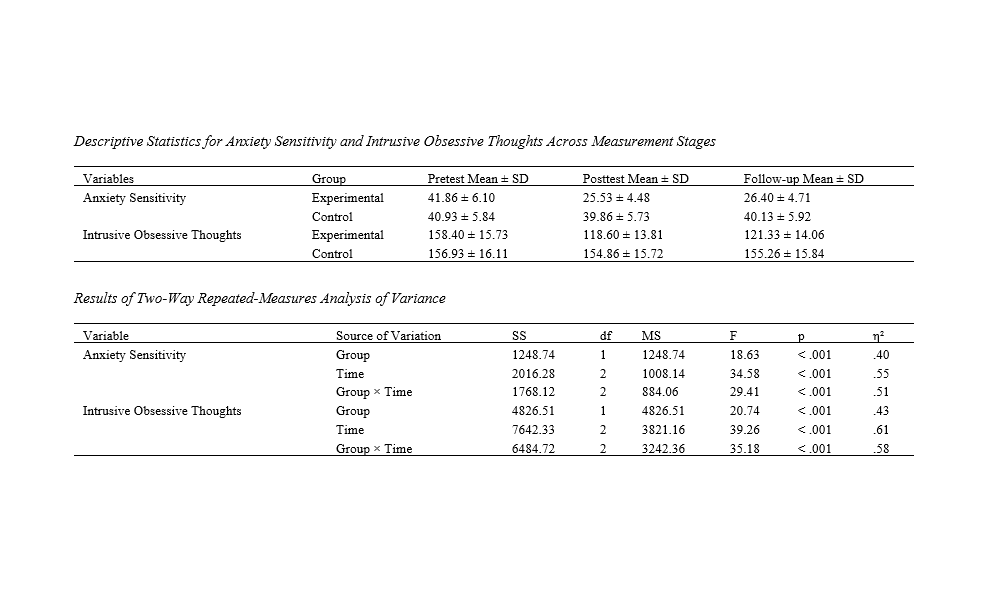
Findings: The results indicated that the experimental and control groups did not differ significantly in terms of demographic characteristics. Furthermore, the results of the two-way repeated-measures analysis of variance demonstrated a significant interaction effect between group and time on anxiety sensitivity and intrusive obsessive thoughts. Mean comparisons showed that anxiety sensitivity and intrusive obsessive thought scores decreased from the pretest to the posttest in the experimental group, and these reductions remained largely stable at the two-month follow-up assessment. In contrast, no substantial changes were observed in the control group.
Conclusion: Based on the findings, cognitive–behavioral therapy can effectively reduce anxiety sensitivity and intrusive obsessive thoughts among high school students. Therefore, the implementation of this intervention in schools, student counseling centers, and psychological clinics may be beneficial for modifying catastrophic interpretations of anxiety-related symptoms, reducing avoidance behaviors, decreasing reassurance-seeking and repetitive checking behaviors, and improving the management of intrusive thoughts.
Downloads
References
Bolton, D., & Perrin, S. (2008). Evaluation of Exposure with Response-Prevention for Obsessive Compulsive Disorder in Childhood and Adolescence. Journal of Behavior Therapy and Experimental Psychiatry, 39(1), 11-22. https://doi.org/10.1016/j.jbtep.2006.11.002
Curtiss, J. E., Levine, D. S., Ander, I., & Baker, A. W. (2021). Cognitive-Behavioral Treatments for Anxiety and Stress-Related Disorders. Focus, 19(2), 184-189. https://doi.org/10.1176/appi.focus.20200045
Demaria, F., Pontillo, M., Bertoncini, I., & Vicari, S. (2025). Obsessive Trajectories in Children and Adolescents Exposed to Adverse Events (Coronavirus Disease 2019: Global Crisis Teaches). Frontiers in psychology, 16, 1623629. https://doi.org/10.3389/fpsyg.2025.1623629
Knapp, A. A., Feldner, M., Allan, N. P., Schmidt, N. B., Keough, M. E., & Leen-Feldner, E. W. (2020). Test of an Anxiety Sensitivity Amelioration Program for At-Risk Youth (ASAP-Y). Behaviour Research and Therapy, 126, 103544. https://doi.org/10.1016/j.brat.2019.103544
Kollárik, M., Heinzel, C. V., Miché, M., Lieb, R., & Wahl, K. (2022). Exam-Related Unwanted Intrusive Thoughts and Related Neutralizing Behaviors: Analogues to Obsessions and Compulsions. PLoS One, 17(7), e0270692. https://doi.org/10.1371/journal.pone.0270692
Kramer, L., & Francis, S. (2025). The Relationships Between Adolescent Anxiety Sensitivity, Parent Emotional Availability, and Gender in the Context of Adolescent Anxiety. Journal of psychopathology and behavioral assessment, 47, 17. https://doi.org/10.1007/s10862-025-10197-w
Law, C., & Boisseau, C. L. (2019). Exposure and Response Prevention in the Treatment of Obsessive-Compulsive Disorder: Current Perspectives. Psychology research and behavior management, 12, 1167-1174. https://doi.org/10.2147/PRBM.S211117
Orben, A., Tomova, L., & Blakemore, S. J. (2020). The Effects of Social Deprivation on Adolescent Development and Mental Health. The Lancet Child & Adolescent Health, 4(8), 634-640. https://doi.org/10.1016/S2352-4642(20)30186-3
Pegg, S., Hill, K., Argiros, A., Olatunji, B. O., & Kujawa, A. (2022). Cognitive Behavioral Therapy for Anxiety Disorders in Youth: Efficacy, Moderators, and New Advances in Predicting Outcomes. Current psychiatry reports, 24(12), 853-859. https://doi.org/10.1007/s11920-022-01384-7
Reid, J. E., Laws, K. R., Drummond, L., Vismara, M., Grancini, B., Mpavaenda, D., & Fineberg, N. A. (2021). Cognitive Behavioural Therapy with Exposure and Response Prevention in the Treatment of Obsessive-Compulsive Disorder: A Systematic Review and Meta-Analysis of Randomised Controlled Trials. Comprehensive Psychiatry, 106, 152223. https://doi.org/10.1016/j.comppsych.2021.152223
Spencer, S. D., Stiede, J. T., Wiese, A. D., Goodman, W. K., Guzick, A. G., & Storch, E. A. (2023). Cognitive-Behavioral Therapy for Obsessive-Compulsive Disorder. The Psychiatric clinics of North America, 46(1), 167-180. https://doi.org/10.1016/j.psc.2022.10.004
Stiede, J. T., Trent, E. S., Viana, A. G., Guzick, A. G., Storch, E. A., & Hershfield, J. (2023). Cognitive Behavioral Therapy for Children and Adolescents with Anxiety Disorders. Child and Adolescent Psychiatric Clinics of North America, 32(3), 543-558. https://doi.org/10.1016/j.chc.2022.12.001
Taylor, S., & Cox, B. J. (1998). An Expanded Anxiety Sensitivity Index: Evidence for a Hierarchic Structure in a Clinical Sample. Journal of anxiety disorders, 12, 463-484.
Villabø, M. A., Narayanan, M., Compton, S. N., Kendall, P. C., & Neumer, S. P. (2018). Cognitive-Behavioral Therapy for Youth Anxiety: An Effectiveness Evaluation in Community Practice. Journal of consulting and clinical psychology, 86(9), 751-764. https://doi.org/10.1037/ccp0000326
Young, K. S., Sandman, C. F., & Craske, M. G. (2019). Positive and Negative Emotion Regulation in Adolescence: Links to Anxiety and Depression. Brain Sciences, 9(4), 76. https://doi.org/10.3390/brainsci9040076
Zvolensky, M. J., Arrindell, W. A., Taylor, S., Bouvard, M., Cox, B. J., Stewart, S. H., Sandin, B., Cardenas, S. J., & Eifert, G. H. (2003). Anxiety Sensitivity in Six Countries. Behaviour Research & Therapy, 41, 841-859.
Downloads
Additional Files
Publication Timeline
- Submitted
- Revised
- Accepted