Predicting High School Dropout Risk from Academic Engagement, Attendance, Self-Efficacy, and Family Support Using TabNet
DOI:
https://doi.org/10.61838/kman.jayps.5684Keywords:
High school dropout, TabNet, academic engagement, school attendance, academic self-efficacy, family supportAbstract
Objective: This study aimed to develop and evaluate an interpretable TabNet model for predicting verified high school dropout among French upper-secondary students using academic engagement, attendance, academic self-efficacy, and perceived family support.
Methods and Materials: A prospective longitudinal predictive design was employed with 1,248 students aged 15–18 years recruited from 12 public high schools across four regions of France. Baseline data on behavioral, emotional, cognitive, and overall academic engagement, academic self-efficacy, and perceived family support were collected through validated French-language questionnaires, while attendance, excused and unexcused absences, lateness, and dropout status were obtained from school administrative records. Students were followed through the end of the academic year and subsequent enrollment verification. Data from nine schools were used for model development, including training and validation subsets, while three schools formed an independent test set. TabNet performance was compared with penalized logistic regression, random forest, and gradient-boosted trees using discrimination, calibration, and classification indices.
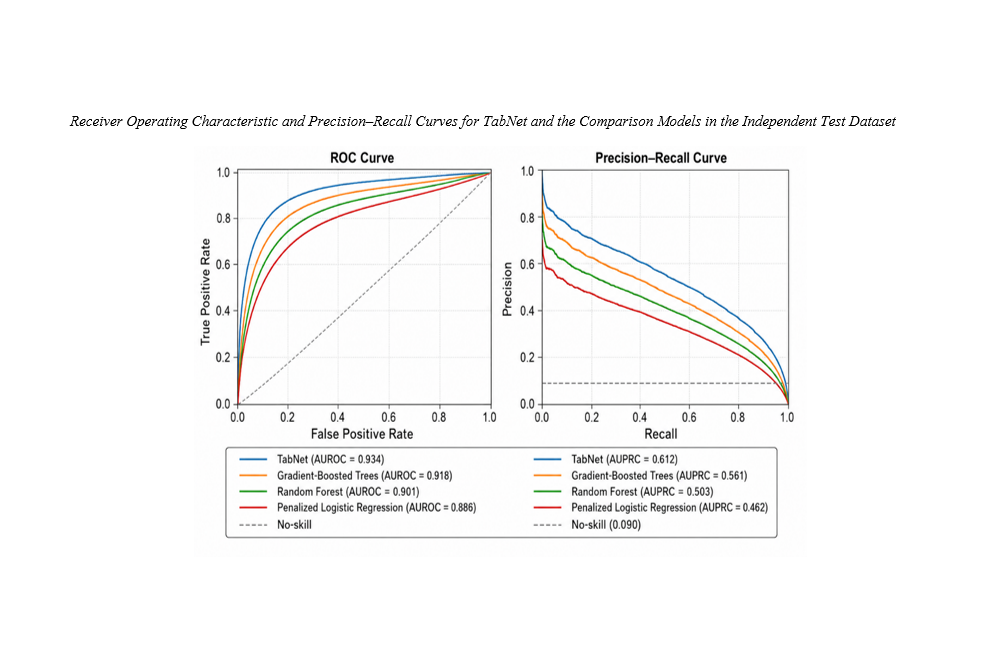
Findings: Students who dropped out had significantly lower overall, behavioral, emotional, and cognitive engagement, lower attendance, weaker academic self-efficacy, and lower perceived family support, alongside significantly higher excused absences, unexcused absences, and lateness, with all comparisons reaching p < .001. In the independent test set, TabNet achieved an AUROC of .934, an AUPRC of .612, sensitivity of .857, specificity of .919, balanced accuracy of .888, and an F1 score of .640. TabNet significantly outperformed penalized logistic regression and random forest in AUROC, while its advantage over gradient-boosted trees was not statistically significant. Unexcused absence, overall attendance, behavioral engagement, academic self-efficacy, and family support were the most influential predictors.
Conclusion: TabNet accurately predicted high school dropout by integrating behavioral, academic, and relational indicators and may support early, targeted, and interpretable school-based prevention when used alongside professional judgment.
Downloads
References
Bălţătescu, S., & Cernea-Radu, A. E. (2025). Age-Related Variations in School Satisfaction: The Mediating Role of School Engagement. The Hungarian Educational Research Journal, 15(1), 67-87. https://doi.org/10.1556/063.2024.00302
Banaag, R., Sumodevilla, J. L., & Potane, J. D. (2024). Factors Affecting Student Drop Out Behavior: a Systematic Review. International Journal of Educational Management and Innovation, 5(1), 53-70. https://doi.org/10.12928/ijemi.v5i1.9396
Banda, L. O. L., Banda, J. T., & Banda, C. V. (2024). Unraveling Secondary School Girls’ Dropout in Rural Malawi Through Self-Determination. https://doi.org/10.21203/rs.3.rs-3768943/v1
Clement, J., & Mwila, P. M. (2023). Extracurricular Activities: Prospects and Challenges Among Female Students in Secondary Schools in Chanika Ward, Tanzania. International Journal of Social Science Management and Economics Research, 01(01), 14-30. https://doi.org/10.61421/ijssmer.2023.1102
Damianidou, E. (2023). Parents as Students: Seeking for the Balance. International Journal about Parents in Education. https://doi.org/10.54195/ijpe.14111
Enderle, C., Kreitz-Sandberg, S., Backlund, Å., Isaksson, J., Fredriksson, U., & Ricking, H. (2024). Secondary School Students’ Perspectives on Supports for Overcoming School Attendance Problems: A Qualitative Case Study in Germany. Frontiers in Education, 9. https://doi.org/10.3389/feduc.2024.1405395
Faisal, N. N. M., Puteri Rohani Megat Abdul, R., Nor Faizah Kaeni Mokh, H., & Bakar, A. H. A. (2023). Understanding School Dropouts Phenomenon Among Youths Through Behavioural Trends. Environment-Behaviour Proceedings Journal, 8(23), 3-11. https://doi.org/10.21834/ebpj.v8i23.4474
Gbaguidi, V. E., & Adetou, D. (2024). Factors Affecting School Dropout: Comparative Study of Rural and Urban Settings. International Journal of Educational Management and Development Studies, 5(2), 233-256. https://doi.org/10.53378/353073
Guenther, J., Oliver, R., Ober, R., & Holmes, C. (2024). Remote School Retention in Australia. Australian and International Journal of Rural Education, 34(3), 73-91. https://doi.org/10.47381/aijre.v34i3.743
Han, Y., Park, J., Song, J., & Kang, D. M. (2024). Distinguishing Characteristics of Out‐of‐school Adolescents in South Korea: A Machine Learning Approach. International Journal of Social Welfare, 34(2). https://doi.org/10.1111/ijsw.12699
Huang, G., & Hai, L. (2026). A Synergistic Social Work–Ethnic Education Intervention for Reducing Dropout Risk Among Male Students in Central Guangxi Zhuang Vocational High Schools: A Mixed-Methods and Quasi-Experimental Study. Behavioral Sciences, 16(6), 1023. https://doi.org/10.3390/bs16061023
Kataga, E., & Mwila, P. M. (2024). Strategies for Managing Truancy and Dropout Rates in Secondary Schools: A Study in Temeke Municipality, Tanzania. Contemporary Research Analysis Journal, 01(06). https://doi.org/10.55677/craj/04-2024-vol01i6
Kearney, C. A. (2022). Functional Impairment Guidelines for School Attendance Problems in Youth: Recommendations for Caseness in the Modern Era. Professional Psychology Research and Practice, 53(3), 295-303. https://doi.org/10.1037/pro0000453
Kearney, C. A., Benoit, L., Gonzálvez, C., Heyne, D., Melvin, G., O'Toole, C., Genitty, C. G., & Keppens, G. (2026). School Attendance and Absenteeism: Towards Next‐generation Common Measurement. Review of Education, 14(1). https://doi.org/10.1002/rev3.70146
Kearney, C. A., & Childs, J. (2023). Translating Sophisticated Data Analytic Strategies Regarding School Attendance and Absenteeism Into Targeted Educational Policy. Improving Schools, 26(1), 5-22. https://doi.org/10.1177/13654802231174986
Kearney, C. A., Dupont, R., Fensken, M., & Gonzálvez, C. (2023). School Attendance Problems and Absenteeism as Early Warning Signals: Review and Implications for Health-Based Protocols and School-Based Practices. Frontiers in Education, 8. https://doi.org/10.3389/feduc.2023.1253595
Kearney, C. A., Fensken, M., & Dupont, R. (2024). The K-16 Education Movement: Common Themes Across K-12 and Higher Education Systems to Inform Development and Evaluation. Frontiers in Education, 9. https://doi.org/10.3389/feduc.2024.1272297
Kearney, C. A., & Gonzálvez, C. (2022). Unlearning School Attendance and Its Problems: Moving From Historical Categories to Postmodern Dimensions. Frontiers in Education, 7. https://doi.org/10.3389/feduc.2022.977672
Khodor, R. M., Valero, O., & Álvarez, I. (2024). Exploring Entrepreneurial Intention and Student Engagement of Youth Living in Poverty. Behavioral Sciences, 14(11), 995. https://doi.org/10.3390/bs14110995
Korkmaz, Ö. (2025). Detection of Early School Drop Out in Vocational and Technical High Schools in Turkey. Sage Open, 15(3). https://doi.org/10.1177/21582440251370443
Kull, M., Farrell, A. F., Moore, F. O., & Morton, M. H. (2026). Understanding the Links Between Youth Homelessness and Educational Disconnection: New Opportunities for Prevention in the Upstream Project. Psychology in the Schools, 63(6), 1033-1048. https://doi.org/10.1002/pits.70145
Kurtyilmaz, Y., & Başak, B. E. (2023). Mediating Role of Academic Self-Efficacy Between Insufficient Self-Control and School Dropout. International Journal of Contemporary Educational Research, 10(1), 157-170. https://doi.org/10.33200/ijcer.1181114
Mokano, M. F., & Letuma, M. C. (2025). Disciplinary Issues in Special Education: Teachers’ Experiences and Attribution. African Journal of Disability, 14. https://doi.org/10.4102/ajod.v14i0.1655
Moreira, T., Rosário, P., Ferreira, M. d. A., Pereira, A., & Fuentes, S. (2025). School Engagement and Implications for Future Opportunities: Roma Students’ Trajectories. Frontiers in psychology, 16. https://doi.org/10.3389/fpsyg.2025.1535063
Morelli, M., Chirumbolo, A., Baiocco, R., & Cattelino, E. (2022). Self-Regulated Learning Self-Efficacy, Motivation, and Intention to Drop-Out: The Moderating Role of Friendships at University. Current Psychology, 42(18), 15589-15599. https://doi.org/10.1007/s12144-022-02834-4
Ong, M. L., Klopack, E. T., Carter, S., Simons, R. L., & Beach, S. R. H. (2022). School Disengagement Predicts Accelerated Aging Among Black American Youth: Mediation by Psychological Maladjustment and Moderation by Supportive Parenting. International journal of environmental research and public health, 19(19), 12034. https://doi.org/10.3390/ijerph191912034
Petre, F.-B., Teodorescu, C., & Cioclu, A. (2024). School Dropout in Satellite Towns Around Bucharest, Romania. Social Sciences, 13(6), 285. https://doi.org/10.3390/socsci13060285
Ramsdal, G. H., & Wynn, R. (2022a). Attachment and School Completion: Understanding Young People Who Have Dropped Out of High School and Important Factors in Their Re-Enrollment. International journal of environmental research and public health, 19(7), 3938. https://doi.org/10.3390/ijerph19073938
Ramsdal, G. H., & Wynn, R. (2022b). Attachment and School Completion: Understanding Young People Who Have Dropped Out of High School and Important Factors in Their Re-Enrolment. https://doi.org/10.31219/osf.io/wsj8h
Ramsdal, G. H., & Wynn, R. (2024). Do Two Weeks in a Learning Camp After Ninth Grade Make a Difference? Experiences of Demotivated Boys With an Increased Risk of School Dropout. Behavioral Sciences, 14(3), 189. https://doi.org/10.3390/bs14030189
Yusof, R., Harith, N. H. M., Lokman, A., Batau, M. F. A., Zain, Z. M., & Rahmat, N. H. (2023). A Study of Perception on Students’ Motivation, Burnout and Reasons for Dropout. International Journal of Academic Research in Business and Social Sciences, 13(7). https://doi.org/10.6007/ijarbss/v13-i7/17187
Zhao-hui, C., Chebet, Y. M., & Sampene, A. K. (2025). To Continue or to Quit: Investigating the Role of Affective and Cognitive Engagement on Female School Dropout. Psychology in the Schools, 62(9), 3481-3497. https://doi.org/10.1002/pits.23558
Zheng, R. (2024). The Impact of Adverse Childhood Experiences on Educational Outcomes in Adolescents. Journal of Education Humanities and Social Sciences, 26, 634-640. https://doi.org/10.54097/qg7vxm92
Downloads
Additional Files
Publication Timeline
- Submitted
- Revised
- Accepted