Classifying Panic-Symptom Risk among Taiwanese Youth Based on Anxiety Sensitivity, Interoceptive Awareness, Sleep Disturbance, and Perceived Stress Using a Support Vector Machine
Keywords:
Panic symptoms, anxiety sensitivity, interoceptive awareness, sleep disturbance, perceived stress, support vector machine, youth, TaiwanAbstract
Objective: This study aimed to develop and internally validate a support vector machine model for classifying elevated panic-symptom risk among Taiwanese youth based on anxiety sensitivity, multidimensional interoceptive awareness, sleep disturbance, and perceived stress.
Methods and Materials: A cross-sectional predictive classification study was conducted with 512 Taiwanese youths aged 15–24 years who were recruited from senior high schools, vocational schools, universities, and community youth centers. Participants completed the Anxiety Sensitivity Index–3, Multidimensional Assessment of Interoceptive Awareness–2, Pittsburgh Sleep Quality Index, Perceived Stress Scale–10, and Panic Disorder Severity Scale–Self-Report. Panic-symptom risk was categorized using a predetermined cutoff score. The sample was stratified into a training set of 410 participants and an independent testing set of 102 participants. A radial basis function support vector machine was developed using repeated stratified 10-fold cross-validation, class weighting, probability calibration, and hyperparameter optimization. Model performance was assessed using accuracy, balanced accuracy, sensitivity, specificity, predictive values, F1 score, receiver operating characteristic area under the curve, precision–recall area under the curve, and Brier score.
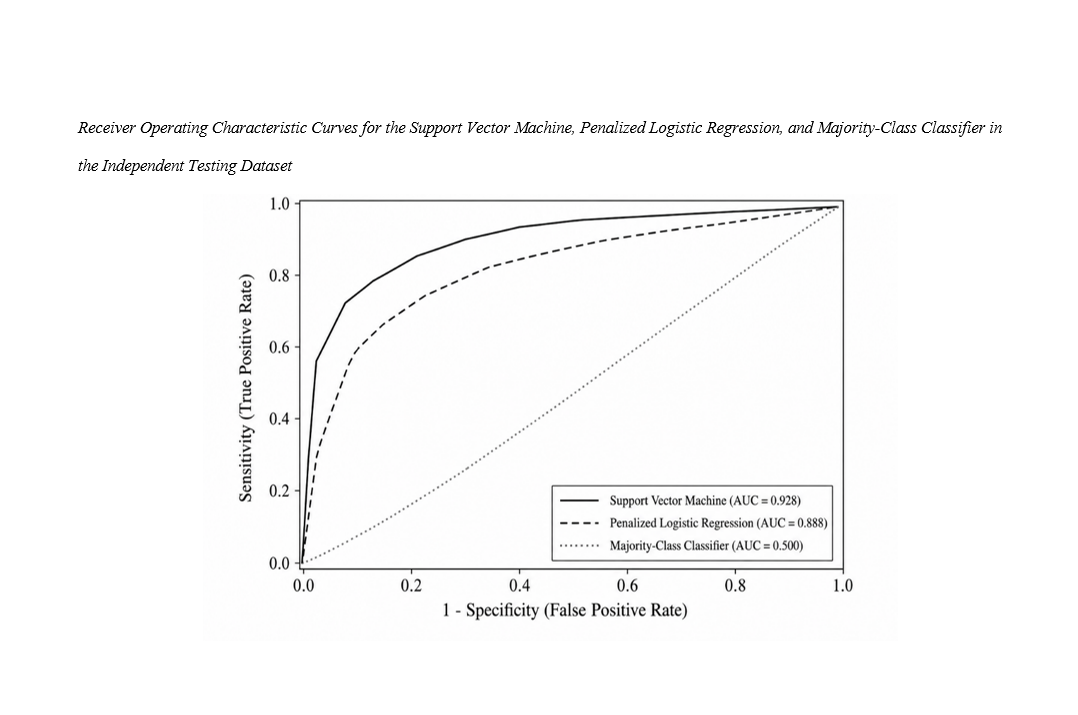
Findings: All psychological predictors differed significantly between elevated-risk and low-risk participants, with the largest effects observed for anxiety sensitivity, perceived stress, body trusting, interoceptive not-worrying, and sleep disturbance, all p < .001. In the independent testing dataset, the support vector machine achieved an accuracy of .882, balanced accuracy of .875, sensitivity of .857, specificity of .892, positive predictive value of .750, negative predictive value of .943, and F1 score of .800. The model produced an area under the receiver operating characteristic curve of .928 and an area under the precision–recall curve of .836. Anxiety sensitivity was the most influential predictor, followed by perceived stress, body trusting, sleep disturbance, interoceptive not-worrying, and interoceptive self-regulation.
Conclusion: Panic-symptom risk among Taiwanese youth can be classified with high accuracy using a multidimensional psychological profile, particularly anxiety sensitivity, perceived stress, body trust, sleep disturbance, and interoceptive regulation.
Downloads
References
Balban, M. Y., Neri, E., Kogon, M. M., Weed, L., Nouriani, B., Jo, B., Holl, G., Zeitzer, J. M., & Spiegel, D. (2023). Brief Structured Respiration Practices Enhance Mood and Reduce Physiological Arousal. Cell Reports Medicine, 4(1), 100895. https://doi.org/10.1016/j.xcrm.2022.100895
Banellis, L., Nikolova, N., Ehmsen, J. F., Courtin, A., Vejlø, M., Tyrer, A., Böhme, R. A., Bavato, F., Hoogervorst, K., Fardo, F., & Allen, M. (2025). Interoceptive Performance Is Unrelated to Mental Health Symptoms: Evidence From a Large Scale Multi-Domain Psychophysical Investigation. https://doi.org/10.1101/2025.08.25.25334366
Bednarek, L., Harrison, B. J., Davey, C. G., Steward, T., & Jamieson, A. J. (2026). Neural Correlates of Altered Interoception in Depressive and Anxiety Disorders: A Systematic Review and Meta-Analysis. European Archives of Psychiatry and Clinical Neuroscience, 276(4), 1411-1423. https://doi.org/10.1007/s00406-026-02201-5
Callus, E. (2025). Remote Eye Movement Desensitization and Reprocessing for Posttraumatic Stress Disorder in Adult Congenital Heart Disease: A Clinical Case Study. Clinical Case Studies, 24(6), 409-426. https://doi.org/10.1177/15346501251386456
Chahine, A., Hemade, A., Zouki, C.-J. E., Obeïd, S., Lahoud, J.-C., Fekih‐Romdhane, F., & Hallit, S. (2025). Examination of the Psychometric Properties of Arabic Version of the Body Vigilance Scale. PLoS One, 20(5), e0324610. https://doi.org/10.1371/journal.pone.0324610
Ciacchini, R., Conversano, C., Orrù, G., Pizzanelli, C., Scarpitta, C., Turco, F., Bonanni, E., Reali, T., & Gemignani, A. (2025). Preliminary Findings From a Mindfulness-Based Intervention in Patients With Psychogenic Non-Epileptic Seizures. Neurology International, 17(10), 171. https://doi.org/10.3390/neurolint17100171
Ciacchini, R., Conversano, C., Orrù, G., Scafuto, F., Sabbatini, S., Paroli, M., Miniati, M., Matiz, A., Gemignani, A., & Crescentini, C. (2024). About Distress in Chronic Pain Conditions: A Pre–Post Study on the Effectiveness of a Mindfulness-Based Intervention for Fibromyalgia and Low Back Pain Patients. International journal of environmental research and public health, 21(11), 1507. https://doi.org/10.3390/ijerph21111507
Dolgilevica, K., Grunfeld, E. A., & Derakhshan, N. (2025). Heart Rate Variability Biofeedback Training Can Improve Menopausal Symptoms and Psychological Well-Being in Women With a Diagnosis of Primary Breast Cancer: A Longitudinal Randomized Controlled Trial. Current Oncology, 32(3), 150. https://doi.org/10.3390/curroncol32030150
Farris, S. G., Derby, L., & Kibbey, M. M. (2025). Getting Comfortable With Physical Discomfort: A Scoping Review of Interoceptive Exposure in Physical and Mental Health Conditions. Psychological bulletin, 151(2), 131-191. https://doi.org/10.1037/bul0000464
Frei, A. K., Studnitz, T., Seiffer, B., Welkerling, J., Zeibig, J.-M., Herzog, E., Günak, M. M., Ehring, T., Takano, K., Nakagawa, T., Himmler, S., Flagmeier, A. L., Zwanzleitner, L., Ramos‐Murguialday, A., Sudeck, G., & Wolf, S. (2026). Changes in Repetitive Negative Thinking and Stress Perception Mediate Treatment Effects of a Transdiagnostic Exercise Intervention. Psychological medicine, 56. https://doi.org/10.1017/s0033291725103085
Garzone, S., Charitos, I. A., Mandorino, M., Maggiore, M. E., Capozzi, L., Cakani, B., Lopes, G. C. D., Bocchio‐Chiavetto, L., & Colella, M. (2025). Can We Modulate Our Second Brain and Its Metabolites to Change Our Mood? A Systematic Review on Efficacy, Mechanisms, and Future Directions of “Psychobiotics”. International Journal of Molecular Sciences, 26(5), 1972. https://doi.org/10.3390/ijms26051972
Heim, N., Bobou, M., Tanzer, M., Jenkinson, P. M., Steinert, C., & Fotopoulou, A. (2023). Psychological Interventions for Interoception in Mental Health Disorders: A Systematic Review of Randomized‐controlled Trials. Psychiatry and clinical neurosciences, 77(10), 530-540. https://doi.org/10.1111/pcn.13576
Kwon, C. Y., & Lee, B. (2022). Systematic Review of Mind–Body Modalities to Manage the Mental Health of Healthcare Workers During the COVID-19 Era. Healthcare, 10(6), 1027. https://doi.org/10.3390/healthcare10061027
Machorrinho, J., Marmeleira, J., Santos, G., & Veiga, G. (2025). Attention to the Body! Comparing the Connection Between Interoceptive Abilities and Somatic Complaints of Women With and Without History of Intimate Partner Violence. Women S Health, 21. https://doi.org/10.1177/17455057251326013
Nayok, S. B., Sreeraj, V. S., Shivakumar, V., & Venkatasubramanian, G. (2023). A Primer on Interoception and Its Importance in Psychiatry. Clinical Psychopharmacology and Neuroscience, 21(2), 252-261. https://doi.org/10.9758/cpn.2023.21.2.252
Nord, C. L., & Garfinkel, S. N. (2022). Interoceptive Pathways to Understand and Treat Mental Health Conditions. Trends in Cognitive Sciences, 26(6), 499-513. https://doi.org/10.1016/j.tics.2022.03.004
Sado, M., Ninomiya, A., Nagaoka, M., Koreki, A., Goto, N., Sasaki, Y., Takamori, C., Kosugi, T., Yamada, M., Park, S., Sato, Y., Fujisawa, D., Nakagawa, A., & Mimura, M. (2021). Effectiveness of Mindfulness-Based Cognitive Therapy With Follow-Up Sessions for Pharmacotherapy-Refractory Anxiety Disorders: Protocol for a Feasibility Randomized Controlled Trial (Preprint). https://doi.org/10.2196/preprints.33776
Sado, M., Ninomiya, A., Nagaoka, M., Koreki, A., Goto, N., Sasaki, Y., Takamori, C., Kosugi, T., Yamada, M., Park, S., Sato, Y., Fujisawa, D., Nakagawa, A., & Mimura, M. (2022). Effectiveness of Mindfulness-Based Cognitive Therapy With Follow-Up Sessions for Pharmacotherapy-Refractory Anxiety Disorders: Protocol for a Feasibility Randomized Controlled Trial. Jmir Research Protocols, 11(1), e33776. https://doi.org/10.2196/33776
Saltafossi, M., Heck, D., Kluger, D. S., & Varga, S. (2024). Common Threads: Altered Interoceptive Processes as Transdiagnostic Mechanisms Across Affective and Anxiety Disorders. https://doi.org/10.31234/osf.io/3d745
Saltafossi, M., Heck, D., Kluger, D. S., & Varga, S. (2025). Common Threads: Altered Interoceptive Processes Across Affective and Anxiety Disorders. Journal of affective disorders, 369, 244-254. https://doi.org/10.1016/j.jad.2024.09.135
Sasin, D., Rybczynski, B., Maj, B., Chwaszcz, J., Pruc, M., Niewiadomska, I., & Szarpak, Ł. (2026). Mechanistic Non-Response After Psychotherapy for Anxiety Disorders: A Maintenance-Mechanism-Based Clinical Taxonomy. Journal of clinical medicine, 15(11), 4223. https://doi.org/10.3390/jcm15114223
Schuman‐Olivier, Z., Fatkin, T., Creedon, T. B., Samawi, F., Moore, S. K., Okst, K., Fredericksen, A. K., Oxnard, A., Roll, D., Smith, L., Cook, B. L., & Weiss, R. D. (2022). Effects of a Trauma‐informed Mindful Recovery Program on Comorbid Pain, Anxiety, and Substance Use During Primary Care Buprenorphine Treatment: A Proof‐of‐concept Study. American Journal on Addictions, 32(3), 244-253. https://doi.org/10.1111/ajad.13364
Seo, A., Nishiyama, R., Lee, K., & Duarte, A. (2025). Factors Linking Interoception and Sleep Across the Adult Lifespan. Psychophysiology, 62(8). https://doi.org/10.1111/psyp.70120
Shin, B., Oh, J., Kim, B.-H., Kim, H. E., Kim, H., Kim, S., & Kim, J. J. (2021). Effectiveness of Self-Guided Virtual Reality–Based Cognitive Behavioral Therapy for Panic Disorder: Randomized Controlled Trial. Jmir Mental Health, 8(11), e30590. https://doi.org/10.2196/30590
Strehli, I., Burns, R. D., Bai, Y., Ziegenfuss, D., Block, M. E., & Brusseau, T. A. (2022). Effectiveness of a Tailored Mind-Body Physical Activity (Mbpa) Intervention on Stress and Well-Being Among College Students During the Covid-19 Pandemic: A Pilot Study. https://doi.org/10.21203/rs.3.rs-1522812/v1
Sumińska, S., & Rynkiewicz, A. (2025). Mindfulness-Based Stress Reduction Training Supplemented With Physiological Signals From Smartwatch Improves Mindfulness and Reduces Stress, but Not Anxiety and Depression. PLoS One, 20(4), e0322413. https://doi.org/10.1371/journal.pone.0322413
Sun, J., & Cicchella, A. (2025). Mental and Physical Health of Chinese College Students After Shanghai Lockdown: An Exploratory Study. Healthcare, 13(15), 1864. https://doi.org/10.3390/healthcare13151864
Vabba, A., Porciello, G., Monti, A., Panasiti, M. S., & Aglioti, S. M. (2023). A Longitudinal Study of Interoception Changes in the Times of COVID-19: Effects on Psychophysiological Health and Well-Being. Heliyon, 9(4), e14951. https://doi.org/10.1016/j.heliyon.2023.e14951
Wang, J. (2026). Heartbeat-Evoked Potentials Reveal Interoceptive Dysfunction in Clinical Disorders: Experimental Frameworks and Promising Applications. Psychological medicine, 56. https://doi.org/10.1017/s003329172610453x
White, A. M., Eglovitch, M., Parlier‐Ahmad, A. B., Dzierzewski, J. M., James, M. H., Bjork, J. M., Moeller, F. G., & Martin, C. E. (2024). Insomnia Symptoms and Neurofunctional Correlates Among Adults Receiving Buprenorphine for Opioid Use Disorder. PLoS One, 19(6), e0304461. https://doi.org/10.1371/journal.pone.0304461
Wintermann, G. B., Noack, R., Steudte‐Schmiedgen, S., & Weidner, K. (2022). Cortisol Response Under Low Intensity Exercise During Cognitive-Behavioral Therapy Is Associated With Therapeutic Outcome in Panic Disorder–an Exploratory Study. PLoS One, 17(9), e0273413. https://doi.org/10.1371/journal.pone.0273413
Yamaoka, K., Ishii, Y., & Terasawa, Y. (2025). Moderating Effects of Individual Factors on the Relationship Between Inflammation and Psychophysiological States in Healthy Adults. Brain Behavior & Immunity - Health, 50, 101135. https://doi.org/10.1016/j.bbih.2025.101135
Yun, S., & Jo, S.-H. (2021). Understanding Insomnia as Systemic Disease. Yeungnam University Journal of Medicine, 38(4), 267-274. https://doi.org/10.12701/yujm.2021.01424
Zhou, L., Bai, X., Wu, B., Tan, Y., Li, M., & Yang, Q. (2024). Characterizing Vitamin B12 Deficiency in Neurology Outpatients: A Retrospective Observational Study. Clinical Neuropharmacology, 47(3), 87-96. https://doi.org/10.1097/wnf.0000000000000593
Zvolensky, M. J., Kauffman, B. Y., Garey, L., Viana, A. G., & Matoska, C. T. (2022). Interoceptive Anxiety-Related Processes: Importance for Understanding COVID-19 and Future Pandemic Mental Health and Addictive Behaviors and Their Comorbidity. Behaviour Research and Therapy, 156, 104141. https://doi.org/10.1016/j.brat.2022.104141
Downloads
Additional Files
Publication Timeline
- Submitted
- Revised
- Accepted