Explaining FOMO Symptoms Based on Maladaptive Perfectionism and Emotional Loneliness with Emphasis on the Mediating Role of Artificial Intelligence Dependency among Female High School Adolescents
DOI:
https://doi.org/10.61838/Keywords:
Fear of Missing Out (FOMO), Maladaptive Perfectionism, Emotional Loneliness, Artificial Intelligence Dependency, Female AdolescentsAbstract
Objective: The present study aimed to explain FOMO (Fear of Missing Out) symptoms based on maladaptive perfectionism and emotional loneliness, with a particular focus on the mediating role of artificial intelligence dependency among female high school adolescents.
Methods and Materials: This correlational study employed a structural equation modeling approach to investigate the relationships among maladaptive perfectionism, emotional loneliness, artificial intelligence dependency, and FOMO symptoms. The statistical population consisted of all female students enrolled in secondary high schools in Dezful, Iran, during the 2025–2026 academic year. A total of 250 students were selected through convenience sampling. Data were collected using the Fear of Missing Out Scale developed by Przybylski et al. (2013), the Multidimensional Perfectionism Questionnaire by Hewitt and Flett (2004), the Social and Emotional Loneliness Scale by DiTommaso et al. (2004), and the Artificial Intelligence Dependency Questionnaire developed by Huang et al. (2024). Data analysis was conducted using descriptive and inferential statistics in SPSS and AMOS software packages. Path analysis and structural equation modeling were utilized to evaluate both direct and indirect relationships among the study variables and to assess the overall model fit.
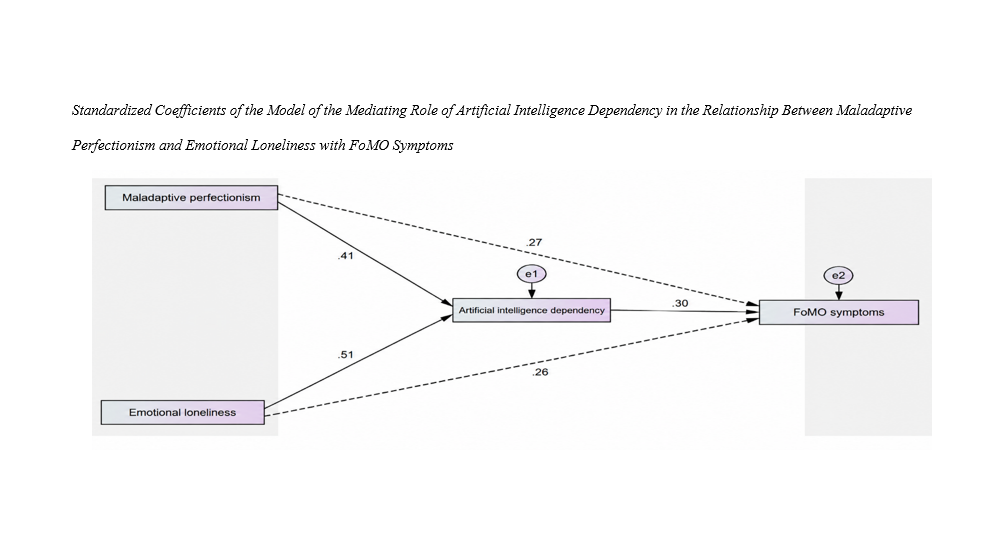
Findings: The results demonstrated that maladaptive perfectionism and emotional loneliness significantly predicted FOMO symptoms both directly and indirectly through artificial intelligence dependency. Maladaptive perfectionism showed a significant positive effect on artificial intelligence dependency (β = 0.411, p < .01), while emotional loneliness also exhibited a significant positive effect on artificial intelligence dependency (β = 0.506, p < .01). Furthermore, maladaptive perfectionism had a significant direct effect on FOMO symptoms (β = 0.267, p < .01) and a significant indirect effect through artificial intelligence dependency (β = 0.124, p < .01). Similarly, emotional loneliness exerted a significant direct effect on FOMO symptoms (β = 0.259, p < .01) and a significant indirect effect mediated by artificial intelligence dependency (β = 0.152, p < .01). Artificial intelligence dependency itself significantly and positively predicted FOMO symptoms (β = 0.301, p < .01). Model fit indices indicated a satisfactory fit of the proposed structural model to the observed data.
Conclusion: The findings suggest that adolescents with higher levels of maladaptive perfectionism and emotional loneliness are more likely to develop dependency on artificial intelligence technologies, which in turn intensifies FOMO symptoms. Artificial intelligence dependency functions as a significant psychological mechanism linking individual vulnerabilities and social-emotional difficulties to heightened fear of missing out. These results highlight the importance of addressing maladaptive perfectionistic standards, strengthening real-world emotional relationships, and promoting healthy patterns of AI use in interventions designed to reduce FOMO among adolescents.
Downloads
References
Arrivillaga, C., Hallauer, C. J., Montag, C., & Elhai, J. D. (2023). Emotion Dysregulation Factors Associated with Problematic Smartphone Use Severity: The Mediating Role of Fear of Missing Out. Addictive behaviors, 143, 107708. https://doi.org/10.1016/j.addbeh.2023.107708
Bien, K., Wagner, J., & Scheithauer, H. (2024). Perfectionism and Psychosocial Maladjustment in Adolescence: A Three-Wave Longitudinal Study University of Hamburg].
Buecker, S., Horstmann, K. T., & Luhmann, M. (2024). Lonely Today, Lonely Tomorrow: Temporal Dynamics of Loneliness in Everyday Life and Its Associations with Psychopathological Symptoms. Sage Open, 15(2), 170-181. https://doi.org/10.1177/19485506231156061
Chęć, M., Konieczny, K., Michałowska, S., & Rachubińska, K. (2025). Exploring the Dimensions of Perfectionism in Adolescence: A Multi-Method Study on Mental Health and CBT-Based Psychoeducation. Brain Sciences, 15(1), 91. https://doi.org/10.3390/brainsci15010091
Fardghassemi, S., & Joffe, H. (2022). The Causes of Loneliness: The Perspective of Young Adults in London's Most Deprived Areas. PLoS One, 17(4), e0266338. https://doi.org/10.1371/journal.pone.0264638
Ghavamipour Sershkeh, M., & Mahmoudi, A. (2024). Analyzing the Challenges of Implementing Ethical Intelligence in Artificial Intelligence. Ethics Research Quarterly, 6(4), 23-48.
Ghorbani, A. (2025). Pathology of Individual and Social Life Based on Dependence on Artificial Intelligence. Civilica Research Notes(16681).
Hassanzadeh Banakar, S., & Nosrati, K. (2024). The Relationship of Perfectionism, Social Anxiety, and Loneliness with Internet Addiction: The Mediating Role of Procrastination: A Descriptive Study. Journal of Rafsanjan University of Medical Sciences, 23(9), 764-779.
Hefazi Torqabeh, L., Najafi, M., & Soltani, M. (2025). Examining the Mediating Role of Obsessive-Compulsive Symptoms in the Relationship between Maladaptive Perfectionism and Interpersonal Problems in Adolescents: A Descriptive Study. Journal of Rafsanjan University of Medical Sciences, 24(10), 907-920.
Heydari, M., & Izadi, F. (2023). Examining the Structural Model of the Relationship between FoMO Syndrome and Nomophobia with the Mediation of Parenting Stress among Adolescents in Isfahan. Clinical Psychology and Personality, 21(2), 123-136.
Huang, S., Lai, X., Ke, L., Li, Y., Wang, H., Zhao, X., Dai, X., & Wang, Y. (2024). AI Technology Panic-Is AI Dependence Bad for Mental Health? A Cross-Lagged Panel Model and the Mediating Roles of Motivations for AI Use among Adolescents. Psychology research and behavior management, 17, 1087-1102. https://doi.org/10.2147/PRBM.S440889
Hutten, E., Jongen, E. M. M., Vos, A. E. C., van den Hout, A. J. H. C., & van Lankveld, J. J. D. M. (2021). Risk Factors of Loneliness across the Life Span. Journal of Social and Personal Relationships, 38(12), 3468-3493.
Khan, A., Lee, S. J., & Kim, Y. J. (2019). The Impact of Digital Technology Use on Adolescent Mental Health: A Systematic Review. Journal of Adolescent Health, 64(4), 435-447.
Piko, B. F., Müller, V., Kiss, H., & Mellor, D. (2025). Exploring Contributors to FoMO (Fear of Missing Out) among University Students: The Role of Social Comparison, Social Media Addiction, Loneliness, and Perfectionism. Acta Psychologica, 253, 104771. https://doi.org/10.1016/j.actpsy.2025.104771
Przybylski, A. K., Murayama, K., DeHaan, C. R., & Gladwell, V. (2013). Motivational, Emotional, and Behavioral Correlates of Fear of Missing Out. Computers in human Behavior, 29(4), 1841-1848. https://doi.org/10.1016/j.chb.2013.02.014
Riordan, B. C., Flett, J. A. M., Cody, L. M., Conner, T. S., & Scarf, D. (2021). The Fear of Missing Out (FoMO) and Event-Specific Drinking: The Relationship between FoMO and Alcohol Use, Harm, and Breath Alcohol Concentration during Orientation Week. Current Psychology, 40, 3691-3701. https://doi.org/10.1007/s12144-019-00318-6
Shomali Ahmadabadi, M., & Barkhordari Ahmadabadi, A. (2024). Development and Validation of the Iranian Students' Attitude toward Artificial Intelligence Questionnaire. Educational Research, 10(39), 50-59.
Steinberg, L. (2017). Adolescent Development and Pathways to Risk Taking. In L. M. Scheier (Ed.), Handbook of Adolescent Drug Use Prevention (pp. 21-38). American Psychological Association.
Tanhan, F., Özok, H. İ., & Tayiz, V. (2022). Fear of Missing Out (FoMO): A Current Review. Psikiyatride Güncel Yaklaşımlar, 14(1), 74-85. https://doi.org/10.18863/pgy.942431
Wang, Y., & Wang, H. (2024). Mediating Effects of Artificial Intelligence on the Relationship between Academic Engagement and Mental Health among Chinese College Students. Frontiers in psychology, 15, 1424385. https://doi.org/10.3389/fpsyg.2024.1477470
Yang, W., Morita, N., Zuo, Z., Kawaida, K., Ogai, Y., Saito, T., & Hu, W. (2021). Maladaptive Perfectionism and Internet Addiction among Chinese College Students: A Moderated Mediation Model of Depression and Gender. International journal of environmental research and public health, 18(5), 2748. https://doi.org/10.3390/ijerph18052748
Zarei, S., & Hemmati, A. (2022). The Mediating Role of Maladaptive Perfectionism and Rumination in the Relationship between Family Functioning and Stressful Life Events with Sleep Quality among Students. Rooyesh-e-Ravanshenasi, 11(9), 21-32.
Zhang, Y., Li, S., & Wang, L. (2025). The Relationship between State-Fear of Missing Out, Loneliness, Adaptive Perfectionism and Social Media Use in University Students: A Questionnaire and Intervention Study. BMC psychology, 13, 761. https://doi.org/10.1186/s40359-025-03090-4
Downloads
Additional Files
Publication Timeline
- Submitted
- Revised
- Accepted