Designing a Curriculum Model Based on Artificial Intelligence and Purposeful Physical Activity to Enhance Learning Self-Regulation, Mental Health, and Psychological Well-Being among Students
DOI:
https://doi.org/10.61838/Keywords:
Artificial Intelligence, Purposeful Physical Activity, Curriculum Design, Learning Self-Regulation, Mental Health, Psychological Well-Being, StudentsAbstract
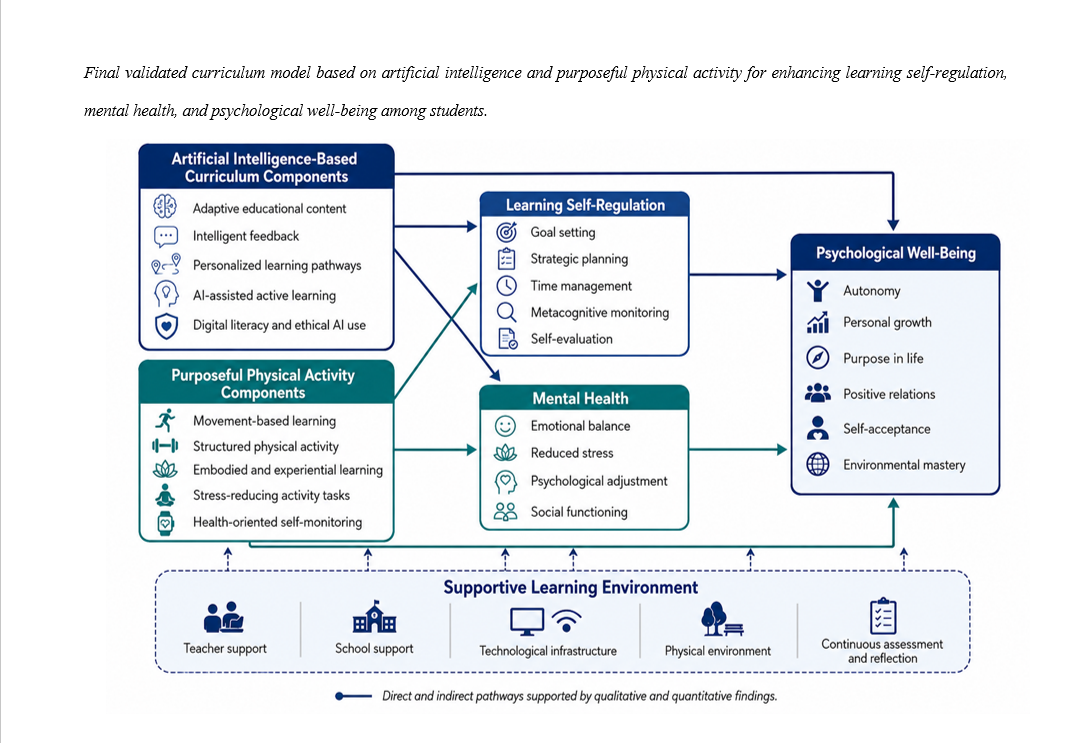
Objective: The objective of this study was to design and validate a curriculum model based on artificial intelligence and purposeful physical activity with emphasis on enhancing learning self-regulation, mental health, and psychological well-being among students.
Methods and Materials: This applied developmental study was conducted using an exploratory sequential mixed-methods design. In the qualitative phase, 20 experts in curriculum studies, educational technology, artificial intelligence in education, physical education, educational psychology, and student mental health were selected through purposive criterion-based sampling from Tehran and participated in semi-structured interviews. The interview data were analyzed using thematic analysis to extract the main dimensions, components, and indicators of the proposed curriculum model. In the quantitative phase, 384 secondary school students from Tehran were selected through multistage cluster sampling during the 2025–2026 academic year. Data were collected using a researcher-made curriculum model validation questionnaire, a learning self-regulation questionnaire, the General Health Questionnaire, and a psychological well-being scale. Data were analyzed using descriptive statistics, reliability analysis, confirmatory factor analysis, and structural equation modeling.
Findings: The inferential findings showed that the final curriculum model had acceptable empirical fit. The final modified model demonstrated favorable fit indices, including χ²/df = 2.14, GFI = 0.917, AGFI = 0.901, CFI = 0.951, TLI = 0.944, RMSEA = 0.054, and SRMR = 0.043. Artificial intelligence-based curriculum components had significant direct effects on learning self-regulation, mental health, and psychological well-being. Purposeful physical activity also had significant direct effects on learning self-regulation, mental health, and psychological well-being. Learning self-regulation and mental health significantly predicted psychological well-being. The model explained 48% of the variance in learning self-regulation, 43% of the variance in mental health, and 57% of the variance in psychological well-being.
Conclusion: The findings indicate that an integrated curriculum model based on artificial intelligence and purposeful physical activity can provide an effective educational framework for strengthening students’ self-regulated learning, supporting mental health, and promoting psychological well-being.
Downloads
References
Ansari, A. N., & Rizvi, N. F. (2023). School‐based Interventions Promoting Social Capabilities Among Students: A Scoping Review of Literature. Review of Education, 11(2). https://doi.org/10.1002/rev3.3404
Cai, Z. (2024). Research on Teachers' Role Orientation and Strategies in the Age of Artificial Intelligence. Advances in Educational Technology and Psychology, 8(4). https://doi.org/10.23977/aetp.2024.080401
Chen, D. (2025). The Effect of English Education on Students' Mental Health Based on Deep Learning. International Journal of Cognitive Informatics and Natural Intelligence, 19(1), 1-19. https://doi.org/10.4018/ijcini.380619
Chen, L. (2023). Research on the Effective Way of Mental Health Education Based on Artificial Intelligence Technology. Applied Mathematics and Nonlinear Sciences, 9(1). https://doi.org/10.2478/amns.2023.2.00464
Corrigan, V. K., Richmond, P. W., Strand, E. B., & Vaisman, J. M. (2025). The Future of Flourishing in Veterinary Medicine: A Systems-Informed Positive Psychology Approach in Veterinary Education. Frontiers in veterinary science, 11. https://doi.org/10.3389/fvets.2024.1484412
Dai, X. (2024). Design of a Computer Technology-Based Teaching System for College Students Mental Health Course. Journal of Electrical Systems, 20(6s), 650-660. https://doi.org/10.52783/jes.2719
Delgado-Montoro, R., Férriz-Valero, A., García-Taibo, O., & Baena‐Morales, S. (2022). Integrating Mindfulness Into the Subject of Physical Education—An Opportunity for the Development of Students’ Mental Health. Healthcare, 10(12), 2551. https://doi.org/10.3390/healthcare10122551
Donaldson, S. I., Zyl, L. E. v., & Donaldson, S. (2022). PERMA+4: A Framework for Work-Related Wellbeing, Performance and Positive Organizational Psychology 2.0. Frontiers in psychology, 12. https://doi.org/10.3389/fpsyg.2021.817244
Drigas, A., Karyotaki, M., & Skianis, C. (2023). Mobiles, Digital Tech, Empathy, Metacognition, Self-Consciousness and the Role of Parents in Schools and Societies of the Future. International Journal of Interactive Mobile Technologies (Ijim), 17(07), 118-132. https://doi.org/10.3991/ijim.v17i07.37201
Hack‐Polay, D., Mahmoud, A. B., Ikafa, I., Rahman, M., Kordowicz, M., & Verde, J. M. (2023). Steering Resilience in Nursing Practice: Examining the Impact of Digital Innovations and Enhanced Emotional Training on Nurse Competencies. Technovation, 120, 102549. https://doi.org/10.1016/j.technovation.2022.102549
Jia, S. (2026). Knowledge-Centric Cognitive Computing Framework for Psychological Well-Being Assessment in Teaching Chinese as a Foreign Language. International Journal of Knowledge Management, 22(1), 1-18. https://doi.org/10.4018/ijkm.413706
Li, H. (2025). Empowering Students: Positive Higher Education Strategies. Frontiers in psychology, 16. https://doi.org/10.3389/fpsyg.2025.1561267
Li, Y. (2022). Construction and Application of Dynamic Evaluation System and Educational Model of College Students' Mental Health. Frontiers in Public Health, 10. https://doi.org/10.3389/fpubh.2022.888052
Maden, W. v. d., Lomas, D., & Hekkert, P. (2023). A Framework for Designing AI Systems That Support Community Wellbeing. Frontiers in psychology, 13. https://doi.org/10.3389/fpsyg.2022.1011883
Miao, M., Chai, H., Xue, R., & Qi, W. (2024). Effects of Perceived Variety-Support on Middle School Students’ Learning Engagement in Physical Education: The Mediating Role of Motivation. Frontiers in psychology, 15. https://doi.org/10.3389/fpsyg.2024.1459362
Naples, L. H., & Tuckwiller, E. D. (2021). Taking Students on a Strengths Safari: A Multidimensional Pilot Study of School-Based Wellbeing for Young Neurodiverse Children. International journal of environmental research and public health, 18(13), 6947. https://doi.org/10.3390/ijerph18136947
Ravenscroft, A., Richards, P., & Bunce, M. (2022). Education 4.0: Is Characterising and Harmonising Intelligences a Way of Thinking About a Pedagogy 4.0 for Higher Education? , 653-669. https://doi.org/10.4135/9781529757217.n41
Razak, N. I. A., Yusoff, M. F. M., & Rahmita Wirza, O. K. R. (2023). ChatGPT Review: A Sophisticated Chatbot Models in Medical &Amp; Health-Related Teaching and Learning. Malaysian Journal of Medicine and Health Sciences, 19(s12), 98-108. https://doi.org/10.47836/mjmhs.19.s12.12
Shan, S., & Yu, L. (2021). Blended Teaching Design of College Students’ Mental Health Education Course Based on Artificial Intelligence Flipped Class. Mathematical Problems in Engineering, 2021, 1-10. https://doi.org/10.1155/2021/6679732
Sheinman, N., & Russo‐Netzer, P. (2021). Mindfulness in Education: Insights Towards an Integrative Paradigm. 609-642. https://doi.org/10.1007/978-3-030-64537-3_24
Siette, J., Ayyoub, J., & Mackenzie, E. (2026). Embedding Brain Health in the Curriculum: A Qualitative Study of Primary School Teacher Perceptions. BMC public health. https://doi.org/10.1186/s12889-026-26747-0
Sturgill, R., Martinasek, M., Schmidt, T., & Goyal, R. K. (2020). A Novel Artificial Intelligence-Powered Emotional Intelligence and Mindfulness App (Ajivar) for the College Student Population During the COVID-19 Pandemic: Quantitative Questionnaire Study (Preprint). https://doi.org/10.2196/preprints.25372
Sturgill, R., Martinasek, M., Schmidt, T., & Goyal, R. K. (2021). A Novel Artificial Intelligence-Powered Emotional Intelligence and Mindfulness App (Ajivar) for the College Student Population During the COVID-19 Pandemic: Quantitative Questionnaire Study. Jmir Formative Research, 5(1), e25372. https://doi.org/10.2196/25372
Tang, C. A., & Wang, Z. (2025). The Impact of Sports Reforms in the New Era on the Physical and Mental Health Development of College Students. International Journal of Cognitive Informatics and Natural Intelligence, 19(1), 1-16. https://doi.org/10.4018/ijcini.368147
Wang, N., Mohd Nazri Bin Abdul, R., & Megat Ahmad Kamaluddin Bin Megat, D. (2021). Diversified Talent Cultivation Mechanism of Early Childhood Physical Education Under the Full-Practice Concept – Oriented by Preschooler Mental Health and Intelligent Teaching. Frontiers in psychology, 11. https://doi.org/10.3389/fpsyg.2020.593063
Zhang, H., & Yang, Y. (2025). Psychological Education in Higher Education: Opportunities and Challenges in the Internet+ Era. World journal of psychiatry, 15(5). https://doi.org/10.5498/wjp.v15.i5.103274
Zhang, Y., & Wang, H. (2022). Influence of Voice Interactive Educational Robot Combined With Artificial Intelligence for the Development of Adolescents. Computational Intelligence and Neuroscience, 2022, 1-8. https://doi.org/10.1155/2022/7655001
Downloads
Additional Files
Publication Timeline
- Submitted
- Revised
- Accepted