The Mediating Role of Moral Development and Religious Orientation in the Relationship of Narcissism and Bullying with Academic Cheating among Upper Secondary School Students
DOI:
https://doi.org/10.61838/Keywords:
Narcissism, Bullying, Academic Cheating, Moral Development, Religious Orientation, Upper Secondary School Students.Abstract
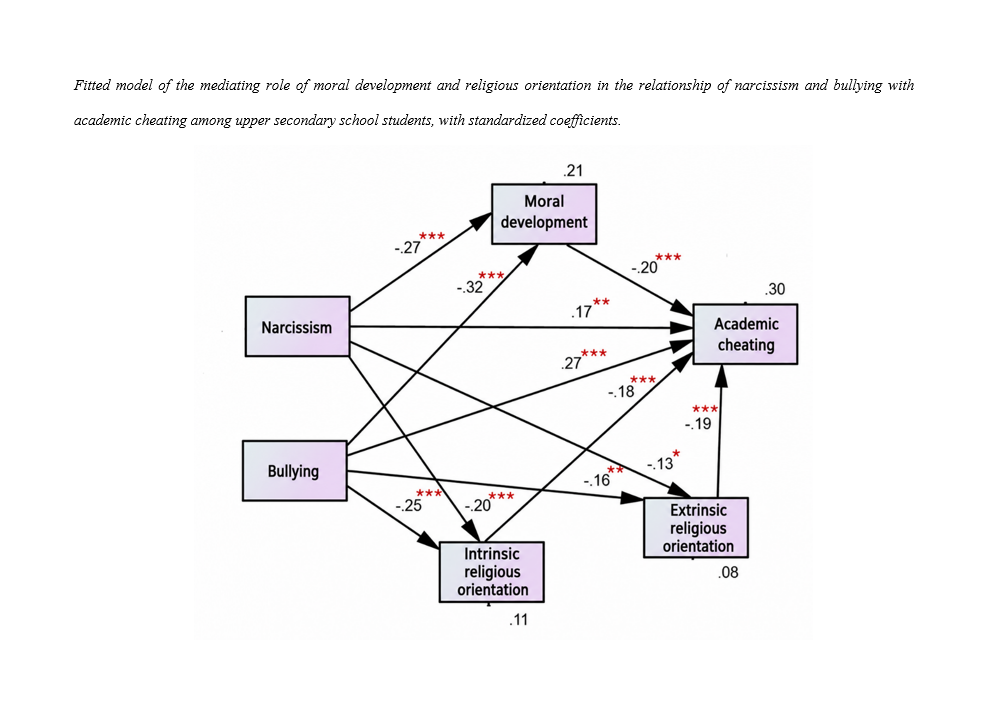
Objective: This study aimed to model the effects of narcissism and bullying on academic cheating through the mediating roles of moral development and religious orientation among upper secondary school students.
Methods and Materials: This applied correlational study was conducted among upper secondary school students in Zanjan during the 2024–2025 academic year. A total of 311 students, including 167 boys and 144 girls, were selected using multistage cluster sampling. Data were collected using Murdock and Stephens’ Academic Cheating Questionnaire, the 16-item Narcissistic Personality Inventory by Ames, Rose, and Anderson, the Illinois Bullying Scale by Espelage and Holt, Manavipour’s Moral Development Scale, and Allport and Ross’s Religious Orientation Scale. Data were analyzed using Pearson correlation coefficients, path analysis, and bootstrap testing in SPSS version 28 and AMOS version 24.
Findings: The proposed model demonstrated acceptable fit indices (GFI = 0.90, CFI = 0.90, RMSEA = 0.053). Narcissism positively and significantly predicted academic cheating (β = 0.168, p = 0.003), and bullying also positively and significantly predicted academic cheating (β = 0.274, p < 0.001). Moral development negatively predicted academic cheating (β = -0.202, p < 0.001). Intrinsic religious orientation (β = -0.181, p < 0.001) and extrinsic religious orientation (β = -0.187, p < 0.001) also negatively and significantly predicted academic cheating. Narcissism (β = -0.270, p < 0.001) and bullying (β = -0.320, p < 0.001) negatively predicted moral development. Indirect effect analysis showed that moral development significantly mediated the relationships between narcissism (β = 0.054, p = 0.002) and bullying (β = 0.065, p < 0.001) with academic cheating. Intrinsic and extrinsic religious orientation also showed significant mediating effects.
Conclusion: The findings indicate that moral development and religious orientation function as protective mechanisms in the relationships of narcissism and bullying with academic cheating. Preventive and educational interventions aimed at reducing academic cheating may benefit from strengthening moral reasoning, empathy, moral self-regulation, and the internalization of religious values among upper secondary school students.
Downloads
References
Alotaibi, J. S., Alotaibi, A., Alasiry, S., Alrasheadi, B., Alanazy, W., Alkubati, S., & Llego, J. (2024). Reasons for academic cheating in a cohort of nursing students in Saudi Arabia: A cross-sectional study. Journal of Medicine and Life, 17(4), 418-425. https://doi.org/10.25122/jml-2023-0517
Bear, G. G. (2024). Lying, Cheating, Bullying, and Narcissism: The Development of Self-Discipline and the Influence of Trumpism. Routledge. https://www.routledge.com/Lying-Cheating-Bullying-and-Narcissism-The-Development-of-Self-Discipline-and-the-Influence-of-Trumpism/Bear/p/book/9781032498584
Brunell, A. B., Staats, S., Barden, J., & Hupp, J. M. (2011). Narcissism and academic dishonesty: The exhibitionism dimension and the lack of guilt. Personality and individual differences, 50(3), 323-328. https://psycnet.apa.org/record/2010-26693-003
Cook, C. R., Williams, K. R., Guerra, N. G., Kim, T. E., & Sadek, S. (2010). Predictors of bullying and victimization in childhood and adolescence. School Psychology Quarterly, 25(2), 65-83. https://www.apa.org/pubs/journals/releases/spq-25-2-65.pdf
Eccles, J. S., & Roeser, R. W. (2011). Schools as developmental contexts. In Handbook of adolescent psychology (pp. 225-241). Wiley. https://psycnet.apa.org/record/2014-14697-009
Esteves, G. G. L., Oliveira, L. S., & Andrade, J. M. (2021). Dark triad predicts academic cheating. Personality and individual differences, 171, 110513. https://www.sciencedirect.com/science/article/abs/pii/S0191886920307042
Estevez, E., Estevez-Garcia, F., & Flores, E. (2025). Dark tetrad personality traits: An analysis by gender in aggressors and victims of school bullying. School Mental Health, 17(2), 1-14. https://link.springer.com/article/10.1007/s12310-025-09772-z
Forbes, M. B., Sims, R. N., & Killen, M. (2026). Children and young adults factor merit into their judgments of gender-based science resource inequalities. Developmental science, 29(1), e70096. https://doi.org/10.1111/desc.70096
Fritz, T., Gonzalez Cruz, H., Janke, S., & Daumiller, M. (2022). Elucidating the associations between achievement goals and academic dishonesty: A meta-analysis. Educational psychology review, 35(33), 2-26. https://link.springer.com/article/10.1007/s10648-023-09753-1
Jolicoeur, J. R. (2010). Hellfire and academic dishonesty: An empirical evaluation of the influence of religious orientation on academic deviance University of Missouri-St. Louis].
Krizan, Z., & Herlache, A. D. (2018). The narcissism spectrum model: A synthetic view of narcissistic personality. Personality and Social Psychology Review, 22(1), 3-31.
Krou, M. R., Fong, C. J., & Hoff, M. A. (2021). Achievement motivation and academic dishonesty: A meta-analytic investigation. Educational psychology review, 33(2), 427-458. https://eric.ed.gov/?q=light&ff1=subStudent+Motivation&pg=8&id=EJ1295973
Manavipour, D. (2012). Construction of a moral development scale for students. Innovations in Educational Management, 7(4), 89-96. https://www.sid.ir/paper/154189/fa
Mikaeeli Manee, F., Dehghan, B., Arzhangi, B., Shirzade, M., Rezaei, F., & Elahi, E. (2025). Examining the relationship between the dark triad of personality and moral idealism with academic cheating among university students: The mediating role of conscientiousness and honesty-humility. qaiie, 10(2), 129-156. https://qaiie.ir/article-1-1320-fa.html
Miller, J. D., Back, M. D., Lynam, D. R., & Wright, A. G. C. (2021). Narcissism today: What we know and what we need to know. Current Directions in Psychological Science, 30(6), 519-525.
Mirzakhani, M., Talepasand, S., & Sotodeh Asl, N. (2023). Modeling the relationship between teacher's enthusiasm and students' academic cheating behavior: The mediating role of academic motivation. Journal of Psychological Science, 22(130), 111-131. http://psychologicalscience.ir/browse.php?a_code=A-10-2087-2&slc_lang=fa&sid=1
Olweus, D., & Limber, S. P. (2018). Some problems with cyberbullying research. Current opinion in psychology, 19, 139-143.
Qi, C. (2025). The impact of adolescent innovation on academic resilience, distance learning self-efficacy, and academic performance. Scientific reports, 15(1), 12396. https://doi.org/10.1038/s41598-025-91542-7
Rosari, R., Chariri, A., & Utomo, D. C. (2026). Academic dishonesty among university students: Gender, semester differences, and influencing factors. Emerging Science Journal, 10(2), 956-973. https://www.ijournalse.org/index.php/ESJ/article/view/3826
Sasaki, J. Y., & Kim, H. S. (2016). Religion and well-being: The mediating role of meaning in life. Journal of Cross-Cultural Psychology, 47(5), 715-730.
Sedikides, C., Tang, Y., Liu, Y., de Boer, E., Assink, M., Thomaes, S., & Brummelman, E. (2026). Narcissism and wellbeing: A cross-cultural meta-analysis. Personality and Social Psychology Bulletin, 52(5), 1222-1238. https://doi.org/10.1177/01461672241307531
Sjovag, H. (2024). Religious orientation and mental health: A meta-analytic review. Journal of religion and health, 63(2), 789-806.
Song, J., & Liu, S. (2025). Dark personality traits are associated with academic misconduct, frustration, negative thinking, and generative AI use habits: The case of Sichuan art universities. BMC psychology, 13(1), 633. https://doi.org/10.1186/s40359-025-02949-w
Steinberg, L. (2014). Age of Opportunity: Lessons from the New Science of Adolescence. Houghton Mifflin Harcourt. https://books.google.com/books/about/Age_of_Opportunity.html?id=sppdBAAAQBAJ
Stephens, J. M. (2018). Bridging the divide: The role of moral reasoning in academic integrity. Journal of College and Character, 19(2), 89-104.
Strowd, J. (2023). When opportunity knocks, do dark personality traits aid in students' rationalization of academic misconduct? University of Southern Mississippi]. https://aquila.usm.edu/cgi/viewcontent.cgi?article=3463&context=dissertations
Tsitsika, A. K., Barlou, E., Andrie, E., Dimitropoulou, C., Tzavela, E. C., Janikian, M., & Tsolia, M. (2014). Bullying behaviors in children and adolescents: An ongoing story. Frontiers in Public Health, 2, 7. https://doi.org/10.3389/fpubh.2014.00007
Twenge, J. M., & Foster, J. D. (2010). Birth cohort increases in narcissistic personality traits among American college students, 1982-2009. Social Psychological and Personality Science, 1(1), 99-106. https://doi.org/10.1177/1948550609355719
Williams, K. M., Nathanson, C., & Paulhus, D. L. (2010). Identifying and profiling scholastic cheaters: Their personality, cognitive ability, and motivation. Journal of Experimental Psychology: Applied, 16(3), 293-307. https://doi.org/10.1037/a0020773
Zhao, L., Peng, J., Dong, L. D., Compton, B. J., Zhong, Z., Li, Y., Mao, H., Ye, J., Heyman, G. D., & Lee, K. (2023). Academic cheating interferes with learning among middle school children. Journal of Experimental Child Psychology, 226, 105566. https://doi.org/10.1016/j.jecp.2022.105566
Downloads
Additional Files
Publication Timeline
- Submitted
- Revised
- Accepted