The Role of Self-Awareness, Self-Control, and Spirituality in the Prevention of Social Harms Among Youth
DOI:
https://doi.org/10.61838/Keywords:
self-awareness, self-control, spirituality, social harms, youth, risk-taking behavior, preventionAbstract
Objective: This study aimed to examine the role of self-awareness, self-control, and spirituality in the prevention of social harms among youth.
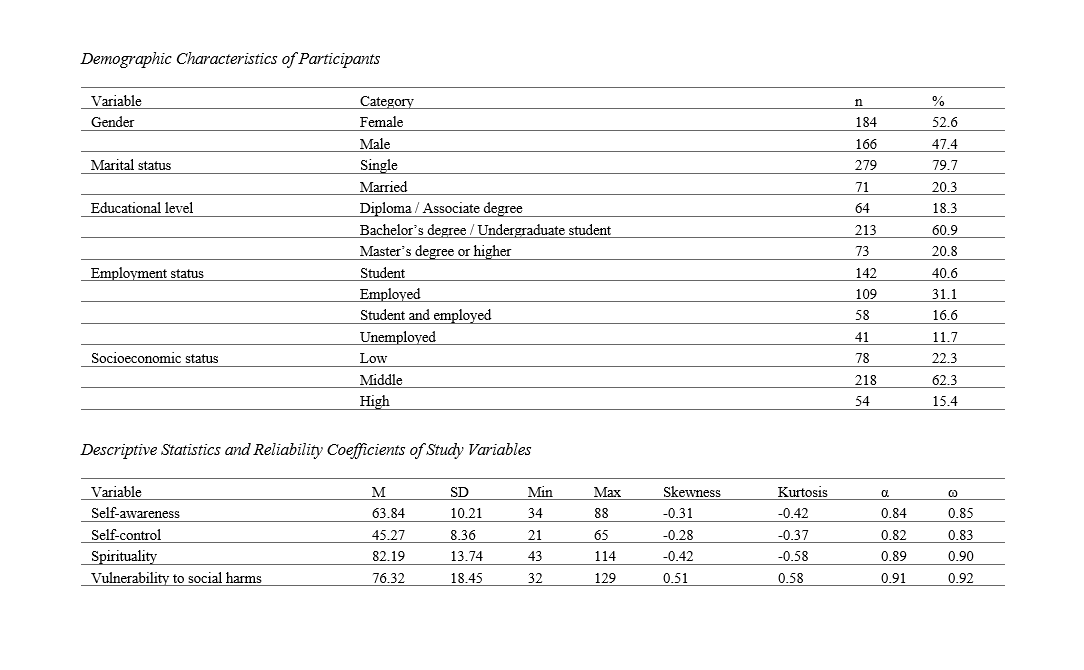
Methods and Materials: A descriptive-correlational design with a predictive modeling approach was used. The sample consisted of 350 young people aged 18 to 29 years selected through multistage cluster sampling. Data were collected using the Self-Reflection and Insight Scale, Brief Self-Control Scale, Spiritual Well-Being Scale, Iranian Adolescents Risk-Taking Scale, and a demographic information form. Data were analyzed using Pearson correlation coefficients, hierarchical multiple regression, and structural equation modeling.
Findings: Self-awareness, self-control, and spirituality were negatively associated with vulnerability to social harms (r = -.43, -.58, and -.49, respectively; p < .001). The hierarchical regression model was significant, F(6, 343) = 42.78, p < .001, and explained 42.8% of the variance. Self-control was the strongest negative predictor (β = -.37, p < .001), followed by spirituality (β = -.26, p < .001) and self-awareness (β = -.18, p = .002). The structural model showed acceptable fit, χ²/df = 2.22, CFI = .94, TLI = .92, RMSEA = .059, and SRMR = .046.
Conclusion: Self-awareness, self-control, and spirituality appear to be important protective factors against vulnerability to social harms among youth. Prevention programs should strengthen reflective capacity, impulse regulation, meaning-making, and value-based decision-making.
Downloads
References
Ahmed, N., Williams, R., & Choi, M. (2026). Neurocognitive Risk Mechanisms in Adolescent Bipolar Disorder: Impulsivity, Emotional Reactivity, and Decision Making Deficits. Journal of affective disorders, 325, 112-123.
Cioban, S., Lazar, A. R., Bacter, C., & Hatos, A. (2021). Adolescent Deviance and Cyber-Deviance: A Systematic Literature Review. Frontiers in psychology, 12, 748006. https://doi.org/10.3389/fpsyg.2021.748006
Durlak, J. A., Weissberg, R. P., Dymnicki, A. B., Taylor, R. D., & Schellinger, K. B. (2011). The Impact of Enhancing Students' Social and Emotional Learning: A Meta-Analysis of School-Based Universal Interventions. Child development, 82(1), 405-432. https://doi.org/10.1111/j.1467-8624.2010.01564.x
Elzamzamy, K., Naveed, S., & Dell, M. L. (2024). Religion, Spirituality, and Pediatric Mental Health: A Scoping Review of Research on Religion and Spirituality in the Journal of the American Academy of Child and Adolescent Psychiatry from 2000 to 2023. Frontiers in Psychiatry, 15, 1472629. https://doi.org/10.3389/fpsyt.2024.1472629
Halliburton, A. E., Murray, D. W., & Ridenour, T. A. (2024). Interplay among Self-Regulation Processes over Time for Adolescents in the Context of Chronic Stress. Journal of Cognitive Development, 25(4), 605-629. https://doi.org/10.1080/15248372.2023.2295894
Hatala, A., McGavock, J., Michaelson, V., & Pickett, W. (2020). Low Risks for Spiritual Highs: Risk-Taking Behaviours and the Protective Benefits of Spiritual Health among Saskatchewan Adolescents. Paediatrics & Child Health, 26(2), e121-e128. https://doi.org/10.1093/pch/pxaa007
Kumar, H., Xiao, R., Lawson, B., Musabirov, I., Shi, J., Wang, X., Luo, H., Williams, J. J., Rafferty, A., Stamper, J., & Li, M. (2024). Supporting Self-Reflection at Scale with Large Language Models: Insights from Randomized Field Experiments in Classrooms. Proceedings of the Eleventh ACM Conference on Learning @ Scale,
Li, J., Huang, J., Zhang, L., & Yang, Y. (2022). Linking Self-Control to Negative Risk-Taking Behavior among Chinese Late Adolescents: A Moderated Mediation Model. International journal of environmental research and public health, 19(13), 7646. https://doi.org/10.3390/ijerph19137646
Michaelson, V., Brooks, F., Jirasek, I., Inchley, J., Whitehead, R., King, N., Walsh, S. D., Davison, C. M., & Pickett, W. (2023). Domains of Spirituality and Their Importance to the Health of 75,533 Adolescents in 12 Countries. Health Promotion International, 38(3), daab185. https://doi.org/10.1093/heapro/daab185
Razeghi, N., Sadat-Hoseini, A. S., & Dehghan Nayeri, N. (2023). Spiritual Health Consequences from the Iranian Adolescents' Perspective. Journal of religion and health, 63, 1530-1548. https://doi.org/10.1007/s10943-023-01911-7
Roberson, A. J., Eiden, R. D., Lessard, J., & Schuetze, P. (2024). Longitudinal Associations between Early Risk and Adolescent Delinquency: The Mediating Role of Self-Control and Moderating Role of Father-Child Closeness. Journal of youth and adolescence, 53, 1896-1911. https://doi.org/10.1007/s10964-024-01993-0
Sam, M., Pirkhaefi, A., & Asgharnezhad Farid, A. (2025). The role of behavioral activation and inhibition systems (BIS/BAS) in impulsive behaviors with the mediating role of difficulty in emotion regulation among female vocational adolescents with borderline personality disorder. Psychological Science, 24(145), 221-237.
Solimannejad, M., Niazi, M., & Abbasi Shavazi, M. T. (2021). Social Harms and Social Class in Iranian Youth and Adolescents Living in Slums in the Suburbs: A Systematic Review. International Journal of Adolescent Medicine and Health. https://doi.org/10.1515/ijamh-2020-0267
Taylor, R. D., Oberle, E., Durlak, J. A., & Weissberg, R. P. (2017). Promoting Positive Youth Development through School-Based Social and Emotional Learning Interventions: A Meta-Analysis of Follow-Up Effects. Child development, 88(4), 1156-1171. https://doi.org/10.1111/cdev.12864
van der Aar, L. P. E., Crone, E. A., & Peters, S. (2022). Parallel Changes in Positive Youth Development and Self-Awareness: The Role of Emotional Self-Regulation, Self-Esteem, and Self-Reflection. Prevention Science, 23, 502-512. https://doi.org/10.1007/s11121-022-01345-9
Wang, Y., Bai, R., Liu, J., Xu, S., & Liu, X. (2026). Latent transition analysis of non-suicidal self-injury comorbidity patterns among adolescents: Predictive roles of impulsivity, emotional dysregulation, and core self-evaluations. International Journal of Clinical and Health Psychology, 26(2), 100708. https://doi.org/10.1016/j.ijchp.2026.100708
Zadeh Mohammadi, A., Ahmadabadi, Z., & Heidari, M. (2011). Construction and Assessment of Psychometric Features of Iranian Adolescents Risk-Taking Scale. Iranian Journal of Psychiatry and Clinical Psychology, 17(3), 218-225.
Zhang, Y., Luo, F., & He, S. (2025). Neurodevelopmental Trajectories of Risk Perception and Impulsive Decision Making in Adolescents. Brain and Cognition, 180, 105-118.
Downloads
Additional Files
Publication Timeline
- Submitted
- Revised
- Accepted