The Mediating Role of Self-Injurious Thoughts in the Relationship Between Psychological Distress and Death Obsession with Suicide Attempts Among Adolescents Experiencing War Anxiety
DOI:
https://doi.org/10.61838/Keywords:
War anxiety, Suicide attempt, Self-injurious thoughts, Psychological distress, Death obsessionAbstract
Objective: This study aimed to examine the mediating role of self-injurious thoughts in the relationship between psychological distress and death obsession with suicide attempts among adolescents experiencing war anxiety.
Methods and Materials: This applied study was conducted using a correlational design based on structural equation modeling. The statistical sample consisted of 215 adolescents aged 15 to 18 years living in Mahshahr, who were selected through voluntary sampling. The research instruments included the Shomali and Barkhordari War Anxiety Questionnaire, the Osman et al. Suicide Attempt Questionnaire, the Abdel-Khalek Death Obsession Scale, the Kessler et al. Psychological Distress Scale, and the Shomali and Barkhordari Self-Injurious Thoughts Questionnaire. Data were analyzed using Pearson correlation and structural equation modeling through SPSS version 27 and AMOS version 24.
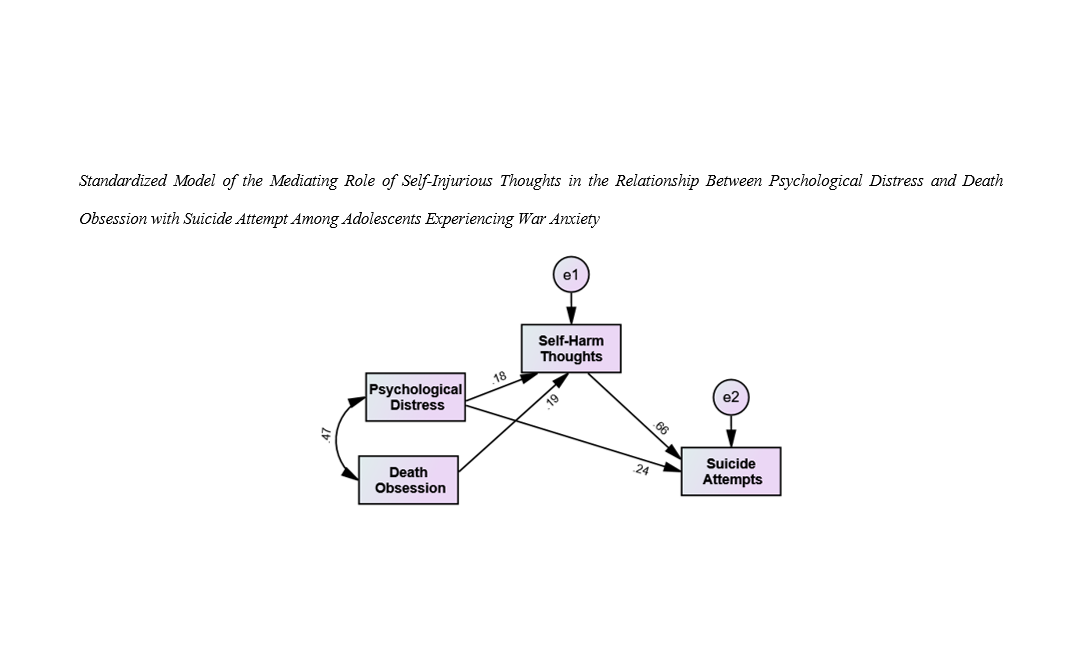
Findings: The inferential results showed that the direct effects of psychological distress and self-injurious thoughts on suicide attempts were positive and statistically significant. The direct effects of psychological distress and death obsession on self-injurious thoughts were also positive and statistically significant. In addition, the indirect effects of psychological distress and death obsession on suicide attempts through self-injurious thoughts were positive and statistically significant. However, the direct effect of death obsession on suicide attempts was not significant in the final structural model. These findings confirmed the mediating role of self-injurious thoughts in the relationship between psychological distress, death obsession, and suicide attempts among adolescents experiencing war anxiety.
Conclusion: The findings indicate that self-injurious thoughts are a key cognitive-emotional mechanism linking psychological distress and death obsession to suicide attempts in adolescents exposed to war-related anxiety. Therefore, preventive and therapeutic interventions should prioritize the early identification and modification of self-injurious thoughts, especially among vulnerable adolescents experiencing psychological distress and death-related preoccupations.
Downloads
References
Aldabbour, B., El-Jamal, M., Abuabada, A., Al-Dardasawi, A., Abusedo, E., Abu Daff, H., & Dardas, L. A. (2025). The Psychological Toll of War and Forced Displacement in Gaza: A Study on Anxiety, Ptsd, and Depression. Chronic Stress, 9, 24705470251334943. doi:10.1177/24705470251334943
Alkhalifah, R. H., AlBani, B., Alotaibi, N. E., Khubzan, W. D., Alharbi, R. M., Alotaibi, A. J., & Alqifari, A. (2026). From Trauma to Resilience: A Systematic Review of Psychological Intervention Strategies for War-Affected Children and Adolescents. Avicenna Journal of Medicine, 16(01), 004-015. doi:10.1055/s-0046-1819570
American Psychiatric, A. (2023). Understanding Mental Disorders: Your Guide to Dsm-5-Tr. American Psychiatric Pub. doi:10.1176/appi.books.9781615375370
Beri, V. (2024). The Mediating Role of Death Obsessions in the Relationship between Caregiver Burden and Somatic Symptoms: A Study on the Informal Dementia Caregivers in India. OMEGA-Journal of Death and Dying, 89(3), 1010-1025. doi:10.1177/00302228221090757
Chikaura, T. A., Weir, E., Griffiths, S., Procyshyn, T., Pelton, M., Allison, C., & Baron-Cohen, S. (2026). Traumatic Experiences, Psychological Distress and Suicide-Related Behaviors in Autistic Adults. Autism Research, 19(1), e70137. doi:10.1002/aur.70137
Choi, S., Hong, J. Y., Kim, Y. J., & Park, H. (2020). Predicting Psychological Distress Amid the Covid-19 Pandemic by Machine Learning: Discrimination and Coping Mechanisms of Korean Immigrants in the U.S. International Journal of Environmental Research and Public Health, 17(17), 6057. doi:10.3390/ijerph17176057
Enea, V., Candel, O. S., Zancu, S. A., Maftei, A., Birladeanu, L., & Timofte, D. (2024). Death Obsession, Covid-19-Related Fear and Religiosity in People Living with Type 2 Diabetes. OMEGA-Journal of Death and Dying, 89(3), 1094-1112. doi:10.1177/00302228221085402
Fitzpatrick, S., Kranzler, A., Fehling, K., Lindqvist, J., & Selby, E. A. (2020). Investigating the Role of the Intensity and Duration of Self-Injury Thoughts in Self-Injury with Ecological Momentary Assessment. Psychiatry research, 284, 112761. doi:10.1016/j.psychres.2020.112761
Gomes, K. D., Collette, T. L., Schlenk, M., Judkins, J., Sanchez-Cardona, I., Channer, B., & Moore, B. A. (2024). Posttraumatic Stress Disorder, Suicidal Ideation, and Stress: The Moderating Role of Dysfunctional and Recovery Cognitions. Archives of Suicide Research, 28(2), 569-584. doi:10.1080/13811118.2023.2199798
Gundogan, S., & Arpaci, I. (2024). Depression as a Mediator between Fear of Covid-19 and Death Anxiety. Current Psychology, 43, 12990-12997. doi:10.1007/s12144-022-03120-z
Haham, L., Aderka, I. M., Pine, D. S., Abend, R., & Shechner, T. (2026). Adolescence under Fire: A Multi-Method Study of Psychological Vulnerability and Resilience among Adolescents Impacted by War. Journal of Child Psychology and Psychiatry, 67(3), 366-379. doi:10.1111/jcpp.70052
Hanifa, H., Alzoubi, M., Khallouf, E. S., Alzoubi, L., Hamesh, F., Qashqash, M. E., & Assaf, N. (2026). The Invisible Wounds of War: A Study of Insomnia and Psychological Distress among Healthcare Students in Conflict-Affected Syria. BMC Psychology, 14(1), 100. doi:10.1186/s40359-025-03879-3
Horwitz, A. V. (2002). Selecting Outcomes for the Sociology of Mental Health: Issues of Measurement and Dimensionality. Journal of Health and Social Behavior, 43(2). doi:10.2307/3090193
Kessler, R. C., Andrews, G., Colpe, L. J., Hiripi, E., Mroczek, D. K., Normand, S. L., & Zaslavsky, A. M. (2002). Short Screening Scales to Monitor Population Prevalences and Trends in Non-Specific Psychological Distress. Psychological medicine, 32(6), 959-976. doi:10.1017/S0033291702006074
Mohammadzadeh, A., & Najafi, M. (2010). Predicting Death Obsession Based on Religious Biases: Examining the Role of Gender. Clinical Psychology, 2(3), 65-72.
Moussa, M. A., & Al-Adamat, O. A. (2025). War Anxiety Scale and Its Relationship to Emotional Empathy from the Point of View of Adolescents in Jordanian Society. Port Said Journal of Educational Research, 4(1), 77-105. doi:10.21608/psjer.2024.295950.1036
Naifeh, J. A., Nock, M. K., Dempsey, C. L., Georg, M. W., Bartolanzo, D., Ng, T. H. H., & Ursano, R. J. (2020). Self-Injurious Thoughts and Behaviors That Differentiate Soldiers Who Attempt Suicide from Those with Recent Suicide Ideation. Depression and Anxiety, 37(8), 738-746. doi:10.1002/da.23016
Orpaz, N., Livne, G. S., Abend, R., Pine, D. S., & Shechner, T. (2026). Pre-War Induced Theta Oscillations Moderate Adolescents' Psychological Responses to War Exposure. International Journal of Clinical and Health Psychology, 26(2), 100701. doi:10.1016/j.ijchp.2026.100701
Rashid, S., Khorramdel, K., Gholami, F., & Senobar, L. (2016). The Relationship between Interpersonal Psychological Theory of Suicide Constructs (Loneliness, Perceived Social Support, Thwarted Belongingness and Burdensomeness) and Suicidal Behavior among Iranian Students. Health Education and Health Promotion, 4(2), 35-48.
Rosas-Fuentes, P. D., Valdes-Garcia, K. P., Monroy-Velasco, I. R., de los Angeles Perez-Pedraza, B., & Sanchez-Loyo, L. M. (2023). Depression, Suicide Ideation, and Irrational Beliefs: Explanatory Models in Psychology Students. Salud mental, 46(2), 61-67. doi:10.17711/SM.0185-3325.2023.009
Sefidgaran, A., Ahmadian, N., Padyab, A., Ramezani, A., & Sharifi Zavashati, M. (2023). The Role of Rumination and Forgiveness in Predicting Mental Health among Nursing Students. Islamic Lifestyle Centered on Health, 7(2), 440-446.
Shapiro, M. O., Threeton, E. M., Morris, P. E., & Raines, A. M. (2026). Examining Reductions in Thwarted Belongingness, Perceived Burdensomeness, and Rumination within Group-Based Behavioral Activation Treatment for Depression. Journal of Behavioral and Cognitive Therapy, 36(2), 100553. doi:10.1016/j.jbct.2025.100553
Shomali Ahmadabadi, M., & Barkhordari Ahmadabadi, A. (2025a). Construction and Validation of the Iranian Adolescents Self-Injurious Thoughts Questionnaire. Modern Studies in Educational Sciences, 2(1).
Shomali Ahmadabadi, M., & Barkhordari Ahmadabadi, A. (2025b). Construction and Validation of the Iranian Version of the War Anxiety Scale. Journal of Social Psychology, 15(2), 120-140.
Shomali Ahmadabadi, M., Barkhordari Ahmadabadi, A., & Shahvaz Khaleqdadi, A. (2025). The Mediating Role of Psychological Distress in the Relationship between Childhood Maltreatment and Parent-Child Relationship Conflict with Suicide Attempts among Women in Less-Privileged Areas in a Cultural Context. Journal of Woman Cultural Psychology, 64(16), 17-29.
Silwal, S., Westerlund, M., Wan Mohd Yunus, W. M. A., Jaakola-Siimes, S., Klomek, A. B., & Sourander, A. (2026). Suicides, Suicide Attempts and Suicidal Ideation among Children and Young People Exposed to War: A Scoping Review. Bmj Open, 16(6), e103126. doi:10.1136/bmjopen-2025-103126
Skokauskas, N. (2025). 3.2 2025 Klingenstein Third Generation Foundation Award for Research in Depression or Suicide, Supported by the Klingenstein Third Generation Foundation: Suicidality and Self-Harm Behavior of Adolescents during the Early Phase of the War in Ukraine. Journal of the American Academy of Child & Adolescent Psychiatry, 64(10), S146. doi:10.1016/j.jaac.2025.08.026
Smith, D. G., Giugni, M., Gulliver, A., Fitzpatrick, S. J., Lamb, H., Ellis, L. A., & Banfield, M. (2026). Peer-Led Models Focussed on Emotional Distress and Suicide Prevention: A Scoping Review. International Journal of Environmental Research and Public Health, 23(2), 273. doi:10.3390/ijerph23020273
Szkup, M., Krsnik, S., Kozybska, M., Rousou, E., Fedortsiv, O., Burbela, E., & Erjavec, K. (2026). Psychological Distress, Resilience, and Coping among Ukrainian War Refugees: Cross-National Differences across Seven European Host Countries and Ukraine. Frontiers in Public Health, 14, 1771440. doi:10.3389/fpubh.2026.1771440
Taghvaei Nia, A. (2018). The Moderating Role of Coping Styles in the Relationship between Attachment Styles and Death Obsession among Older Adults. Developmental Psychology (Iranian Psychologists), 14(56), 461-473.
Yang, S. L., Lv, Y. L., Yu, B. J., Chen, W. L., & Li, H. (2024). Death Anxiety, Death Obsession and Quality of Life across Frailty Level among Chinese Community-Dwelling Older Adults. Current Psychology, 1-11. doi:10.1007/s12144-024-05801-3
Downloads
Additional Files
Publication Timeline
- Submitted
- Revised
- Accepted