Privacy-Preserving Prediction of Psychological Distress Across Schools Using Academic Workload, Bullying, Sleep Quality, and Social Support: A Federated XGBoost Study
Keywords:
psychological distress, federated learning, XGBoost, academic workload, bullying, sleep quality, social support, adolescent mental healthAbstract
Objective: This study aimed to develop and evaluate a privacy-preserving federated XGBoost model for predicting psychological distress among Norwegian upper secondary school students using academic workload, bullying victimization, sleep quality, and perceived social support.
Methods and Materials: A multicenter cross-sectional predictive study was conducted among 2,428 students aged 16–19 years from 12 public upper secondary schools in Norway. Psychological distress was assessed using the Kessler Psychological Distress Scale, while academic workload, bullying victimization, sleep quality, and perceived social support were measured using standardized self-report instruments. Each school retained its raw data locally and participated as an independent node in a federated learning network. Federated XGBoost was trained using locally computed gradient and Hessian statistics transmitted through secure aggregation. Data were divided into training, validation, and independent test subsets. Model performance was evaluated using the area under the receiver operating characteristic curve, area under the precision–recall curve, sensitivity, specificity, balanced accuracy, F1 score, and Brier score. Performance was compared with centralized XGBoost, locally trained XGBoost models, and federated logistic regression.
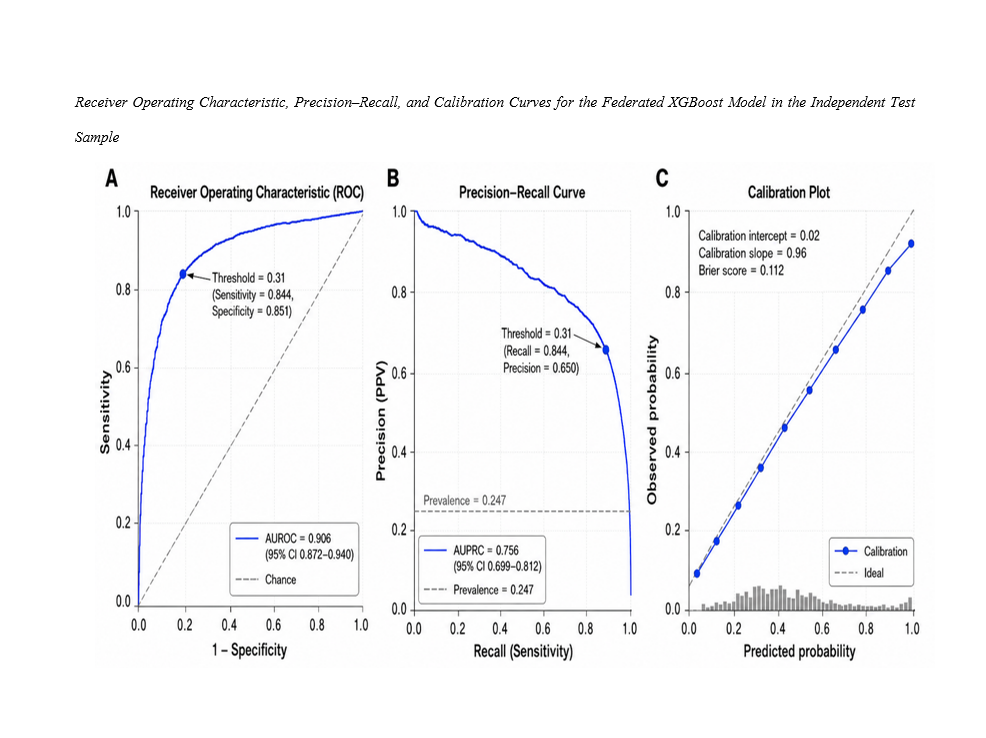
Findings: Federated XGBoost achieved an area under the receiver operating characteristic curve of .906 and an area under the precision–recall curve of .756 in the independent test sample. The model produced balanced accuracy of .848, sensitivity of .844, specificity of .851, an F1 score of .734, and a Brier score of .112. Its performance did not differ significantly from centralized XGBoost, whereas it significantly outperformed locally trained XGBoost models and federated logistic regression. Academic workload, poor sleep quality, recurrent bullying, low family support, short sleep duration, cyberbullying, and low friend support were the strongest predictors. Leave-one-school-out validation showed stable performance across participating schools.
Conclusion: Federated XGBoost provided accurate and well-calibrated prediction of psychological distress while preserving institutional control over sensitive student data, supporting its potential use as a privacy-conscious screening aid in school mental health systems.
Downloads
References
Abbasi, M. A. A., Shaikh, J. M., & Kazmi, S. W. (2023). The Enigma of Bullying and Unhealthy Atmosphere in Higher Education. Jossams, 7(1), 44-53. https://doi.org/10.58921/jossams.07.01.0251
Al‐Mamun, F., Nodi, T. S., Abdullah, A. H., Hossain, S., Hasan, M. M., Malakar, J., Abdelall, M. M. R., & Mamun, M. A. (2026). Ecological Factors Associated With Psychological Distress Among Adolescents: The Role of Educational Stress, Peer Victimization, and Physical Activity. Brain and Behavior, 16(5). https://doi.org/10.1002/brb3.71450
Cheng, Y. X., Jiang, Y. L., Zou, H., Chen, J., Hou, H., Liu, Y. J., Ao, M. Q., Cui, J., Zhang, G., Lv, Z. Y., Wang, X. Q., Luo, D., & Yang, B. X. (2025). Concurrent Trajectories of Depressive Symptoms and Insomnia and Influencing Factors in Adolescents. Journal of Advanced Nursing, 82(2), 1430-1443. https://doi.org/10.1111/jan.17036
Chung, S. Y. (2025). Academic Impairment From Sleep Difficulties: The Role of Substance Use, Psychological Distress, and Loneliness in U.S. College Students. https://doi.org/10.1101/2025.06.02.25328834
Dailey, S. F., & Roche, R. R. (2025). The SHIELD Framework: Advancing Strength-Based Resilience Strategies to Combat Bullying and Cyberbullying in Youth. International journal of environmental research and public health, 22(1), 66. https://doi.org/10.3390/ijerph22010066
Ghasemi, F. (2025). Teachers' Mental Health Challenges and Contributing Risk Factors: A Systematic Narrative Review Based on the Socio‐Ecological Model. Psychology in the Schools, 62(7), 2111-2135. https://doi.org/10.1002/pits.23455
Ghofur, A., Purwanti, N. S., & Donsu, J. D. T. (2022). Impact of Bullying and Facts on Victims in Elementary Schools. Open Access Macedonian Journal of Medical Sciences, 9(T5), 115-120. https://doi.org/10.3889/oamjms.2021.7817
Gull, M., Kaur, N., Abuhasan, W. M. F., & Kandi, S. (2025). A Comprehensive Review of Psychosocial, Academic, and Psychological Issues Faced by University Students in India. Annals of Neurosciences, 33(1), 90-101. https://doi.org/10.1177/09727531241306571
Hafizi, M. Z. (2024). Cyberbullying and Its Impact on Adolescent Emotional Well-Being. International Journal of Applied Research and Sustainable Sciences, 2(1), 57-68. https://doi.org/10.59890/ijarss.v2i1.1284
Halliday, S., Taylor, A., Turnbull, D., & Gregory, T. (2022). The Relationship Between Traditional and Cyber Bullying Victimization in Early Adolescence and Emotional Wellbeing: A Cross-Sectional, Population-Based Study. International Journal of Bullying Prevention, 6(2), 110-123. https://doi.org/10.1007/s42380-022-00144-8
Hashim, A. H., Khan, A. A., & Hayat, A. A. (2026). Psychological Distress and Associated Factors Among High-School Students in Makkah, Saudi Arabia: A Cross-Sectional Study Using the Arabic GHQ-30. International journal of environmental research and public health, 23(6), 733. https://doi.org/10.3390/ijerph23060733
Hu, S., Wang, Y., Wan, Q., Chen, Z., & Fan, J. (2025). Reducing the Impact of Peer Victimization on Adolescent Insomnia: Which Is More Important, Peers or Family Support? Frontiers in Psychiatry, 16. https://doi.org/10.3389/fpsyt.2025.1487715
Ikeda, T., Hori, D., Sasaki, H., Komase, Y., Doki, S., Takahashi, T., Oi, Y., Ikeda, Y., Arai, Y., Muroi, K., Ishitsuka, M., Matsuura, A., Go, W., Matsuzaki, I., & Sasahara, S. (2022). Prevalence, Characteristics, and Psychological Outcomes of Workplace Cyberbullying During the COVID-19 Pandemic in Japan: A Cross-Sectional Online Survey. BMC public health, 22(1). https://doi.org/10.1186/s12889-022-13481-6
Kim, J., Scroggins, J. K., Ledbetter, L., & Gagné, J. C. D. (2023). Cyberincivility Among Adolescents: A Systematic Review of Qualitative Evidence. https://doi.org/10.21203/rs.3.rs-3777386/v1
King, N., Pickett, W., Rivera, D., Byun, J., Li, M., Cunningham, S., & Duffy, A. (2022). The Impact of the COVID-19 Pandemic on the Mental Health of First-Year Undergraduate Students Studying at a Major Canadian University: A Successive Cohort Study. The Canadian Journal of Psychiatry, 68(7), 499-509. https://doi.org/10.1177/07067437221094549
Kwon, M., Livingston, J. A., Wang, W., & Hequembourg, A. (2025). Longitudinal Association Between Adolescent Sexual Identity and Sleep Quality: The Mediating Roles of Peer Victimization and Perceived Social Support. Sleep health, 11(1), 25-32. https://doi.org/10.1016/j.sleh.2024.09.012
Lakeman, R., Coutts, R., Hutchinson, M., Massey, D., Nasrawi, D., Fielden, J., & Lee, M. (2023). Stress, Distress, Disorder and Coping: The Impact of Anonymous Student Evaluation of Teaching on the Health of Higher Education Teachers. https://doi.org/10.31234/osf.io/ux7km
Limone, P., & Toto, G. A. (2022). Factors That Predispose Undergraduates to Mental Issues: A Cumulative Literature Review for Future Research Perspectives. Frontiers in Public Health, 10. https://doi.org/10.3389/fpubh.2022.831349
Lin, J., & Guo, W. (2024). The Research on Risk Factors for Adolescents’ Mental Health. Behavioral Sciences, 14(4), 263. https://doi.org/10.3390/bs14040263
Mei, S., Hu, Y., Sun, M., Fei, J., Li, C., Liang, L., & Hu, Y. (2021). Association Between Bullying Victimization and Symptoms of Depression Among Adolescents: A Moderated Mediation Analysis. International journal of environmental research and public health, 18(6), 3316. https://doi.org/10.3390/ijerph18063316
Nagabhushan, S., Kumar, M., Ghosh, S., & Kadirova, N. (2026). Impact of Sleep Quality, Sleep Disturbances on Quality of Life Among Medical Students Worldwide: A Narrative Review. Cureus. https://doi.org/10.7759/cureus.108356
Pang, X., Zhang, X., Peng, C., & Tu, Z. (2026). Associative Pathways of School Bullying With Adolescent Internet Addiction and the Moderating Role of Emotional Resilience. Frontiers in Psychiatry, 17. https://doi.org/10.3389/fpsyt.2026.1836080
R., B. (2024). Psychosomatic Disorders in College Going Studentsb:a Risk Factor. International Journal for Multidisciplinary Research, 6(1). https://doi.org/10.36948/ijfmr.2024.v06i01.13553
Ram, D., & Alharbi, H. Y. (2025). Mental Health Issues Among Physicians in Saudi Arabia: A Scoping Review. Saudi Journal of Medicine and Medical Sciences, 13(3), 157-172. https://doi.org/10.4103/sjmms.sjmms_128_25
Sari, T. T. (2023). The Correlating Factors Aligned With Bullying Acts at Elementary Schools in Sumenep Regency. Qalamuna Jurnal Pendidikan Sosial Dan Agama, 15(2), 1053-1064. https://doi.org/10.37680/qalamuna.v15i2.3414
Sharma, S. (2025). Silent Struggles: The Untold Story of Bullying Among Girls. Bjpsych Advances, 32(1), 8-16. https://doi.org/10.1192/bja.2025.10119
Shi, Y. (2024). The Age of Social Media: Shifts and Challenges in Adolescents Behavior. Communications in Humanities Research, 25(1), 130-135. https://doi.org/10.54254/2753-7064/25/20231903
Song, Y., Li, Y., Zhou, K., Tang, J., Chen, X., & Liu, G.-w. (2025). Negative Correlation Between School Bullying and Multi-Dimensional Health in Adolescent Female Migrants: A Digital Visual Analog Scale Study. Frontiers in psychology, 16. https://doi.org/10.3389/fpsyg.2025.1551243
Steffey, M. A., Griffon, D. J., Risselada, M., Buote, N. J., Scharf, V. F., Zamprogno, H., & Winter, A. L. (2023). A Narrative Review of the Physiology and Health Effects of Burnout Associated With Veterinarian-Pertinent Occupational Stressors. Frontiers in veterinary science, 10. https://doi.org/10.3389/fvets.2023.1184525
Steffey, M. A., Griffon, D. J., Risselada, M., Scharf, V. F., Buote, N. J., Zamprogno, H., & Winter, A. L. (2023). Veterinarian Burnout Demographics and Organizational Impacts: A Narrative Review. Frontiers in veterinary science, 10. https://doi.org/10.3389/fvets.2023.1184526
Sutter, C. C., Haugen, J. S., Campbell, L. O., & Jones, J. L. T. (2022). School and Electronic Bullying Among Adolescents: Direct and Indirect Relationships With Sadness, Sleep, and Suicide Ideation. Journal of adolescence, 95(1), 82-96. https://doi.org/10.1002/jad.12101
Wang, J., Chen, J., Li, G., Liu, Y., Zhang, Q., Wu, X., & Zhang, Y. (2025). Mobile Phone Addiction Was the Mediator and Physical Activity Was the Moderator Between Bullying Victimization and Sleep Quality. BMC public health, 25(1). https://doi.org/10.1186/s12889-025-22813-1
Wu, D., Yang, H., Zhang, B., Dan, L., & Yin, H. (2025). The Longitudinal Relationship Between Bullying Victimization and Adolescents' Sleep Quality: A Moderated Mediation Model. Psychology in the Schools, 63(3), 727-738. https://doi.org/10.1002/pits.70123
Yang, X., Hu, D., Li, L., & Rezak, R. (2025). Factors of Suicide-Related Behaviors Based on Stress-Vulnerability Model and Prevention Strategies Among Nurses: A Scoping Review. Frontiers in psychology, 16. https://doi.org/10.3389/fpsyg.2025.1483904
Zhou, X., Li, R., Gao, Q., Wang, x., Cheng, P., & Zhu, H. (2024). Injury Risk and Influencing Factors of Substance Use and Problematic Internet Use Among Emerging Adults in Beijing, China. https://doi.org/10.21203/rs.3.rs-4934481/v1
Downloads
Additional Files
Publication Timeline
- Submitted
- Revised
- Accepted