Predicting Social Anxiety Among Adolescents Based on Peer Rejection and Friendship Quality: The Mediating Role of Negative Self-Evaluation
Keywords:
Social anxiety, Peer rejection, Friendship quality, Negative self-evaluation, Adolescents, MediationAbstract
Objective: This study aimed to predict social anxiety among adolescents based on peer rejection and friendship quality and to examine the mediating role of negative self-evaluation in these relationships.
Methods and Materials: The study employed a cross-sectional correlational design with mediation analysis. Participants were 368 adolescents aged 13–18 years enrolled in Grades 8–12 in public secondary schools in Ontario, Canada, during the 2025–2026 academic year, selected through multistage cluster sampling. Social anxiety was assessed using the Social Anxiety Scale for Adolescents, friendship quality using the Friendship Quality Questionnaire, peer rejection through a classroom-based sociometric peer-nomination procedure, and negative self-evaluation using the Negative Self-Evaluation Scale. Data were analyzed using Pearson correlation, multiple and hierarchical regression analyses, and PROCESS Model 4 with 5,000 bootstrap resamples. Age and gender were statistically controlled.
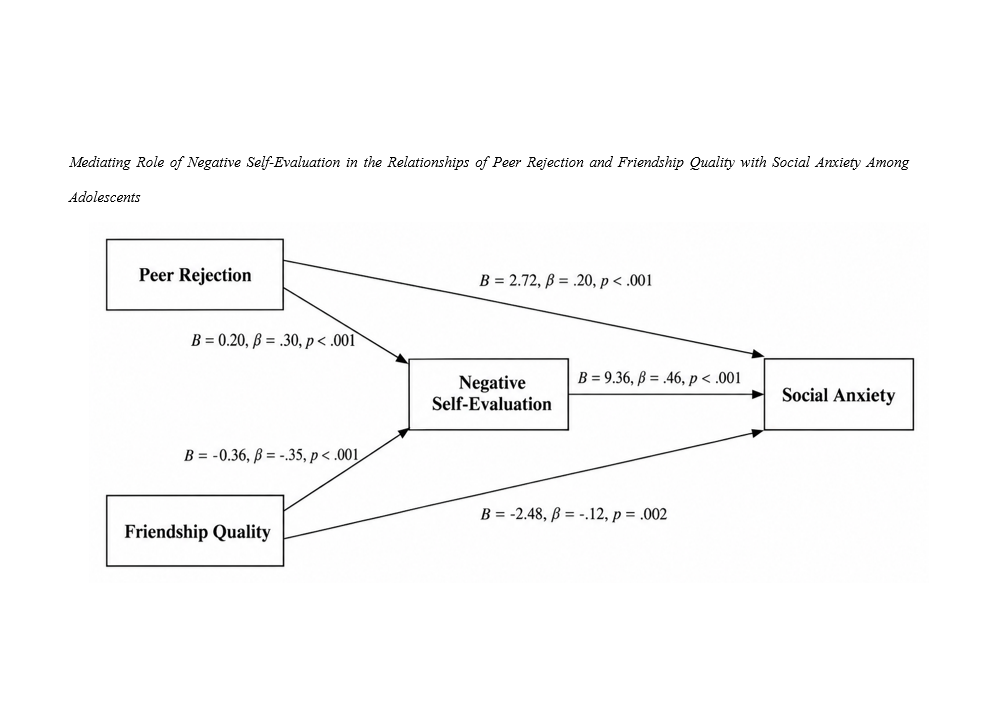
Findings: Peer rejection significantly predicted higher negative self-evaluation (β = .30, p < .001), whereas friendship quality significantly predicted lower negative self-evaluation (β = -.35, p < .001). In the final regression model, negative self-evaluation was the strongest predictor of social anxiety (β = .46, p < .001), while peer rejection remained a significant positive predictor (β = .20, p < .001) and friendship quality remained a significant negative predictor (β = -.12, p = .002). The final model explained 46.1% of the variance in social anxiety. Bootstrapping confirmed significant indirect effects of peer rejection through negative self-evaluation (B = 1.87, 95% CI [1.23, 2.60]) and friendship quality through negative self-evaluation (B = -3.37, 95% CI [-4.57, -2.35]), indicating partial mediation.
Conclusion: The findings indicate that peer rejection and friendship quality are significantly associated with adolescent social anxiety both directly and indirectly through negative self-evaluation, highlighting self-evaluative processes as an important mechanism linking peer experiences with social anxiety.
Downloads
References
Accogli, G. (2026). Social Isolation, Related Constructs and Problematic School Attendance Problems in Adolescence: A Systematic Review. Children, 13(8), 1020. https://doi.org/10.3390/children13081020
Alsarrani, A., Hunter, R. F., Dunne, L., & García, L. (2022). Association Between Friendship Quality and Subjective Wellbeing Among Adolescents: A Systematic Review. BMC public health, 22(1). https://doi.org/10.1186/s12889-022-14776-4
Alsayed, A. (2025). Barriers to Belonging: An Ecological and Appraisal Framework for Peer Relationships, Self-Awareness, and Confidence in Deaf and Hard of Hearing. Frontiers in psychology, 16. https://doi.org/10.3389/fpsyg.2025.1632263
Chiracu, A., & Buică-Belciu, C. (2023). Well-Being in Adolescents With and Without Visual Impairments. Review of Psychopedagogy, 12(1), 42-53. https://doi.org/10.56663/rop.v12i1.57
Clapham, R., Kim, Y., Davis, M. M., Modi, H. H., Skymba, H. V., & Rudolph, K. D. (2025). Differential Susceptibility to Friendship Quality: The Role of Need for Approval. Social Development, 34(3). https://doi.org/10.1111/sode.12807
Delgado, E., Sarrato, C. S., Martínez, I., & Cruise, E. (2022). Parental Attachment and Peer Relationships in Adolescence: A Systematic Review. International journal of environmental research and public health, 19(3), 1064. https://doi.org/10.3390/ijerph19031064
Dodan, D., & Negru‐Subtirica, O. (2025). Is Using TikTok Stressful? Exploring the Longitudinal Relationships Between Adolescents' Self‐concept Clarity and Digital Stress. Journal of Research on Adolescence, 35(1). https://doi.org/10.1111/jora.70011
Farmakopoulou, I., Lekka, M., & Gkintoni, E. (2024). Clinical Symptomatology of Anxiety and Family Function in Adolescents—The Self-Esteem Mediator. Children, 11(3), 338. https://doi.org/10.3390/children11030338
Kanth, D. B. (2022). Effects of Personal Relationships on Physical and Mental Health Among Young Adults- A Scoping Review. The Open Psychology Journal, 15(1). https://doi.org/10.2174/18743501-v15-e2208180
Kiing, J. S. H., Ragen, E. S., Sulaiman, M., Goh, W. S., Tan, N. J. H., Ng, S. H., Luo, Y., Samuel, M., Young, D., & Loh, V. W. K. (2025). Bullying and Depression Among Adolescents in East Asia: A Scoping Review on Prevalence Rates, Risk and Protective Factors. Frontiers in Psychiatry, 16. https://doi.org/10.3389/fpsyt.2025.1497866
Lin, J., & Guo, W. (2024). The Research on Risk Factors for Adolescents’ Mental Health. Behavioral Sciences, 14(4), 263. https://doi.org/10.3390/bs14040263
Martínez, R. F., Fernández-Pereira, C., Pérez-Rodríguez, D., Salgado‐Barreira, Á., Veiga, C., Teso-Cuesta, S., Prieto-González, J. M., Diez, J. M., & Agís‐Balboa, R. C. (2022). Association Between Peer Victimization (PV) in Childhood/Adolescence and Personality Disorders Among Adult Patients. International Journal of Translational Medicine, 3(1), 12-26. https://doi.org/10.3390/ijtm3010002
Nesi, J., Dredge, R., Maheux, A. J., Roberts, S. R., Fox, K. A., & Choukas‐Bradley, S. (2023). Peer Experiences via Social Media. 182-195. https://doi.org/10.1016/b978-0-12-818872-9.00046-7
Park, C., Mukula, H. M., Ndeezi, M., & Adarkwa, E. (2026). When Cyberbullying Undermines Friendship: A Moderated Mediation Analysis of Self-Esteem and Life Satisfaction in Korean Adolescents. https://doi.org/10.21203/rs.3.rs-8759607/v1
Rosenberg, M., Rodriguez, R. M., Grant, S., Miguel, A. S., Lee, J. O., & Rosenberg, L. (2024). Benefits and Process of Providing Peer Support for Pediatric Burn Survivors and Caregivers During Inpatient and Outpatient Phases of Recovery. Seminars in Plastic Surgery, 38(02), 145-153. https://doi.org/10.1055/s-0044-1782650
Saiding, A., Wang, H., Ma, J., Zhang, H., Guo, K., Wu, Y., Luo, X., & Chen, C. (2025). Belief in Others and Social Anxiety Symptoms Among Rural Chinese Adolescents: A Moderated Mediation Model of Self-Esteem and Gender. School Psychology International, 46(5), 475-498. https://doi.org/10.1177/01430343251377115
Schacter, H. L., Hoffman, A. J., & Ehrhardt, A. (2023). The Power Dynamics of Friendship: Between- And Within- Person Associations Among Friend Dominance, Self-Esteem, and Adolescent Internalizing Symptoms. Journal of youth and adolescence, 52(6), 1206-1218. https://doi.org/10.1007/s10964-023-01763-0
Shani, M. (2023). Love Beyond Gluten: Self-Esteem, Illness Identity, and Social Support in Romantic Rejection Concerns Among Adolescents With Celiac Disease. https://doi.org/10.31234/osf.io/c9mwy
Shen, Y., Lv, S., Wang, B., & Zhu, Y. (2023). The Relationship Between Self-Esteem and Mobile Phone Addiction Among
Downloads
Additional Files
Publication Timeline
- Submitted
- Revised
- Accepted