Deep Neural Network Prediction of Depression Risk Among Young Adults Based on Psychological, Sleep, Lifestyle, and Social Variables
Keywords:
depression risk, deep neural network, Young Adults, sleep quality, psychological distress, lifestyle, social support, machine learningAbstract
Objective: This study aimed to develop and evaluate a deep neural network model for predicting elevated depression risk among young adults in Canada using psychological, sleep-related, lifestyle, and social variables.
Methods and Materials: This cross-sectional predictive study included 1,042 Canadian young adults aged 18–35 years. Depression risk was assessed using the Patient Health Questionnaire-9, with scores ≥10 indicating elevated risk. Predictors included perceived stress, anxiety symptoms, self-esteem, loneliness, resilience, sleep quality, sleep duration, sleep-onset latency, physical activity, sedentary behavior, screen time, perceived social support, financial strain, and meaningful social interactions. Data were divided into training (n = 729), validation (n = 156), and independent test (n = 157) sets using stratified sampling. A feedforward deep neural network with three hidden layers was trained using the Adam optimizer and binary cross-entropy loss. Performance was evaluated using accuracy, sensitivity, specificity, precision, F1 score, ROC-AUC, PR-AUC, and Brier score. Logistic regression, random forest, and gradient boosting were used as benchmark models, and SHAP values were applied to interpret predictor importance.
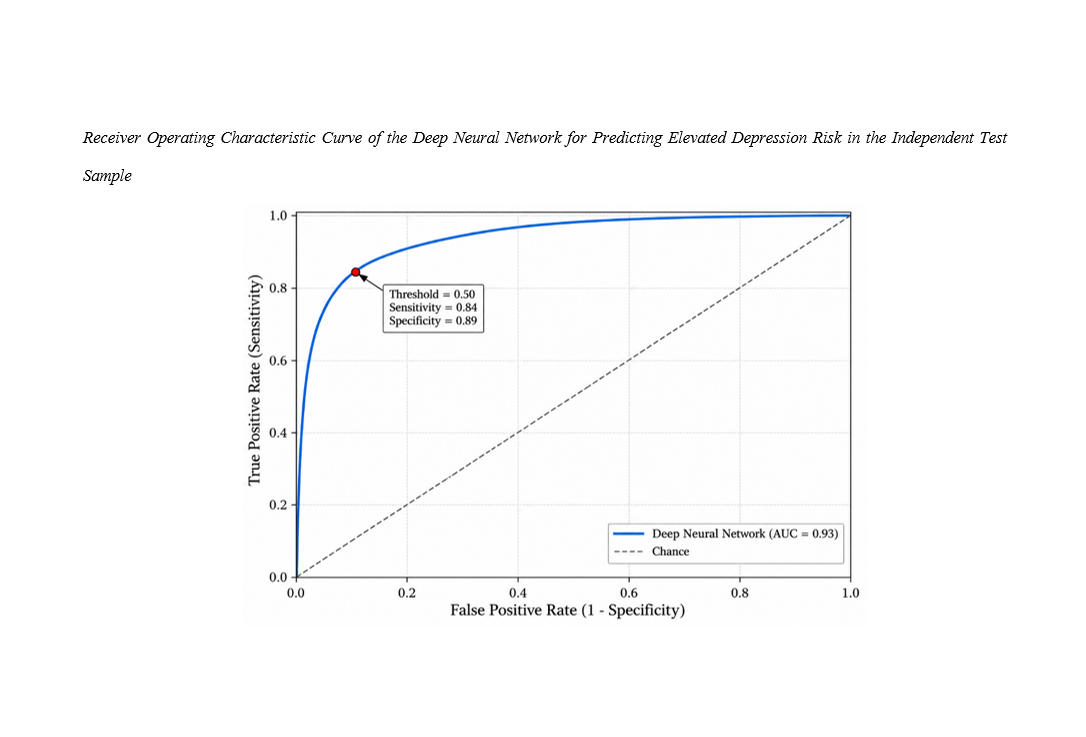
Findings: The deep neural network achieved an accuracy of 0.87, sensitivity of 0.84, specificity of 0.89, precision of 0.82, F1 score of 0.83, ROC-AUC of 0.93, PR-AUC of 0.89, and Brier score of 0.101 in the independent test set. It outperformed logistic regression, random forest, and gradient boosting. The strongest predictors were generalized anxiety symptoms, perceived stress, low social support, low self-esteem, loneliness, poor sleep quality, financial strain, low resilience, shorter sleep duration, and greater sedentary time. Nonlinear effects and cross-domain interactions were also identified.
Conclusion: Depression risk among young adults can be predicted with high accuracy by integrating psychological, sleep, lifestyle, and social variables within an interpretable deep neural network framework.
Downloads
References
Alamoudi, D., Breeze, E., Crawley, E., & Nabney, I. (2023). The Feasibility of Using Smartphone Sensors to Track Insomnia, Depression, and Anxiety in Adults and Young Adults: Narrative Review. Jmir Mhealth and Uhealth, 11, e44123. https://doi.org/10.2196/44123
Anandavelu, P. A. P., Ma’rof, A. A., & Abdullah, H. (2022). The Impact of Psychological Factors on Sleep Quality Among Public University Students in Klang Valley, Malaysia. International Journal of Academic Research in Business and Social Sciences, 12(10). https://doi.org/10.6007/ijarbss/v12-i10/15215
Chen, Y., Hao, C., & Xin, Y. (2025). Exercise and Sleep Health in College Students: Efficacy, Mechanisms, and Implications for Practice. World journal of psychiatry, 15(10). https://doi.org/10.5498/wjp.v15.i10.108884
Chung, S. Y. (2025). Academic Impairment From Sleep Difficulties: The Role of Substance Use, Psychological Distress, and Loneliness in U.S. College Students. https://doi.org/10.1101/2025.06.02.25328834
Dresp, B., & Hutt, A. (2022). Digital Addiction and Sleep. International journal of environmental research and public health, 19(11), 6910. https://doi.org/10.3390/ijerph19116910
Futenma, K., Takaesu, Y., Komada, Y., Shimura, A., Okajima, I., Matsui, K., Tanioka, K., & Inoue, Y. (2023). Delayed Sleep–wake Phase Disorder and Its Related Sleep Behaviors in the Young Generation. Frontiers in Psychiatry, 14. https://doi.org/10.3389/fpsyt.2023.1174719
Hua, Y., Xue, H., Zhang, X., Fan, L., Tian, Y., Wang, X., Ni, X., Du, W., Zhang, F., & Yang, J. (2023). Joint Contributions of Depression and Insufficient Sleep to Self-Harm Behaviors in Chinese College Students: A Population-Based Study in Jiangsu, China. Brain Sciences, 13(5), 769. https://doi.org/10.3390/brainsci13050769
Kim, J., Hwang, E., Shin, S., & Kim, K. H. (2022). University Students’ Sleep and Mental Health Correlates in South Korea. Healthcare, 10(9), 1635. https://doi.org/10.3390/healthcare10091635
Meneo, D., Curati, S., Russo, P. M., Martoni, M., Gelfo, F., & Baglioni, C. (2024). A Comprehensive Assessment of Bedtime Routines and Strategies to Aid Sleep Onset in College Students: A Web-Based Survey. Clocks & Sleep, 6(3), 468-487. https://doi.org/10.3390/clockssleep6030031
Merlo, G., Sugden, S., Rosenfeld, R. M., Baron, D., Karlsen, M., Keyes, S. A., McHugh, J., Miller, L. A., Nemeroff, C. B., Ramas, M.-E., Livingston, K. A., Williams, K. A., Wilson, K. P., Wong, W., & Viswanathan, R. (2026). Lifestyle Interventions for Major Depressive Disorder (MDD): An Expert Consensus Statement From the American College of Lifestyle Medicine. American Journal of Lifestyle Medicine, 20(4), 608-627. https://doi.org/10.1177/15598276251408353
Narang, Y. (2024). Relationship Between Gratitude and Sleep Quality Among Young Adults. Interantional Journal of Scientific Research in Engineering and Management, 08(05), 1-5. https://doi.org/10.55041/ijsrem32549
Nutakor, J. A., Zhou, L., Larnyo, E., Gavu, A. K., Chohan, I. M., Addai‐Dansoh, S., & Tripura, D. (2023). The Relationship Between Social Capital and Sleep Duration Among Older Adults in Ghana: A Cross-Sectional Study. International Journal of Public Health, 68. https://doi.org/10.3389/ijph.2023.1605876
Patrono, A., Renzetti, S., Manco, A., Brunelli, P., Moncada, S. M., Macgowan, M. J., Placidi, D., Calza, S., Cagna, G., Rota, M., Memo, M., Tira, M., & Lucchini, R. G. (2022). COVID-19 Aftermath: Exploring the Mental Health Emergency Among Students at a Northern Italian University. International journal of environmental research and public health, 19(14), 8587. https://doi.org/10.3390/ijerph19148587
Pegado, A., Alvarez, M. J., & Roberto, M. S. (2023). The Role of Behaviour‐change Theory in Sleep Interventions With Emerging Adults (Aged 18–29 years): A Systematic Review and meta‐analysis. Journal of Sleep Research, 32(5). https://doi.org/10.1111/jsr.13877
Philbrook, L. E., Chen, G. J., Decker, R. A., & Khaner, L. B. (2023). Loneliness and Maladjustment in Young Adults: The Protective Effects of High Respiratory Sinus Arrhythmia and Sleep Quality. Emerging Adulthood, 11(4), 994-1005. https://doi.org/10.1177/21676968231174081
Purnawati, E., Saraswati, L. D., Wurjanto, M. A., & Yuliawati, S. (2022). The Effect of the Covid-19 Pandemic on Mental Health (Children, Adolescents, Young Adults) and Mental Health Service: Systematic Review. Unnes Journal of Public Health, 11(2), 179-197. https://doi.org/10.15294/ujph.v11i2.53472
Ray, S. (2023). Mental Health and Well-Being – Perspective of Undergraduate Urban College Goers. International Journal of Scientific Research in Engineering and Management, 07(07). https://doi.org/10.55041/ijsrem24724
Schamilow, S., Santonja, I., Weitzer, J., Strohmaier, S., Klösch, G., Seidel, S., Schernhammer, E., & Papantoniou, K. (2023). Time Spent Outdoors and Associations With Sleep, Optimism, Happiness and Health Before and During the COVID-19 Pandemic in Austria. Clocks & Sleep, 5(3), 358-372. https://doi.org/10.3390/clockssleep5030027
Sivertsen, B., Harvey, A. G., Gradisar, M., Pallesen, S., & Hysing, M. (2021). Delayed Sleep–wake Phase Disorder in Young Adults: Prevalence and Correlates From a National Survey of Norwegian University Students. Sleep Medicine, 77, 184-191. https://doi.org/10.1016/j.sleep.2020.09.028
Spicuzza, L. (2021). Sleep Disturbance and COVID-19: An Epidemic Inside the Pandemic. Infect Dis Ther, 2(1). https://doi.org/10.31038/idt.2021211
Sysło, O., Jung, M., Jung, M., Jaworski, A. P., Słowińska, B., Jasiński, D., Jung, S., Woźniak, K., Jędral, K., & Czyż, S. (2024). How Electronic Devices Affect the Sleep of Young People: Summary of Current Knowledge. Journal of Education Health and Sport, 71, 49444. https://doi.org/10.12775/jehs.2024.71.49444
Tahmasian, M., Küppers, V., Genon, S., Eickhoff, S. B., Golombek, D. A., & Ibanez, A. (2026). Elevating Sleep to a Global Health Priority: The One Sleep Health Framework. Cell Reports Medicine, 7(6), 102828. https://doi.org/10.1016/j.xcrm.2026.102828
Tomás Olivo Martins de, P., Mesas, A. E., Beneit, N., Díaz‐Goñi, V., Peral-Martinez, F., Cekrezi, S., Martínez‐Vizcaíno, V., & Jiménez‐López, E. (2024). Are Sleep Parameters and Chronotype Associated With Eating Disorder Risk? A Cross-Sectional Study of University Students in Spain. Journal of clinical medicine, 13(18), 5482. https://doi.org/10.3390/jcm13185482
Uccella, S., Cordani, R., Salfi, F., Gorgoni, M., Scarpelli, S., Gemignani, A., Geoffroy, P. A., Gennaro, L. D., Palagini, L., Ferrara, M., & Nobili, L. (2023). Sleep Deprivation and Insomnia in Adolescence: Implications for Mental Health. Brain Sciences, 13(4), 569. https://doi.org/10.3390/brainsci13040569
Wang, D., Jiang, F., Zhu, M., Jia, Y., Song, X., Xu, Q., & Luo, G. (2023). Association of Chronotype and Depressive Symptoms in Chinese Infertile Population Undergoing Assisted Reproductive Technology. https://doi.org/10.22541/au.169566334.46320800/v1
Wen, L.-y., Shi, L.-x., Zhu, L.-j., Zhou, M., Long, H., Jin, Y., & Chang, W. (2022). Associations Between Chinese College Students’ Anxiety and Depression: A Chain Mediation Analysis. PLoS One, 17(6), e0268773. https://doi.org/10.1371/journal.pone.0268773
Xu, Y., Qin, L., Wen, S. W., Zhang, X., & Zhou, Y. (2025). Effects of Sleep on Multimodal Cognitive Functioning in College Students. Frontiers in Psychiatry, 16. https://doi.org/10.3389/fpsyt.2025.1637699
Yeom, J. W., & Lee, H. J. (2024). Managing Circadian Rhythms: A Key to Enhancing Mental Health in College Students. Psychiatry Investigation, 21(12), 1309-1317. https://doi.org/10.30773/pi.2024.0250
Zhao, Y., Liao, J., & Huang, Q. (2025). Role of Chronotype in Depression. World journal of psychiatry, 15(10). https://doi.org/10.5498/wjp.v15.i10.109087
Zou, H., Zhou, H., Yan, R., Yao, Z., & Lu, Q. (2022). Chronotype, Circadian Rhythm, and Psychiatric Disorders: Recent Evidence and Potential Mechanisms. Frontiers in Neuroscience, 16. https://doi.org/10.3389/fnins.2022.811771
Downloads
Additional Files
Publication Timeline
- Submitted
- Revised
- Accepted