K-Nearest Neighbors Classification of Adolescents at Risk for Problematic Internet Use Based on Psychological and Behavioral Features
Keywords:
Problematic Internet Use, Adolescents, K-Nearest Neighbors, Machine Learning, Psychological Features, Behavioral Features, ClassificationAbstract
Objective: This study aimed to classify adolescents at risk for problematic Internet use using a K-Nearest Neighbors algorithm based on a multidimensional set of psychological and behavioral features.
Methods and Materials: This cross-sectional predictive classification study was conducted with 704 adolescents aged 13–18 years enrolled in secondary schools in Ontario, Canada. Problematic Internet use was assessed using the Internet Addiction Test, and psychological predictors included depressive symptoms, anxiety, perceived stress, self-esteem, loneliness, and emotion regulation difficulties. Behavioral predictors included recreational Internet use, social-media use, online gaming, bedtime Internet use, smartphone checking, digital multitasking, sleep duration, physical activity, and interference of digital use with homework and face-to-face interactions. The sample was stratified into a training set of 528 participants and an independent test set of 176. Continuous predictors were standardized, and KNN hyperparameters were optimized through stratified 10-fold cross-validation. Model performance was evaluated using accuracy, sensitivity, specificity, precision, F1 score, balanced accuracy, and ROC-AUC.
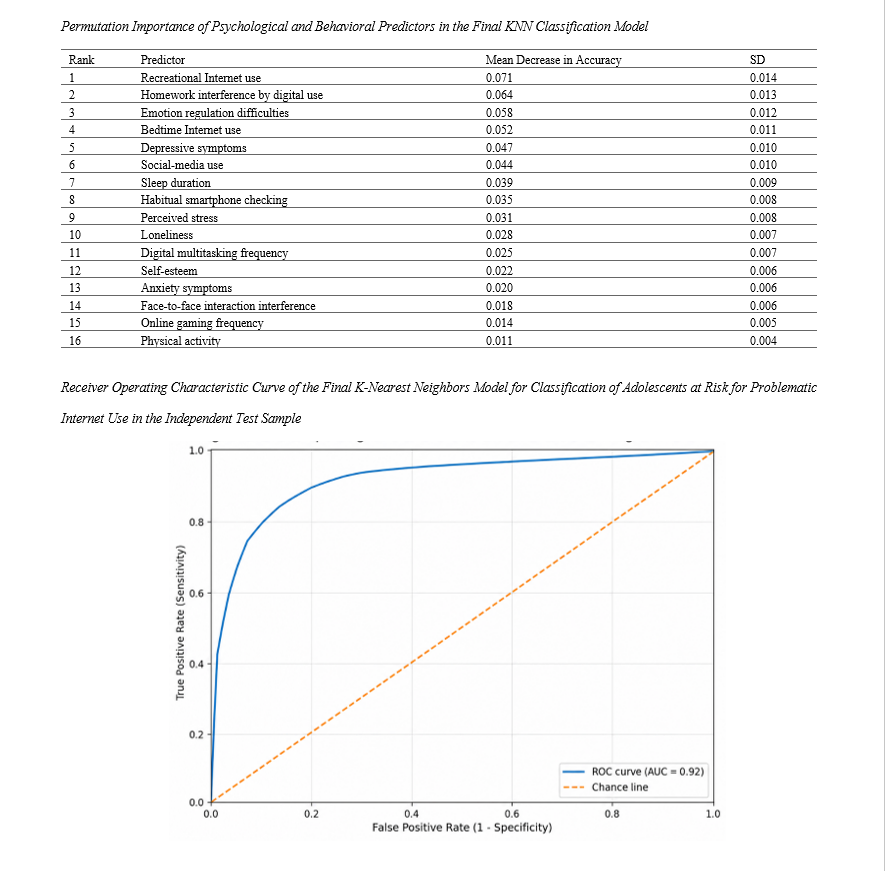
Findings: Cross-validation identified a distance-weighted KNN model with k = 9 as optimal, yielding mean accuracy of 0.87, sensitivity of 0.82, specificity of 0.89, F1 score of 0.81, and ROC-AUC of 0.92. In the independent test sample, the model correctly classified 154 of 176 adolescents, corresponding to an accuracy of 0.88. Sensitivity was 0.83, specificity 0.89, precision 0.77, negative predictive value 0.92, F1 score 0.80, balanced accuracy 0.86, and ROC-AUC 0.92. Permutation analysis identified recreational Internet use, homework interference, emotion regulation difficulties, bedtime Internet use, depressive symptoms, and social-media use as the most influential predictors.
Conclusion: KNN classification based on combined psychological and behavioral features demonstrated strong discrimination of adolescents at risk for problematic Internet use and may provide a useful basis for early screening and targeted preventive assessment.
Downloads
References
Bottaro, R., & Faraci, P. (2022). The Use of Social Networking Sites and Its Impact on Adolescents’ Emotional Well-Being: A Scoping Review. Current Addiction Reports, 9(4), 518-539. https://doi.org/10.1007/s40429-022-00445-4
Chin, F. F., & Leung, C. H. (2022). Using Path Analysis to Investigate Predictors of Problematic Internet Use Among Hong Kong Adolescents. 142-160. https://doi.org/10.2991/978-94-6463-096-1_11
Fontana, A., Benzi, I. M. A., & Cipresso, P. (2022). Problematic Internet Use as a Moderator Between Personality Dimensions and Internalizing and Externalizing Symptoms in Adolescence. Current Psychology, 42(22), 19419-19428. https://doi.org/10.1007/s12144-021-02409-9
Giordano, A. L., Schmit, M. K., & McCall, J. (2022). Exploring Adolescent Social Media and Internet Gaming Addiction: The Role of Emotion Regulation. Journal of Addictions & Offender Counseling, 44(1), 69-80. https://doi.org/10.1002/jaoc.12116
Hu, Y., Chen, S., Qi, D., & Zhu, S. (2025). Problematic Gaming and Self-Control Among Adolescents and Emerging Adults: A Systematic Review and Meta-Analysis. Cyberpsychology Behavior and Social Networking, 28(5), 301-317. https://doi.org/10.1089/cyber.2024.0537
Jolin, E. M., & Weller, R. A. (2023). Problematic Internet Use and Suicidal Behavior in Adolescents: A Review. Annals of Clinical Psychiatry, 35(4), 272-279. https://doi.org/10.12788/acp.0119
Jović, J., Čorac, A., Stanimirović, A., Nikolić, M., Stojanović, M., Bukumirić, Z., & Ristić, D. I. (2024). Using Machine Learning Algorithms and Techniques for Defining the Impact of Affective Temperament Types, Content Search and Activities on the Internet on the Development of Problematic Internet Use in Adolescents’ Population. Frontiers in Public Health, 12. https://doi.org/10.3389/fpubh.2024.1326178
Liu, X., Liu, J., Flores, D. D., & McDonald, C. C. (2024). Family Factors Related to Adolescent Screen Media Use and Mental Health Outcomes: A Systematic Review and Recommendation for Practices. Journal of adolescence, 96(7), 1401-1427. https://doi.org/10.1002/jad.12367
Losaberidze, M., Mallorquí‐Bagué, N., Demetrovics, Z., Jiménez‐Múrcia, S., Potenza, M. N., Soborun, Y., Romero, P., Reinhardt, M., Kökönyei, G., Mestre‐Bach, G., & Czakó, A. (2025). Scars, Screens, and Stakes: Link Between Non-Suicidal Self-Injury and Problem Gambling, Problem Gaming, and Problematic Internet Use – A Systematic Review. Journal of Behavioral Addictions, 14(4), 1481-1502. https://doi.org/10.1556/2006.2025.00079
Milkovich, L. M., Tomopoulos, S., Ajumobi, T., Cross, C., Gerwin, R., Radesky, J. S., Evans, Y. N., Cahan, E. M., Milkovich, E., Bracho-Sanchez, E., Parga-Belinkie, J., Munzer, T. G., Husain, A., Patel, A., & Shapiro, I. (2026). Digital Ecosystems, Children, and Adolescents: Technical Report. Pediatrics, 157(2). https://doi.org/10.1542/peds.2025-075321
Moriyama, S. (2026). Family-Based Preventive Interventions for Problematic Internet Use Among Children and Adolescents: Protocol for a Systematic Review and Meta-Analysis. International journal of environmental research and public health, 23(5), 637. https://doi.org/10.3390/ijerph23050637
Morshidi, M. I., Naidu, K. N. C., Embleton, S. G., & Aj, M. (2025). From Withdrawal to Web: A Cross-Sectional Study of Hikikomori Tendencies, Social Cynicism, and Problematic Internet Use Among Young Adults in Singapore. International Journal of Social Psychiatry, 72(1), 129-137. https://doi.org/10.1177/00207640251357077
Niklová, M., Karina, Z., & Annamária, Š. (2024). Prevalence of the Hikikomori Syndrome in the Context of Internet Addictive Behaviour Among Primary School Pupils in the Slovak Republic. Tem Journal, 476-4483. https://doi.org/10.18421/tem131-49
Normand, C. L., Fisher, M. H., Fecteau, S.-M., Tremblay, K. L., Roy, E., & Poulin, M.-H. (2022). Exploring Problematic Internet Use and Gaming in Young Adults With Autism Spectrum Disorder. https://doi.org/10.1101/2022.09.16.22279979
Orsolini, L., Longo, G., & Volpe, U. (2023). The Mediatory Role of the Boredom and Loneliness Dimensions in the Development of Problematic Internet Use. International journal of environmental research and public health, 20(5), 4446. https://doi.org/10.3390/ijerph20054446
Paulus, F. W., Joas, J., Gerstner, I., Kühn, A. L., Wenning, M., Gehrke, T., Burckhart, H., Richter, U., Nonnenmacher, A., Zemlin, M., Lücke, T., Brinkmann, F., Rothoeft, T., Lehr, T., & Möhler, E. (2022). Problematic Internet Use Among Adolescents 18 Months After the Onset of the COVID-19 Pandemic. Children, 9(11), 1724. https://doi.org/10.3390/children9111724
Singh, S., Datta, M., Gupta, P. K., & Batra, S. (2022). Predictors of ‘Problematic Internet Use’ Among Adolescents and Adults Amid the Pandemic in India. Clinical Epidemiology and Global Health, 15, 101036. https://doi.org/10.1016/j.cegh.2022.101036
Soriano-Molina, E., Gras, R. M. L., Patró-Hernández, R. M., & Rubio‐Aparicio, M. (2025). The Association Between Internet Addiction and Adolescents’ Mental Health: A Meta-Analytic Review. Behavioral Sciences, 15(2), 116. https://doi.org/10.3390/bs15020116
Stavropoulos, V., Motti‐Stefanidi, F., & Griffiths, M. D. (2022). Risks and Opportunities for Youth in the Digital Era. European Psychologist, 27(2), 86-101. https://doi.org/10.1027/1016-9040/a000451
Stewart, K., Brodowsky, G. H., & Sciglimpaglia, D. (2021). Parental Supervision and Control of Adolescents’ Problematic Internet Use: Understanding and Predicting Adoption of Parental Control Software. Young Consumers, 23(2), 213-232. https://doi.org/10.1108/yc-04-2021-1307
Swed, S., Bohsas, H., Alibrahim, H., Rais, M. A., Elsayed, M., Nashwan, A. J., Hasan, M. M., Nasif, M. N., Sawaf, B., Albuni, M. K., Battikh, E., Kash, R. A., & Shoib, S. (2023). Internet Addiction and Depression Among Syrian College Students: A Cross-Sectional Study. Psychiatry International, 4(3), 275-285. https://doi.org/10.3390/psychiatryint4030027
Downloads
Additional Files
Publication Timeline
- Submitted
- Revised
- Accepted