Prediction of Depression Risk Among Adolescents Using Random Forest Based on Psychological, Family, and School Factors
Keywords:
adolescent depression, Random Forest, machine learning, perceived stress, self-esteem, family functioning, school connectedness, peer victimizationAbstract
Objective: This study aimed to predict elevated depression risk among Canadian adolescents using a Random Forest model incorporating psychological, family, peer, and school-related factors.
Methods and Materials: A cross-sectional predictive study was conducted among 612 adolescents aged 13–18 years recruited from secondary schools in Ontario, British Columbia, and Alberta, Canada. Depression risk was assessed using the Patient Health Questionnaire for Adolescents, with a score of 10 or higher indicating elevated risk. Psychological predictors included self-esteem, perceived stress, cognitive reappraisal, and expressive suppression; family predictors included family functioning and perceived family support; and school-related predictors included school connectedness, peer support, academic performance, attendance, and peer victimization. The dataset was divided using stratified sampling into an 80% training set and a 20% independent test set. A Random Forest classifier was optimized using stratified five-fold cross-validation and evaluated using accuracy, sensitivity, specificity, precision, F1 score, ROC-AUC, and Brier score. Predictor importance was assessed using permutation importance and SHAP values.
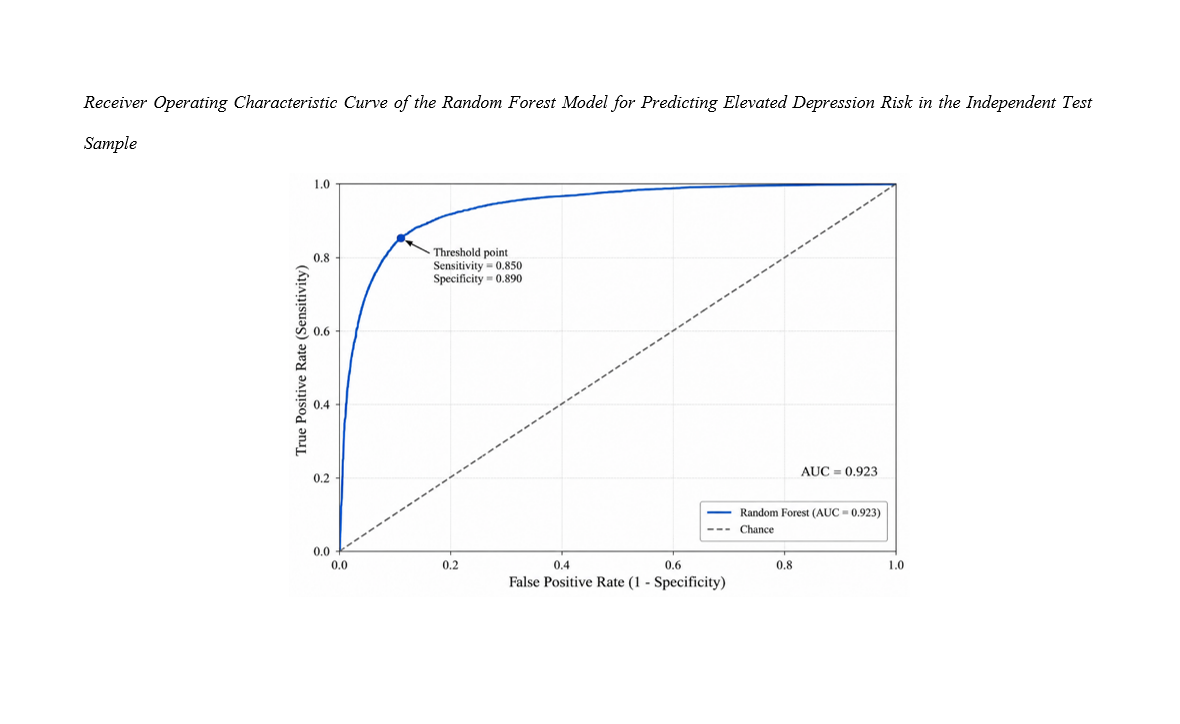
Findings: The optimized Random Forest model achieved a mean cross-validated ROC-AUC of .913, with accuracy of .851, sensitivity of .823, specificity of .864, and F1 score of .786. In the independent test sample, the model achieved an accuracy of .877, sensitivity of .850, specificity of .890, precision of .791, F1 score of .829, ROC-AUC of .923, and Brier score of .112. Perceived stress showed the highest predictive importance, followed by self-esteem, school connectedness, family functioning, peer victimization, perceived family support, and expressive suppression. Higher stress, peer victimization, and expressive suppression increased predicted depression risk, whereas higher self-esteem, school connectedness, family functioning, and perceived support were associated with lower predicted risk.
Conclusion: The Random Forest model demonstrated strong discrimination and stable predictive performance, indicating that adolescent depression risk can be effectively identified through the combined assessment of psychological, family, and school factors.
Downloads
References
Azasu, E. (2025). Using a Machine Learning Analysis of Socio-Ecological and Psychological Factors to Predict Suicide Risk Among a Nationally Representative Sample of Ghanaian Adolescents. Cambridge Prisms Global Mental Health, 12. https://doi.org/10.1017/gmh.2025.10083
Bernard, R., & Norbury, C. (2023). Factors Associated With Symptoms of Anxiety and Depression in Children Who Stutter. Language Speech and Hearing Services in Schools, 54(2), 535-549. https://doi.org/10.1044/2022_lshss-22-00086
Bowers, R. M., & Bowers, E. P. (2023). A Literature Review on the Role of Hope in Promoting Positive Youth Development Across Non-Weird Contexts. Children, 10(2), 346. https://doi.org/10.3390/children10020346
Cobb, C. L., & Martínez, C. R. (2023). Trajectories of Depression for Latino Immigrant Adolescents: The Influence of Individual, Family, and Sociocultural Factors. Journal of Psychopathology and Clinical Science, 132(1), 1-12. https://doi.org/10.1037/abn0000798
Farooqui, M., Shoaib, S., Afaq, H., Quadri, S. A., Zaina, F., Baig, A., Liaquat, A., Sarwar, Z., Zafar, A., & Younus, S. (2023). Bidirectionality of Smoking and Depression in Adolescents: A Systematic Review. Trends in Psychiatry and Psychotherapy. https://doi.org/10.47626/2237-6089-2021-0429
Fosco, G. M., & Coffey, J. K. (2026). Fragile Connectedness in Caregiver‐Adolescent Relationships Confers Risk for Diminished Well‐Being. Family Process, 65(1). https://doi.org/10.1111/famp.70131
Hocking, D. C., & Sundram, S. (2022). Age and Environmental Factors Predict Psychological Symptoms in Adolescent Refugees During the Initial Post-Resettlement Phase. Child and adolescent psychiatry and mental health, 16(1). https://doi.org/10.1186/s13034-022-00538-y
Kassis, W., Vasiou, A., Govaris, C., Rietz, C., & Graf, U. (2023). Individual and Social Predictors of Greek Early Adolescents’ Self-Determination: A Longitudinal Structural Equation Analysis. Psychology the Journal of the Hellenic Psychological Society, 28(2), 176-194. https://doi.org/10.12681/psy_hps.31471
Katsantonis, I. (2022). The Mediating Role of School and Sibling Bullying in the Relationship Between Subjective Well-Being and Mental Health Symptoms. Psych, 4(2), 258-268. https://doi.org/10.3390/psych4020022
Klettner, A., Luo, S., White, T. D., Elkin, T. B., & Hersey, G. C. (2023). Predicting Chinese Adolescents’ Depressive Symptoms From Their Cultural Orientations and Perceived Parental Psychological Control. Psychological Reports, 128(5), 3282-3306. https://doi.org/10.1177/00332941231203576
Li, L. Y., Zhang, S., & Fan, W. (2025). Machine Learning-Based Prediction Model and Key Determinants of Adolescent Depression in China: A Multicenter Cross-Sectional Study. https://doi.org/10.21203/rs.3.rs-6887876/v1
Lin, J., & Guo, W. (2024). The Research on Risk Factors for Adolescents’ Mental Health. Behavioral Sciences, 14(4), 263. https://doi.org/10.3390/bs14040263
Lu, Y., Zhao, H., Zhu, X., & Li, W. (2025). How Parental Educational Anxiety Fuels Adolescent Depression: The Mediating Chain of Moral Disengagement and Negative Coping, and the Buffering Role of Psychological Resilience. BMC psychology, 13(1). https://doi.org/10.1186/s40359-025-03718-5
Nishijima, D. K., Kuppermann, N., Suskauer, S. J., Arbogast, K. B., Badawy, M., Casper, T. C., Cruz, A. T., Corwin, D. J., Johnson, T. J., Ruest, S. M., Tancredi, D. J., Thomas, D. G., Zonfrillo, M. R., Slomine, B. S., & Group, t. S. S. (2026). Screening Emotions in Adolescents Receiving Care at the Hospital for Mild Traumatic Brain Injury (SEARCH-mTBI): Protocol for a Multicenter Observational Study. BMC pediatrics, 26(1). https://doi.org/10.1186/s12887-026-06788-5
Qiu, T., Wang, S., Hu, D., Feng, N., & Cui, L. (2024). Predicting Risk of Bullying Victimization Among Primary and Secondary School Students: Based on a Machine Learning Model. Behavioral Sciences, 14(1), 73. https://doi.org/10.3390/bs14010073
Rahman, A. A., Rani, N. A., Wan Mohd Zahiruddin Wan, M., & Zakaria, N. (2023). Sources of Perceived Social Support and Associated Factors for Depression Amongst Malay Primary School Adolescents in Kelantan, Malaysia. Iium Medical Journal Malaysia, 22(4). https://doi.org/10.31436/imjm.v22i4.2329
Rapp, A. M., Ponting, C., Ramos, G., Escovar, E., Hazlett, C., Tan, P. Z., Torres, V. C., & Chavira, D. A. (2026). A Data-Driven Approach to Identifying Determinants of Depression in Rural Latine Adolescents. Cultural diversity & ethnic minority psychology. https://doi.org/10.1037/cdp0000768
Sasaki, Y., Usami, M., Hakosima, Y., Inazaki, K., Mizumoto, Y., Miyamae, M., Ito, M., Mikami, K., Tsujii, N., Okada, T., & Takahashi, H. (2026). Preliminary Findings on School Refusal Outcomes in Children and Adolescents Following 1‐Year Psychiatric Outpatient Treatment. Early Intervention in Psychiatry, 20(3). https://doi.org/10.1111/eip.70156
Werner‐Seidler, A., Maston, K., Calear, A. L., Batterham, P. J., Larsen, M., Torok, M., O’Dea, B., Huckvale, K., Beames, J. R., Brown, L., Fujimoto, H., Bartholomew, A., Bal, D., Schweizer, S., Skinner, S. R., Steinbeck, K. S., Ratcliffe, J., Oei, J. L., Venkatesh, S., . . . Christensen, H. M. (2022). The Future Proofing Study: Design, Methods and Baseline Characteristics of a Prospective Cohort Study of the Mental Health of Australian Adolescents. International Journal of Methods in Psychiatric Research, 32(3). https://doi.org/10.1002/mpr.1954
West, K. B., Hale, M. E., Roche, K. M., White, R. M. B., & Suveg, C. (2022). Predictors of Latent Class Trajectories of Depressive Symptoms in Latina Mothers. Journal of Family Psychology, 36(4), 545-554. https://doi.org/10.1037/fam0000957
Xu, H., Chen, Z.-h., Ji, J.-j., She, J., Hou, C.-t., & Zhang, Y. (2023). The Factors of Adolescent Depression in Jiangsu Province, China, From the Perspective of Social Ecosystem: A Case-Control Study. Depression and Anxiety, 2023, 1-8. https://doi.org/10.1155/2023/2861629
Yang, Q., Hu, Y., Zeng, Z., Liu, S.-J., Wu, T., & Zhang, G.-H. (2022). The Relationship of Family Functioning and Suicidal Ideation Among Adolescents: The Mediating Role of Defeat and the Moderating Role of Meaning in Life. International journal of environmental research and public health, 19(23), 15895. https://doi.org/10.3390/ijerph192315895
Zhang, Z., Guo, J., Zhao, Y., Li, X., & Qi, C. (2025). Visualized Analysis of Adolescent Non-Suicidal Self-Injury and Comorbidity Networks. Behavioral Sciences, 15(11), 1513. https://doi.org/10.3390/bs15111513
Downloads
Additional Files
Publication Timeline
- Submitted
- Revised
- Accepted