Predicting Psychological Distress Among Adolescents Using a Multilayer Perceptron Neural Network Based on Academic, Family, and Social Factors
Keywords:
Psychological distress, Adolescents, Multilayer perceptron, Neural network, Academic stress, Family functioning, Social supportAbstract
Objective: This study aimed to develop and evaluate a multilayer perceptron neural network for predicting psychological distress among Taiwanese adolescents based on academic, family, social, and selected demographic factors.
Methods and Materials: This cross-sectional predictive study was conducted among 612 adolescents aged 13–18 years enrolled in junior and senior high schools in Taiwan. Psychological distress was assessed using the Kessler Psychological Distress Scale (K10), academic stress using the Educational Stress Scale for Adolescents, family functioning using the Family APGAR Scale, and perceived social support using the Multidimensional Scale of Perceived Social Support. Academic performance, daily study time, and selected demographic variables were also assessed. The dataset was divided into training, validation, and testing subsets using a 70:15:15 ratio. A multilayer perceptron model with two hidden layers was trained using the Adam optimization algorithm, with early stopping and regularization applied to reduce overfitting. Model performance was evaluated using mean absolute error, root mean squared error, and the coefficient of determination. Predictor importance was examined using permutation-based analysis.
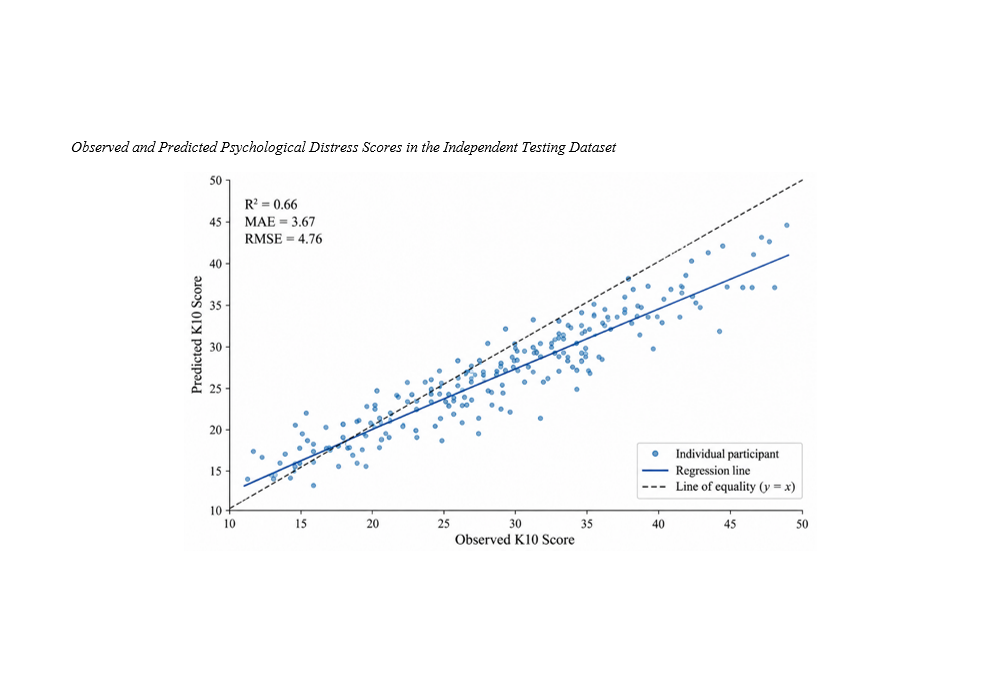
Findings: Psychological distress was positively associated with educational stress (r = .68, p < .001), despondency (r = .64, p < .001), worry about grades (r = .58, p < .001), and pressure from study (r = .55, p < .001), while it was negatively associated with family functioning (r = −.53, p < .001), perceived social support (r = −.49, p < .001), and academic performance (r = −.27, p < .001). The multilayer perceptron model explained 76% of variance in the training dataset, 69% in the validation dataset, and 66% in the independent testing dataset. In the testing set, MAE was 3.67 and RMSE was 4.76. Educational stress, despondency, family functioning, worry about grades, and perceived social support were the most influential predictors.
Conclusion: Psychological distress among adolescents can be predicted with acceptable accuracy using a multilayer perceptron model incorporating academic, family, and social factors, with educational stress and family functioning emerging as especially important predictors.
Downloads
References
Berger, E., Reupert, A., Allen, K. A., & Campbell, T. C. H. (2022). A Systematic Review of the Long-Term Benefits of School Mental Health and Wellbeing Interventions for Students in Australia. Frontiers in Education, 7. https://doi.org/10.3389/feduc.2022.986391
Boutrin, M. C., & Williams, D. R. (2021). What Racism Has to Do With It: Understanding and Reducing Sexually Transmitted Diseases in Youth of Color. Healthcare, 9(6), 673. https://doi.org/10.3390/healthcare9060673
Campione‐Barr, N., Skinner, A. T., Moeller, K., Cui, L., Kealy, C., & Cookston, J. T. (2024). The Role of Family Relationships on Adolescents' Development and Adjustment During the COVID‐19 Pandemic: A Systematic Review. Journal of Research on Adolescence, 35(1). https://doi.org/10.1111/jora.12969
Charesma Grace, K. L.-a., Atianzar, M. B., & Gano, E. B. (2022). Teen Suicide in One Province in Cordillera. International Review of Social Sciences Research, 2(4), 40-61. https://doi.org/10.53378/352951
Diamond, G., Kodish, T., Ewing, E. S. K., Hunt, Q. A., & Russon, J. (2022). Family Processes: Risk, Protective and Treatment Factors for Youth at Risk for Suicide. Aggression and Violent Behavior, 64, 101586. https://doi.org/10.1016/j.avb.2021.101586
Dupuis, J. B., Bourque, J., & Adlouni, S. E. E. (2021). Odds of Anxiety and Depression Symptoms in School-Aged Children From Official Language Minority Communities. Frontiers in Public Health, 9. https://doi.org/10.3389/fpubh.2021.660041
Espinoza, G., & Hernandez, H. L. (2022). Adolescent Loneliness, Stress and Depressive Symptoms During the COVID‐19 Pandemic: The Protective Role of Friends. Infant and Child Development, 31(3). https://doi.org/10.1002/icd.2305
Espinoza, G., Mariano, J. E., & Blanco, A. N. (2024). “Our Social Lives Were Kind of Ruined”: Challenges and Sources of Support During COVID-19 Distance Learning Among Latinx High School Students. Journal of Adolescent Research, 39(6), 1447-1475. https://doi.org/10.1177/07435584241231432
Field, T. (2021). Suicidality in Youth During COVID-19: A Narrative Review. Journal of Psychiatry Research Reviews & Reports, 3(2), 1. https://doi.org/10.47363/jpsrr/2021(3)124
Garagiola, E. R., Lam, Q., Wachsmuth, L. S., Tan, T. Y., Ghali, S., Asafo, S. M., & Swarna, M. (2022). Adolescent Resilience During the COVID-19 Pandemic: A Review of the Impact of the Pandemic on Developmental Milestones. Behavioral Sciences, 12(7), 220. https://doi.org/10.3390/bs12070220
Goff, T. M., Moody, M. E., Acosta, L. L., & Joyce‐Beaulieu, D. (2022). School-Based Cognitive-Behavioral Therapy in an Inclusion Model for an Adolescent With Comorbid Major Depressive Disorder, Generalized Anxiety Disorder, and Attention Deficit Hyperactivity Disorder: A Case Study. Clinical Case Studies, 21(5), 457-473. https://doi.org/10.1177/15346501221078329
Goh, W. S., Tan, J. H. N., Luo, Y., Ng, S. H., Mohamed Sufyan Bin Mohamed, S., Wong, J. C. M., & Loh, V. W. K. (2023). Risk and Protective Factors Associated With Adolescent Depression in Singapore: A Systematic Review. Singapore medical journal, 66(1), 2-14. https://doi.org/10.4103/singaporemedj.smj-2021-192
Hertz, M., Kilmer, G., Verlenden, J., Liddon, N., Rasberry, C. N., Barrios, L. C., & Ethier, K. A. (2022). Adolescent Mental Health, Connectedness, and Mode of School Instruction During COVID-19. Journal of Adolescent Health, 70(1), 57-63. https://doi.org/10.1016/j.jadohealth.2021.10.021
Høiseth, M., Alsos, O. A., Holme, S., Ek, S., & Gabrielsen, C. T. (2021). Serious Game Design to Support Children Struggling With School Refusal. International Journal of Serious Games, 8(2), 109-128. https://doi.org/10.17083/ijsg.v8i2.416
Kara, B., Scharf, N., Bhreathnach, L., Currie, C., & Symonds, J. (2025). Adolescent Anxiety During the COVID‐19 Pandemic: A Qualitative Systematic Review of Risk and Protective Factors. Journal of adolescence, 97(8), 2048-2066. https://doi.org/10.1002/jad.70038
Laurier, C., Pascuzzo, K., & Beaulieu, G. (2021). Uncovering the Personal and Environmental Factors Associated With Youth Mental Health During the COVID-19 Pandemic: The Pursuit of Sports and Physical Activity as a Protective Factor. Traumatology an International Journal, 27(4), 354-364. https://doi.org/10.1037/trm0000342
Lin, J., & Guo, W. (2024). The Research on Risk Factors for Adolescents’ Mental Health. Behavioral Sciences, 14(4), 263. https://doi.org/10.3390/bs14040263
Lopatovska, I., Arora, K., Fernandes, F. V., Rao, A., Sivkoff-Livneh, S., & Stamm, B. (2022). Experiences of the Ukrainian Adolescents During the Russia-Ukraine 2022 War. Information and Learning Sciences, 123(11/12), 666-704. https://doi.org/10.1108/ils-07-2022-0093
Lundahl, L. H., & Cannoy, C. N. (2021). COVID-19 and Substance Use in Adolescents. Pediatric Clinics of North America, 68(5), 977-990. https://doi.org/10.1016/j.pcl.2021.05.005
Luthar, S. S., Pao, L. S., & Kumar, N. L. (2021). COVID-19 and Resilience in Schools: Implications for Practice and Policy. Child Policy Nexus, 34(3), 1-65. https://doi.org/10.1002/sop2.16
Mucci, G., Collins, E., Pearce, E., Avina, M., Hao, S., Onungwa, C., Bunac, J., Hunte, Y., Coopersmith, L., & Yewell, N. (2024). The Lost Years: An Integrative Review of the Mental Health, Educational, and Social Impact of the Pandemic on Children and Adolescents From 2019 to 2022. Journal of Pediatric Neuropsychology, 10(1), 49-90. https://doi.org/10.1007/s40817-024-00160-0
Mufson, L., Young, J. F., Dietz, L. J., & Schwartz, K. T. G. (2026). Interpersonal Psychotherapy for Depression in Youth. 473-493. https://doi.org/10.1037/0000438-025
Novak, A. M. (2025). Growing Up With MS: The Adolescent Experience of Pediatric-Onset Multiple Sclerosis. Adolescents, 5(4), 66. https://doi.org/10.3390/adolescents5040066
Raval, V. V., Raman, V., Aggarwal, P., Sreenivas, K. K., Krishnamurthy, S., Goud, B. R., Hay, M. C., & Visweswariah, A. M. (2025). How Do Adolescents and Others Around Them Conceptualize Depression? Toward a Contextually Grounded Understanding of Depression During Adolescence in India. Journal of Cross-Cultural Psychology, 56(6), 607-628. https://doi.org/10.1177/00220221251319343
Rider, E. A., Ansari, E. A., Varrin, P., & Sparrow, J. (2021). Mental Health and Wellbeing of Children and Adolescents During the Covid-19 Pandemic. bmj, n1730. https://doi.org/10.1136/bmj.n1730
Russo, K. (2022). Assessment and Treatment of Adolescents With Chronic Medical Conditions. Journal of Health Service Psychology, 48(2), 69-78. https://doi.org/10.1007/s42843-022-00059-4
Sabina, C., Marsical, E. S., & Cuevas, C. A. (2021). Psychological Functioning Among Latino Victims of Teen Dating Violence: The Role of Relational and Collective Resources. Journal of interpersonal violence, 37(21-22). https://doi.org/10.1177/08862605211044097
Sarfika, R., Saifudin, I. M. M. Y., Wicaksana, A. L., Malini, H., Wenny, B. P., Rahayuningsih, A., Wijaya, N. E., Putri, D. E., & Abdullah, K. L. (2025). Predictors and Protective Factors of Mental Health Outcomes Among Indonesian Adolescents: An SCT-Based Multi-Center Study. International Journal of Social Psychiatry, 72(3), 582-593. https://doi.org/10.1177/00207640251372672
Shabbir, S., & Farzand, K. (2022). Cyberbullying Among University Students; How Do Peers Support in Recovering From Mental Health Problems. Educational Research and Innovation, 2(01), 51-61. https://doi.org/10.61866/eri.v2i01.15
Silan, M. A. A. (2023). Are the Kids Alright? The Impact of COVID-19 Pandemic on the Mental Health and Psychosocial Wellbeing of Filipino Children in Selected Cities in Metro Manila. https://doi.org/10.31234/osf.io/v2ygm
Silk, J. S., Scott, L. N., Hutchinson, E., Lu, C., Sequeira, S., McKone, K. M., Quyen, B., & Ladouceur, C. D. (2021). Storm Clouds and Silver Linings: Day-to-Day Life in COVID-19 Lockdown and Emotional Health in Adolescent Girls. Journal of Pediatric Psychology, 47(1), 37-48. https://doi.org/10.1093/jpepsy/jsab107
Thiha, N., Soe, P. P., Win, H. H., Delorme, L., Clevenbergh, P., & Babin, F. X. (2025). Exploring the Psychological Impact on Children and Adolescents During the Initial Period of the COVID-19 Pandemic-a Systematic Review. BMC psychology, 13(1). https://doi.org/10.1186/s40359-025-03165-2
Vaillancourt, T., McDougall, P., Comeau, J., & Finn, C. A. (2021). COVID-19 School Closures and Social Isolation in Children and Youth: Prioritizing Relationships in Education. Facets, 6, 1795-1813. https://doi.org/10.1139/facets-2021-0080
Wilksch, S. (2025). Reducing the Harms of Social Media for Youth: An Urgent Call for Comprehensive Action. International Journal of Eating Disorders, 59(4), 650-665. https://doi.org/10.1002/eat.70001
Windarwati, H. D., Lestari, R., Supianto, A. A., Wicaksono, S. A., Ati, N. A. L., Kusumawati, M. W., Humayya, A., & Ekawati, D. (2022). A Narrative Review Into the Impact of COVID‐19 Pandemic on Senior High School Adolescent Mental Health. Journal of Child and Adolescent Psychiatric Nursing, 35(3), 206-217. https://doi.org/10.1111/jcap.12370
Downloads
Additional Files
Publication Timeline
- Submitted
- Revised
- Accepted