
Predicting Adolescent Depression From Digital Behavior, Sleep, and Social Connectedness Using CatBoost With SHAP Explainability
DOI:
https://doi.org/10.61838/kman.jayps.6304Keywords:
adolescent depression, CatBoost, SHAP, digital behavior, sleep quality, social connectedness, machine learning, digital phenotypingAbstract
Objective: This study aimed to predict depressive symptom severity among Canadian adolescents from digital behavior, sleep characteristics, and social connectedness using CatBoost and to explain the contribution of individual predictors through SHAP analysis.
Methods and Materials: A cross-sectional predictive study was conducted among 1,238 Canadian adolescents aged 13–18 years. Depressive symptoms were assessed using the Patient Health Questionnaire-9 modified for adolescents (PHQ-9A). Digital behavior variables included recreational screen time, smartphone use, social media use, checking frequency, nighttime device use, and number of social media platforms. Sleep was assessed using the Pittsburgh Sleep Quality Index and supplementary measures of sleep duration, latency, and bedtime variability. Social connectedness was measured using the Social Connectedness Scale–Revised, with additional indicators of family support, peer support, loneliness, and face-to-face interaction. The dataset was divided into 80% training and 20% independent test samples. CatBoost regression was tuned using five-fold cross-validation and compared with random forest, conventional gradient boosting, elastic net, and multiple linear regression. Model interpretability was examined using SHapley Additive exPlanations.
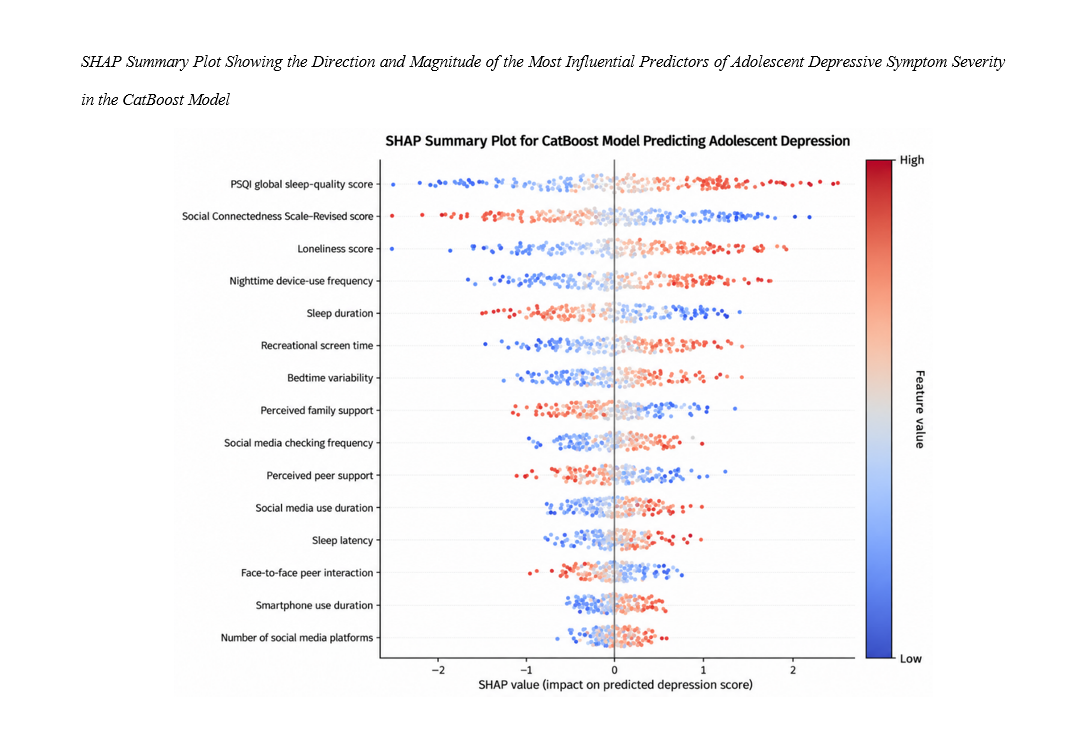
Findings: The CatBoost model achieved MAE = 2.72, RMSE = 3.57, and R² = 0.61 in the independent test sample, outperforming random forest (R² = 0.53), gradient boosting (R² = 0.56), elastic net (R² = 0.41), and multiple linear regression (R² = 0.38). SHAP analysis identified poor sleep quality as the strongest predictor, followed by lower social connectedness, greater loneliness, more frequent nighttime device use, shorter sleep duration, greater recreational screen time, and higher bedtime variability. Higher family support, peer support, face-to-face interaction, and social connectedness were associated with lower predicted depressive symptom severity.
Conclusion: Adolescent depressive symptoms were predicted with substantial accuracy from a multidimensional combination of sleep, digital behavior, and social connectedness, with sleep quality and interpersonal factors contributing more strongly than overall technology exposure.
Downloads
References
Ana, M., Dimitri, L., Ann-Christin, H., Christopher, K., Christian, M., & Birgit, A. (2026). Smartphone-Based Digital Markers and Clinical Symptoms During Therapy for Borderline Personality Disorder. Internet Interventions, 45, 100952. https://doi.org/10.1016/j.invent.2026.100952
Baker, A. E., Cooper, R. E., Buysse, D. J., Chien, A. T., González, R., Levenson, J. C., Miller, T., Rivero-Conil, S., Seo, D., Visweswaran, S., Wang, Y. R., Caswell, A., Chan, S., Chiu, K., Corcoran, M., Churchill, S., Currie, R., Duque, M., Elder, I., . . . Soehner, A. M. (2026). Pediatric Precision Sleep Network: A Study Protocol for Identifying Sleep Signatures of Mental Health Risk in Peri-Adolescents. BMC pediatrics, 26(1). https://doi.org/10.1186/s12887-026-07253-z
Benheim, T. S., Dalal, M., Holcomb, J. M., Dutta, A., Hosker, D. K., Jellinek, M. S., & Murphy, J. M. (2022). Back to Basics: Lifestyle Interventions for Adolescent Depression. Harvard Review of Psychiatry, 30(5), 283-302. https://doi.org/10.1097/hrp.0000000000000343
Chin-Fatt, C., Minhajuddin, A., Vasu, S., Goodman, L. C., Sethuram, S., & Trivedi, M. H. (2026). Active and Passive Data Collection Using mHealth to Monitor Mental Wellness: Pilot Findings From the Texas Resilience Against Depression Study. Digital Health, 12. https://doi.org/10.1177/20552076261458952
Cho, M., Park, D., Choo, M., Han, D. H., & Kim, J. (2025). Impact of Digital Phenotypes and Question-Asking on Emotional Disorders in Adolescents: 4-Week Field Study. JMIR human factors, 12, e66536-e66536. https://doi.org/10.2196/66536
Fahed, M., McManus, K. R., Vahia, I. V., & Offodile, A. C. (2022). Digital Phenotyping of Behavioral Symptoms as the Next Frontier for Personalized and Proactive Cancer Care. Jco Clinical Cancer Informatics(6). https://doi.org/10.1200/cci.22.00095
Gardea‐Resendez, M., Breitinger, S., Walker, A. J., Harper, L., Xiong, A., Stoppel, C., Volety, R., Raman, J., Byun, J. S., Langholm, C., Goes, F. S., Zandi, P. P., Torous, J., & Frye, M. A. (2024). Digital Technologies Tracking Active and Passive Data Collection in Depressive Disorders: Lessons Learned From a Case Series. Journal of Psychiatric Practice, 30(6), 434-439. https://doi.org/10.1097/pra.0000000000000820
Hamilton, J. L., Dreier, M. J., Caproni, B., Fedor, J., Durica, K. C., & Low, C. A. (2024). Improving the Science of Adolescent Social Media and Mental Health: Challenges and Opportunities of Smartphone-Based Mobile Sensing and Digital Phenotyping. https://doi.org/10.31234/osf.io/agck3
Hirshberg, M. J., Heyroth, M., & Davidson, R. J. (2025). Wellbeing Skills Strengthening as a Model for Healthy Adolescent Digital Technology Use. Annals of the New York Academy of Sciences, 1550(1), 5-13. https://doi.org/10.1111/nyas.15414
Kadirvelu, B., Bel, T. B., Freccero, A., Simplicio, M. D., Nicholls, D., & Faisal, A. A. (2026). Digital Phenotyping for Adolescent Mental Health: Feasibility Study Using Machine Learning to Predict Mental Health Risk From Active and Passive Smartphone Data. Journal of medical Internet research, 28, e72501-e72501. https://doi.org/10.2196/72501
Kamath, J., León-Barriera, R., Jain, N., Keisari, E. J., & Wang, B. (2022). Digital Phenotyping in Depression Diagnostics: Integrating Psychiatric and Engineering Perspectives. World journal of psychiatry, 12(3), 393-409. https://doi.org/10.5498/wjp.v12.i3.393
Kang, S. R. (2026). Psychosocial and Behavioral Factors Associated With Excessive Smartphone Use Among Korean Adolescents: A National Cross-Sectional Study. Children, 13(4), 472. https://doi.org/10.3390/children13040472
Kilic, Z., Maheux, A. J., Nesi, J., Silk, J. S., & Choukas‐Bradley, S. (2026). Intimate Disclosure in Online‐only Friendships Predicts Adolescents' Depressive Symptoms. Journal of Research on Adolescence, 36(1). https://doi.org/10.1111/jora.70144
Kiss, O., Alzueta, E., Yüksel, D., Pohl, K. M., Zambotti, M. d., Müller‐Oehring, E. M., Prouty, D., Durley, I., Pelham, W. E., McCabe, C., Gonzalez, M. R., Brown, S. A., Wade, N. E., Marshall, A. T., Sowell, E. R., Breslin, F. J., Lisdahl, K. M., Dick, A. S., Sheth, C. S., . . . Baker, F. C. (2022). The Pandemic's Toll on Young Adolescents: Prevention and Intervention Targets to Preserve Their Mental Health. Journal of Adolescent Health, 70(3), 387-395. https://doi.org/10.1016/j.jadohealth.2021.11.023
Leijse, M. M. L., Hansen, A., Semeijn, I. K., Beuning, E., Staaks, J., Thimo, M. v. d. P., Geert Jan, J. M. S., Popma, A., & Dam, L. v. (2025). Passive Smartphone Sensing of Adolescents’ Mental Health: A Multilevel Meta-Analysis. https://doi.org/10.21203/rs.3.rs-7766286/v1
Liu, G., & Lee, K. C. (2026). Associations of Smartphone Use Duration and Loneliness With Depressive Symptoms Among Korean Adolescents: A Nationally Representative Cross-Sectional Study. Frontiers in Public Health, 14. https://doi.org/10.3389/fpubh.2026.1834994
Marciano, L., Vocaj, E., Bekalu, M. A., Tona, A. L., Rocchi, G., & Viswanath, K. (2023). The Use of Mobile Assessments for Monitoring Mental Health in Youth: Umbrella Review (Preprint). https://doi.org/10.2196/preprints.45540
Marks, A., Berthelot, M., Jones, H., Chang, K. K., Crozier, S., & Cosper, S. (2026). The Impact of Smartphone Use on Brain Function in Adolescence: A Scoping Review. Pediatric Reports, 18(2), 43. https://doi.org/10.3390/pediatric18020043
Nestor, B. A., Chimoff, J., Koike, C., Weitzman, E. R., Riley, B., Uhl, K., & Kossowsky, J. (2024). Adolescent and Parent Perspectives on Digital Phenotyping in Youths With Chronic Pain: Cross-Sectional Mixed Methods Survey Study. Journal of medical Internet research, 26, e47781. https://doi.org/10.2196/47781
Paquin, V., Raugh, I. M., Davies, M., Lepage, M., Lavigne, K. M., Dion, J., Abdel‐Baki, A., Shah, J., Iyer, S. N., & Ferrari, M. (2025). Understanding the Game Experiences and Mental Health of Youth: Protocol for the Game-in-Action Quebec Cohort Study. BMJ open, 15(9), e103685. https://doi.org/10.1136/bmjopen-2025-103685
Pereira, H. (2026). Beyond Risk: Revisiting Suicide Risk and Protective Factors Among LGBTQIA+ Populations and Anticipating Future Directions. Swiss Archives of Neurology Psychiatry and Psychotherapy, 176(2), 13. https://doi.org/10.3390/sanpp176020013
Petit, P., & Vuillerme, N. (2026). The Digital Exposome: A Life Course Framework for Health in the Digital Age. Journal of medical Internet research, 28, e90153-e90153. https://doi.org/10.2196/90153
Piccin, J., Viduani, A., Buchweitz, C., Pereira, R., Zimerman, A., Amando, G. R., Cosenza, V., Ferreira, L. Z., McMahon, N. A., Melo, R. F. d., Richter, D., Reckziegel, F. D., Rohrsetzer, F., Souza, L., Tonon, A. C., Costa-Valle, M. T., Zajkowska, Z., Araújo, R., Hauser, T. U., . . . Kieling, C. (2024). Prospective Follow-Up of Adolescents With and at Risk for Depression: Protocol and Methods of the Identifying Depression Early in Adolescence Risk Stratified Cohort Longitudinal Assessments. Jaacap Open, 2(2), 145-159. https://doi.org/10.1016/j.jaacop.2023.11.002
Pizzoli, S. F. M., Monzani, D., Conti, L., Ferraris, G., Grasso, R., & Pravettoni, G. (2023). Issues and Opportunities of Digital Phenotyping: Ecological Momentary Assessment and Behavioral Sensing in Protecting the Young From Suicide. Frontiers in psychology, 14. https://doi.org/10.3389/fpsyg.2023.1103703
Pontz, M. M., & Helbing, M.-L. C. (2026). AI in School Health: Is It Appropriate for Mental Health Help? Nasn School Nurse, 41(2), 68-73. https://doi.org/10.1177/1942602x261423916
Prochnow, T., Senthil, R., Patterson, M. S., Blake, J. J., & Massey, P. M. (2025). Virtual Bonds; Real Emotions: Systematic Review Exploring Online Social Connections and Adolescent Mental Health. Cyberpsychology Behavior and Social Networking, 28(10), 658-671. https://doi.org/10.1177/21522715251377377
Rahimi, M., Abrishamifar, K., Hazhir, S., Valizadeh, H., Nourani, A., & Rahimi, B. (2026). Sensor‐Equipped Digital Technologies for Monitoring and Detecting Depressive Disorders: A Systematic Review. Health Science Reports, 9(3). https://doi.org/10.1002/hsr2.71743
Sakellariou, C. (2023). Estimating Bidirectional Effects Between Social Connectedness and Mental Health in Adolescent Students: Addressing Biases Due to Endogeneity. PLoS One, 18(12), e0294591. https://doi.org/10.1371/journal.pone.0294591
Vignapiano, A., Monaco, F., Pagano, C., Piacente, M., Farina, F., Petrillo, G., Sica, R., Marenna, A., Shin, J. I., Solmi, M., & Corrivetti, G. (2023). A Narrative Review of Digital Biomarkers in the Management of Major Depressive Disorder and Treatment-Resistant Forms. Frontiers in Psychiatry, 14. https://doi.org/10.3389/fpsyt.2023.1321345
Yang, L. (2026). Adherence and Acceptability of Smartphone- And Wearable-Based Digital Phenotyping in Patients With First-Episode Psychosis: Observance Et Acceptabilité Du Phénotypage Numérique Fondé Sur Les Téléphones Intelligents Et Les Objets Personnels Connectés Chez Les Patients Présentant Un Premier Épisode De Psychose. The Canadian Journal of Psychiatry. https://doi.org/10.1177/07067437261486958
Zakai, J. G., & Alharthi, S. A. (2025). Harnessing Digital Phenotyping for Early Self-Detection of Psychological Distress. Healthcare, 13(16), 2008. https://doi.org/10.3390/healthcare13162008
Downloads
Additional Files
Publication Timeline
- Submitted
- Revised
- Accepted