The Moderating Role of AI Literacy in the Relationships Between Generative AI Reliance, Academic Self-Efficacy, and Cognitive Engagement Among Adolescents
DOI:
https://doi.org/10.61838/kman.jayps.6307Keywords:
generative artificial intelligence, AI literacy, academic self-efficacy, cognitive engagement, adolescents, generative AI reliance, moderation analysisAbstract
Objective: This study aimed to examine the relationships between generative AI reliance, academic self-efficacy, and cognitive engagement among Canadian adolescents and to determine whether AI literacy moderates the associations between generative AI reliance and these two academic outcomes.
Methods and Materials: A cross-sectional correlational design was employed with 612 secondary school students aged 14–18 years from Ontario, British Columbia, Alberta, and Quebec, Canada. Participants completed self-report measures assessing generative AI reliance, AI literacy, academic self-efficacy, and cognitive engagement. Data were analyzed using Pearson correlation coefficients and multiple regression-based moderation analyses using the PROCESS macro in SPSS. Generative AI reliance was specified as the predictor, AI literacy as the moderator, and academic self-efficacy and cognitive engagement as separate dependent variables. Age, gender, grade level, and frequency of academic generative AI use were included as covariates. Interaction effects were examined using simple-slope and Johnson-Neyman analyses.
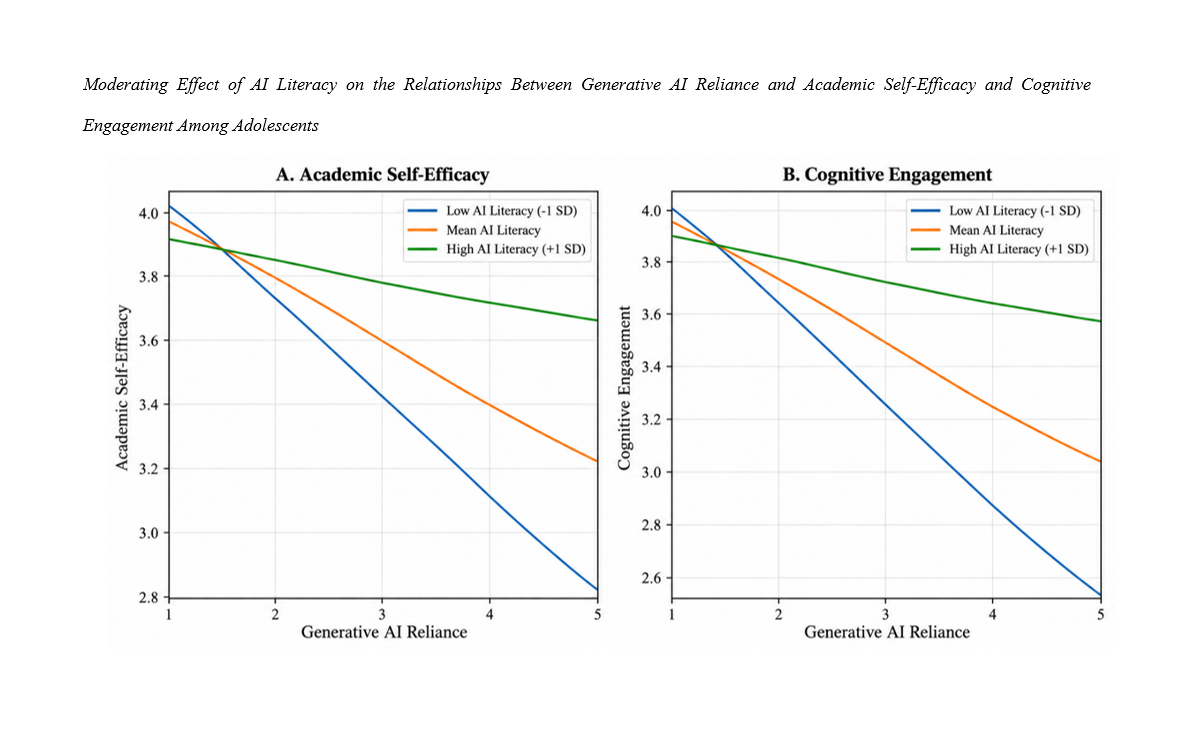
Findings: Generative AI reliance was significantly and negatively correlated with academic self-efficacy, r = -.36, p < .001, and cognitive engagement, r = -.41, p < .001, whereas AI literacy was positively associated with academic self-efficacy, r = .44, p < .001, and cognitive engagement, r = .51, p < .001. The moderation model predicting academic self-efficacy was significant, F(7, 604) = 51.11, p < .001, R² = .372, and the interaction between generative AI reliance and AI literacy was significant, B = 0.18, SE = 0.04, β = .15, p < .001, ΔR² = .021. The cognitive engagement model was also significant, F(7, 604) = 70.87, p < .001, R² = .451, with a significant interaction effect, B = 0.21, SE = 0.04, β = .17, p < .001, ΔR² = .025. In both models, the negative effects of generative AI reliance weakened as AI literacy increased and became nonsignificant at high levels of AI literacy.
Conclusion: AI literacy appears to function as a protective factor that attenuates the negative associations of generative AI reliance with adolescents’ academic self-efficacy and cognitive engagement, highlighting the importance of developing critical, evaluative, and responsible AI competencies alongside increased educational use of generative AI.
Downloads
References
Dong, S., & Gan, F. (2026). Exploring Academic Engagement of Chinese Art Students in Multimodal AI‐Assisted Learning: The Roles of Teacher Support and AI Literacy. European Journal of Education, 61(1). https://doi.org/10.1111/ejed.70489
Espina-Romero, L., Olmedo, J. I., Ochoa-Díaz, A., Janbeih, O. E. K., Jimenez, K. R., & Hinope, H. B. (2026). Academic Performance in Nursing Education Through Digital Competencies and AI Integration: A Systematic Review. Encyclopedia, 6(7), 143. https://doi.org/10.3390/encyclopedia6070143
Fan, Y. (2026). Family-School Autonomy Support for Children’s Responsible Use of Generative Artificial Intelligence: A Self-Determination Theory Synthesis and Developmental Research Agenda. Frontiers in psychology, 17. https://doi.org/10.3389/fpsyg.2026.1969217
Feng, L. (2026). Artificial Intelligence Literacy and Self-Efficacy Among Nursing Students: A Network Analysis of Educational Stratification. https://doi.org/10.21203/rs.3.rs-10670363/v1
Giansanti, D. (2026). Smartphones and Generative AI in Digital Cognition: A Narrative Review of Convergences, Divergences, and Implications for Human Agency. Ai, 7(9), 355. https://doi.org/10.3390/ai7090355
Giansanti, D., & Cosenza, C. (2026). Artificial Intelligence and Youth: Cognitive, Educational, and Behavioral Impacts. Ai, 7(4), 121. https://doi.org/10.3390/ai7040121
Hao, X. (2026). Helpful or Harmful? How AI Assistant Intelligence on Online Learning Platforms Shapes Students’ Innovative Behavior for Sustainable Education. Sustainability, 18(17), 9084. https://doi.org/10.3390/su18179084
Hoque, M. O., Chowdhury, H. J., & Islam, M. S. (2026). Exploring Potential Cognitive Decline in Future Generations Due to Over‐Reliance on Artificial Intelligence ( AI ): The Mediating Role of User Characteristics. Applied Cognitive Psychology, 40(4). https://doi.org/10.1002/acp.70269
Hossain, S. (2026). Four Types of LLM Reliance and Their Predictors Among Undergraduate Writers: A Mixed-Methods Study at a Minority-Serving R1 University. https://doi.org/10.48550/arxiv.2606.28749
Ibrahim, I., Firmansyah, J., Jalaluddin, J., & Marwan, M. (2026). The Influence of ChatGPT Usage, Learning Content, and Digital Competence on Biology Students’ Learning Motivation in the Digital Education Era: A Moderated Effect Analysis Model. https://doi.org/10.21203/rs.3.rs-8675352/v1
Li, H. (2026). Empowerment Over Enforcement: Unpacking the Psychological Drivers of AI-assisted Deep Revision in EFL Writing. Frontiers in psychology, 17. https://doi.org/10.3389/fpsyg.2026.1871022
Liu, J., Qiao, Y., Zhou, J., Fu, C., Wang, T., Li, X., & Wang, R. (2026). The Impact of Learning Engagement on Learning Outcomes Among Public Administration Majors: The Mediating Role of Digital Literacy and the Moderating Role of AI Tool Acceptance. Frontiers in psychology, 17. https://doi.org/10.3389/fpsyg.2026.1857564
Liu, L. (2026). Are Students Dependent on AI in Writing Courses? Analyzing Factors Influencing Dependence on Generative AI Through the I-Pace Model. Frontiers in psychology, 17. https://doi.org/10.3389/fpsyg.2026.1905037
Luyo, S. L. L. (2026). Artificial Intelligence Literacy and the Responsible Use of Generative AI Among University Students in Peru: The Mediating Role of Self-Regulated Learning and the Moderating Effect of Technostress. European Journal of Investigation in Health Psychology and Education, 16(9), 143. https://doi.org/10.3390/ejihpe16090143
Mohamed, A. A. (2026). From AI Assisted to Self-Regulated Learning: Roles of Digital Literacy, Critical Thinking, and Self-Efficacy Among University Students. https://doi.org/10.21203/rs.3.rs-10597413/v1
Niu, T. (2026). The Role of Generative AI in Facilitating Children's Creative Thinking and Cognitive Development: A Systematic Scoping Review. Frontiers in psychology, 17. https://doi.org/10.3389/fpsyg.2026.1880052
Seung, Y., & Basham, J. D. (2026). Cognitive Offloading in the Age of Generative AI: What Does It Mean for Students With Learning Disabilities? Learning Disability Quarterly, 49(3), 121-133. https://doi.org/10.1177/07319487261439132
Su, T. (2026). Generative AI Technostress and Learning Engagement Among Chinese University Students: A Moderated Mediation Model of Academic Adaptability and AI Literacy. Frontiers in psychology, 17. https://doi.org/10.3389/fpsyg.2026.1955418
Sun, X., Gao, Y., Zhou, D., Wang, Z., & Ji, H. (2026). Heterogeneity in Nursing Students’ Artificial Intelligence Literacy: A Study of Self-Efficacy, Attitudes Toward Technology, and Ethical Concerns Based on Latent Profile Analysis. https://doi.org/10.21203/rs.3.rs-10281161/v1
Tian, Z. (2026). Undergraduate Students Trust in Generative AI for Academic Writing: Epistemology, Mechanisms, and Learning Outcomes. https://doi.org/10.21203/rs.3.rs-9819153/v1
Tubi-Nwangwu, I., & Adewole, F. (2026). Behavioural Determinants of Artificial Intelligence-Support Nutrition Information Use Among Adolescents in Ibadan, Nigeria: A Cross-Sectional Study. https://doi.org/10.21203/rs.3.rs-10431649/v1
Wang, D., Wang, Q., & Zhang, S. (2026). Latent Profiles of AI Literacy Among K-12 Students: Predictors and Links to Self-Regulated Learning. Frontiers in psychology, 17. https://doi.org/10.3389/fpsyg.2026.1834851
Wang, N. (2026). The Impact of Artificial Intelligence Literacy on Learning Engagement Among University Students: The Mediating Role of Psychological Capital and the Moderating Role of Professional Identity. Frontiers in psychology, 17. https://doi.org/10.3389/fpsyg.2026.1892204
Zhuge, Z., & Li, C. (2026). Dynamic Pathways in the Development of University Students’ AI Literacy: Integrating Quantitative and Qualitative Evidence. Frontiers in psychology, 17. https://doi.org/10.3389/fpsyg.2026.1822027
Downloads
Additional Files
Publication Timeline
- Submitted
- Revised
- Accepted