Predicting Future Anxiety Among Youth Based on Career Uncertainty, Social Support, and Psychological Flexibility Using CatBoost
DOI:
https://doi.org/10.61838/kman.jayps.6327Keywords:
Future anxiety, Career uncertainty, Social support, Psychological flexibility, Youth, CatBoost, Machine learning, GeorgiaAbstract
Objective: This study aimed to predict future anxiety among youth in Georgia based on career uncertainty, perceived social support, and psychological flexibility using the CatBoost machine-learning algorithm.
Methods and Materials: A cross-sectional predictive study was conducted among 472 young people aged 18–29 years from Georgia. Future anxiety was assessed using the Dark Future Scale, perceived social support using the Multidimensional Scale of Perceived Social Support, and psychological flexibility using the Psy-Flex; career uncertainty was assessed with a brief career uncertainty measure based on established career-decision indicators. CatBoost regression was used as the principal predictive method, with 80% of the data allocated to training and 20% to independent testing. Five-fold cross-validation was applied for hyperparameter tuning. Model performance was evaluated using the coefficient of determination (R²), root mean squared error (RMSE), and mean absolute error (MAE). Multiple linear regression was used as a benchmark model, and SHAP analysis was employed to determine predictor importance and direction of effects.
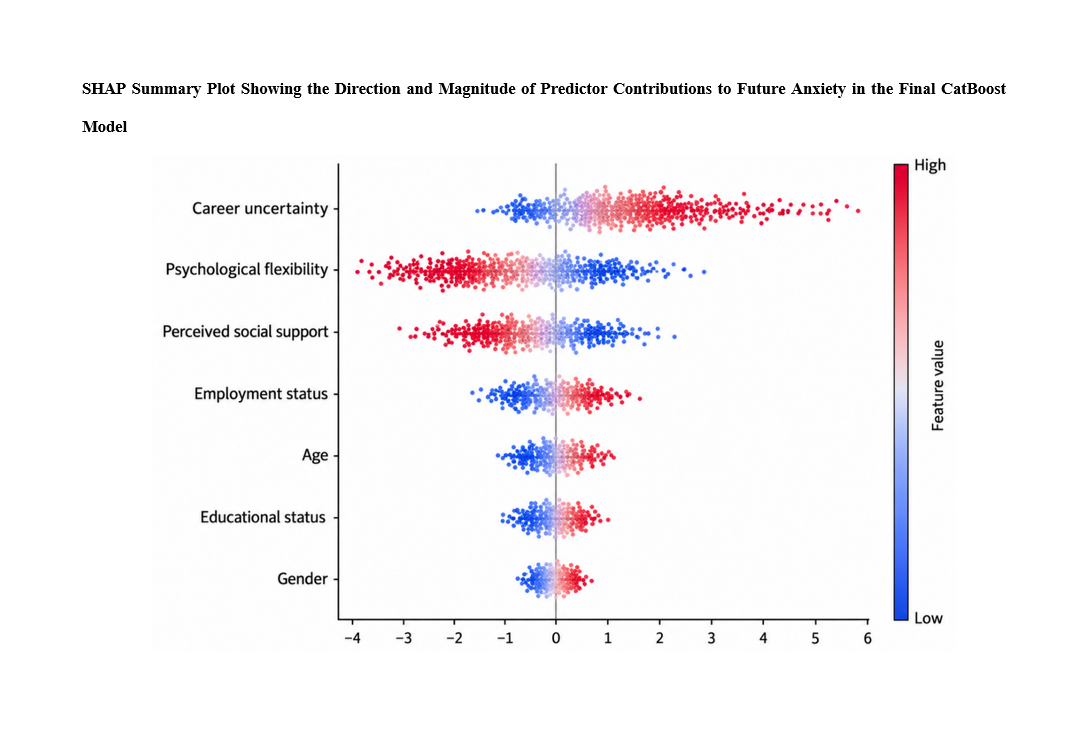
Findings: The final CatBoost model achieved an R² of .63, RMSE of 3.79, and MAE of 2.93 on the independent test set, outperforming multiple linear regression, which yielded R² = .49, RMSE = 4.46, and MAE = 3.49. Career uncertainty was the strongest predictor, accounting for 33.72% of model importance, followed by psychological flexibility at 27.84% and perceived social support at 19.63%. SHAP analysis showed that higher career uncertainty increased predicted future anxiety, whereas greater psychological flexibility and stronger perceived social support reduced predicted anxiety. The adverse effect of career uncertainty was particularly pronounced when psychological flexibility or social support was low.
Conclusion: Future anxiety among Georgian youth can be predicted with substantial accuracy using a machine-learning approach, with career uncertainty emerging as the principal risk factor and psychological flexibility and social support functioning as important protective predictors.
Downloads
References
Alam, A., Marín, A., Zubayer, A. A., Hasan, M. S., Arzu, M. S. A., Sharma, L., Mim, F. I., Haque, I., Palit, S., Rahman, F. T., Gomes, A. A., Azad, M. I., Chowdhury, R. I., Jamil, S., & Biswas, M. S. (2026). Prevalence of and Factors Associated With Depression and Anxiety Among Job‐Seeking Graduates: A Cross‐Sectional Study on Bangladesh. Public Health Challenges, 5(2). https://doi.org/10.1002/puh2.70279
Albash, N. I. (2026). Understanding Future Anxiety and Adaptive Coping Through a Mixed-Methods Lens: Experiences of Female Hard of Hearing Students in Saudi Arabia. BMC psychology, 14(1). https://doi.org/10.1186/s40359-026-04304-z
Boğazlıyan, E. E., & Ayaz, A. (2026). A Gateway to the Future or a Mind Trapped in Anxiety? The Transformative Power of Career Resources. The Career Development Quarterly, 74(2), 150-162. https://doi.org/10.1002/cdq.70022
Burgess, A., Yeomans, H., & Fenton, L. Z. (2022). ‘More Options…less Time’ in the ‘Hustle Culture’ of ‘Generation Sensible’: Individualization and Drinking Decline Among Twenty‐first Century Young Adults. British Journal of Sociology, 73(4), 903-918. https://doi.org/10.1111/1468-4446.12964
ÇArkit, E. (2025). A Social Cognitive Lens on Employment Anxiety and Career Optimism in the Transition From School to Work. The Career Development Quarterly, 73(3), 194-204. https://doi.org/10.1002/cdq.70000
Chua, V., Chew, H. G., & Lee, P. (2025). Entangled Transitions: How COVID-19 Widened Well-Being Gaps Among Youth in Singapore (2017–2022). Journal of Sociology, 62(1), 137-157. https://doi.org/10.1177/14407833251382691
Habib, A. A., Uddin, I., Hasan, M. S., Al‐Mamun, F., Almerab, M. M., Gozal, D., & Mamun, M. A. (2025). Exploring Prevalence and Factors Associated With Depression and Anxiety Symptoms Among Bangladeshi Graduates: A GIS-based Cross-Sectional Study. Cambridge Prisms Global Mental Health, 12. https://doi.org/10.1017/gmh.2025.21
Hatos, A., Bekesi, D.-G., Cosma, M. L., Bottyan, Z.-B., Dobai, D., & Mikó, S.-M. (2025). The Impact of the COVID-19 Pandemic on the Career Aspirations of Adolescents in Romania: A Longitudinal Analysis. Frontiers in Sociology, 10. https://doi.org/10.3389/fsoc.2025.1653577
Henseke, G., Green, F., & Schoon, I. (2022). Living With COVID-19: Subjective Well-Being in the Second Phase of the Pandemic. Journal of youth and adolescence, 51(9), 1679-1692. https://doi.org/10.1007/s10964-022-01648-8
Kara, B., Scharf, N., Bhreathnach, L., Currie, C., & Symonds, J. (2025). Adolescent Anxiety During the COVID‐19 Pandemic: A Qualitative Systematic Review of Risk and Protective Factors. Journal of adolescence, 97(8), 2048-2066. https://doi.org/10.1002/jad.70038
Kim, J., Oh, J., & Rajaguru, V. (2022). Job-Seeking Anxiety and Job Preparation Behavior of Undergraduate Students. Healthcare, 10(2), 288. https://doi.org/10.3390/healthcare10020288
Kovacheva, S., & Rambla, X. (2023). The Dual Nature of Opportunity Structures Amid the Global Pandemic. Societies, 13(1), 14. https://doi.org/10.3390/soc13010014
Kuzu, A., Kazan, G., Özdemir-Güzel, S., & Uzun-Kocamış, T. (2026). The Mediating Effect of Personal Failure Feeling in the Effect of Unemployment Anxiety on Migration Attitude: A Study on University Students. https://doi.org/10.21203/rs.3.rs-8724019/v1
Liu, T. (2026). A Study on the Impact of College Students’ Employment-Oriented Social Media Use on Employment Anxiety: A Dual Mediation Effect Based on Social Capital and Risk Perception. Frontiers in psychology, 17. https://doi.org/10.3389/fpsyg.2026.1918154
Mancaniello, M. R., & Lavanga, F. (2024). Adolescence in the Italian Labour Market: In Search of an Equilibrium Among Instability, Uncertainty, and AI Challenges. Social Sciences, 13(12), 688. https://doi.org/10.3390/socsci13120688
Mauno, S., Klug, K., Rantanen, J., Muotka, J., & Kiuru, N. (2023). Profiles of Early Career Insecurity and Its Outcomes in Adolescence: A Four‐wave Longitudinal Study. Journal of Research on Adolescence, 33(4), 1196-1208. https://doi.org/10.1111/jora.12869
Moavero, C., Pace, F., & Sciotto, G. (2025). Parental Criticism and Career Confidence in Workers and Students: The Mediating Role of the Fear of an Uncertain Future. Youth, 5(1), 24. https://doi.org/10.3390/youth5010024
Pandey, S., Saxena, S., Joshi, P. C., & Mahajan, C. (2023). Perceived Stress, Anxiety and Depression : Living Along the Border in Jammu and Kashmir. International Journal of Social Psychiatry, 69(6), 1532-1540. https://doi.org/10.1177/00207640231168032
Parola, A., Marcionetti, J., Sica, L. S., & Donsì, L. (2022). The Effects of a Non-Adaptive School-to-Work Transition on Transition to Adulthood, Time Perspective and Internalizing and Externalizing Problems. Current Psychology, 42(29), 25855-25869. https://doi.org/10.1007/s12144-022-03605-x
Pelekh, Y., Rudiuk, O., & Demianiuk, V. (2022). Personality Employment Crisis in the Subjective Projection of the Unemployed Youth With Higher Education. Problems of Education in the 21st Century, 80(3), 456-473. https://doi.org/10.33225/pec/22.80.456
Pignault, A., Vayre, É., & Houssemand, C. (2022). What Do They Want From a Career? University Students’ Future Career Expectations and Resources in a Health Crisis Context. Sustainability, 14(24), 16406. https://doi.org/10.3390/su142416406
Qian, S. (2026). Impact of Paternal Job Insecurity on Youth's Perceived Employability. Stress and Health, 42(1). https://doi.org/10.1002/smi.70141
Ratner, K., Budesheim, E. F., Alexander, C., Klein, R. B., Leinenweber, S., Zhang, L., & Napolitano, C. M. (2025). Hurry Up and Wait: Developmental Anxiety During the Transition to Adulthood. Journal of Family Theory & Review, 17(3), 483-505. https://doi.org/10.1111/jftr.12621
Saripudin, M., Sunarya, Y., Afiati, E., & Rahmawati, R. (2022). The Urgency of Developing Youth Career Resilience Through Guidance and Counseling as an Effort to Prepare for the Golden Generation 2045. Indonesian Journal of Educational Counseling, 6(1), 1-7. https://doi.org/10.30653/001.202261.178
Soeker, M. S., Bester, A. H., Mvubu, A., Boonzaaier, G., Roodman, N., Beukman, M., & Fourie, M. (2026). A Qualitative Exploration of How Job Insecurity Influences the Worker Roles of Youth That Are Homeless. Work a Journal of Prevention Assessment & Rehabilitation, 85(2), 362-373. https://doi.org/10.1177/10519815261421500
Tao, Z., Wang, Z., Lan, Y., Zhang, W., & Qiu, B. (2025). Socioeconomic Status Impacts Chinese Late Adolescents’ Internalizing Problems: Risk Role of Psychological Insecurity and Cognitive Fusion. BMC public health, 25(1). https://doi.org/10.1186/s12889-025-22628-0
Wang, R., & Lin, X. (2023). Fight Back Against the Stress: The Effects of Parental Job Insecurity on Career Networking Behaviors of Emerging Adults. Journal of adolescence, 95(5), 1045-1056. https://doi.org/10.1002/jad.12174
Zheng, S., & Yan, Y. (2024). Changes in Employment Psychology of Chinese University Students During the Two Stages of COVID-19 Control and Their Impacts on Their Employment Intentions. Frontiers in psychology, 15. https://doi.org/10.3389/fpsyg.2024.1447103
Zhou, T., Bao, Y., Guo, D., Bai, Y., Wang, R., Cao, X., Li, H., & Hua, Y. (2022). Intolerance of Uncertainty and Future Career Anxiety Among Chinese Undergraduate Students During COVID-19 Period: Fear of COVID-19 and Depression as Mediators. Frontiers in Public Health, 10. https://doi.org/10.3389/fpubh.2022.1015446
Downloads
Additional Files
Publication Timeline
- Submitted
- Revised
- Accepted