Detecting Adolescent Emotional Distress from Daily Smartphone Behavioral Patterns Using Long Short-Term Memory Networks
DOI:
https://doi.org/10.61838/kman.jayps.6354Keywords:
adolescents, emotional distress, smartphone behavior, digital phenotyping, Long Short-Term MemoryAbstract
Objective: This study aimed to determine whether daily smartphone-derived behavioral patterns could accurately detect high emotional distress among Colombian adolescents using Long Short-Term Memory (LSTM) networks and whether sequential deep learning outperformed alternative predictive models.
Methods and Materials: A prospective longitudinal observational study was conducted among 312 adolescents aged 13–18 years recruited from public and private secondary schools in Bogotá, Medellín, and Cali, Colombia. Participants were monitored for eight consecutive weeks using a custom Android smartphone application that passively recorded non-content behavioral metadata related to screen activity, application use, communication, mobility, and temporal routines. Daily emotional distress was assessed through ecological momentary assessment. After preprocessing, 15,884 valid participant-days and 13,912 seven-day behavioral sequences were available for analysis. Data were divided at the participant level into training, validation, and independent test sets. An LSTM model was developed and compared with logistic regression, random forest, gradient boosting, and feed-forward neural network models.
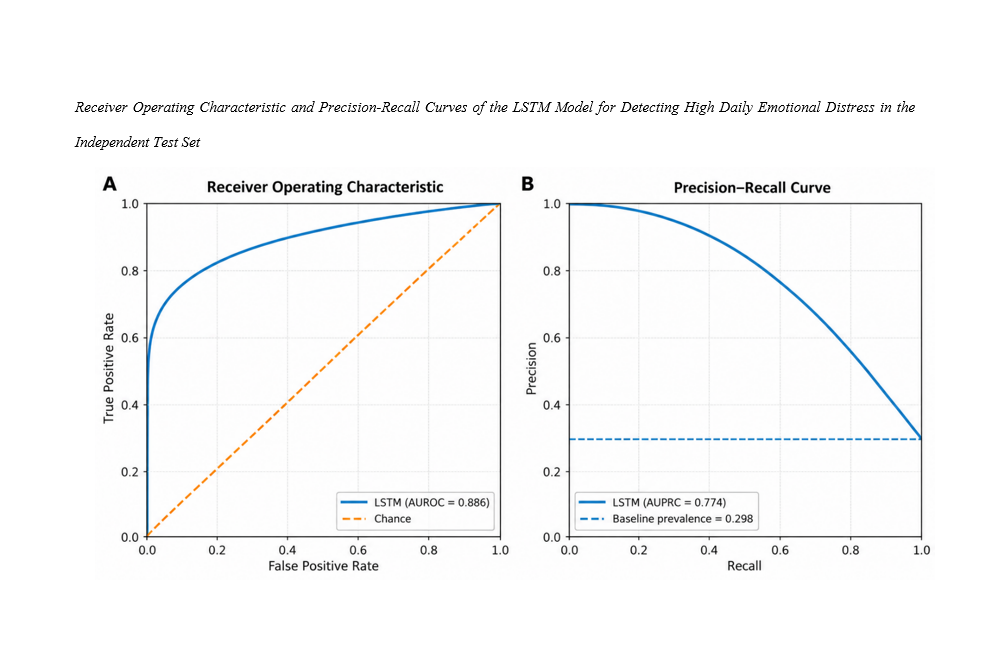
Findings: The LSTM model achieved a ROC-AUC of 0.886, PR-AUC of 0.774, accuracy of 82.3%, sensitivity of 81.1%, specificity of 82.8%, balanced accuracy of 81.9%, and F1 score of 0.737 in the independent test set. It outperformed logistic regression (ROC-AUC = 0.724), random forest (0.801), gradient boosting (0.827), and feed-forward neural network (0.842). Temporal-routine features showed the strongest single-domain predictive performance, followed by mobility features. The seven-day sequence yielded better discrimination than three-day, five-day, and ten-day alternatives. Increased nighttime use, later final smartphone interaction, reduced mobility, greater time spent at the primary location, and reduced routine regularity were among the most influential predictive features.
Conclusion: Daily smartphone behavioral patterns provide a meaningful, privacy-preserving signal for detecting adolescent emotional distress, and LSTM networks offer superior performance by capturing temporal dependencies across multiple behavioral domains.
Downloads
References
Abdoli, M., Khoshgoftar, M., Jadidi, H., Daniali, S. S., & Kelishadi, R. (2024). Screen Time and Child Behavioral Disorders During COVID-19 Pandemic: A Systematic Review. International journal of preventive medicine, 15. https://doi.org/10.4103/ijpvm.ijpvm_78_23
Abdoli, M., Rahimi, M., Dianati, A., Daniali, S. S., & Kelishadi, R. (2025). The Association of Cyberspace and Attention‐Deficit Hyperactivity Disorder Symptoms in Children During the COVID‐19 Pandemic: A Systematic Review. Journal of Paediatrics and Child Health, 61(4), 549-558. https://doi.org/10.1111/jpc.70003
Ayhan, N. (2026). Nomophobia and Adolescent Social Isolation in a Rapidly Transforming Cultural Context: Evidence From Kyrgyzstan. Public Health Challenges, 5(2). https://doi.org/10.1002/puh2.70286
Aykutlu, M. Ş., Aykutlu, H. C., Özveren, M. F., & Garip, R. (2024). Digital Media Use and Its Effects on Digital Eye Strain and Sleep Quality in Adolescents: A New Emerging Epidemic? PLoS One, 19(12), e0314390. https://doi.org/10.1371/journal.pone.0314390
Cho, M., Park, D., Choo, M., Han, D. H., & Kim, J. (2025). Impact of Digital Phenotypes and Question-Asking on Emotional Disorders in Adolescents: 4-Week Field Study. JMIR human factors, 12, e66536-e66536. https://doi.org/10.2196/66536
Fatima, A., Akhter, M. S., Kanekar, A., Roy, S., Imade, B., & Sharma, M. (2025). A Scoping Review of the Use and Determinants of Social Media Among College Students. Healthcare, 13(17), 2234. https://doi.org/10.3390/healthcare13172234
Fendel, J. C., Bürkle, J. J., & Schmidt, S. (2025). The Relationship Between Trait Mindfulness And problematic Usage of the Internet, Screen Time, and Nomophobia: A Systematic Review And meta-Analysis. Journal of Behavioral Addictions, 14(2), 590-610. https://doi.org/10.1556/2006.2025.00052
Floris, M., & Gentili, C. (2026). Association Between Problematic Internet and Mobile Phone Use, Autistic Traits, and Psychological Distress Among Adults: A Cross-Sectional Survey. PLOS Mental Health, 3(6), e0000524. https://doi.org/10.1371/journal.pmen.0000524
Fortunato, L., Coco, G. L., Teti, A., Bonfanti, R. C., & Salerno, L. (2023). Time Spent on Mobile Apps Matters: A Latent Class Analysis of Patterns of Smartphone Use Among Adolescents. International journal of environmental research and public health, 20(15), 6439. https://doi.org/10.3390/ijerph20156439
Gale, E. L., Williams, A. J., & Cecil, J. E. (2024). Late-Night Screen Time and Screen Time Addiction as Shared Determinants of Poor Sleep and Obesity in Adolescents Aged 11-14 Years in Scotland. https://doi.org/10.21203/rs.3.rs-5386674/v1
Gamlı, İ. S., & Gürbüz, A. A. (2025). Examining the Impact of Screen Time on Clinical Presentation and Symptom Severity in Children Diagnosed With Attention Deficit Hyperactivity Disorder: A Cross-Sectional Study. Journal of Indian Association for Child and Adolescent Mental Health, 21(3), 235-242. https://doi.org/10.1177/09731342251342664
Gu, Q., & Zhao, M. (2025). The Chain Mediating Effects of Parent–Child Conflict and Screen Time on the Relationship Between Parental Phubbing and Problem Behaviors in Preschoolers. Behavioral Sciences, 15(2), 203. https://doi.org/10.3390/bs15020203
Gupta, V., Gupta, A., Valjiyani, S., Uppal, S., Gautam, S., & Vishwas, G. (2023). Physical, Psychological and Social Effects of Mobile Phone Use in Children: A Prospective Cohort Study. J Biomed Res Environ Sci, 4(8), 1206-1232. https://doi.org/10.37871/jbres1788
Haag, A. C., Nick, E. A., Chen, S., Telzer, E. H., Prinstein, M. J., & Bonanno, G. A. (2024). Investigating Risk Profiles of Smartphone Activities and Psychosocial Factors in Adolescents During the COVID‐19 Pandemic. Journal of Research on Adolescence, 35(1). https://doi.org/10.1111/jora.13045
Hamp, N., Radesky, J., Weeks, H. M., Miller, A. L., & Kaciroti, N. (2024). Novel Profiles of Family Media Use: Latent Profile Analysis (Preprint). https://doi.org/10.2196/preprints.59215
Hamp, N., Radesky, J., Weeks, H. M., Miller, A. L., & Kaciroti, N. (2025). Novel Profiles of Family Media Use: Latent Profile Analysis. Jmir Pediatrics and Parenting, 8, e59215-e59215. https://doi.org/10.2196/59215
Islam, M. A. (2023). Exploring the Impact of Covid-19 on Children's Social Media Usage: A Pragmatic Analysis of Excessive Screen Time and Its Effects on Child Development. Journal of Community Positive Practices, 23(2), 69-84. https://doi.org/10.35782/jcpp.2023.2.05
Kim, A., Lee, U., Kim, S., & Shah, V. (2025). Adolescent Smartphone Overdependence in South Korea: A Place-Stratified Evaluation of Conceptually Informed AI/ML Modeling. International journal of environmental research and public health, 22(10), 1515. https://doi.org/10.3390/ijerph22101515
Liu, X., Liu, J., Flores, D. D., & McDonald, C. C. (2024). Family Factors Related to Adolescent Screen Media Use and Mental Health Outcomes: A Systematic Review and Recommendation for Practices. Journal of adolescence, 96(7), 1401-1427. https://doi.org/10.1002/jad.12367
Marks, A., Berthelot, M., Jones, H., Chang, K. K., Crozier, S., & Cosper, S. (2026). The Impact of Smartphone Use on Brain Function in Adolescence: A Scoping Review. Pediatric Reports, 18(2), 43. https://doi.org/10.3390/pediatric18020043
Martínez, B. A., d’Hombres, B., & Kovačič, M. (2025). Social Media Use, Loneliness and Emotional Distress Among Young People in Europe. https://doi.org/10.2139/ssrn.5108845
Nagata, J. M., Low, P., Lee, E. D., Yu, S., Leong, A. W., Bao, K., Wong, J. H., Moreno, M. A., & Lavender, J. M. (2026). Digital Media Use and Psychosocial Health Among Adolescent Boys and Young Men. Current psychiatry reports, 28(1). https://doi.org/10.1007/s11920-026-01681-5
Ntumi, S., Ogah, M., Nyarko, B., & Nimo, D. G. (2025). “Quiet Screens, Loud Minds”: Classroom-Based Assessment of Nocturnal Social Media Use, Sleep Quality, and Anxiety Among Middle Adolescents in Ghana. https://doi.org/10.21203/rs.3.rs-6645487/v1
Özbay, Ö. (2026). ‘Brain Rot’ Among University Students in the Digital Age: A Phenomenological Study. Current psychiatry reports, 28(1). https://doi.org/10.1007/s11920-025-01658-w
Patel, D. G., Kshatri, A. H. S., Kommuru, S., & Javvaji, C. K. (2025). A Narrative Review of Digital Addiction and Health: A New Challenge for Modern Medicine. Cureus. https://doi.org/10.7759/cureus.100491
Ruiz‐Olivares, R., Lucena, V., Ruiz‐García, A., & Raya, A. (2025). Social Anxiety, Risk Perception, and Problematic Use of Mobile Phones and Video Games: A Gender Perspective. Healthcare, 13(22), 2831. https://doi.org/10.3390/healthcare13222831
Sheehan, C. M., Low, S., & Price, C. D. (2025). How Did the Relationship Between Technology Use and Sleep Change During the Pandemic for High Schoolers? Evidence From a County‐Wide Sample. Social Development, 34(3). https://doi.org/10.1111/sode.70006
Wu, J. X., Jia, L., Li, Y., Liu, Q., Zhang, Y., Zhang, J., Jia, Y. R., & Fan, Z. (2024). The Interplay of Psychological Resilience and Adolescent Mobile Phone Addiction in Henan Province, China: Insights From Latent Class Analysis. Frontiers in Public Health, 12. https://doi.org/10.3389/fpubh.2024.1386500
Xie, Z., Bi, K., & Cui, L. (2025). Developmental Trajectories of Adolescent Problematic Mobile Phone Use and Their Longitudinal Associations With Intolerance of Uncertainty and Distress Tolerance: The Moderating Role of Early‐life Environmental Unpredictability. Journal of Research on Adolescence, 35(4). https://doi.org/10.1111/jora.70092
Xu, L., Song, K., Geng, X., Zhang, J., Fang, X., Potenza, M. N., & Zhang, J. (2025). Beyond Screen Time: The Core Influences of Problematic Screen Use on Adolescent Development Networks. Journal of Behavioral Addictions, 14(2), 724-737. https://doi.org/10.1556/2006.2025.00035
Yi, H., Wu, X., & Liu, X. (2025). When Smartphones Fragment the Mind: Exploring the Links Between Fragmented Smartphone Use and Anxiety Among College Students Through Distraction and Procrastination. https://doi.org/10.21203/rs.3.rs-7600425/v1
Zhang, Y. (2026). Emotional Symptoms, Not Pre-Sleep Screen Use, Predict Poor Sleep Quality in Young and Middle-Aged Adults: A Cross-Sectional Study. https://doi.org/10.21203/rs.3.rs-10792232/v1
Zhao, J., & Li, S. (2026). The Developmental Trajectories of Phubbing in Chinese Adolescents: A Variable-Centered and Person-Centered Perspective. Frontiers in Psychiatry, 17. https://doi.org/10.3389/fpsyt.2026.1784683
Downloads
Additional Files
Publication Timeline
- Submitted
- Revised
- Accepted