Constructing a Qualitative Model of Psychological Readiness for the Transition From School to an AI-Transformed Labor Market Among Youth
DOI:
https://doi.org/10.61838/kman.jayps.6363Keywords:
Artificial intelligence, psychological readiness, school-to-work transition, youth, career adaptability, career self-efficacy, labor marketAbstract
Objective: This study aimed to construct a qualitative model explaining the psychological readiness of youth for the transition from school to an AI-transformed labor market.
Methods and Materials: A qualitative grounded theory design was employed among 24 young people aged 18–25 years in Turkey who were in the final stages of formal education, recent graduates seeking employment, or early-career employees. Participants were selected using purposeful maximum-variation sampling followed by theoretical sampling until theoretical saturation was achieved. Data were collected through individual semi-structured in-depth interviews focusing on perceptions of AI-related labor-market change, career uncertainty, employability, emotional responses, adaptability, continuous learning, professional identity, and contextual support. Interviews were transcribed verbatim and analyzed concurrently with data collection through open, axial, and selective coding using.
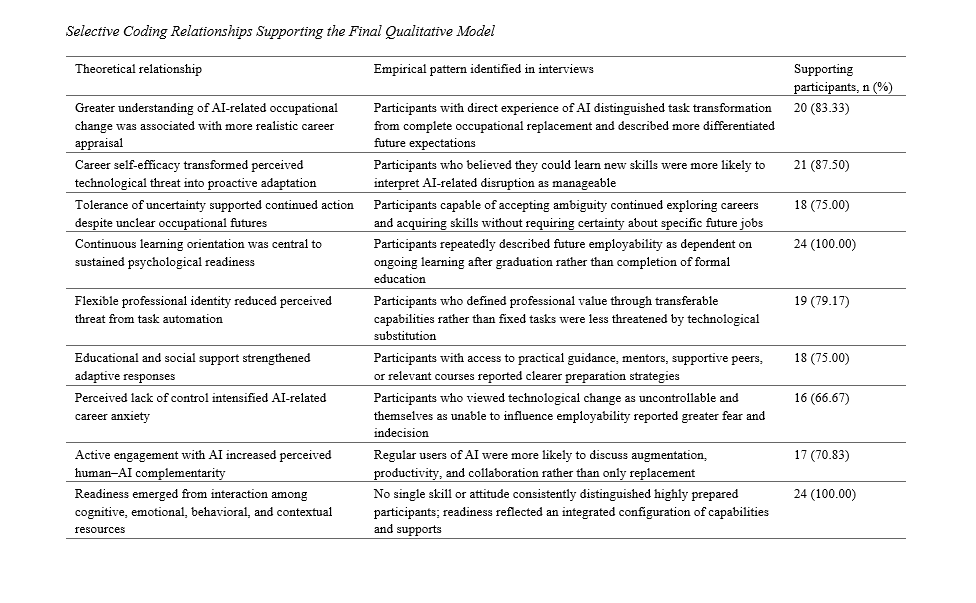
Findings: Analysis generated 112 initial open codes, which were consolidated into 18 subcategories and seven major categories. Selective coding identified adaptive psychological readiness for AI-mediated career transition as the core phenomenon. The resulting model showed that readiness emerged through the interaction of perceived AI-related labor-market disruption, cognitive appraisal of opportunity and threat, emotional regulation and tolerance of uncertainty, career agency and adaptive self-efficacy, continuous learning and AI-oriented adaptability, contextual readiness resources, and flexible professional identity. Greater understanding of AI-related occupational change, stronger career self-efficacy, higher tolerance of uncertainty, continuous learning orientation, educational and social support, and active engagement with AI were associated with more adaptive career responses. Weak readiness was characterized by AI-related career anxiety, avoidance of career decisions, perceived helplessness, rigid occupational identity, and fear of skill obsolescence.
Conclusion: Psychological readiness for entering an AI-transformed labor market is a dynamic, multidimensional capacity that depends on the integration of cognitive, emotional, behavioral, identity-related, and contextual resources rather than technological competence alone.
Downloads
References
Aidoo‐Frimpong, G., Owusu, E., Asitanga, D. A., Aduku, G., Moore, S. E., Oduro, M. A., & Ni, Z. (2026). Readiness, Equity, and Ethical Concerns in Artificial Intelligence (AI) Adoption in Ghana: Implications for AI Integration in Healthcare and Education. https://doi.org/10.64898/2026.02.05.26345694
Briddick, H. S., & Briddick, W. C. (2024). Who Owns Their Story: Career Construction With Gifted and Talented Students. Gifted Education International, 40(3), 312-327. https://doi.org/10.1177/02614294241268036
Chawla, S., Chen, S., Qian, J., Svarovsky, G., Cheng, A., Johnson, R., Chawla, N. V., & Metoyer, R. (2026). AI4CAREER: Responsible AI for STEM Career Development at Scale in K-16 Education. https://doi.org/10.48550/arxiv.2603.02568
Dewi, N. K., Jamil, A., & Wijaya, F. W. (2024). Artificial Intelligence and the Jobs of the Future: Preparing Young Moderates for Change. Lentera Multidisciplinary Studies, 2(3). https://doi.org/10.57096/lentera.v2i3.96
Duong, C. D. (2025). AI Literacy and Higher Education Students’ Digital Entrepreneurial Intention: A Moderated Mediation Model of AI Self-Efficacy and Digital Entrepreneurial Self-Efficacy. Industry and Higher Education, 40(2), 242-255. https://doi.org/10.1177/09504222251370089
Elbasyouny, O., & Dababneh, O. (2025). Feasibility and Challenges of Pilotless Passenger Aircraft: Technological, Regulatory, and Societal Perspectives. Future Transportation, 6(1), 3. https://doi.org/10.3390/futuretransp6010003
Falco, L. D. (2026). School Counselors and the Future of Work: Preparing P–12 Students for Career Development Amid AI, Technological Change, and Economic Volatility. Journal of employment counseling, 63(2), 129-140. https://doi.org/10.1002/joec.70012
George, A. (2024). Navigating the Digital Transformation: Unveiling Industry 4.0 Challenges and Preparing for Industry 5.0. https://doi.org/10.5772/intechopen.1004152
Hurford, R. M., Derry, M., & Bavuso, E. (2025). Embracing the Future: Artificial Intelligence in the Provision of Pre-Employment Transition Services to Autistic and Neurodivergent Youth. Journal of Vocational Rehabilitation, 62(2), 178-190. https://doi.org/10.1177/10522263241312734
Ifitri, M., Aryani, N. F., Fajar, W., Sudianto, S., & Herman, H. (2024). Digital Transformation in Human Resource Management: The Impact of Ai and Automation on Employee Competency Development. Indo-Fintech Intellectuals Journal of Economics and Business, 4(5), 2317-2328. https://doi.org/10.54373/ifijeb.v4i5.2033
Kasule, A., Mutebi, B., Balunywa, A., Makubuya, R., & Kyeyune, R. (2023). Readiness of Graduates From Ugandan Higher Institutions of Learning for Work in the Fourth Industrial Revolution. Uherj, 11(2), 69-81. https://doi.org/10.58653/nche.v11i2.6
Kenny, M. E., Wu, X., Guterres, K., Gordon, P., Schmidtberger, R., Masters, A., Tanega, C., & Cunningham, S. (2023). Youth Perspectives on Decent Education and College and Career Readiness. Journal of Career Assessment, 32(3), 598-618. https://doi.org/10.1177/10690727231217108
Khoo, W. C. (2026). Global Unemployment Dynamics and Labour Market Transformation: A Multidimensional Analysis. https://doi.org/10.21203/rs.3.rs-10924528/v1
Levitt, G., & Grubaugh, S. J. (2024). Why Do I Have to Learn This Stuff? Using AI to Assist Secondary Teachers in Teaching Future-Ready Practical Life Skills With Any Social Studies Lesson. Technium Social Sciences Journal, 59, 327-341. https://doi.org/10.47577/tssj.v59i1.11241
Lim, J., Kim, E., & Colletta, A. (2026). Human Capital and Regional Resilience: Nevada Computable General Equilibrium Approach. Growth and Change, 57(1). https://doi.org/10.1111/grow.70099
Malik, A. (2026). From Reactive to Autonomous: Evolution of AI Operations in Cloud Network Infrastructure. https://doi.org/10.48550/arxiv.2608.14574
Mohandas, N. P., Mukundan, S. P., Jose, G., Tesi, A., & Alias, R. (2023). Future of Work – Apprehensions and Excitement Of management Graduates. Higher Education Skills and Work-Based Learning, 13(5), 911-926. https://doi.org/10.1108/heswbl-08-2022-0181
Mtshali, S., & Dhanpat, N. (2026). Establishing Career Competencies for the Fourth Industrial Revolution: A Qualitative Study of Expert Perspectives in South Africa. Frontiers in psychology, 17. https://doi.org/10.3389/fpsyg.2026.1823256
Pawar, M. S., & Babacan, H. (2025). Full Employment and Decent Work: Policy Gaps and Strategic Pathways. The International Journal of Community and Social Development, 7(2), 175-193. https://doi.org/10.1177/25166026251351371
Popovici, A., Alam, M. S., Castillo, C. M. A., Dang, R., Eker, S., Fakoya, K. A., Falsarone, A., Ibeto, C. N., Kühn, M., Liu, Q., Momanyi, S., Mycoo, M., Reiter, C., Shimpuku, Y., Kempen, L. v., Wagner, F., Salami, B., Stevance, A. S., Kelly, W. K., & Gunalan, K. N. (2024). From Science to Action: Leveraging Scientific Knowledge and Solutions for Advancing Sustainable and Resilient Development. https://doi.org/10.24948/2024.09
Rani, P., Bagri, K., Yadav, P., & Dahiya, S. (2026). Unravelling the Impact of Artificial Intelligence on Employee Work: A Triangulated Approach Using SPAR, ADO Framework, and Bibliometric Analysis. Human Systems Management, 45(5), 667-681. https://doi.org/10.1177/01672533251414497
Stylianou, V. (2026). Sustainable Career Readiness in the GenAI Era: Student Perceptions of Automation, Entry-Level Employment, and Pedagogical Support. Sustainability, 18(18), 9379. https://doi.org/10.3390/su18189379
Tenakwah, E. S., & Watson, C. (2024). Embracing the AI/automation Age: Preparing Your Workforce for Humans and Machines Working Together. Strategy & Leadership, 53(1), 32-48. https://doi.org/10.1108/sl-05-2024-0040
Thi, T. D. P. (2025). Are College Students Ready to Learn AI?—A Readiness Perspective. The Career Development Quarterly, 74(1), 24-40. https://doi.org/10.1002/cdq.70011
Thompson, A. G., Rinaldi, N., Smith, C., & Bigelman, K. A. (2025). The Holistic Health and Fitness Management System (H2FMS): A Modernised Software Capability for Optimising Soldier Readiness and Performance. BMJ Military Health, 171(5), 438-446. https://doi.org/10.1136/military-2024-002945
Wong, L. P. W. (2024). Artificial Intelligence and Job Automation: Challenges for Secondary Students’ Career Development and Life Planning. Merits, 4(4), 370-399. https://doi.org/10.3390/merits4040027
Downloads
Additional Files
Publication Timeline
- Submitted
- Revised
- Accepted