Navigating the Virtual Classroom: The Mediating Role of Psychological Distress in the Association between Psychological Flexibility and Academic Burnout in Adolescent Students
DOI:
https://doi.org/10.61838/kman.jayps.2545Keywords:
Psychological flexibility, Academic burnout , Psychological distressAbstract
Objective: The challenges of the education period can put students under pressure and endanger their health, with academic burnout being one of the predictable outcomes. This research aims to investigate the relationship between psychological flexibility and academic burnout, considering the mediating role of psychological distress.
Methods and Materials: The participants included 769 students (386 girls and 383 boys) who completed the Educational Burnout Questionnaire (MBI-SS), the Depression, Anxiety, and Stress Scale (DASS-21), and the Acceptance and Action Questionnaire 2nd Edition (AAQ-II).
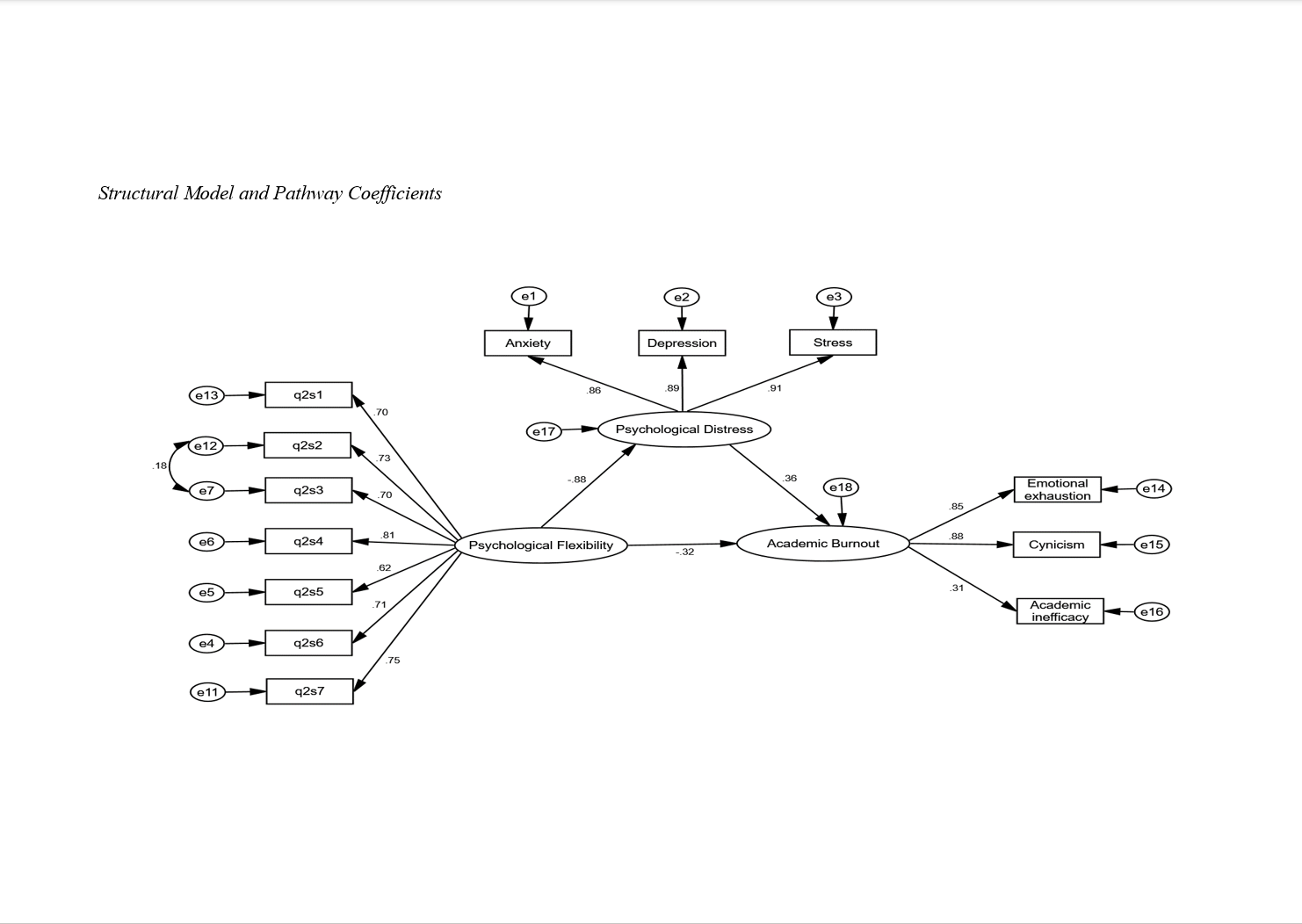
Findings: The structural model showed that psychological flexibility is negatively correlated with academic burnout, while psychological distress is positively correlated with academic burnout. Additionally, the results indicated that psychological distress mediates the relationship between psychological flexibility and academic burnout..
Conclusion: Based on these findings, it is recommended that educational programs integrate psychological flexibility training into school curricula to help students manage stress and negative emotions related to their studies. Interventions targeting psychological distress as a key factor in academic burnout could also be beneficial.
Downloads
References
Aazami, Y., Khanjani, M., & Sader, M. M. (2017). Confirmatory factor structure of Depression, Anxiety and Stress Scale in students [Research(Original)]. Journal of Mazandaran University of Medical Sciences, 27(154), 94-106. http://jmums.mazums.ac.ir/article-1-9617-en.html
Akbari, M., Seydavi, M., & Zamani, E. (2021). The mediating role of personalized psychological flexibility in the association between distress intolerance and psychological distress: A national survey during the fourth waves of COVID-19 pandemic in Iran. Clinical Psychology & Psychotherapy, 28(6), 1416-1426. https://doi.org/10.1002/cpp.2685
Antony, M., Bieling, P., Cox, B., Enns, M., & Swinson, R. (1998). Psychometric properties of the 42-item and 21-item versions of the Depression Anxiety Stress Scales in clinical groups and a community sample. Psychological Assessment, 10, 176-181. https://doi.org/10.1037/1040-3590.10.2.176
Arbuckle, J. L. (2006). AMOS user’s guide 7.0. Spring House, U.S.A. http://amosdevelopment.com
Azadeh, S. M., Kazemi-Zahrani, H., & Besharat, M. A. (2015). Effectiveness of Acceptance and Commitment Therapy on Interpersonal Problems and Psychological Flexibility in Female High School Students With Social Anxiety Disorder. Glob J Health Sci, 8(3), 131-138. https://doi.org/10.5539/gjhs.v8n3p131
Azevedo, A., & Matos, A. P. (2015). Psychological Flexibility and Self-Compassion: Contributions of gender and its association with adolescent depression. Global Academic Institute Education & Social Sciences, 1(2), 95-109. //hdl.handle.net/10316/47293
Bask, M., & Salmela-Aro, K. (2013). Burned out to drop out: Exploring the relationship between school burnout and school dropout. European Journal of Psychology of Education, 28(2), 511-528. http://www.jstor.org/stable/23421907
Betts, J., Gullone, E., & Allen, J. S. (2009). An examination of emotion regulation, temperament, and parenting style as potential predictors of adolescent depression risk status: a correlational study. Br J Dev Psychol, 27(Pt 2), 473-485. https://doi.org/10.1348/026151008x314900
Bond, F. W., Hayes, S. C., Baer, R. A., Carpenter, K. M., Guenole, N., Orcutt, H. K., Waltz, T., & Zettle, R. D. (2011). Preliminary psychometric properties of the Acceptance and Action Questionnaire-II: a revised measure of psychological inflexibility and experiential avoidance. Behavior Therapy, 42(4), 676-688. https://doi.org/10.1016/j.beth.2011.03.007
Caballero Domínguez, C., & Bresó, E. (2015). Burnout in university students. psicología desde el caribe, 32, 89-108. https://doi.org/10.14482/psdc.32.3.6217
Cao, W., Fang, Z., Hou, G., Han, M., Xu, X., Dong, J., & Zheng, J. (2020). The psychological impact of the COVID-19 epidemic on college students in China. Psychiatry Research, 287, 112934. https://doi.org/https://doi.org/10.1016/j.psychres.2020.112934
Chen, H. L., Wang, H. Y., Lai, S. F., & Ye, Z. J. (2022). The Associations Between Psychological Distress and Academic Burnout: A Mediation and Moderation Analysis. Psychology Research and Behavior Management, 15, 1271-1282. https://doi.org/10.2147/prbm.S360363
Cheng, J., Zhao, Y. Y., Wang, J., & Sun, Y. H. (2020). Academic burnout and depression of Chinese medical students in the pre-clinical years: the buffering hypothesis of resilience and social support. Psychology, Health and Medicine, 25(9), 1094-1105. https://doi.org/10.1080/13548506.2019.1709651
Fernández-Castillo, A. (2021). State-Anxiety and Academic Burnout Regarding University Access Selective Examinations in Spain During and After the COVID-19 Lockdown [Original Research]. Frontiers in Psychology, 12, 621863. https://doi.org/10.3389/fpsyg.2021.621863
Fowler, S. (2015). Burnout and depression in academia: A look at the discourse of the university. Empedocles: European Journal for the Philosophy of Communication, 6, 155-167. https://doi.org/10.1386/ejpc.6.2.155_1
Gamble, M. A. (2019). The New Majority: Psychological Flexibility as a Moderator of the Impact of Employment on Academic Performance and Burnout in College Students (Publication Number 13878219) [M.S., University of Louisiana at Lafayette]. ProQuest Dissertations & Theses Global; Publicly Available Content Database. United States -- Louisiana. https://www.proquest.com/dissertations-theses/new-majority-psychological-flexibility-as/docview/2550665216/se-2
Gerber, M., Lang, C., Feldmeth, A. K., Elliot, C., Brand, S., Holsboer-Trachsler, E., & Pühse, U. (2015). Burnout and Mental Health in Swiss Vocational Students: The Moderating Role of Physical Activity. Journal of Research on Adolescence, 25(1), 63-74. https://doi.org/https://doi.org/10.1111/jora.12097
Golberstein, E., Wen, H., & Miller, B. F. (2020). Coronavirus Disease 2019 (COVID-19) and Mental Health for Children and Adolescents. JAMA Pediatrics, 174(9), 819-820. https://doi.org/10.1001/jamapediatrics.2020.1456
Grégoire, S., Gagnon, J., Lachance, L., Shankland, R., Dionne, F., Kotsou, I., Monestès, J.-L., Rolffs, J. L., & Rogge, R. D. (2020). Validation of the English and French versions of the Multidimensional Psychological Flexibility Inventory short form (MPFI-24). Journal of contextual behavioral science, 18, 99-110. https://doi.org/10.1016/j.jcbs.2020.06.004
Hasan, N., & Bao, Y. (2020). Impact of "e-Learning crack-up" perception on psychological distress among college students during COVID-19 pandemic: A mediating role of "fear of academic year loss". Children and Youth Services Review, 118, 105355. https://doi.org/10.1016/j.childyouth.2020.105355
Hayes, S. C., Luoma, J. B., Bond, F. W., Masuda, A., & Lillis, J. (2006). Acceptance and commitment therapy: model, processes and outcomes. Behaviour Research and Therapy, 44(1), 1-25. https://doi.org/10.1016/j.brat.2005.06.006
Holm, S. (2013). Declaration of Helsinki. In H. LaFollette (Ed.), The international encyclopedia of ethics. Wiley-Blackwell. https://doi.org/10.1002/9781444367072
Hooper, D., Coughlan, J. P., & Mullen, M. R. (2008). Structural equation modelling: Guidelines for determining model fit. Electronic Journal of Business Research Methods, 6(1), 53-60. https://doi.org/10.21427/D7CF7R
Huang, C., Xie, J., Owusua, T., Chen, Z., Wang, J., Qin, C., & He, Q. (2021). Is psychological flexibility a mediator between perceived stress and general anxiety or depression among suspected patients of the 2019 coronavirus disease (COVID-19)? Personality and Individual Differences, 183, 111132. https://doi.org/10.1016/j.paid.2021.111132
Huang, Y.-C., & Lin, S.-H. (2010). Canonical Correlation Analysis on Life Stress and Learning Burnout of College Students in Taiwan. International Electronic Journal of Health Education, 13, 145-155. //files.eric.ed.gov/fulltext/EJ912645.pdf
Ilic, M., Todorovic, Z., Jovanovic, M., & Ilic, I. (2017). Burnout Syndrome Among Medical Students at One University in Serbia: Validity and Reliability of the Maslach Burnout Inventory-Student Survey. Journal of Behavioral Medicine, 43(4), 323-328. https://doi.org/10.1080/08964289.2016.1170662
Imani, M. (2016). Evaluation of the factor structure of the psychological flexibility questionnaire in students. Journal of Teaching and Learning Studies, 8(1), 162-181. https://doi.org/10.22099/jsli.2016.3830
jenatferidooni, m., sharifi, t., nikkhah, m., & khalatbari, j. (2018). Measuring Burnout in High School Students: Maslach Burnout Inventory-Student Survey. Career and Organizational Counseling, 10(37), 91-116. https://jcoc.sbu.ac.ir/article_99909_6fa370e6853c7602405c78f2241e1e2a.pdf
Jung, I., Kim, J.-h., Ma, Y., & Seo, C. (2015). Mediating Effect of Academic Self-Efficacy on the Relationship between Academic Stress and Academic Burnout in Chinese Adolescents. International Journal of Human Ecology, 16, 63-77. https://doi.org/10.6115/ijhe.2015.16.2.63
Kakemam, E., Navvabi, E., Albelbeisi, A. H., Saeedikia, F., Rouhi, A., & Majidi, S. (2022). Psychometric properties of the Persian version of Depression Anxiety Stress Scale-21 Items (DASS-21) in a sample of health professionals: a cross-sectional study. BMC Health Services Research, 22(1), 111. https://doi.org/10.1186/s12913-022-07514-4
Karekla, M., & Panayiotou, G. (2011). Coping and experiential avoidance: unique or overlapping constructs? Journal of Behavior Therapy and Experimental Psychiatry, 42(2), 163-170. https://doi.org/10.1016/j.jbtep.2010.10.002
Kashdan, T., & Rottenberg, J. (2010). Psychological Flexibility as a Fundamental Aspect of Health. Clinical Psychology Review, 30, 865-878. https://doi.org/10.1016/j.cpr.2010.03.001
Kim, B., Lee, M., Kim, K., Choi, H., & Lee, S. M. (2015). Longitudinal Analysis of Academic Burnout in Korean Middle School Students. Stress & Health, 31(4), 281-289. https://doi.org/10.1002/smi.2553
Klainin-Yobas, P., Ramirez, D., Fernandez, Z., Sarmiento, J., Thanoi, W., Ignacio, J., & Lau, Y. (2016). Examining the predicting effect of mindfulness on psychological well-being among undergraduate students: A structural equation modelling approach. Personality and Individual Differences, 91, 63-68. https://doi.org/https://doi.org/10.1016/j.paid.2015.11.034
Koçak, L., & Secer, I. (2018). Investigation of the relationship between school burnout, depression and anxiety among high school students. Cukurova University Faculty of Education Journal, 47(2), 601-622.
Lappalainen, R., Lappalainen, P., Puolakanaho, A., Hirvonen, R., Eklund, K., Ahonen, T., Muotka, J., & Kiuru, N. (2021). The Youth Compass -the effectiveness of an online acceptance and commitment therapy program to promote adolescent mental health: A randomized controlled trial. Journal of contextual behavioral science, 20, 1-12. https://doi.org/https://doi.org/10.1016/j.jcbs.2021.01.007
Lee, R. T., & Ashforth, B. E. (1993). A further examination of managerial burnout: Toward an integrated model [https://doi.org/10.1002/job.4030140103]. Journal of Organizational Behavior, 14(1), 3-20. https://doi.org/https://doi.org/10.1002/job.4030140103
Livheim, F., Hayes, L., Ghaderi, A., Magnusdottir, T., Högfeldt, A., Rowse, J., Turner, S., Hayes, S. C., & Tengström, A. (2015). The Effectiveness of Acceptance and Commitment Therapy for Adolescent Mental Health: Swedish and Australian Pilot Outcomes. Journal of Child and Family Studies, 24(4), 1016-1030. https://doi.org/10.1007/s10826-014-9912-9
Lovibond, P. F., & Lovibond, S. H. (1995). The structure of negative emotional states: comparison of the Depression Anxiety Stress Scales (DASS) with the Beck Depression and Anxiety Inventories. Behaviour Research and Therapy, 33(3), 335-343. https://doi.org/10.1016/0005-7967(94)00075-u
Martínez-Rubio, D., Martínez-Brotons, C., Monreal-Bartolomé, A., Barceló-Soler, A., Campos, D., Pérez-Aranda, A., Colomer-Carbonell, A., Cervera-Torres, S., Solé, S., Moreno, Y., & Montero-Marín, J. (2021). Protective role of mindfulness, self-compassion and psychological flexibility on the burnout subtypes among psychology and nursing undergraduate students. Journal of Advanced Nursing, 77(8), 3398-3411. https://doi.org/10.1111/jan.14870
Maslach, C. (2003). Burnout: The cost of caring. Ishk.
Masuda, A., & Tully, E. C. (2011). The Role of Mindfulness and Psychological Flexibility in Somatization, Depression, Anxiety, and General Psychological Distress in a Nonclinical College Sample. Journal of Evidence-Based Complementary & Alternative Medicine, 17(1), 66-71. https://doi.org/10.1177/2156587211423400
McCracken, L. M., Badinlou, F., Buhrman, M., & Brocki, K. C. (2021). The role of psychological flexibility in the context of COVID-19: Associations with depression, anxiety, and insomnia. Journal of Contextual Behavioral Science, 19, 28-35. https://doi.org/10.1016/j.jcbs.2020.11.003
McLaughlin, K. A., Hatzenbuehler, M. L., Mennin, D. S., & Nolen-Hoeksema, S. (2011). Emotion dysregulation and adolescent psychopathology: a prospective study. Behaviour Research and Therapy, 49(9), 544-554. https://doi.org/10.1016/j.brat.2011.06.003
Moeller, J., Brackett, M. A., Ivcevic, Z., & White, A. E. (2020). High school students’ feelings: Discoveries from a large national survey and an experience sampling study. Learning and Instruction, 66, 101301. https://doi.org/https://doi.org/10.1016/j.learninstruc.2019.101301
Ohayashi, H., & Yamada, S. (2012). Psychological distress : symptoms, causes, and coping. Nova Science Publishers.
Pennato, T., Berrocal, C., Bernini, O., & Rivas Moya, T. (2013). Italian Version of the Acceptance and Action Questionnaire-II (AAQ-II): Dimensionality, Reliability, Convergent and Criterion Validity. Journal of Psychopathology and Behavioral Assessment, 35, 552-563. https://doi.org/10.1007/s10862-013-9355-4
Puolakanaho, A., Muotka, J. S., Lappalainen, R., Lappalainen, P., Hirvonen, R., & Kiuru, N. (2023). Adolescents' stress and depressive symptoms and their associations with psychological flexibility before educational transition. Journal of Adolescence, 95(5), 990-1004. https://doi.org/https://doi.org/10.1002/jad.12169
Puolakanaho, A., Tolvanen, A., Kinnunen, S. M., & Lappalainen, R. (2020). A psychological flexibility-based intervention for Burnout: A randomized controlled trial. Journal of contextual behavioral science, 15, 52-67.
R.Radha, K. M. D. V. S. K. D. A. R. S. (2020). E-Learning during Lockdown of Covid-19 Pandemic: A Global Perspective. International Journal of Control and Automation, 13(4), 1088-1099. http://sersc.org/journals/index.php/IJCA/article/view/26035
Riediger, M., & Klipker, K. (2014). Emotion Regulation in Adolescence. In (pp. 187-202). The Guilford Press. //psycnet.apa.org/record/2013-44085-012
Salmela-Aro, K., Savolainen, H., & Holopainen, L. (2009). Depressive symptoms and school burnout during adolescence: evidence from two cross-lagged longitudinal studies. Journal of Youth and Adolescence, 38(10), 1316-1327. https://doi.org/10.1007/s10964-008-9334-3
Sarabia-Cobo, C., Pérez, V., de Lorena, P., Fernández-Rodríguez, Á., González-López, J. R., & González-Vaca, J. (2021). Burnout, Compassion Fatigue and Psychological Flexibility among Geriatric Nurses: A Multicenter Study in Spain. International Journal of Environmental Research and Public Health, 18(14), 7560. https://doi.org/10.3390/ijerph18147560
Schaufeli, W. B., Martínez, I. M., Pinto, A. M., Salanova, M., & Bakker, A. B. (2002). Burnout and Engagement in University Students: A Cross-National Study. Journal of Cross-Cultural Psychology, 33(5), 464-481. https://doi.org/10.1177/0022022102033005003
seçer, İ. (2015). Üniversite Öğrencilerinde Okul Tükenmişliği ile Psikolojik Uyumsuzluk Arasındaki İlişkinin İncelenmesi. Atatürk Üniversitesi Sosyal Bilimler Enstitüsü Dergisi, 19, 81-99. https://www.researchgate.net/publication/289813045_Universite_Ogrencilerinde_Okul_Tukenmisligi_ile_Psikolojik_Uyumsuzluk_Arasindaki_Iliskinin_Incelenmesi
Sharififard, F., Asayesh, H., Hosseini, M., & Sepahvandi, M. (2020). Motivation, self-efficacy, stress, and academic performance correlation with academic burnout among nursing students. Journal of Nursing and Midwifery Sciences, 7(2), 88-93. https://doi.org/10.4103/JNMS.JNMS_30_19
Silk, J. S., Steinberg, L., & Morris, A. S. (2003). Adolescents' emotion regulation in daily life: links to depressive symptoms and problem behavior. Child Development, 74(6), 1869-1880. https://doi.org/10.1046/j.1467-8624.2003.00643.x
Silva, P. G. B., de Oliveira, C. A. L., Borges, M. M. F., Moreira, D. M., Alencar, P. N. B., Avelar, R. L., Bitu Sousa, R. M. R., & Sousa, F. B. (2021). Distance learning during social seclusion by COVID-19: Improving the quality of life of undergraduate dentistry students. European Journal of Dental Education, 25(1), 124-134. https://doi.org/10.1111/eje.12583
Smith, K. J., & Emerson, D. J. (2021). Resilience, psychological distress, and academic burnout among accounting students. Accounting Perspectives, 20(2), 227-254. https://doi.org/10.1111/1911-3838.12254
Tangney, J. P., Baumeister, R. F., & Boone, A. L. (2004). High self-control predicts good adjustment, less pathology, better grades, and interpersonal success. Journal of personality, 72(2), 271-324. https://doi.org/10.1111/j.0022-3506.2004.00263.x
Walburg, V. (2014). Burnout among High School Students: A Literature Review. Children and Youth Services Review, 42, 28-33. https://doi.org/10.1016/j.childyouth.2014.03.020
Wang, G., Zhang, Y., Zhao, J., Zhang, J., & Jiang, F. (2020). Mitigate the effects of home confinement on children during the COVID-19 outbreak. The Lancet, 395(10228), 945-947. https://doi.org/10.1016/s0140-6736(20)30547-x
Wang, J., Fang, S., Yang, C., Tang, X., Zhu, L., & Nie, Y. (2023). The Relationship Between Psychological Flexibility and Depression, Anxiety and Stress: A Latent Profile Analysis. Psychology Research and Behavior Management, 16, 997-1007. https://doi.org/10.2147/prbm.S400757
Wąsowicz, G., Mizak, S., Krawiec, J., & Białaszek, W. (2021). Mental Health, Well-Being, and Psychological Flexibility in the Stressful Times of the COVID-19 Pandemic. Frontiers in Psychology, 12, 647975. https://doi.org/10.3389/fpsyg.2021.647975
Yang, H.-J., & Farn, C. (2005). An investigation of the factors MIS student burnout in technical- vocational college. Computers in Human Behavior, 21, 917-932. https://doi.org/10.1016/j.chb.2004.03.001
Yap, M. B., Allen, N. B., & Sheeber, L. (2007). Using an emotion regulation framework to understand the role of temperament and family processes in risk for adolescent depressive disorders. Clinical Child and Family Psychology Review, 10(2), 180-196. https://doi.org/10.1007/s10567-006-0014-0
Yusoff, M. S. B., Hadie, S. N. H., & Yasin, M. A. M. (2021). The roles of emotional intelligence, neuroticism, and academic stress on the relationship between psychological distress and burnout in medical students. BMC Medical Education, 21(1), 1-10. https://doi.org/10.1186/s12909-021-02733-5
Zettle, R. D., Hocker, T. R., Mick, K. A., Scofield, B. E., Petersen, C. L., Song, H.-E., & Sudarijanto, R. P. (2005). Differential Strategies in Coping with Pain as a Function of Level of Experiential Avoidance. The Psychological Record, 55, 511-524. https://doi.org/10.1007/BF03395524
Downloads
Additional Files
Publication Timeline
- Submitted
- Revised
- Accepted
Issue
Section
License
Copyright (c) 2025 Omid Isanejad (Corresponding Author); Salah Moradian (Author)

This work is licensed under a Creative Commons Attribution-NonCommercial 4.0 International License.