The Effectiveness of Dynamic Mindset Training on Students' Buoyancy and Academic Self-Efficacy
DOI:
https://doi.org/10.61838/kman.jayps.6.5.8Keywords:
dynamic mindset, academic buoyancy, academic self-efficacyAbstract
Objective: This research aimed to determine the effectiveness of dynamic mindset training on the buoyancy and academic self-efficacy of secondary school students.
Methods and Materials: The research method was quasi-experimental with a pre-test-post-test design, including three follow-up assessments. A total of 37 female high school students from District 1 of Tehran in the academic year 2023-2024 were selected using purposive sampling and were randomly assigned to experimental and control groups. Initially, both groups completed the Academic Buoyancy Questionnaire (Dehghanizadeh & Hossein Chari, 2013) and the Academic Self-Efficacy Scale (Morgan & Jinks, 1999) as pre-tests. The experimental group then participated in 10 sessions of dynamic mindset training, each lasting 90 minutes, while the control group received no intervention. Following the training, both groups underwent post-tests and follow-up assessments. Data analysis was conducted using repeated measures analysis of variance.
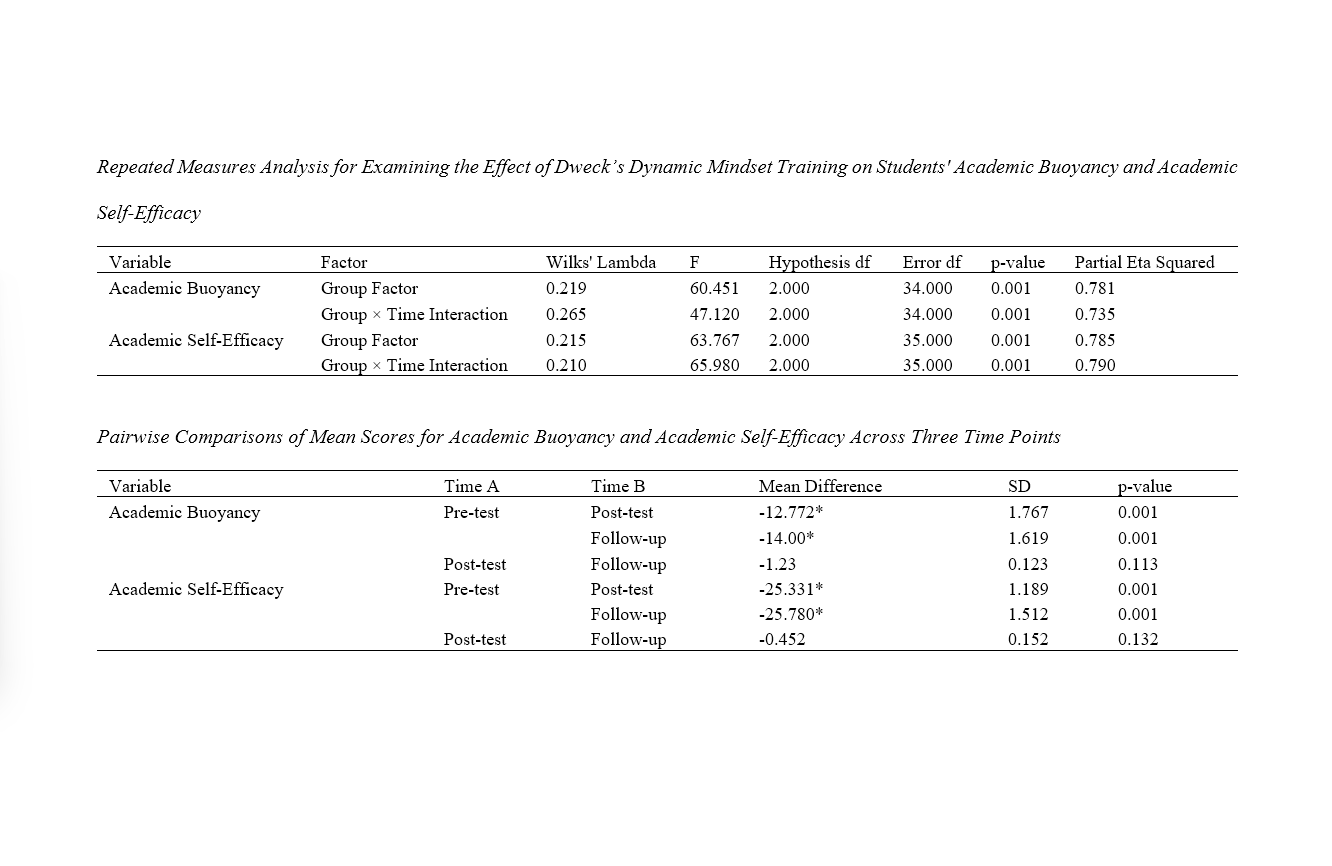
Findings: The findings indicated a significant increase in post-test and follow-up scores for academic buoyancy and self-efficacy in the experimental group (p < 0.001).
Conclusion: Therefore, it is suggested that dynamic mindset training be implemented to enhance students' academic buoyancy and self-efficacy.
Downloads
References
Alemany-Arrebola, I., Rojas-Ruiz, G., Granda-Vera, J., & Mingorance-Estrada, Á. C. (2020). Influence of COVID-19 on the perception of academic self-efficacy, state anxiety, and trait anxiety in college students. Frontiers in psychology, 11, 570017. https://doi.org/10.3389/fpsyg.2020.570017
Badali, M., Hatami, J., Farrokhnia, M., & Noroozi, O. (2022). The effects of using Merrill's first principles of instruction on learning and satisfaction in MOOC. Innovations in Education and Teaching International, 59(2), 216-225. https://doi.org/10.1080/14703297.2020.1813187
Blackwell, L. S., Trzesniewski, K. H., & Dweck, C. S. (2007). Implicit theories of intelligence predict achievement across an adolescent transition: A longitudinal study and an intervention. Child development, 78(1), 246-263. https://doi.org/10.1111/j.1467-8624.2007.00995.x
Burger, K., Mortimer, J., & Johnson, M. K. (2020). Self-esteem and self-efficacy in the status attainment process and the multigenerational transmission of advantage. Social science research, 86, 102374. https://doi.org/10.1016/j.ssresearch.2019.102374
Cleary, T. J., Velardi, B., & Schnaidman, B. (2017). Effects of the self-regulation empowerment program (SREP) on middle school students' strategic skills, self-efficacy, and mathematics achievement. Journal of School Psychology, 64, 28-42. https://doi.org/10.1016/j.jsp.2017.04.004
Cromley, T. J. (2014). Changes in implicit theories of ability in biology and dropout from STEM majors: A latent growth curve approach. Contemporary Educational Psychology, 39, 233-247. https://doi.org/10.1016/j.cedpsych.2014.06.003
Dweck, C. (2008). Mindsets and math/science achievement. http//: dev.opeq.blenderbox.com/ uploads/ files/ 868cea 4-5888-31 e 45-a 62-832 b4377 dbbfb.pdf
Dweck, C. S., & Yeager, D. S. (2019). Mindsets: A view from two eras. Perspectives on Psychological Science, 14(3), 481-496. https://doi.org/10.1177/1745691618804166
Emami Khotbesara, Z., Mahdian, H., & Bakhshipour, A. (2024). Comparing the Effectiveness of Academic Buoyancy and Psychological Capital Training on Academic Procrastination in Female High School Students [Research Article]. Iranian Journal of Educational Sociology, 7(3), 149-160. https://doi.org/10.61838/kman.ijes.7.3.18
Granziera, H., Liem, G. A. D., Chong, W. H., Martin, A. J., Collie, R. J., Bishop, M., & Tynan, L. (2022). The role of teachers' instrumental and emotional support in students' academic buoyancy, engagement, and academic skills: A study of high school and elementary school students in different national contextsJO - Learning and instruction. 80, 101619. https://doi.org/10.1016/j.learninstruc.2022.101619
Hasnur, J., Wirza, E., & Yatno, L. D. (2025). The Effect of the Growth Mindset and Campus Environment on Cadet Academic Performance. International Journal of Management Entrepreneurship Social Sciences and Humanities, 8(2), 16-33. https://doi.org/10.31098/ijmesh.v8i2.2798
Howard, J. L., Bureau, J. S., Guay, F., Chong, J. X., & Ryan, R. M. (2021). Student motivation and associated outcomes: A meta-analysis from self-determination theory. Perspectives on Psychological Science, 16(6), 1300-1323. https://doi.org/10.1177/1745691620966789
Howell, A. J., & Buro, K. (2009). Implicit beliefs, achievement goals, and procrastination: A mediational analysis. Learning & Individual Differences, 19(1), 151-154. https://doi.org/10.1016/j.lindif.2008.08.006
King, R. B. (2025). The Rich Get Richer: Socioeconomic Advantage Amplifies the Role of Growth Mindsets in Learning. British Journal of Educational Psychology. https://doi.org/10.1111/bjep.12755
King, R. B., McInerney, D. M., & Watkins, D. A. (2012). Competitiveness is not that bad… at least in the East: Testing the hierarchical model of achievement motivation in the Asian setting. International Journal of Intercultural Relations, 36(3), 446-457. https://doi.org/10.1016/j.ijintrel.2011.10.003
Leenknecht, M., Wijnia, L., Köhlen, M., Fryer, L. A. U. R. R., & Loyens, S. (2021). Formative assessment as practice: The role of students' motivation. Assessment & Evaluation in Higher Education, 46(2), 236-255. https://doi.org/10.1080/02602938.2020.1765228
Levontin, L., Halperin, E., & Dweck, C. S. (2013). Implicit theories block negative attributions about a longstanding adversary: The case of Israelis and Arabs. Journal of Experimental Social Psychology, 49, 670-675. https://doi.org/10.1016/j.jesp.2013.02.002
Li, J., Ma, T., & Lee, C. S. (2024). Influence of Conscientiousness on Academic Self-Efficacy in College Students: Dual Mediation by Growth Mindset and Grit. Asia-pacific Journal of Convergent Research Interchange, 10(4), 707-717. https://doi.org/10.47116/apjcri.2024.04.53
Li, L. A. U. G. H., & Xu, Y. (2020). The mediating and buffering effect of academic self-efficacy on the relationship between smartphone addiction and academic procrastination. Computers & Education, 159, 104001. https://doi.org/10.1016/j.compedu.2020.104001
Martin, A. J., Nejad, H. G., Colmar, S., & Liem, G. A. (2013). Adaptability: How students' responses to uncertainty and novelty predict their academic and nonacademic outcomes. Journal of Educational Psychology, 105(3), 728-746. https://doi.org/10.1037/a0032794
Mashraki, S. S. (2025). Verifying a Causal Model of the Relationship Between the Fixed Mindset and the Growth Mindset, Academic Motivation and Academic Engagement Among Teachers' College Students Inside the Green Line. Jordanian Educational Journal, 10(1), 148-172. https://doi.org/10.46515/jaes.v10i1.1323
Naz, S., Habib Elahi, D., & Niwaz, A. (2022). Mathematics Self-Efficacy And Belief About Incremental And Entity Intelligence: A Study Of University Students In Gender Context. Journal of Positive School Psychology, 6IS - 1, 143-151.
Noghabi, M. S. (2016). The impact of cognitive and metacognitive strategies on self-esteem and self-efficacy in students. International Journal of Humanities and Cultural Studies, 3(1), 983-993.
Orth, U., & Robins, R. W. (2022). Is high self-esteem beneficial? Revisiting a classic question. American psychologist, 77(1), 5-17. https://doi.org/10.1037/amp0000922
Park, S., & Jeong, D. (2022). A Study on the Effect of Growth Mindset and Writing Motivation on Self-Directed Learning Ability of College Students: Focusing on the Mediating Effect of Academic Self-Efficacy. Korean Association for Learner-Centered Curriculum and Instruction, 22(20), 521-534. https://doi.org/10.22251/jlcci.2022.22.20.521
Pianta, R. C., & Stuhlman, M. W. (2014). Teacher-child relationships and children's success in the first years of school. Journal of School Psychology Review, 33(2), 444-458. https://doi.org/10.1080/02796015.2004.12086261
Radfar, M., hazbanzadeh, R., Honarmand Darbadam, M., & Mousavi, M. (2019). The Effectiveness of Teaching Cognitive and Metacognitive Strategies on Self-Efficacy and Academic Optimism. Quarterly Journal of Leadership and Educational Management, 13(1), 91-104.
Razi, A. M., & Asadi Mojreh, S. (2022). The Relationship Between Communication Patterns and Family Emotional Climate with Students' Academic Vitality: The Mediating Role of Academic Resilience. Quarterly Journal of Modern Psychological Research, 17(67), 127-136.
Shabani, M., Sadoughi, M., & Samkhaniani, E. (2024). Effectiveness of Cognitive-Behavioral Play Therapy on Social Anxiety and Academic Self-Efficacy in Elementary School Students with Learning Disabilities. KMAN Counseling & Psychology Nexus, 2(2), 181-191. https://doi.org/10.61838/kman.psynexus.2.2.23
Sims, D. C., & Skarbek, A. J. (2019). Parental Self-efficacy: a concept analysis related to teen parenting and implications for school nurses. The Journal of School Nursing, 35IS - 1, 8-14. https://doi.org/10.1177/1059840518755871
Suharsono, Y. (2024). Growth Mindset in Higher Education: Exploring Academic Buoyancy's Mediating Effect on Students' Academic Engagement and Psychological Well-Being. Kne Social Sciences. https://doi.org/10.18502/kss.v9i5.15189
Thomas, C. L., & Allen, K. (2021). Driving engagement: investigating the influence of emotional intelligence and academic buoyancy on student engagement. Journal of Further and Higher Education, 45(1), 107-119. https://doi.org/10.1080/0309877X.2020.1741520
Zander, L., Brouwer, J., Jansen, E., Crayen, C., & Hannover, B. (2018). Academic Self-Efficacy, Growth Mindsets, and University Students' Integration in Academic and Social Support Networks. Learning and Individual Differences, 62, 98-107. https://doi.org/10.1016/j.lindif.2018.01.012
Zangiabadi, M., Sadeghi, M., & Ghadampour, E. (2019). The Effectiveness of Self-Regulation Strategies Training on Academic Self-Efficacy and Academic Adjustment of Maladjusted Students. Research in Educational Systems, 13(44), 71-87.
Zhao, H., Li, Y., Wan, L., & Ke, L. (2023). Grit and Academic Self-Efficacy as Serial Mediation in the Relationship Between Growth Mindset and Academic Delay of Gratification: A Cross-Sectional Study. Psychology research and behavior management, Volume 16, 3185-3198. https://doi.org/10.2147/prbm.s421544
Downloads
Additional Files
Publication Timeline
- Submitted
- Revised
- Accepted
Issue
Section
License
Copyright (c) 2025 Shahrzad Abdiyeh (Author); Mohammadagha Delavarpour (Corresponding Author); Seyed Mosa Tabatabaee , Shahab Moradi (Author)

This work is licensed under a Creative Commons Attribution-NonCommercial 4.0 International License.