Smartphone Dependency and Its Impact on Emotional Fatigue: Mediated by Sleep Disturbance
DOI:
https://doi.org/10.61838/kman.jayps.6.4.15Keywords:
Smartphone Dependency, Emotional Fatigue, Sleep Disturbance, University Students, Structural Equation Modeling, Digital BehaviorAbstract
Objective: This study aimed to investigate the impact of smartphone dependency on emotional fatigue among Indian university students, with sleep disturbance examined as a potential mediating variable.
Methods and Materials: The study employed a descriptive correlational design involving 433 participants selected based on the Morgan and Krejcie sampling table. Standardized tools were used to measure the variables: the Smartphone Addiction Scale–Short Version for smartphone dependency, the Pittsburgh Sleep Quality Index for sleep disturbance, and the Emotional Exhaustion subscale of the Maslach Burnout Inventory–General Survey for emotional fatigue. Data analysis included Pearson correlation using SPSS-27 to assess bivariate relationships, and Structural Equation Modeling (SEM) via AMOS-21 to test direct and indirect effects and evaluate model fit. All assumptions for correlation and SEM, including normality, linearity, and absence of multicollinearity, were confirmed prior to analysis.
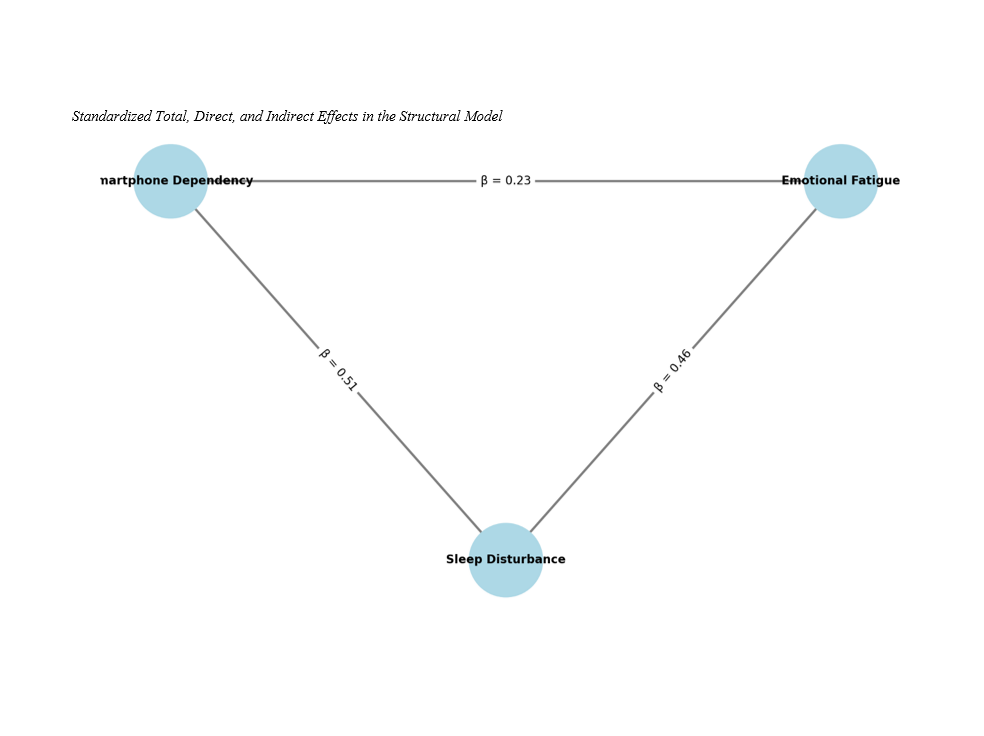
Findings: The results indicated that smartphone dependency was significantly correlated with both sleep disturbance (r = .51, p < .001) and emotional fatigue (r = .48, p < .001), and that sleep disturbance was significantly associated with emotional fatigue (r = .56, p < .001). SEM analysis showed that smartphone dependency had a significant direct effect on sleep disturbance (β = .51, p < .001) and emotional fatigue (β = .23, p = .005), while sleep disturbance also had a significant direct effect on emotional fatigue (β = .46, p < .001). The indirect effect of smartphone dependency on emotional fatigue via sleep disturbance was also significant (β = .23, p < .001), confirming partial mediation. The model fit indices indicated good model fit (χ²/df = 2.28, CFI = .97, RMSEA = .054).
Conclusion: The findings highlight the detrimental effects of smartphone dependency on emotional fatigue, both directly and indirectly through its impact on sleep disturbance, suggesting the need for targeted interventions to manage digital behaviors and promote healthy sleep among young adults.
Downloads
References
Alsop, M. A., Hambrick, M. E., Heitz, H. K., & Batley, P. N. (2024). Effects on Personal and Cultural Wellbeing of Attending Free Community Outreach Concerts Given by a Professional Orchestra. Musicae Scientiae. https://doi.org/10.1177/10298649241296499
Asambang, D. A. (2023). The Impact of Covid-19 on the Social and Emotional Wellbeing Among School-Aged Children in Minnesota, USA. Texila International Journal of Academic Research, 10(3), 128-135. https://doi.org/10.21522/tijar.2014.10.03.art011
Berglund, E., Olsson, E., Jönsson, M., Svensson, L., Hollenberg, J., Claesson, A., Nordberg, P., Lundgren, P., Högstedt, Å., & Ringh, M. (2022). Wellbeing, Emotional Response and Stress Among Lay Responders Dispatched to Suspected Out-of-Hospital Cardiac Arrests. Resuscitation, 170, 352-360. https://doi.org/10.1016/j.resuscitation.2021.11.005
Cali, M. A. A., Fernández-López, L., Navarro‐Zaragoza, J., Caravaca, F., & Romero, M. F. (2024). Smartphone Addiction Among Adolescents in Southern Italy and Correlation With Other Risky Behaviors. Actas Esp Psiquiatr, 52(5), 632-640. https://doi.org/10.62641/aep.v52i5.1664
Callender, J., Bridge, P., Al-Samarraie, F., & Blair, D. V. (2022). The Use of Emoji to Establish Student Wellbeing: Does the Image Reflect the Reality? Journal of Radiotherapy in Practice, 22. https://doi.org/10.1017/s1460396921000704
Cheung, F. (2022). Work-Related Smartphone Use at Night and Job Satisfaction: Testing a Moderated Mediation Model of Emotional Exhaustion and Organizational Dehumanization. International journal of environmental research and public health, 19(17), 10674. https://doi.org/10.3390/ijerph191710674
Chun, J. W., Choi, J., Hu, M., & Kim, D. J. (2024). Connected but Protected: Guiding Healthy Brain Development in the Digital Age. Frontiers for Young Minds, 12. https://doi.org/10.3389/frym.2024.1445381
Cruz, G. V., Aboujaoude, E., Khan, R., Rochat, L., Brahim, F. B., Courtois, R., & Khazaal, Y. (2023). Smartphone Apps for Mental Health and Wellbeing: A Usage Survey and Machine Learning Analysis of Psychological and Behavioral Predictors. Digital Health, 9. https://doi.org/10.1177/20552076231152164
F., M., & P., M. (2024). Gender, Number of Attempts and Social Media Usage as Correlates of Wellbeing Among Civil Service Aspirants. International Journal for Multidisciplinary Research, 6(4). https://doi.org/10.36948/ijfmr.2024.v06i04.25259
Golds, L., Gillespie‐Smith, K., & MacBeth, A. (2024). Associations Between Maternal Smartphone Use and Mother‐infant Responsiveness: A Cluster Analysis of Potential Risk and Protective Factors. Infant Mental Health Journal, 45(3), 341-353. https://doi.org/10.1002/imhj.22112
Hidayat, H. (2025). Smartphone Addiction and Its Psychological Consequences Among University Students in Pakistan. Ijss, 3(1), 549-558. https://doi.org/10.59075/ijss.v3i1.729
Khpalwak, A. T., & Hamidi, M. S. (2024). Relationship Between Social Media Use and Sleep Disturbance Among Adults in Afghanistan. American Journal of Medical Science and Innovation, 3(1), 27-34. https://doi.org/10.54536/ajmsi.v3i1.2418
Lavanya, K. (2023). Smartphone Usage as a Predictor of Psychological Wellbeing Among College Students. International Journal of Research and Scientific Innovation, X(VIII), 153-168. https://doi.org/10.51244/ijrsi.2023.10812
Liu, T., Geng, Y., Han, Z., Qin, W., Zhou, L., Ding, Y., Zhang, Z., & Sun, G. (2023). Self-reported sleep disturbance is significantly associated with depression, anxiety, self-efficacy, and stigma in Chinese patients with rheumatoid arthritis. Psychology, Health & Medicine, 28(4), 908-916. https://doi.org/10.1080/13548506.2022.2039398
Manzoor, H., & Safdar, A. (2022). The Impact of Smartphones on Social Relations and Emotional Behaviors of Youth. Global Digital & Print Media Review, V(II), 92-104. https://doi.org/10.31703/gdpmr.2022(v-ii).09
Miner, S., McVoy, M., & Damato, E. G. (2023). Evaluation of the Relationship of Sleep Disturbances to Severity and Common Behaviors in Autism Spectrum Disorder. https://doi.org/10.21203/rs.3.rs-2674526/v1
Onur, E. E., Muslu, G. K., & Manav, G. (2022). Examining the Relationship Between Subjective Wellbeing and Emotional Eating in Adolescents in Turkey. Journal of Child and Adolescent Psychiatric Nursing, 35(3), 257-266. https://doi.org/10.1111/jcap.12373
Rabbani, Q. S., Hidayat, P., Maharani, E. A., & Satrianawati, S. (2025). The Influence of Smartphone Use on the Cognitive Abilities and Emotional Intelligence of Students at Pogung 2 State Elementary School. J. Comput. Sci. Math. Learn., 2(1), 1-5. https://doi.org/10.70232/jcsml.v2i1.11
Rodman, A. M., Burns, J. A., Cotter, G., Ohashi, Y. G. B., Rich, R. K., & McLaughlin, K. A. (2024). Within-Person Fluctuations in Objective Smartphone Use and Emotional Processes During Adolescence: An Intensive Longitudinal Study. Affective science, 5(4), 332-345. https://doi.org/10.1007/s42761-024-00247-z
Saikia, U., Dodd, M. M., Chalmers, J., Dasvarma, G., & Schech, S. (2021). COVID-19, Individual Wellbeing and Multi-Dimensional Poverty in the State of South Australia. PLoS One, 16(6), e0252898. https://doi.org/10.1371/journal.pone.0252898
Sari, S. J., Saputri, A. D., Anggraini, M., Retina, S., & Sari, A. P. (2024). Pengaruh Intensitas Penggunaan Smartphone Terhadap Regulasi Emosi Pada Mahasiswa. Educate, 2(1), 35-41. https://doi.org/10.61994/educate.v2i1.347
Sweeney, A., & Hynes, S. M. (2024). An Exploration of the Emotional Impact of Working in an Adult Hospice Service for Irish Healthcare Professionals. International Journal of Palliative Nursing, 30(5), 236-246. https://doi.org/10.12968/ijpn.2024.30.5.236
Tanko, D. B., Austin, M. I., Abbas, F. S., Ahmadu, A. S., & Gambo, N. (2024). Leadership Styles and Employee Wellbeing in Federal Capital Territory Internal Revenue Service. European Journal of Business and Innovation Research, 12(5), 45-60. https://doi.org/10.37745/ejbir.2013/vol12n54560
Terzimehić, N., Aragon-Hahner, S., & Hußmann, H. (2023). The Tale of a Complicated Relationship. Proceedings of the Acm on Interactive Mobile Wearable and Ubiquitous Technologies, 7(1), 1-34. https://doi.org/10.1145/3580792
Zhang, M., Zhang, W., & Shi, Y. (2023). Can Adolescents' Subjective Wellbeing Facilitate Their Pro-Environmental Consumption Behaviors? Empirical Study Based on 15-Year-Old Students. Frontiers in Public Health, 11. https://doi.org/10.3389/fpubh.2023.1184605
Zhoc, K. C. H., Cai, Y., Yeung, S. S., & Shan, J. (2022). Subjective Wellbeing and Emotion Regulation Strategies: How Are They Associated With Student Engagement in Online Learning During Covid‐19? British Journal of Educational Psychology, 92(4), 1537-1549. https://doi.org/10.1111/bjep.12513
Zhu, C. (2025). The Impact of Smartphone Addiction on Mental Health and Its Relationship With Life Satisfaction in the Post-Covid-19 Era. Frontiers in Psychiatry, 16. https://doi.org/10.3389/fpsyt.2025.1542040
Downloads
Additional Files
Publication Timeline
- Submitted
- Revised
- Accepted
Issue
Section
License

This work is licensed under a Creative Commons Attribution-NonCommercial 4.0 International License.