Investigating the Relationship Between Educational Stressors and Academic Motivation and Self-Worth in High School Students
DOI:
https://doi.org/10.61838/kman.jayps.6.6.7Keywords:
Educational stressors, Academic motivation, Self-worth, High school students, Psychological well-beingAbstract
Objective: This study aimed to investigate the predictive role of educational stressors on academic motivation and self-worth among second-cycle high school students in Tonekabon, Iran.
Methods and Materials: The research employed a descriptive-correlational design within a quantitative framework. The statistical population consisted of all high school students in the second cycle of education in Tonekabon during the 2024–2025 academic year (N = 1100). Using Krejcie and Morgan’s table, a sample of 285 students was selected through simple random sampling. Data were collected using three standardized questionnaires: the Educational Stressors Questionnaire by Masoumi and Dashti (2017), the Academic Motivation Scale adapted from Harter (1981), and the Self-Worth Assessment Questionnaire by Doosti and Hoseininia (2020). SPSS version 27 was used for data analysis. Descriptive statistics, Pearson correlation coefficients, and univariate linear regression were conducted to examine the relationships among variables and the predictive role of educational stress.
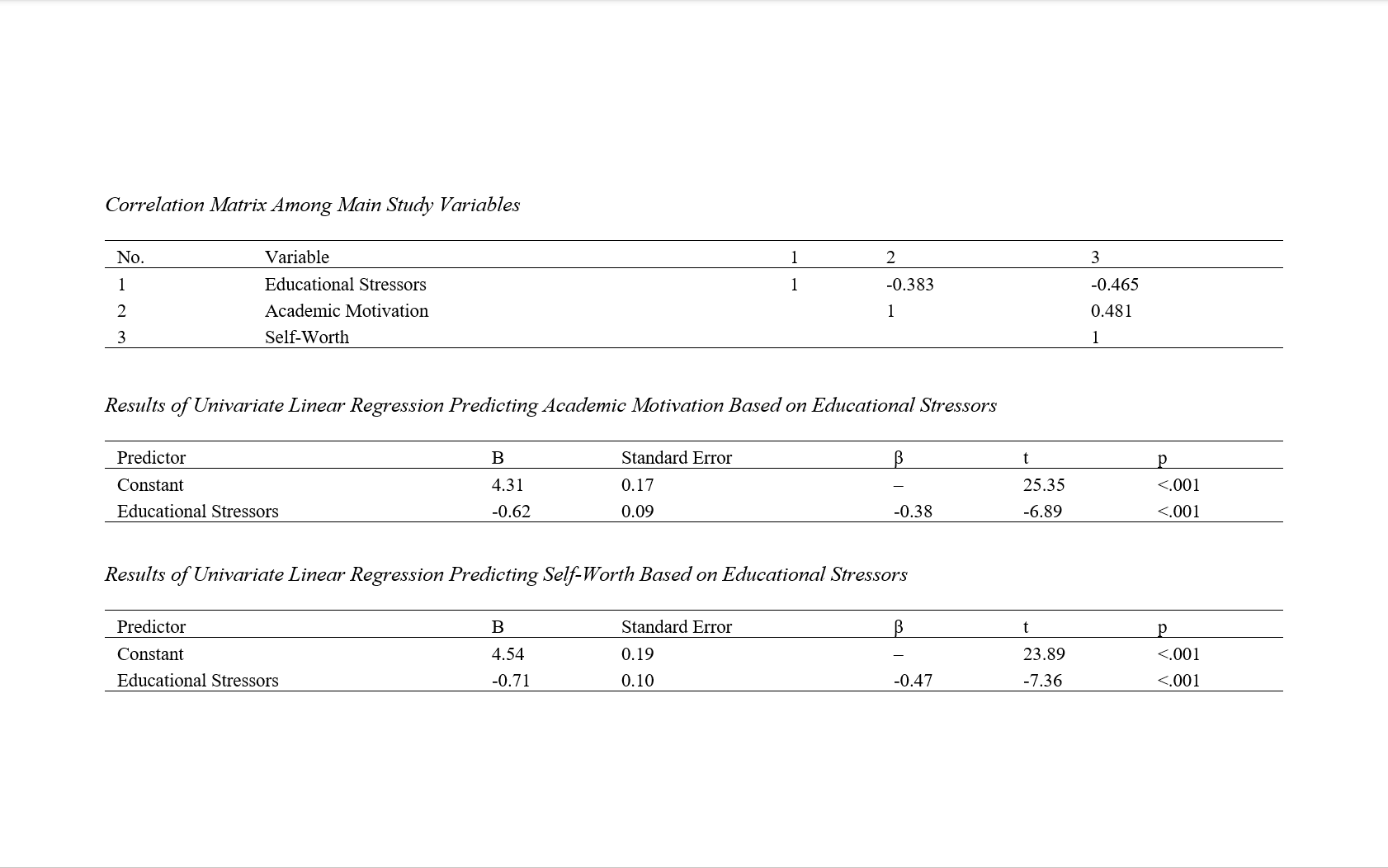
Findings: Results indicated a significant negative correlation between educational stressors and both academic motivation (r = -0.383, p < .01) and self-worth (r = -0.465, p < .01). A positive correlation was also found between academic motivation and self-worth (r = 0.481, p < .01). Regression analysis showed that educational stressors significantly predicted a decrease in academic motivation (β = -0.38, p < .001) and self-worth (β = -0.47, p < .001), confirming the detrimental impact of stress on students' psychological functioning.
Conclusion: The findings underscore the critical influence of educational stress on students’ motivation and self-perception, emphasizing the need for school-based interventions that reduce stress and enhance psychological well-being. Fostering supportive learning environments and implementing stress management strategies may help improve academic engagement and self-worth in adolescents.
Downloads
References
Abolfazli, P., Tahmasebi Pour, N., & Nasri, S. (2020). The Effectiveness of a Mindfulness-Based Stress Reduction Program on Academic Resilience and Self-Esteem in Female High School Students. Journal of Research in Educational Systems, 14(Special Issue), 383-397.
Almurumudhe, L. K. A., Mahdad, A., Abdulkadhim Johni, A., & Yousefi, Z. (2024). The Mediating Role of Self-Esteem in the Relationship between Psychological Capital, Academic Engagement, and Academic Procrastination with Academic Performance among Students in Al-Diwaniyah, Iraq [Research Article]. Iranian Journal of Educational Sociology, 7(3), 1-9. https://doi.org/10.61838/kman.ijes.7.3.1
Azimi, D., Gadimi, S., Khazan, K., & Dargahi, S. (2017). The Role of Psychological Capitals and academic motivation in academic vitality and decisional procrastination in nursing students. JMED, 12(3), 147-157. http://jmed.ssu.ac.ir/article-1-807-en.html
Chen, B.-B. (2017). Parent–Adolescent Attachment and Academic Adjustment: The Mediating Role of Self-Worth. Journal of Child and Family Studies, 26(8), 2070-2076. https://doi.org/10.1007/s10826-017-0728-2
Emesi, K. E., Anyanwu, A. N., & Ezenwosu, E. N. (2024). Examining Students' Mental Toughness, Self-Worth and Critical Thinking Skill as Predictors of Academic Achievement in Mathematics in Anambra State, Nigeria. European Journal of Contemporary Education and E-Learning, 2(1), 88-102. https://doi.org/10.59324/ejceel.2024.2(1).08
Hāshemi, N., & Khorouti, F. (2020). Comparison of the academic motivation, self-regulation and self-worth of the gifted and normal students in Karaj. Educational Innovations, 19(1), 147-162. https://noavaryedu.oerp.ir/article_107719.html?lang=en
Hashemi Nosratabad, B., Mansour, V., & Shahram, B. (2017). Effectiveness of Help-Seeking Strategies Training on Academic Stress, Performance, and Academic Motivation in Students. Learning Strategies in Cognition, 5(8), 139-158.
Igomigo, R., Obosi, A., & Oyelade, O. (2023). Influence of self-efficacy, academic motivation, academic stress and anxiety on memory recall among PG students. https://doi.org/10.21203/rs.3.rs-3715535/v1
Karaman, M. A., & Watson, J. C. (2017). Examining associations among achievement motivation, locus of control, academic stress, and life satisfaction: A comparison of U.S. and International undergraduate students. Personality and individual differences, 111, 106-110. https://doi.org/10.1016/j.paid.2017.02.006
Kritikou, M., & Giovazolias, T. (2022). Emotion regulation, academic buoyancy, and academic adjustment of university students within a self-determination theory framework: A systematic review [Systematic Review]. Frontiers in psychology, 13. https://doi.org/10.3389/fpsyg.2022.1057697
Meyer, H. H., & Stutts, L. A. (2024). The Effect of Mindset Interventions on Stress and Academic Motivation in College Students. Innovative Higher Education, 49(4), 783-798. https://doi.org/10.1007/s10755-024-09706-8
Mulyadi, S., Rahardjo, W., & Basuki, A. M. H. (2016). The Role of Parent-child Relationship, Self-esteem, Academic Self-efficacy to Academic Stress. Procedia - Social and Behavioral Sciences, 217, 603-608. https://doi.org/10.1016/j.sbspro.2016.02.063
Ragusa, A., González-Bernal, J., Trigueros, R., Caggiano, V., Navarro, N., Minguez-Minguez, L. A., Obregón, A. I., & Fernandez-Ortega, C. (2023). Effects of academic self-regulation on procrastination, academic stress and anxiety, resilience and academic performance in a sample of Spanish secondary school students [Original Research]. Frontiers in psychology, 14. https://doi.org/10.3389/fpsyg.2023.1073529
Roshanzadeh, M., Tajabadi, A., Mazhari Dehkordi, B., & Mohammadi, S. (2021). Correlations of Self-esteem and Relationship with Parents with Academic Procrastination in Students: An Analytical, Cross-Sectional Study [Research]. Iran Journal of Nursing, 34(131), 31-43. https://doi.org/10.52547/ijn.34.131.31
Salehi, A., & Behzadi, F. (2018). The Impact of Stress Management Training on Academic Motivation of University Students. Iranian Journal of Educational Sociology, 1(3), 80-93.
Struthers, C. W., Perry, R. P., & Menec, V. H. (2000). An Examination of the Relationship Among Academic Stress, Coping, Motivation, and Performance in College. Research in Higher Education, 41(5), 581-592. https://doi.org/10.1023/A:1007094931292
Terp, U., Hjärthag, F., & Bisholt, B. (2019). Effects of a Cognitive Behavioral-Based Stress Management Program on Stress Management Competency, Self-efficacy and Self-esteem Experienced by Nursing Students. Nurse Educator, 44(1), E1-E5. https://doi.org/10.1097/nne.0000000000000492
Travis, J., Kaszycki, A., Geden, M., & Bunde, J. (2020). Some stress is good stress: The challenge-hindrance framework, academic self-efficacy, and academic outcomes. Journal of Educational Psychology, 112(8), 1632-1643. https://doi.org/10.1037/edu0000478
Turki, M., Sahnoun, F., Guermazi, A., Elleuch, O., Bennaceur, F., Halouani, N., Ellouze, S., & Aloulou, J. (2023). Relationship between self-esteem, self-efficacy and academic procrastination among medical students. European Psychiatry, 66(S1), S554-S554. https://doi.org/10.1192/j.eurpsy.2023.1169
Tus, J. (2020). Academic stress, academic motivation, and its relationship on the academic performance of the senior high school students. Asian Journal of Multidisciplinary Studies, 8(11), 29-37. https://www.researchgate.net/publication/345149814_Academic_Stress_Academic_Motivation_and_Its_Relationship_on_the_Academic_Performance_of_the_Senior_High_School_Students
Wong, E. H., Wiest, D. J., & Cusick, L. B. (2002). Perceptions of autonomy support, parent attachment, competence and self-worth as predictors of motivational orientation and academic achievement: An examination of sixth-and ninth-grade regular education students. Adolescence, 37(146), 255. https://psycnet.apa.org/record/2009-10436-014
Downloads
Additional Files
Publication Timeline
- Submitted
- Revised
- Accepted
Issue
Section
License
Copyright (c) 2025 Fatemeh Roshanfekr (Author); Samira Pali (Corresponding Author)

This work is licensed under a Creative Commons Attribution-NonCommercial 4.0 International License.