Identifying the Dimensions of Love in Adolescence from the Perspective of Adolescents in Qazvin Province: A Study Based on Grounded Theory
DOI:
https://doi.org/10.61838/kman.jayps.4247Keywords:
Adolescents, Romantic Love, Grounded Theory, Emotional Development, Family CommunicationAbstract
Objective: This study aimed to identify and analyze the dimensions of adolescent love from the perspective of teenagers in Qazvin Province using grounded theory and Schatzman’s dimensional analysis.
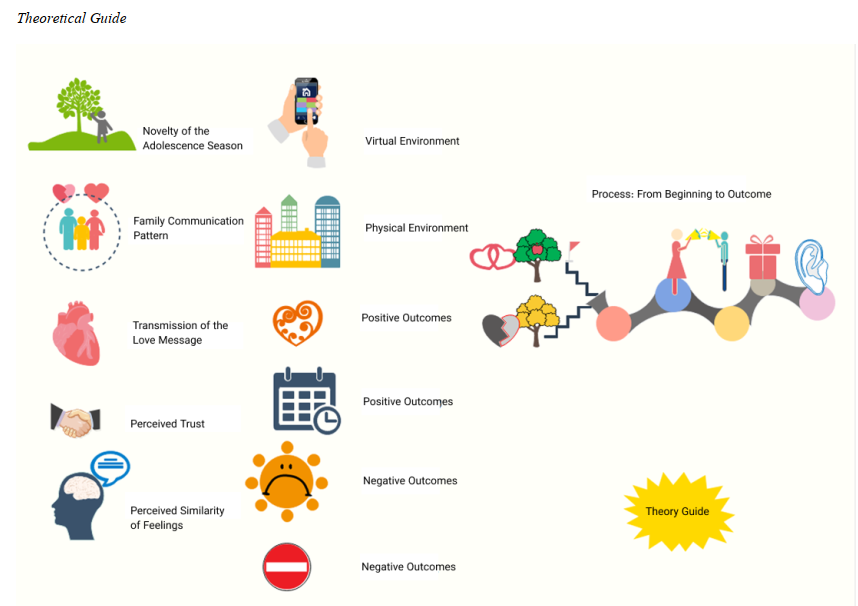
Methods and Materials: A qualitative research design based on grounded theory was employed to explore adolescents’ lived experiences of love. Thirty adolescents (aged 13–18) were selected through purposive sampling, and semi-structured interviews were conducted along with the collection of ten written letters. The interviews and texts were analyzed using Schatzman’s dimensional analysis, encompassing five key dimensions: perspective, context, conditions, process, and outcomes. Theoretical saturation guided the termination point of data collection. The core category that emerged—“navigating the season of adolescence”—served as the theoretical lens through which the other categories were integrated. Credibility was ensured through member checking, peer debriefing, and prolonged engagement with participants.
Findings: The study identified 36 primary categories grouped under nine major subdimensions. Adolescents described their romantic experiences as beginning with attraction and emotional curiosity, progressing through stages of affection, connection, conflict, and either resolution or dissolution. The findings highlighted both positive outcomes—such as increased self-confidence, emotional growth, and improved social skills—and negative consequences including emotional instability, academic decline, and psychological distress following breakups. Trust and perceived similarity emerged as critical preconditions for forming and sustaining romantic connections. The family’s communication style and emotional support level played significant roles in shaping relational behavior and coping mechanisms.
Conclusion: Adolescent love is a complex, multifaceted phenomenon influenced by emotional, social, and contextual variables. It serves as both a developmental challenge and a transformative opportunity. Understanding its structure and consequences can inform educational, psychological, and familial interventions aimed at promoting healthy relational development during adolescence.
Downloads
References
Abbasi Shovazi, M., & Delavar, M. (2019). Media, love and marriage: The relationship between social/mass media, liquid love and attitude toward marriage. Journal of Iranian Cultural Research, 12(4), 51-74. https://www.jicr.ir/article_404.html?lang=en
Alam Al-Huda, J., & Tahmasbzadeh Sheikhlar, D. (2008). Love as an Absurd Curriculum. Curriculum Studies, 3(11), 1-26. https://www.magiran.com/paper/761087/
Ashrafian, N., & Salehi, K. (2021). Using Grounded Theory to Explain the Process of Developing Self-Regulated Students in Elementary Schools with Emphasis on the Role of Teachers. Educational Research Journal, 9(43), 3. https://ensani.ir/fa/article/509106/
Baniasadi, A., & Salehi, K. (2019). Introduction on the Principles and Process of Construction and Validation of the Interview Protocol. Higher Education Letter, 12(46), 177-203. http://journal.sanjesh.org/article_36128.html
Behrbigi, F., Haqparast, P., Haqqi-Haris, F., Khanzadeh, Z., & Jafari-Kleiber, F. (2022). Types of fantasy in children and adolescents and their proper guidance. Journal of New Achievements in Humanities Studies, 5(57). https://www.jonahs.ir/showpaper/7725507
Bode, A., Luoto, S., & Kavanagh, P. S. (2025). Sex differences in romantic love: an evolutionary perspective. Biology of Sex Differences, 16. https://doi.org/10.1186/s13293-025-00698-4
Clayton, R. B., Nagurney, A., & Smith, J. R. (2013). Cheating, breakup, and divorce: Is Facebook use to blame? Cyberpsychology, Behavior, and Social Networking, 16(10), 717-720. https://doi.org/10.1089/cyber.2012.0424
Collins, W. A. (2003). Relationships in adolescence: Interpersonal influences on patterns of adjustment. Journal of Research on Adolescence, 13(1), 1-24. https://doi.org/10.1111/1532-7795.1301001
Crosnoe, R., & Muller, C. (2004). Adolescent friendships, educational outcomes, and the importance of selectivity. Social Forces, 83(2), 529-557.
Dahl, R. E. (2004). Adolescent brain development: Vulnerabilities and opportunities. Annals of the New York Academy of Sciences, 1021(1), 1-22. https://doi.org/10.1196/annals.1308.001
Das, K., & Rao, T. S. S. (2022). Love, Veritably-A Mélange of Love, Intimacy, Attraction, and Sensuality. Journal of Psychosexual Health, 4(3), 195-202. https://doi.org/10.1177/26318318221102126
Farnam, A., Zamanlou, M., & Khoshdeli, S. (2018). Phenomenology of love: the destructive and constructive nature of love. Philosophical Investigation (Journal of Faculty of Letters and Humanities) (Tabriz), 11(21), 233-242. https://ensani.ir/fa/article/396010/phenomenology-of-love-the-destructive-and-constructive-nature-of-love
Fisher, H. (2004). Why we love: The nature and chemistry of romantic love. Henry Holt. https://books.google.com/books/about/Why_We_Love.html?id=SPxmHKLwj3MC
Ghafoori, A., & Salehi, K. (2017). Using Grounded Theory to Represent the Process of the Transmogrification of Values with a Focus on Women. Women's Studies Sociological and Psychological, 14(4), 157-208. https://jwsps.alzahra.ac.ir/article_2671.html?lang=en
Ghafoori, A., & Salehi, K. (2023). Dimensional analysis of increasing students' interest in work and technology courses from the perspective of students and teachers: A study of the grounded theory and Schatzman dimensional analysis. The Journal of New Thoughts on Education, 19(4), 45-47. https://jontoe.alzahra.ac.ir/article_6472.html?lang=en
Hoseinpour Tonekaboni, R., Masoudi, J., & Hoseini Shahrudi, M. (2021). Making Meanings or Discovering Meanings? A Study, Assessment, and Reconciliation of the Views of Irvin Yalom and Viktor Frankl about the Meaningfulness of Life in the context of Philosophical Therapy. Theological Reflection and Philosophical Criticism, 26(104), 156-185. https://jpt.isca.ac.ir/article_71939.html?lang=en
Hosseini, A., Zolfaghari, H., Gholamhoseinzadeh, G., & Doori, N. (2022). Classification and analysis based on "The beginning of love" in Persian love poems. Journal of Lyrical Literature Researches, 20(39), 99-116. https://jllr.usb.ac.ir/article_7377.html?lang=en
Jones, M., & Alony, I. (2011). Guiding the use of Grounded Theory in Doctoral studies- an example from the Australian film industry. International Journal of Doctoral Studies, 6, 99-113. https://doi.org/10.28945/1429
Lourenço, O. M. (2016). Developmental stages, Piagetian stages in particular: A critical review. New Ideas in Psychology, 40, 123-137. https://doi.org/10.1016/j.newideapsych.2015.08.002
Morse, J. M., Noerager Stern, P., Corbin, J., Bowers, B., Charmaz, K., & Clarke, A. E. (2016). Developing grounded theory: The second generation. Routledge. https://doi.org/10.4324/9781315430577
Qamari, M. (2009). Family and its impact on adolescent developments. Behavioral Sciences, 1(2), 133-141. https://www.sid.ir/paper/190427/en
Reyna, V. F., & Farley, F. (2006). Risk and rationality in adolescent decision making: Implications for theory, practice, and public policy. Psychological Science in the Public Interest, 7(1), 1-44. https://doi.org/10.1111/j.1529-1006.2006.00026.x
Rose, I. D., Lesesne, C. A., Sun, J., Johns, M. M., Zhang, X., & Hertz, M. (2022). The relationship of school connectedness to adolescents' engagement in co-occurring health risks: a meta-analytic review. The Journal of School, 40(1), 58-73. https://doi.org/10.1177/10598405221096802
Rubenzadeh, S., Rasoulzadeh Tabatabaei, S. K., Ghorbani, N., & Abedin, A. (2016). Investigating the effect of the self-knowledge process, the level of commitment, and the components of thematic relationships on the formation of adolescents' identity. Sadra Medical Sciences, 4(4), 267-276. https://smsj.sums.ac.ir/article_43947.html?lang=en
Saeb Tabrizi, M. A. (2024). The book Divan of Saeb Tabrizi. Negah Publications.
Saidmoradi, K., Shafiabadi, A., Sarrokhi, N. A., Salami Bajestani, H., & Ghafoori, A. (2020). Exploring the process of utilizing social capital in resilience of survivors of earthquake in Kermanshah: A qualitative study. Social Psychology Research, 9(36), 89-114. https://www.socialpsychology.ir/article_105545_en.html
Steen, K., Antoniou, A., Lindemann, L., & Jerneck, A. (2024). Meanings and implications of love: review of the scholarship of love with a sub-Saharan focus. Humanities and Social Sciences Communications, 11, 129. https://doi.org/10.1057/s41599-023-02504-1
Tienda, M., Villalta, S. I., Goldberg, R. E., & Koffman, D. (2023). Adolescents' Love Lives: Heterogeneity in Relationship Status Trajectories and Links with Affect. Journal of youth and adolescence, 52, 1325-1339. https://pubmed.ncbi.nlm.nih.gov/37145238/
Ugalde, L., Racionero-Plaza, S., Munté, A., & Tellado, I. (2022). Dialogic reconstruction of memories of violent sexual-affective relationships via dialogic gatherings of "Radical Love". Children and Youth Services Review, 139, 1. https://doi.org/10.1016/j.childyouth.2022.106548
Downloads
Additional Files
Publication Timeline
- Submitted
- Revised
- Accepted
Issue
Section
License
Copyright (c) 2025 Arezu Ghafoori, Mohammad Mahdi Shariat Bagheri, Keyvan Salehi (Author)

This work is licensed under a Creative Commons Attribution-NonCommercial 4.0 International License.