The Effectiveness of Positive Psychology Intervention on Academic Well-Being, Academic Emotions, and Academic Vitality in Lower Secondary School Students in Tabriz
DOI:
https://doi.org/10.61838/kman.jayps.4294Keywords:
Generalized Anxiety Disorder, Self-Handicapping, WorryAbstract
Objective: The present study was conducted with the aim of determining the effectiveness of a positive psychology intervention on academic well-being, academic emotions, and academic vitality in lower secondary school students in Tabriz.
Methods and Materials: The research method was quasi-experimental using a pretest-posttest design with a control group. The statistical population included female students in the lower secondary level of District 3 in Tabriz. To select the sample, the questionnaires of academic well-being, academic emotions, and academic vitality were administered to 600 students from the mentioned population who had been selected using a cluster random sampling method. Then, 60 students who had the lowest scores on all three questionnaires were selected through purposive sampling and were randomly assigned to three groups (two experimental groups and one control group). The experimental groups received a 10-session intervention of 90 minutes each based on positive psychology, while the control group received no intervention. The research instruments included the Academic Well-Being Questionnaire developed by Tuominen-Soini and Salmela-Aro (2012), the Academic Vitality Scale by Martin and Marsh (2006), and the short form of the Achievement Emotions Questionnaire by Pekrun et al. (2005).
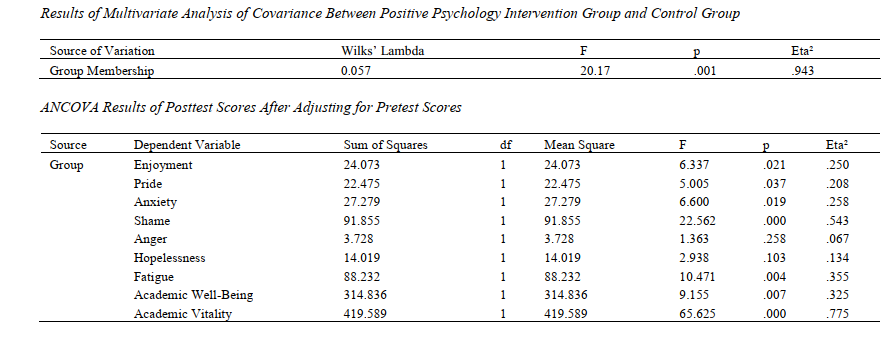
Findings: The data were analyzed using covariance analysis through SPSS-26 software. The results showed that the positive psychology intervention was effective in improving students’ academic well-being (P < .05). The intervention also had a significant effect on students’ academic emotions (P < .05). Furthermore, the intervention was found to be effective in enhancing academic vitality in lower secondary school students (P < .05).
Conclusion: Therefore, it is recommended that positive psychology interventions be utilized to improve academic well-being, academic vitality, and academic emotions.
Downloads
References
Abbasi, G. R., Fathabadi, J., Shokri, O., & Zargham Hajebi, M. (2021). The effect of a positive psychological educational program on coping styles and academic well-being of students. Quarterly Journal of Research in School and Virtual Learning, 9(2), 23-28. https://etl.journals.pnu.ac.ir
Badri, R., Rahimi, R., Nemati, S., Vahidi, S., Taheri Azam, A., Bolouri, A., Shalchi, B., & Azmoodeh, M. (2019). The effectiveness of school-based positive psychological interventions on social and behavioral levels of academic well-being The effectiveness of cognitive emotion regulation training on academic emotions and academic well-being of high school students in the COVID-19 pandemic. Quarterly Journal of Educational Strategies in Medical Sciences, 12(1), 102-109. http://edcbmj.ir/article-1-1867-fa.html
Dandachi‐FitzGerald, B. (2024). A Scale for Measuring Positive and Negative Experiences of Psychotherapy (PNEP): First Psychometric Findings of a New Instrument for Monitoring Clients' Experiences. Clinical Psychology & Psychotherapy, 31(3). https://doi.org/10.1002/cpp.3014
Golestaneh, S. M., & Behzadi, A. (2019). The effectiveness of positive psychology intervention training on increasing well-being, academic vitality, and academic achievement of female students. Journal of Applied Psychology, 13(2), 187-208. https://www.sid.ir/fileserver/jf/30313985001.pdf
Harifi, E., Sanaguy Moharer, G., & Shirazi, M. (2022). The effectiveness of positive psychological intervention on happiness and positive thinking in chronic mental patients. Journal of Applied Psychological Research, 13(2), 249-263. https://japr.ut.ac.ir/article_88616_en.html
Hashemi, S. M., Mahdad, A., & Shokri, O. (2023). Comparing the effectiveness of positive psychology, resilience, and mindfulness training packages on students' academic well-being. Rooyesh-e-Ravanshenasi (Journal of Psychology), 12(2), 141-152. https://frooyesh.ir
Heratirad, A., & Miri, M. (2023). The effectiveness of positive psychotherapy on hopefulness and the quality of academic life of slow-paced students: A quasi-experimental study. Journal of Rafsanjan University of Medical Sciences, 22(12), 1279EP - 1296. https://doi.org/10.61186/jrums.22.12.1279
Jarsouzeh, G., Yarahmadi, Y., Ahmadian, H., & Akbari, M. (2023). The effectiveness of an educational program based on academic well-being on academic vitality and emotional intelligence in students. Journal of Mashhad University of Medical Sciences, 66(1), 43-56. https://www.sid.ir/paper/258964/en
Khorasani, A. H. (2024). Investigating the effectiveness of positive psychotherapy on cognitive flexibility and distress tolerance in divorced women. J Fam Relat Stud, 4(13), 32-39. https://doi.org/10.32598/jfrs.4.13.32
Krifa, I., Hallez, Q., van Zyl, L. E., Braham, A. A. U. S. J., Ben Nasr, S., & Shankland, R. (2021). Effectiveness of an online positive psychology intervention among Tunisian healthcare students on mental health and study engagement during the Covid-19 pandemicJO - Appl Psychol Health. https://doi.org/10.1111/aphw.12332
Lambert, L., Passmore, H. A., & Joshanloo, M. (2019). A positive psychology intervention program in a culturally-diverse university: Boosting happiness and reducing fear. Journal of Happiness Studies, 20, 1141-1162. https://doi.org/10.1007/s10902-018-9993-z
Naeimi Tajdar, S. S., Nejatimehr, A., & Firoozabadi, A. (2024). The Character Virtues and Self-Compassion in female students of Iranian Universities: the role of Positive emotions. Sociology of Education. https://doi.org/10.22034/ijes.2024.2010096.1458
Nair, R. L., Delgado, M. Y., Wheeler, L. A., & Thomas, R. (2021). Prospective links between acculturative stress and academic well-being among Latinx adolescents. Journal of Applied Developmental Psychology, 73, 1-13. https://doi.org/10.1016/j.appdev.2021.101254
Olenichenko, I. (2024). THE USE OF PROJECTIVE METHODS IN POSITIVE PSYCHOTHERAPY WHILE WORKING WITH CLIENTS WITH PSYCHOSOMATIC DISORDERS. Journal of Positive Psychology. https://doi.org/10.52982/lkj221
Saleem, F., Legette, K. B., & Byrd, C. M. (2022). Examining school ethnic-racial socialization in the link between race-related stress and academic well-being among African American and Latinx adolescents. Journal of School Psychology, 91, 97-111. https://doi.org/10.1016/j.jsp.2022.01.001
Sheikh Al-Islami, A. (2022). Predicting students' academic vitality based on academic support and academic self-concept. Research in Educational Systems, 16(57), 51-61. https://www.jaesjo.com
Widlund, A., Tuminen, H., & Korhonen, J. (2018). Academic well-being, mathematics performance and educational aspiration in lower secondary education: Changes within a school yearJO - Frontiers in Psychology. 9, 297. https://doi.org/10.3389/fpsyg.2018.00297
Yekani Zadeh, A., Golmohammadnejad Bahrami, G., & Soleimannejad, A. (2018). The effectiveness of positive thinking skills training on psychological capital and well-being of students. Journal of Child Mental Health, 5(4), 135-147. https://www.sid.ir/paper/258258/en
Yurayat, P., & Seechaliao, T. (2021). Effectiveness of Online Positive Psychology Intervention on Ps ychological Well-Being among Undergraduate Students. Journal of Education and Learning, 10(4), 34-52. https://doi.org/10.5539/jel.v10n4p143
Downloads
Additional Files
Publication Timeline
- Submitted
- Revised
- Accepted
Issue
Section
License
Copyright (c) 2025 Kobra Zahedan Zinjanab (Author); Seyed Davood Hosseininasab (Corresponding Author); Masoumeh Azmoudeh (Author)

This work is licensed under a Creative Commons Attribution-NonCommercial 4.0 International License.