The Effectiveness of Enhanced Care Psychoeducational Therapy on Irritability, Thought Control Ability, and Executive Functioning in Adolescents at Risk for Bipolar Disorder
DOI:
https://doi.org/10.61838/kman.jayps.4361Keywords:
Bipolar disorder, psychoeducational advanced care therapy, irritability, thought control ability, executive functions, adolescentsAbstract
Objective: The present study aimed to investigate the effectiveness of psychoeducational enhanced care therapy on irritability, thought control ability, and executive functions in adolescents at risk for bipolar disorder.
Methods and Materials: This study employed a quasi-experimental pretest–posttest design with a control group and was conducted on 32 male students aged 15 to 18 years who were at risk for bipolar disorder in District 3 of the Isfahan Department of Education during the 2023–2024 academic year. The experimental group received six 2-hour sessions of psychoeducational enhanced care therapy, while the control group received no intervention. Research instruments included the Mood Disorder Questionnaire (MDQ), the Emotionality–Activity–Sociability (EAS) Temperament Survey Irritability Subscale, the Thought Control Ability Questionnaire (TCAQ), and the Behavior Rating Inventory of Executive Function (BRIEF). Data were analyzed using univariate and multivariate analysis of covariance.
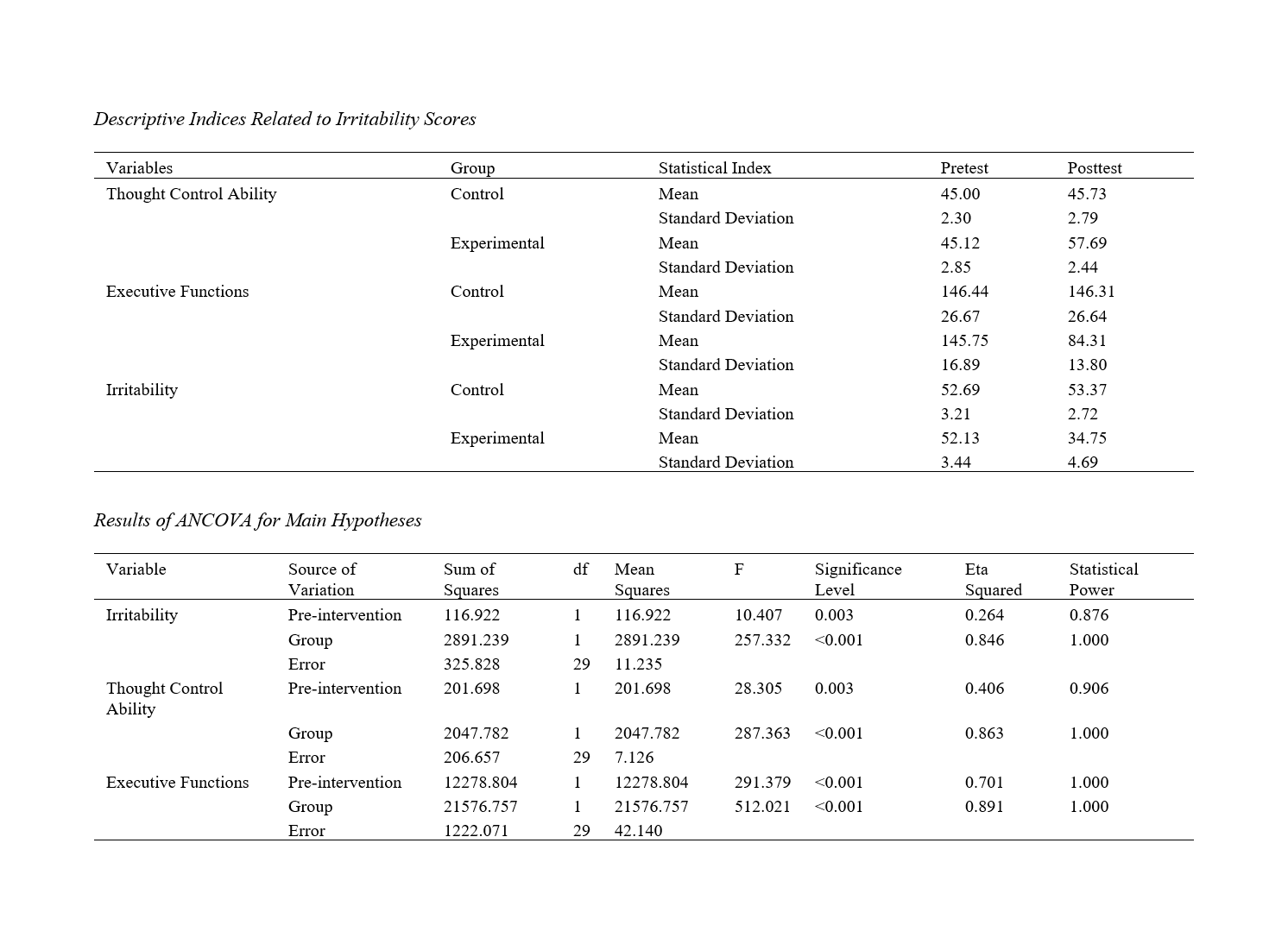
Findings: The results indicated that the intervention had a significant effect on reducing irritability (84% of variance), increasing thought control ability (86% of variance), and improving executive functions (89% of variance).
Conclusion: These findings highlight the importance of early psychosocial interventions in preventing the exacerbation of bipolar disorder symptoms in adolescents and suggest that this therapy can be utilized as a preventive strategy in educational and clinical settings.
Downloads
References
Amini, A., & Norouzi, H. (2022). The effectiveness of sensory-motor integration exercises and cognitive rehabilitation software on executive functions (working memory, response inhibition, and cognitive flexibility) in children with attention deficit hyperactivity disorder. Empowerment of Exceptional Children, 13(2), 79-95. https://www.ceciranj.ir/article_158142.html?lang=en
Andreu-Pascual, M., Merranko, J., Gill, M. K., Levenson, J. C., Hafeman, D., Hower, H., & Goldstein, T. R. (2022). Risk factors preceding new onset abuse among youth with bipolar disorder: A longitudinal prospective analysis. Journal of affective disorders, 300, 296-304. https://doi.org/10.1016/j.jad.2022.01.003
Barclay, M. E., Silvers, J. A., & Lee, S. S. (2022). Childhood irritability: Predictive validity and mediators of adolescent psychopathology. Research on Child and Adolescent Psychopathology, 50(9), 1165-1177. https://doi.org/10.1007/s10802-022-00908-2
Brickman, H. M., & Fristad, M. A. (2022). Psychosocial treatments for bipolar disorder in children and adolescents. Annual Review of Clinical Psychology, 18(1), 291-327. https://doi.org/10.1146/annurev-clinpsy-072220-021237
Damavandian, A., Armaghan, Golshani, Safariniya, Baghdasarian, & Anita. (2021). Comparison of the effectiveness of compassion-focused therapy and dialectical behavior therapy on aggression, self-harming behaviors, and emotional self-regulation in juvenile delinquents at the Tehran rehabilitation center. Social Psychology Research, 11(41), 31-58. https://www.socialpsychology.ir
Ebrahimi, O., Badri, G., Nemati, S., & Hashemi. (2023). The effectiveness of verbal problem-solving training based on schema therapy on improving executive functions in students with specific learning disabilities related to mathematics. Journal of Applied Psychological Research, 14(3), 25-44. https://www.academia.edu
Evans, S. C., Shaughnessy, S., & Karlovich, A. R. (2023). Future directions in youth irritability research. Journal of Clinical Child & Adolescent Psychology, 52(5), 716-734. https://doi.org/10.1080/15374416.2023.2209180
Garrett, A. S., Chang, K. D., Singh, M. K., Armstrong, C. C., Walshaw, P. D., & Miklowitz, D. J. (2021). Neural changes in youth at high risk for bipolar disorder undergoing family‐focused therapy or psychoeducation. Bipolar Disorders, 23(6), 604-614. https://doi.org/10.1111/bdi.13045
Ghadiri, & Soleimani. (2021). Design of an executive function training program and its effectiveness on enhancing empathy in children with high-functioning autism. Journal of Applied Psychological Research, 12(1), 227-245. https://www.mdpi.com
Ghasemi, M., Islami, & Dartaj. (2025). The effectiveness of a cognitive therapy program based on mindfulness on social comparison and emotional self-regulation in students addicted to the internet. Journal of News Sciences. https://journals.lww.com
Harandi Moghadam, Z., Alavi, L., & Seyed, K. (2025). Comparison of the effectiveness of metacognitive therapy and cognitive-behavioral therapy on hope for life and severity of depression in adolescents with depression in Yazd city. Yazd Health Dawn, 23(6), 49-63. https://doi.org/10.18502/tbj.v23i6.18192
Harmancı, P., & Yıldız, E. (2023). The effects of psychoeducation and motivational interviewing on treatment adherence and functionality in individuals with bipolar disorder. Archives of Psychiatric Nursing, 45, 89-100. https://doi.org/10.1016/j.apnu.2023.04.026
Kessel, E. M., Dougherty, L. R., Hubachek, S., Chad-Friedman, E., Olino, T., Carlson, G. A., & Klein, D. N. (2021). Early predictors of adolescent irritability. Child and Adolescent Psychiatric Clinics of North America, 30(3), 475. https://doi.org/10.1016/j.chc.2021.04.002
Levrat, V., Favre, S., & Richard-Lepouriel, H. (2024). Current practices of psychoeducation interventions with persons with bipolar disorders: a literature review. Frontiers in Psychiatry, 14. https://doi.org/10.3389/fpsyt.2023.1320654
Malhi, G. S., Jadidi, M., & Bell, E. (2023). The diagnosis of bipolar disorder in children and adolescents: Past, present and future. Bipolar Disorders, 25(6), 469-477. https://doi.org/10.1111/bdi.13367
Miklowitz, D. J., Schneck, C. D., Walshaw, P. D., Singh, M. K., Sullivan, A. E., Suddath, R. L., & Chang, K. D. (2020). Effects of family-focused therapy vs enhanced usual care for symptomatic youths at high risk for bipolar disorder: a randomized clinical trial. JAMA Psychiatry, 77(5), 455-463. https://doi.org/10.1001/jamapsychiatry.2019.4520
Norouzi, H., Hatami, N., & Sadri, D. (2024). The effectiveness of group psychodrama therapy and cognitive-behavioral play therapy on executive functions (working memory, response inhibition, cognitive flexibility, and emotional self-regulation) in male students with social anxiety disorder. Neuropsychology, 9(35), 1-17. https://www.pachjournal.com
Oliva, V., Fico, G., De Prisco, M., Gonda, X., Rosa, A. R., & Vieta, E. (2025). Bipolar disorders: an update on critical aspects. The Lancet Regional Health-Europe, 48. https://doi.org/10.1016/j.lanepe.2024.101135
Patino, L. R., & DelBello, M. P. (2021). Irritability, anger, and aggression in the context of pediatric bipolar disorder. Child and Adolescent Psychiatric Clinics, 30(3), 561-571. https://doi.org/10.1016/j.chc.2021.04.007
Post, R. M., & Grunze, H. (2021). The challenges of children with bipolar disorder. Medicina, 57(6). https://doi.org/10.3390/medicina57060601
Rahbar-Karbassdehi, E., & Ghasemzadeh, S. (2024). The effectiveness of evidence-based psychosocial interventions on symptom recurrence in adolescents with bipolar spectrum disorders: A systematic review study. https://doi.org/10.18502/ssu.v32i2.15382
Saatchi, B., Olshansky, E. F., & Fortier, M. A. (2023). Irritability: A concept analysis. International journal of mental health nursing, 32(5), 1193-1210. https://doi.org/10.1111/inm.13140
Samadi, B., Seyed, A., Razjouyan, & Shahabizadeh. (2023). Comparison of the effectiveness of behavioral activation therapy and dialectical behavior therapy on self-harming and self-critical behaviors in adolescents with bipolar disorder. Journal of the Faculty of Medicine, Mashhad University of Medical Sciences, 66(2), 394-408. https://stoptransingkids.wordpress.com
Samame, C., Durante, P., Cattaneo, B., Aprahamian, I., & Strejilevich, S. (2023). Efficacy of cognitive remediation in bipolar disorder: systematic review and meta-analysis of randomized controlled trials. Psychological medicine, 53(12), 5361-5373. https://doi.org/10.1017/S0033291723001897
Shamshiri, D., Havasci, Tari, M., & Arezoo. (2025). Comparison of the effectiveness of computer-based cognitive rehabilitation with cognitive-behavioral play therapy on improving executive functions in students with dyslexia. Journal of Psychiatry and Clinical Psychology in Iran, 31(1), 0-0. https://doi.org/10.32598/ijpcp.31.1977.2
Sleurs, D., Speranza, M., Etain, B., Aouizerate, B., Aubin, V., Bellivier, F., & Roux, P. (2024). Functioning and neurocognition in very early and early-life onset bipolar disorders: the moderating role of bipolar disorder type. European Child & Adolescent Psychiatry, 33(11), 4029-4041. https://doi.org/10.1007/s00787-024-02372-3
Tervo-Clemmens, B., Calabro, F. J., Parr, A. C., Fedor, J., Foran, W., & Luna, B. (2023). A canonical trajectory of executive function maturation from adolescence to adulthood. Nature Communications, 14(1). https://doi.org/10.1038/s41467-023-42540-8
Weintraub, M. J., Schneck, C. D., Posta, F., Merranko, J. A., Singh, M. K., Chang, K. D., & Miklowitz, D. J. (2022). Effects of family intervention on psychosocial functioning and mood symptoms of youth at high risk for bipolar disorder. Journal of consulting and clinical psychology, 90(2), 161. https://psycnet.apa.org/fulltext/2022-23731-001.html
Wozniak, J., O'Connor, H., Iorini, M., & Ambrose, A. J. H. (2025). Pediatric Bipolar Disorder: Challenges in Diagnosis and Treatment. Pediatric Drugs, 27(2), 125-142. https://doi.org/10.1007/s40272-024-00669-z
Yildiz, M. (2021). Psychosocial rehabilitation interventions in the treatment of schizophrenia and bipolar disorder. Archives of Neuropsychiatry, 58(Suppl 1), S77. https://doi.org/10.29399/npa.27430
Zargari. (2021). Effective therapeutic methods in the treatment of bipolar disorder. Studies in Psychology and Educational Sciences (Negareh Higher Education Institute), 61(4), 471-478. https://www.thelancet.com
Downloads
Additional Files
Publication Timeline
- Submitted
- Revised
- Accepted
Issue
Section
License
Copyright (c) 2025 Zohreh Salahshoori (Author); Fatemeh Izadi (Corresponding Author)

This work is licensed under a Creative Commons Attribution-NonCommercial 4.0 International License.