The Effectiveness of Acceptance and Commitment Therapy on Obsessive Beliefs in University Students
DOI:
https://doi.org/10.61838/kman.jayps.4364Keywords:
Acceptance and Commitment Therapy, Obsessive Beliefs, University Students, Perfectionism, Cognitive FlexibilityAbstract
Objective: The present study aimed to examine the effectiveness of Acceptance and Commitment Therapy (ACT) on obsessive beliefs and their components in university students.
Methods and Materials: This applied, quantitative research employed a quasi-experimental pretest–posttest design with a control group and a two-month follow-up. The statistical population comprised all undergraduate law students admitted in 2024 at the Islamic Azad University, Shiraz Branch. Using convenience sampling, 78 students were selected and randomly assigned to an experimental group (n = 39) receiving ACT and a control group (n = 39) receiving no intervention. The Obsessive Beliefs Questionnaire-44 (OBQ-44) was administered at pretest, posttest, and follow-up. The ACT intervention followed Steven C. Hayes’s eight-session, 90-minute protocol. Data were analyzed using univariate and multivariate analyses of covariance (ANCOVA, MANCOVA) in SPSS version 26 after confirming the relevant parametric assumptions.
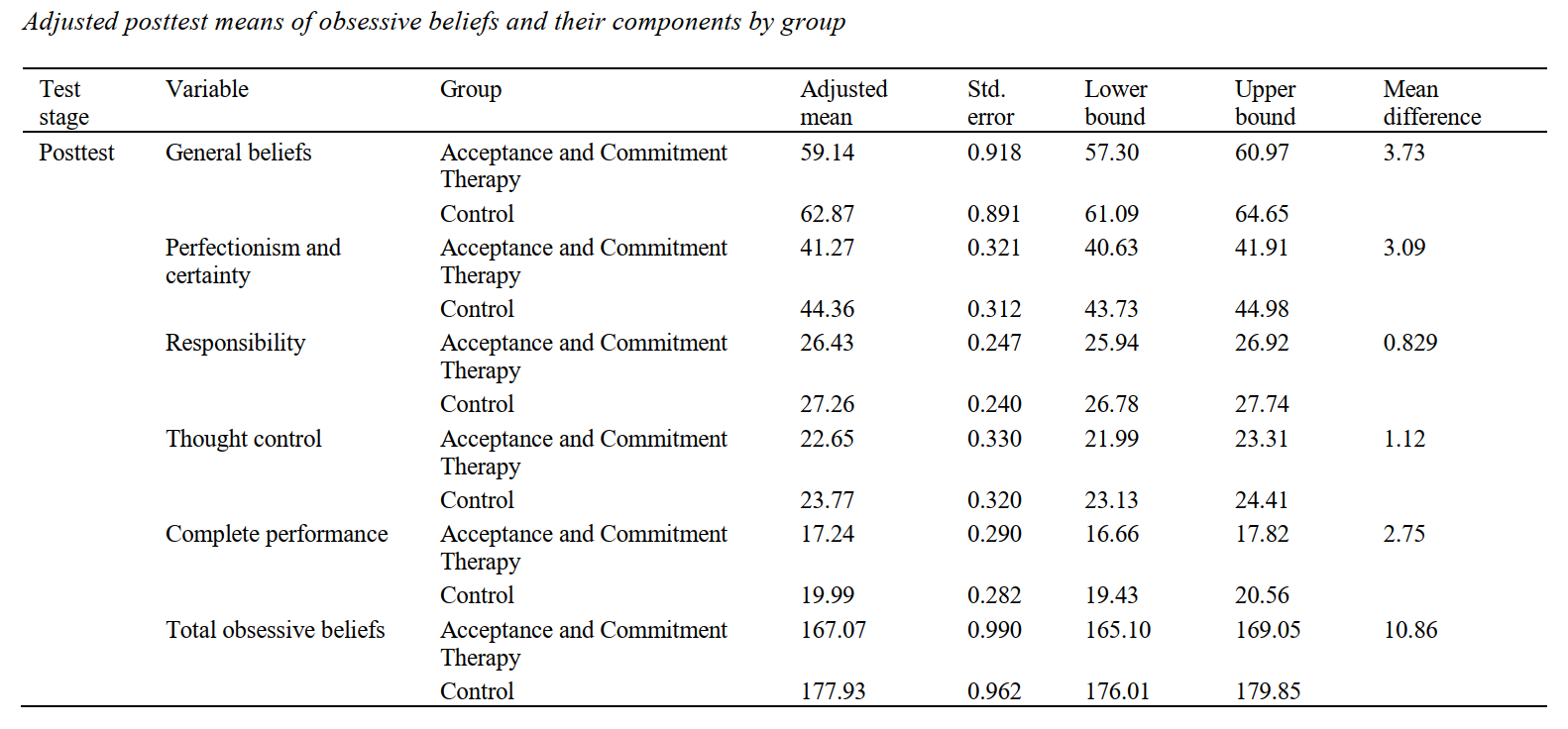
Findings: ANCOVA results indicated significant differences between the experimental and control groups at posttest in all obsessive belief components—general beliefs (p = 0.006, η² = 0.115), perfectionism and certainty (p < 0.001, η² = 0.422), responsibility (p = 0.021, η² = 0.082), thought control (p = 0.020, η² = 0.083), and complete performance (p < 0.001, η² = 0.414)—as well as in the total obsessive beliefs score (p < 0.001, η² = 0.480). Adjusted posttest means showed lower scores in the experimental group compared to the control group across all measures. Follow-up analysis confirmed the maintenance of treatment effects over two months.
Conclusion: Acceptance and Commitment Therapy significantly reduced obsessive beliefs and their subcomponents in university students, with effects maintained at follow-up. The findings highlight ACT’s potential as an effective cognitive-behavioral intervention for addressing maladaptive belief patterns in student populations.
Downloads
References
Ardestani, S. Y., Keykhosrovani, M., & Amini, N. (2022). The Effectiveness of Acceptance and Commitment Therapy on Experiential Avoidance, Uncertainty Intolerance and Positive Metacognitive Beliefs in Women With Obsessive-Compulsive Disorder. Jayps, 3(1), 209-221. https://doi.org/10.61838/kman.jayps.3.1.17
Asli Azad, M., Manshaee, G. R., & Ghamarani, A. (2020). Effectiveness of acceptance and commitment therapy on cognitive emotion regulation and intolerance of uncertainty of the students with obsessive-compulsive disorder. Psychology of Exceptional Individuals, 9(36), 33-53.
Asli Azad, M., Manshaei, G. R., & Ghamarani, A. (2019). Effectiveness of Acceptance and Commitment Therapy on the Signs of Obsessive-Compulsive Disorder and Thought-Action Fusion in the Students with Obsessive-Compulsive Disorder [Research]. Journal of Psychological Science, 18(73), 67-76. http://psychologicalscience.ir/article-1-135-en.html
Baniasadi, K., Gerdooie, R., Gorji, M., Shahbazi, G., Babaahmadi, F., Ghafourian, G., & Pourmohammad Ghouchani, K. (2025). Comparison of Cognitive Behavioral Therapy and Acceptance and Commitment Therapy on Enhancing Resilience, Cognitive Flexibility, and Distress Tolerance in Adolescents with Obsessive-Compulsive Disorder. Journal of Adolescent and Youth Psychological Studies (JAYPS), 6(6), 1-10. https://doi.org/10.61838/kman.jayps.6.6.6
Cakmak, S. (2024). The Role of Acceptance and Commitment Therapy in the Treatment of Obsessive-Compulsive Disorder. International Journal of Computational and Experimental Science and Engineering, 10(4). https://doi.org/10.22399/ijcesen.758
Fuenmayor, M., de Fernandez, J., & Suarez-Roca, H. (2019). Addicted to Compulsions: A Complex Case Study of Obsessive and Compulsive Disorder Treated with Acceptance and Commitment Therapy (ACT) And Exposure Therapy (ERP). Drug Depend Addict, 1, 01-07. https://doi.org/10.33513/DDAD/1801-01
Izatpour, M., Tanha, Z., Emraei, K., & Goudarzi, K. (2024). The Effectiveness of Acceptance and Commitment Therapy on Perfectionism and Quality of Life in Patients with Obsessive-Compulsive Disorder. Family and Health Quarterly, 14(2), 193-210. https://www.sid.ir/paper/1404227/fa
Lee, S. W., Choi, M., & Lee, S. J. (2023). A randomized controlled trial of group-based acceptance and commitment therapy for obsessive-compulsive disorder. Journal of Contextual Behavioral Science, 27, 45-23. https://doi.org/10.1016/j.jcbs.2022.11.009
Ong, C. W., Blakey, S. M., Smith, B. M., Morrison, K. L., Bluett, E. J., Abramowitz, J. S., & Twohig, M. P. (2020). Moderators and processes of change in traditional exposure and response prevention (ERP) versus acceptance and commitment therapy-informed ERP for obsessive-compulsive disorder. Journal of Obsessive-Compulsive and Related Disorders, 24, 100499. https://doi.org/10.1016/j.jocrd.2019.100499
Parviziyaan, F., Sharifi, T., Shakarkon, H., & Ghazanfari, A. (2022). Comparison of the effectiveness of schema therapy and acceptance and commitment therapy on perfectionism in patients with obsessive-compulsive personality disorder. Nursing Psychology, 10(3), 117-131. http://ijpn.ir/
Philip, J., & Cherian, V. (2021). Acceptance and commitment therapy in the treatment of Obsessive-Compulsive Disorder: A systematic review. Journal of Obsessive-Compulsive and Related Disorders, 28, 100603. https://doi.org/10.1016/j.jocrd.2020.100603
Pseftogianni, F., Panagioti, M., Birtwell, K., & Angelakis, I. (2023). Mindfulness interventions for obsessive–compulsive and related disorders: A systematic review and meta-analysis of randomized controlled trials. Clinical Psychology: Science and Practice, 30(3), 233-243. https://doi.org/10.1037/cps0000132
Soondrum, T., Wang, X., Gao, F., Liu, Q., Fan, J., & Zhu, X. (2022). The Applicability of Acceptance and Commitment Therapy for Obsessive-Compulsive Disorder: A Systematic Review and Meta-Analysis. Brain Sciences, 12(5), 656. https://doi.org/10.3390/brainsci12050656
Taghavizade, M., Akbari, B., Hossein Khanzadeh, A., & Mashkbeid, M. (2019). Comparing the effectiveness of cognitive-behavioral and acceptance and commitment therapies on perfectionism in obsessive-compulsive personality disorder. Modern Internal Medicine, 26(1), 24-37. https://imtj.gmu.ac.ir/browse.php?a_id=3249&sid=1&slc_lang=en&html=1
Tayebi Naieni, P., Mohammad-Khani, S., Akbari, M., & Abedi, M. (2017). The Effectiveness of Acceptance and Commitment Therapy on Psychological Flexibility in Children with Obsessive-Compulsive Disorder [Research]. Quarterly Journal of Child Mental Health, 4(3), 91-106. http://childmentalhealth.ir/article-1-204-en.html
Thompson, B. L., Twohig, M. P., & Luoma, J. B. (2021). Psychological Flexibility as Shared Process of Change in Acceptance and Commitment Therapy and Exposure and Response Prevention for Obsessive-Compulsive Disorder: A Single Case Design Study. Behavior therapy, 52(2), 286-297. https://doi.org/10.1016/j.beth.2020.04.011
Twohig, M. P., Abramowitz, J. S., Smith, B. M., Fabricant, L. E., Jacoby, R. J., Morrison, K. L., & Ledermann, T. (2018). Adding acceptance and commitment therapy to exposure and response prevention for obsessive-compulsive disorder: A randomized controlled trial. Behaviour Research and Therapy, 108, 1-9. https://doi.org/10.1016/j.brat.2018.06.005
Twohig, M. P., Vilardaga, J. C. P., Levin, M. E., & Hayes, S. C. (2015). Changes in psychological flexibility during acceptance and commitment therapy for obsessive compulsive disorder. Journal of Contextual Behavioral Science, 4(3), 196-202. https://doi.org/10.1016/j.jcbs.2015.07.001
Xiong, A., Lai, X., Wu, S., Yuan, X., Tang, J., Chen, J., Liu, Y., & Hu, M. (2021). Relationship Between Cognitive Fusion, Experiential Avoidance, and Obsessive–Compulsive Symptoms in Patients With Obsessive–Compulsive Disorder [Original Research]. Frontiers in psychology, 12. https://doi.org/10.3389/fpsyg.2021.655154
Yarahmadi, M., Oraki, M., Saadat, S. H., Eshaghian, M., & Momeni, A. (2021). The effectiveness of acceptance and commitment therapy (ACT) on distress tolerance and the severity of obsessive-compulsive symptoms [Research]. Shenakht Journal of Psychology and Psychiatry, 7(6), 66-79. https://doi.org/10.52547/shenakht.7.6.66
Yarahmadi, M., Owrki, M., Saadat, S. H., Es'haqian, M., & Momeni, A. (2020). The Effectiveness of Acceptance and Commitment Therapy on Distress Tolerance and Severity of Obsessive-Compulsive Symptoms in Adolescents with OCD. Journal of Psychology and Cognitive Psychiatry, 7(6), 66-79. https://doi.org/10.52547/shenakht.7.6.66
Downloads
Additional Files
Publication Timeline
- Submitted
- Revised
- Accepted
Issue
Section
License
Copyright (c) 2025 Amin Feisali (Author); Ali Naseri (Corresponding Author)

This work is licensed under a Creative Commons Attribution-NonCommercial 4.0 International License.