Effectiveness of Cognitive–Behavioral Therapy on Weight Management, Dietary Adherence, and Anger Control in Overweight Students
DOI:
https://doi.org/10.61838/kman.jayps.4623Keywords:
Cognitive–behavioral therapy (CBT), weight management, dietary adherence, anger control, overweightAbstract
Objective: This study aimed to examine the effectiveness of cognitive–behavioral therapy (CBT) on improving weight management, dietary adherence, and anger control among overweight secondary school students.
Methods and Materials: The research utilized a quasi-experimental design with a pretest–posttest structure and a control group. The statistical population included all overweight female secondary school students in Mashhad during the 2023–2024 academic year. A total of 30 students with a body mass index (BMI) greater than 25 were selected through purposive sampling and randomly assigned to experimental and control groups (15 participants each). The experimental group received ten 60-minute sessions of group-based cognitive–behavioral therapy based on Agha Harris’s (2022) model, focusing on cognitive restructuring, self-regulation, and behavioral modification strategies. Measurement tools included the Kagan and Squires (1984) Weight Management Questionnaire, the Morisky et al. (1986) Dietary Adherence Scale, and the Spielberger (2003) Anger Control Inventory. Data were analyzed using multivariate and univariate analyses of covariance (MANCOVA and ANCOVA) via SPSS version 26 after confirming all statistical assumptions.
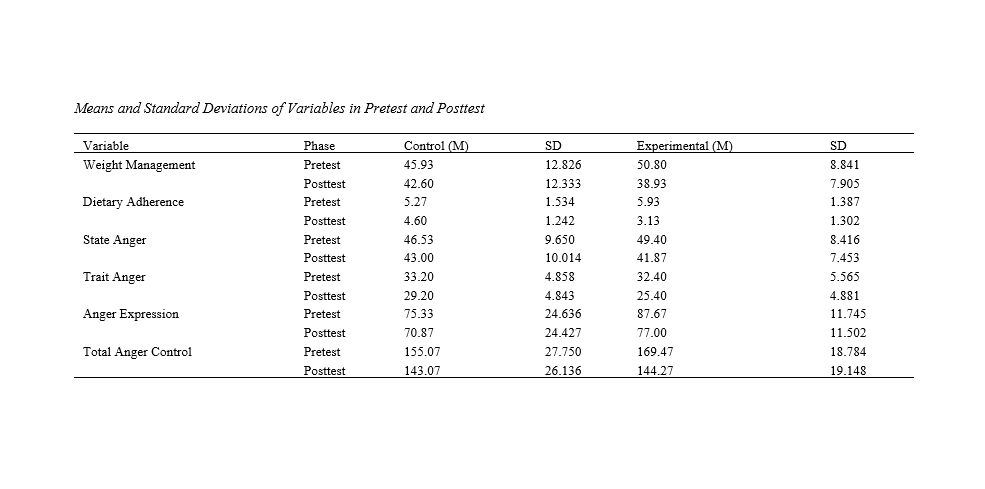
Findings: The results revealed significant differences between the experimental and control groups in posttest scores of weight management (F = 57.418, p < .01, η² = .699), dietary adherence (F = 5.487, p < .01, η² = .723), and anger control (F = 234.282, p < .01, η² = .852). Participants who received CBT demonstrated improved weight regulation, higher dietary adherence, and enhanced anger control compared to those in the control group.
Conclusion: Cognitive–behavioral therapy effectively enhanced weight management, dietary adherence, and anger control among overweight students by modifying maladaptive cognitions and improving emotional and behavioral self-regulation. These findings underscore the importance of incorporating CBT-based interventions into adolescent weight management and emotional health programs.
Downloads
References
Abedi Shargh, N., Ramazani Farani, A., Ghorayi, B., Ghorbani, S., & Farahani, H. (2021). Effectiveness of Internet-Based Cognitive Behavioral Therapy in Weight Loss and Increasing Self-Efficacy of Lifestyle Through Virtual Groups During the COVID-19 Pandemic. Military Medicine Journal, 23(3), 219-209. https://doi.org/10.5812/ijpbs.113096
Amirkhanloo, A., Dousti, Y., & Donyavi, R. (2022). The Comparison of the Effectiveness of Cognitive-Behavioral Therapy with Emotional Intelligence Training on Social Adjustment in Adolescents with Conduct Disorder. Journal of Applied Family Therapy, 3(4), 217-242. https://doi.org/10.22034/aftj.2022.340757.1564
Apovian, C. M. (2016). Obesity: definition, comorbidities, causes, and burden. Am J Manag Care, 22(7 Suppl), s176-185. https://pubmed.ncbi.nlm.nih.gov/27356115/
Bulut, M., & Yüksel, Ç. (2023). Self-Help Techniques in Anger Management With Cognitive Behavioral Interventions: Understanding and Managing Anger. Humanistic Perspective, 5(2), 844-856. https://doi.org/10.47793/hp.1222353
Cheng, P., Casement, M. D., Kalmbach, D. A., Castelan, A. C., & Drake, C. L. (2021). Digital cognitive behavioral therapy for insomnia promotes later health resilience during the coronavirus disease 19 (COVID-19) pandemic. Sleep, 44(4). https://doi.org/10.1093/sleep/zsaa258
Elahi Doost, S., Ansari, P. M., Ravanbakhsh, A., & Hojjati, M. (2022). A Review of Behavioral Factors Influencing Obesity and Strategies for Their Control. Journal of Behavioral Science Research, 20(3), 468-482. https://rbs.mui.ac.ir/article-1-1362-fa.html
Golabi, F., Alizadeh Oghdam, M. B., Aghayari Hir, T., & Akram. (2019). Investigating the Social and Economic Determinants of Obesity Among Citizens. Journal of Economic Sociology and Development, 8(1), 131-158. https://www.sid.ir/paper/518396/
Golestani Bakht, T., Babaei, A., & Masoumzadeh, Z. (2022). The Effectiveness of Cognitive-Behavioral Therapy on Perfectionism and Body Dysmorphic Concerns in Students with Body Dysmorphic Worries. Scientific Journal of Ilam University of Medical Sciences, 3(6), 83-92. https://doi.org/10.52547/sjimu.30.6.83
Hamatani, S., Numata, N., Matsumoto, K., Sutoh, C., Ibuki, H., & Oshiro, K. (2019). Internet-Based Cognitive Behavioral Therapy via Videoconference for Patients With Bulimia Nervosa and Binge-Eating Disorder: Pilot Prospective Single-Arm Feasibility Trial. Jmir Formative Research, 3(4), e15738. https://doi.org/10.2196/15738
Heriseanu, A. I., Karin, E., Walker, J., Scott, A. J., Bisby, M. A., Gandy, M., Dudeney, J., Fisher, A., Titov, N., & Dear, B. F. (2023). The impact of obesity and overweight on response to internet-delivered cognitive behavioural therapy for adults with chronic health conditions. International Journal of Obesity, 47(6), 487-495. https://doi.org/10.1038/s41366-023-01285-6
Honnardar, A., Ansari Shahidi, M., Rah Najat, A. H., & Rezaei Jamalooei, H. (2022). Comparing the Effectiveness of Dialectical Behavior Therapy and Cognitive-Behavioral Therapy on Emotional Eating in Obese Individuals. Community Health, 16(4), 1-11. https://chj.rums.ac.ir/article_165956.html
Jacob, A., Moullec, G., Lavoie, K. L., Laurin, C., Cowan, T., Tisshaw, C., Kazazian, C., Raddatz, C., & Bacon, S. L. (2018). Impact of cognitive-behavioral interventions on weight loss and psychological outcomes: A meta-analysis. Health Psychology, 37(5), 417-432. https://doi.org/10.1037/hea0000576
Jamalomidi, N., Hassani, F., & Kochakentezar, R. (2021). Comparison of the Effectiveness of Emotional Focused therapy with Cognitive Behavioral therapy on the Quality of life in Obese Women with Polycystic Ovary Syndrome. medical journal of mashhad university of medical sciences, 64(4), 3356-3368. https://doi.org/10.22038/mjms.2021.19462
Jebeile, H., Cardel, M. I., Kyle, T. K., & Jastreboff, A. M. (2021). Addressing psychosocial health in the treatment and care of adolescents with obesity. Obesity, 29(9), 1413-1422. https://doi.org/10.1002/oby.23194
Kachoui, M., & Shahmardi, S. (2019). The Relationship Between Body Mass Index and Body Appreciation and Symptoms of Eating Disorders: The Moderating Role of Self-Compassion in Female Students. Iranian Journal of Diabetes and Metabolism, 19(2), 103-113. https://ijdld.tums.ac.ir/article-1-5903-fa.html
Khatibi, F., Khan Mohammadi Otagsara, A., & Heydari, S. (2022). Effectiveness of Group Cognitive Behavioral Therapy on Resilience and Emotion Regulation in Obese Women in Amol City. Quarterly Journal of Applied Family Therapy, 3(14), 20-34. https://doi.org/10.61838/kman.aftj.3.5.3
Khatibi, F., Khanmohammasi Otaghsar, A., & Heydari, S. (2023). Effectiveness of Group Cognitive Behavioral therapy on Resilience and Emotion Regulation in Obese Women of Amol City. Journal of Applied Family Therapy, 3(5), 20-34. https://doi.org/10.22034/aftj.2022.329002.1393
Kwon, M., & Lee, J. S. (2025). Influence of Negative Parenting Behavior Perceived by School-Aged Children on Aggression: Mediating Effects of Basic Psychological Needs Frustration. Soc Cognitive Enhancement Intervention, 16(1), 69-83. https://doi.org/10.21197/jcei.16.1.4
Lotfi Kongreshahi, A., Dehghani Arani, F., Rostami, R., Ashraf Talash, S. H., & Abolhasani, M. (2019). Comparing the Effectiveness of Cognitive-Behavioral Therapy with Mindfulness-Based Cognitive Therapy in Increasing Activity and Reducing Weight in Obese Individuals with Coronary Artery Disease. Health Psychology, 8(31), 53-78. https://www.sid.ir/paper/227297/
Naserifar, M., Seraj Khorrami, N., Safarzadeh, S., & Heidari, A. (2022). Effectiveness of Cognitive-Behavioral Therapy on Lifestyle Based on Self-Efficacy and Body Valuation in Obese Women. Applied Family Therapy, 3(2), 467-481. https://journals.kmanpub.com/index.php/aftj/article/view/965
Pakandish, S., Kraskian, A., & Jamhari, F. (2021). Determining the Effectiveness of Cognitive-Behavioral Therapy in Regulating Emotion and Mental Health of Obese Women. IJNR, 16(2), 59-68. http://ijnr.ir/article-1-2518-en.html
Pakandish, S., Kraskyan, A., & Jomehri, F. (2020). Comparing the Effectiveness of Schema Therapy and Cognitive-Behavioral Therapy on Quality of Life and Body Image of Obese Women. Journal of Excellence in counseling and psychotherapy, 9(34), 20-32.
Razmpoosh, E., Mokhtari, M. J., Bassiri, M., Montazeri, A., Sajadian, A., Zarrati, M., & Salehi-Abargoueil, A. (2020). The Effects of Lifestyle Modifications Including Dietary and Physical Interventions With Cognitive-Behavioral Therapy on Quality of Life and Cancer-Recurrence Rate Among Patients With Breast Cancer and Survivors: A Protocol for a Systematic Review and Meta-Analysis of Randomized Controlled Trial. International Journal of Cancer Management, 13(9). https://doi.org/10.5812/ijcm.103647
Wenzel, A. (2017). Basic strategies of cognitive behavioral therapy. Psychiatric Clinics, 40(4), 597-609. https://doi.org/10.1016/j.psc.2017.07.001
Wilson, G. T., Fairburn, C. C., Agras, W. S., Walsh, B. T., & Kraemer, H. (2002). Cognitive-behavioral therapy for bulimia nervosa: Time course and mechanisms of change. Journal of consulting and clinical psychology, 70(2), 267-274. https://doi.org/10.1037/0022-006X.70.2.267
Downloads
Additional Files
Publication Timeline
- Submitted
- Revised
- Accepted