A Comparative Study Between the Paradigmatic Models of Girls and Boys in the Formation Process of Marriage Trauma
DOI:
https://doi.org/10.61838/kman.jayps.4763Keywords:
Marriage trauma, grounded theory, gender differences, fear of marriage, socio-cultural factors, emotional breakup, youth psychologyAbstract
Objective: This study aimed to compare the paradigmatic models of girls and boys in the formation process of marriage trauma using a grounded theory framework.
Methods and Materials: This qualitative study employed the systematic grounded theory approach of Strauss and Corbin. Semi-structured, in-depth, face-to-face interviews were conducted with 21 unmarried girls and 17 unmarried boys residing in Shahreza who did not have psychological disorders. Participants were recruited through an Instagram call posted by a psychological clinic and selected via snowball sampling. Interviews lasted 60–80 minutes and explored causal conditions, contextual conditions, intervening conditions, strategies, and consequences related to fear of marriage. Data were analyzed through open, axial, and selective coding to identify core categories and reconstruct gender-specific paradigmatic models explaining marriage trauma.
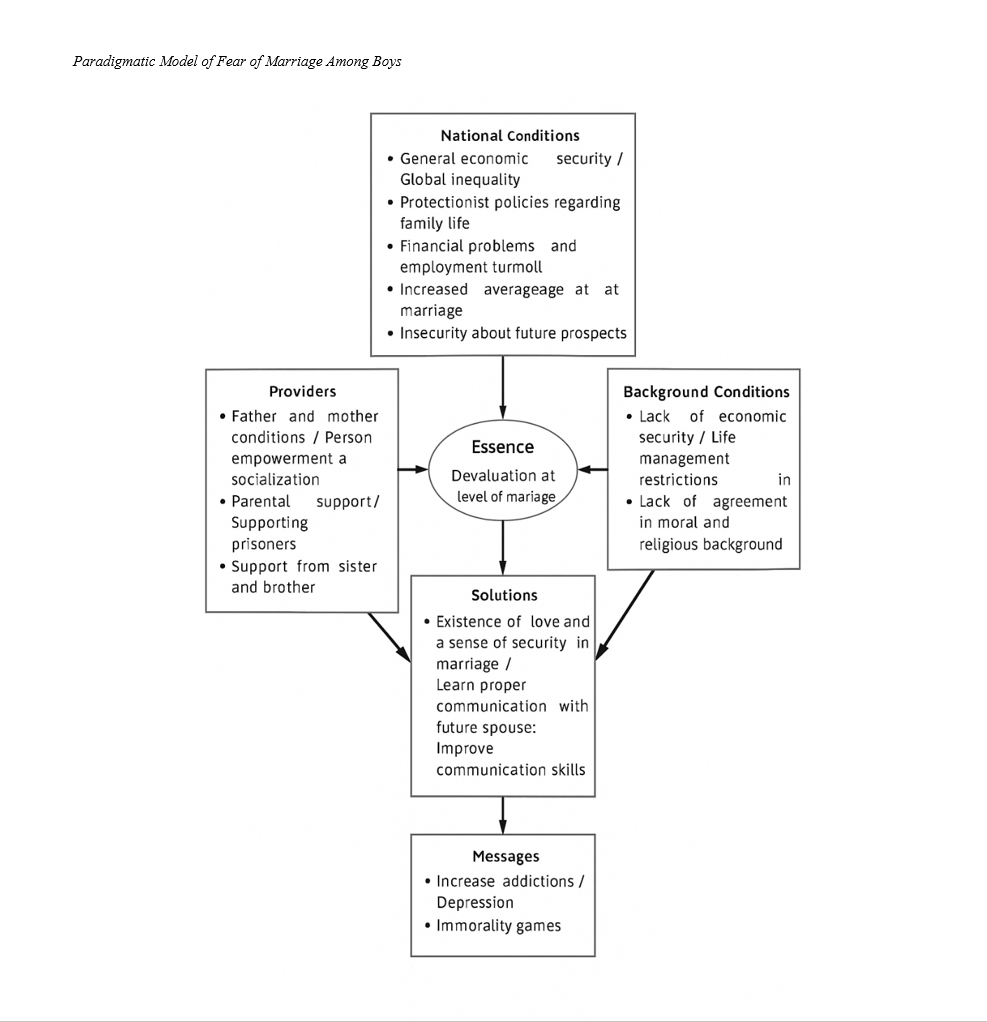
Findings: The analysis revealed distinct gendered pathways in the formation of marriage trauma. For girls, the core category was “the ambiguity of the value of marriage and perfectionism of self and parents,” arising from emotional failures of others, familial expectations, religious–moral incongruence, and economic insecurity. For boys, the core category was “the meaninglessness of marital authenticity,” driven by fear of unsuccessful marriage, economic instability, perceived legal vulnerability, past relational hurt, and sociocultural constraints. Across both groups, intervening conditions such as parental conflict, emotional dependency, and intergenerational narratives intensified trauma trajectories. Strategies included seeking emotional reassurance, emphasizing compatibility, and attempting to learn communication skills; however, consequences such as increased dependency, avoidance, and loss of perceived marriage opportunities were evident.
Conclusion: Marriage trauma among youth arises from intertwined emotional, familial, sociocultural, and structural factors, with clear gender-specific mechanisms shaping fear and avoidance of marriage; understanding these paradigmatic models can inform culturally responsive interventions and support systems.
Downloads
References
Abbasi-Shavazi, M. J., McDonald, P., & Hosseini-Chavoshi, M. (2008). Modernization or cultural maintenance: the practice of consanguineous marriage in Iran. Journal of Biosocial Science, 40(6), 911-933. https://doi.org/10.1017/S0021932008002782
Akbari Ghamsari , A., & Mehdizadeh Moghadam , H. (2020). Comparative Analysis of the Attitude to Marriage and the Factors Affecting it Among University students and Tollabs in Tehran. Iranian Journal of Sociology, 20(4), 58-85. https://www.magiran.com/paper/2208214
Arana, F. G., Rice, K. G., & Aiello, M. (2024). A Cross-Cultural Look at the Role of Rumination in the Relationship Between Trait Anxiety and Romantic Breakup Distress. European Journal of Trauma & Dissociation, 8(1), 100376. https://doi.org/10.1016/j.ejtd.2023.100376
Avneesh Kumar, N. I. M., & Apeksha, T. (2024). Reimagining Marriage: The Depiction of Modern Relationships in Contemporary Fiction. Pj, 15(02), 91. https://doi.org/10.59467/pj.2024.15.91
Azami, Z. (2021). Predicting Quality of Life Based on Marital Satisfaction, Marriage Age, Mate Selection Patterns, and Age Differences among Couples in Mahshahr. Journal of Modern Advances in Psychology, Educational Sciences, and Training(40). https://en.civilica.com/doc/1670790/
Bahadari Moghadam, F. (2023). A Comparison of the Relationship Between Self-Differentiation and Communication Patterns in Women with Successful and Unsuccessful Marriages Yazd University of Science and Art, Faculty of Humanities]. General Psychology.
Eisma, M. C., Tonus, D., & de Jong, P. J. (2022). Desired Attachment and Breakup Distress Relate to Automatic Approach of the Ex-Partner. Journal of Behavior Therapy and Experimental Psychiatry, 75, 101713. https://doi.org/10.1016/j.jbtep.2021.101713
Field, T., Diego, M., Pelaez, M., Deeds, O., & Delgado, J. (2020). Breakup distress and loss of intimacy in university students. Psychology, 1(3), 173-177. https://doi.org/10.4236/psych.2010.13023
Fife, S., Theobald, A., Gossner, J., Yakum, B., & White, K. (2022). Individual healing from infidelity and breakup for emerging adults: a grounded theory. Journal of Social and Personal Relationships, 39(6), 1814-1838. https://doi.org/10.1177/02654075211067441
Gara, E. (2022). Interfaith Marriage in the Early Modern Ottoman Empire: Legal and Social Aspects. Akdeniz Kadın Çalışmaları Ve Toplumsal Cinsiyet Dergisi, 5(2), 240-259. https://doi.org/10.33708/ktc.1169473
Grøntvedt, T. V., Kennair, L. E. O., & Bendixen, M. (2020). Breakup Likelihood Following Hypothetical Sexual or Emotional Infidelity: Perceived Threat, Blame, and Forgiveness. Journal of Relationships Research, 11, e7, Article e7. https://doi.org/10.1017/jrr.2020.5
Hoffman, W. (2020). Communication Modes During Romantic Dissolution: The Impact of Attachment and Intimacy on Initiator Breakup Strategies. Interpersona an International Journal on Personal Relationships, 14(2), 87-103. https://doi.org/10.5964/ijpr.v14i2.3937
Honarparvaran, N. (2017). Comparing the marital stability and love dimensions among students with traditional and modern marriage. Quarterly Journal of Women and Society, 7, 17-28. https://jzvj.marvdasht.iau.ir/article_2205.html?lang=en
Ismail, M. F., Faisal, R., & Zainur, Z. (2025). Marriage and Divorce in Islamic Law: Sociological Implications for Modern Muslim Societies. Journal of Islamic Law El Madani, 4(1), 25-37. https://doi.org/10.55438/jile.v4i1.142
Khodavardian, S., Khodabakhshi Koolaei, A., & Sanagoo, A. (2020). Explaining Psychological and Social Adjustment Experiences of Young Women After Emotional Breakup: A Qualitative Study. Psychiatric Nursing, 8(1), 1-9. https://www.sid.ir/fa/journal/ViewPaper.aspx?id=550086
Loan, N. T., Minh, T. T. K., Truc, N. V. T., & My, T. T. H. (2023). The Mediating Role Of Rumination In Breakup Distress After Romantic Relationships And Sleep Disturbance Of The Students And A Five-Day-Proposed Intervention Program. Journal of Namibian Studies: History Politics Culture, 33, 1464-1496.
Mączka, E. (2021). Some reflections on marriage and family in (post) modern social space. Forum Teologiczne(22), 111-123. https://doi.org/10.31648/ft.6925
Najmabadi, A. (2022). Familial Undercurrents: Untold Stories of Love and Marriage in Modern Iran. Duke University Press. https://ensani.ir/file/download/article/1645441461-10521-1400-2.pdf
Niakani, S. S. (2022). Comparing Love Styles, Marriage Stability, Fear of Intimacy, and Empathy in Traditional and Modern Marriages Master's Thesis, General Psychology, Feyz-al-Islam Higher Education Institute, Faculty of Humanities].
Rahai, E. (2023). The influence of the principle of autonomy in marriage contracts from the perspective of jurisprudence, Iranian law, and international rules. Journal of Modern Law and Studies, 2, 1-10.
Sadeghi, S. (2021). Sociological evaluation of temporary marriage and the feasibility of its replacement with permanent marriage in the modern world. Historical, Social, and Political Research, 49, 37-56.
Shabani, E., Sarookhani, B., & Labibi, M. m. (2022). Sociological investigating the impact of modern and traditional marriage selection methods on difinitive divorce. Women Studies, 13(41), 113-150. https://doi.org/10.30465/ws.2021.33667.3162
Shishefar, H., Fard, F. D., & Nicknam, M. (2024). Prediction of Psychological Pain Based on Emotional Expression With the Mediation of Fear of Intimacy in Girls With Emotional Breakup Experience. Aftj, 5(2), 266-274. https://doi.org/10.61838/kman.aftj.5.2.29
Tajbakhsh, G. R., & Goodarzi, A. (2021). A Model for Explaining the Components of Marriage Style in Iran with the Meta-Combination Method. Strategic Studies on Youth and Sports, 19(50), 269-286. https://faslname.msy.gov.ir/article_420_599424686294ddb0484689f7ee3396cb.pdf
Thapa, B. K., & Kattel, S. P. (2019). Impact of modernization on family and marriage system of Nepal. World Wide Journal of Multidisciplinary Research and Development, 5(12), 6-9. https://wwjmrd.com/archive/2019/12/1304/impact-of-modernization-on-family-and-marriage-system-of-nepal
Trần, K., Castiglioni, L., Walper, S., & Lux, U. (2023). Resolving Relationship Dissolution—What Predicts Emotional Adjustment After Breakup? Family Process, 63(3), 1157-1170. https://doi.org/10.1111/famp.12914
Verhallen, A. M., Renken, R. J., Marsman, J. B. C., & Ter Horst, G. J. (2019). Romantic Relationship Breakup: An Experimental Model to Study Effects of Stress on Depression (-Like) Symptoms. PLoS One, 14(5), e0217320. https://doi.org/10.1371/journal.pone.0217320
Yılmaz, C. D., Lajunen, T., & Sullman, M. J. M. (2023). Trust in relationships: a preliminary investigation of the influence of parental divorce, breakup experiences, adult attachment style, and close relationship beliefs on dyadic trust. Frontiers in psychology, 14(2), 1260480. https://doi.org/10.3389/fpsyg.2023.1260480
Zamanshoar, E., Rezaeian, H., Hoseinian, S., & Abdollahi, A. (2022). Longing for the Ideal Self: A Thematic Analysis of Narratives About Emotional Breakup Experience. Journal of counseling research, 21(83), 47-84. https://doi.org/10.18502/qjcr.v21i83.11086
Касаркина, Е. Н., & Antipova, A. A. (2020). Influence of Socio-Cultural Attitudes on Marriage of Modern Youth in Mordovia (On the Example of Saransk). Finno-Ugric World, 12(4), 411-422. https://doi.org/10.15507/2076-2577.012.2020.04.411-422
Downloads
Additional Files
Publication Timeline
- Submitted
- Revised
- Accepted